Archive
Tunnels, Rock Wheels, Water & More Water…!
Update
Temporary Sump. For those have been waited with baited breath about the outcome of temporary sump and drainage at the base of the Approach Ramps, I am afraid there are a few more sleepless nights ahead (sorry Ros!). The works are still on hold pending the Designer’s decision about the final design based on the CPT results. The CPT results confirmed the soil stratification, and confirmed the extremely poor nature of top 3 metres of soil, as well as the varying degrees of consolidation within the Terrace Gravels. The sumps remain installed and the contaminated water in the East is being diverted into a sewer, and the water in the West is overflowing onto the invert slab and into the tunnel. Silt migration is evident from the deposits being left on the invert slab. However, until a design decision is made, the sumps will remain.
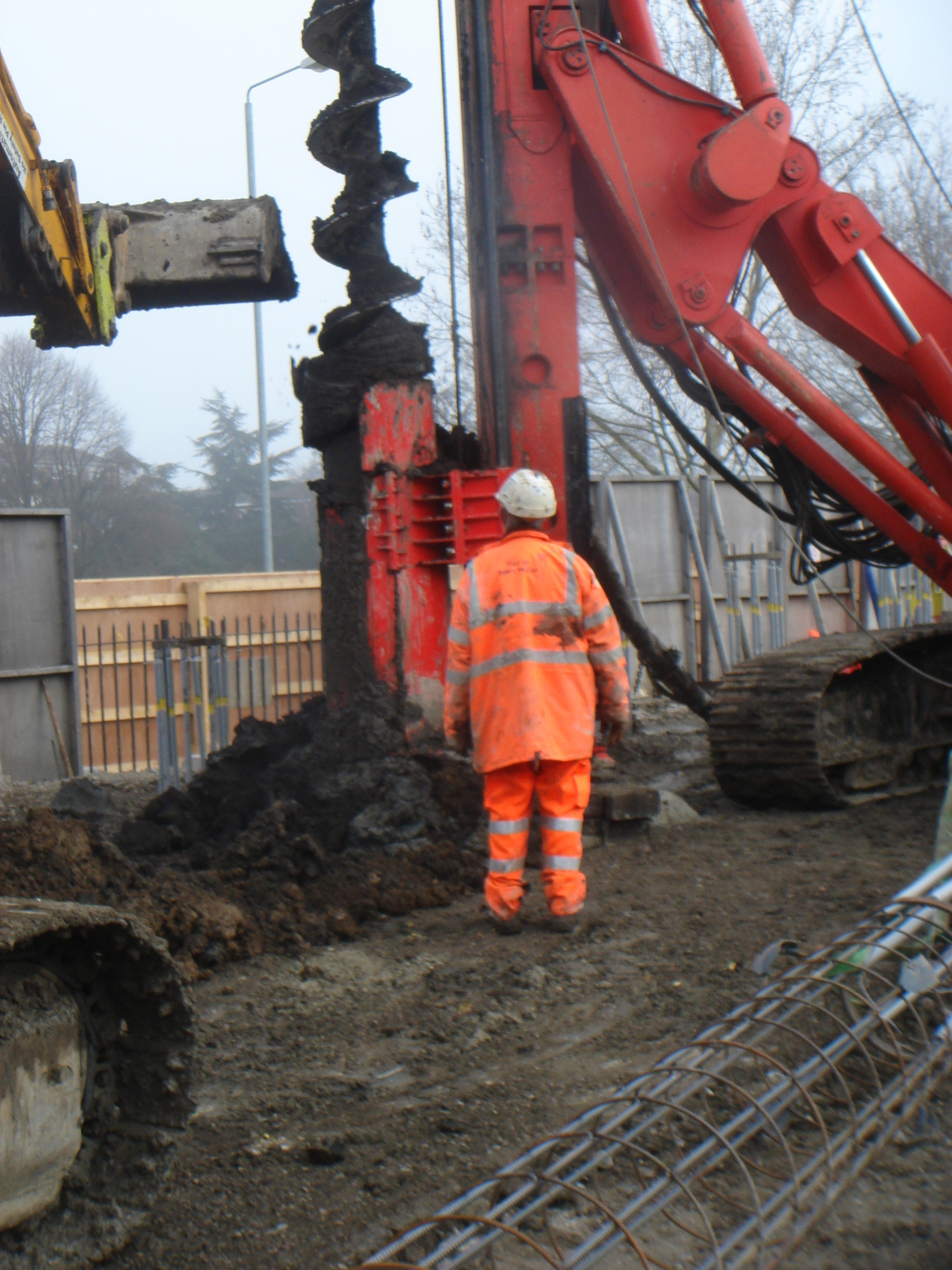
CFA Piling on the surface continues however with only 1999 left to go!
Why a Plan Never Survives Contact with Commercial
Whilst, I remain slightly vexed by the lack of flexibility instilled in ‘can do’ teams, as a result of the commercial and contractual handling of works, I am coming to accept, (albeit a little begrudgingly) that in the current climate, that will not change. Three distinct but commercially linked examples:
Contract. Having spent considerable time and effort planning for the Temporary Services Sub-contractor (VVB) to start works on Monday (de-conflicting works, scheduling subsequent works which cannot start until power, lighting and ventilation and pumps are installed), I was then informed that certain parts of the contract had not yet been agreed. Despite the VVB Project Manager being able, and willing to start the work which had been agreed, and admitting that there were alternative methods to undertake the works currently under dispute, the ‘collaborative approach’ stipulated by NEC all too often falls victim to commercial risk aversion.
Release of Information. In a similar way, the Drilling & Grouting Sub-contractor (Bachy) arrived on site to co-ordinate his works, to find that his scope of works had changed, which had a significant impact on his programme. Whilst the Contractor knew about the change 3 weeks prior, they chose not to inform Bachy, not wanting to risk delaying the start date (due to Olympic closure restictions). Whilst, Bachy will obviously get paid for the additional work, the early release of the changed scope would have saved considerable time and planning effort, and may have avoided what will now be a later start date in any case, and subsequent time pressures. Whether or not releasing this information before Bachy had confirmed their project documentation would have further impacted on the start date I do not know. However, I have learnt that the military adage of ‘never sit on information’ is not always applicable where money and contracts are involved!
Consultant Advice. VINCI’s Geological consultant (Bob Allen from London Bridge Associates – he has a friend who knows you John!) was invited in to discuss Temporary Works Design with the Temporary Works Co-coordinator, the Project Manager also asked that I take him on site to assess and advise on existing and potential water issues. We spent 2 hours walking the site and tunnel, and his depth of knowledge, acute appreciation of the affect of history on the structures (e.g. the presence of original formwork and sumps beneath the retaining walls), and prediction of existing conditions was both intriguing and relevant. Equipped with this enlightenment, I could not understand the logic behind certain permanent and temporary works designs. Clearly having been paid for his time (which for my education as the Approach Ramps and Tunnels Section Engineer was invaluable), I was surprised at the relative lack of action resulting from his visit. I was soon educated, and it has since become apparent, that the only area of financial risk to VINCI is Temporary Works, and the Clients owns any damage as a result of construction in accordance with the Client’s Design. It is therefore not in the interest if VINCI to take (or suggest) any corrective action, or indeed make any changes to the agreed methodology unless instructed to do so, which normally results from something not going to plan, or a design risk factor becoming too high.
Permanent Works
Concrete Invert Slab Re-profiling. From the base of the approach ramps through to the twin tunnel interface at the centre of the tunnel, the base of the tunnel comprised the original concrete invert slab, a gravity brick drainage system, ballast, sleepers and track. All material has now been removed down to the invert slab. The next stage is the preparation of the invert slab for the installation of the final track slabs upon handover of the project. In order to achieve the correct design level and profile, two methods are being employed. One is the complete replacement of the concrete slab in 1.5m bays immediately adjacent to the twin tunnels (30m West, 140m East), and the other is the re-profiling of the slab. A sub-contractor will carry out the replacement, and (following Drilling & Grouting and Dewatering) the re-profiling is being carried out by the VINCI.
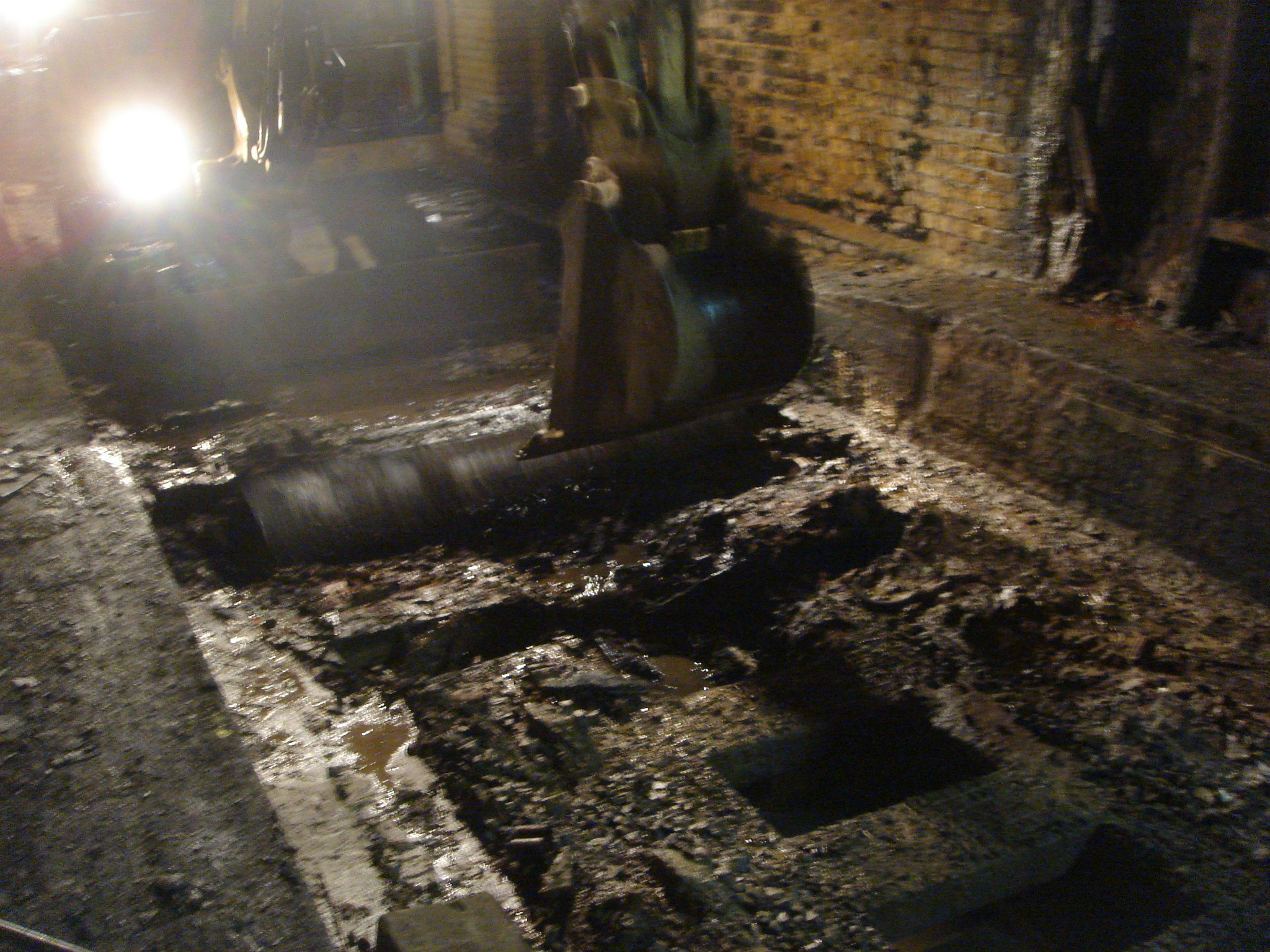
Stripping out of the existing ballast and drain
As the Approach Ramps & Tunnels Section Engineer I am responsible for planning, coordinating and enabling all of the works, and in the case of the re-profiling carrying it out. Two trials took place to establish the most effective, accurate and safe equipment and methodology. A Rock Wheel attachment to a 21t excavator was selected, and manual setting out and checking is currently deemed as the most suitable means to ensure levels are within the Designer’s stipulated tolerances. The works have started and are progressing well, although the setting out and monitoring is time consuming for my Site Engineer, as is the checking for me. We are looking into alternative monitoring systems – thought I may look up Margaret Beach in the Survey department to seek some advice (I know she was keen for a field trip for the survey students!).
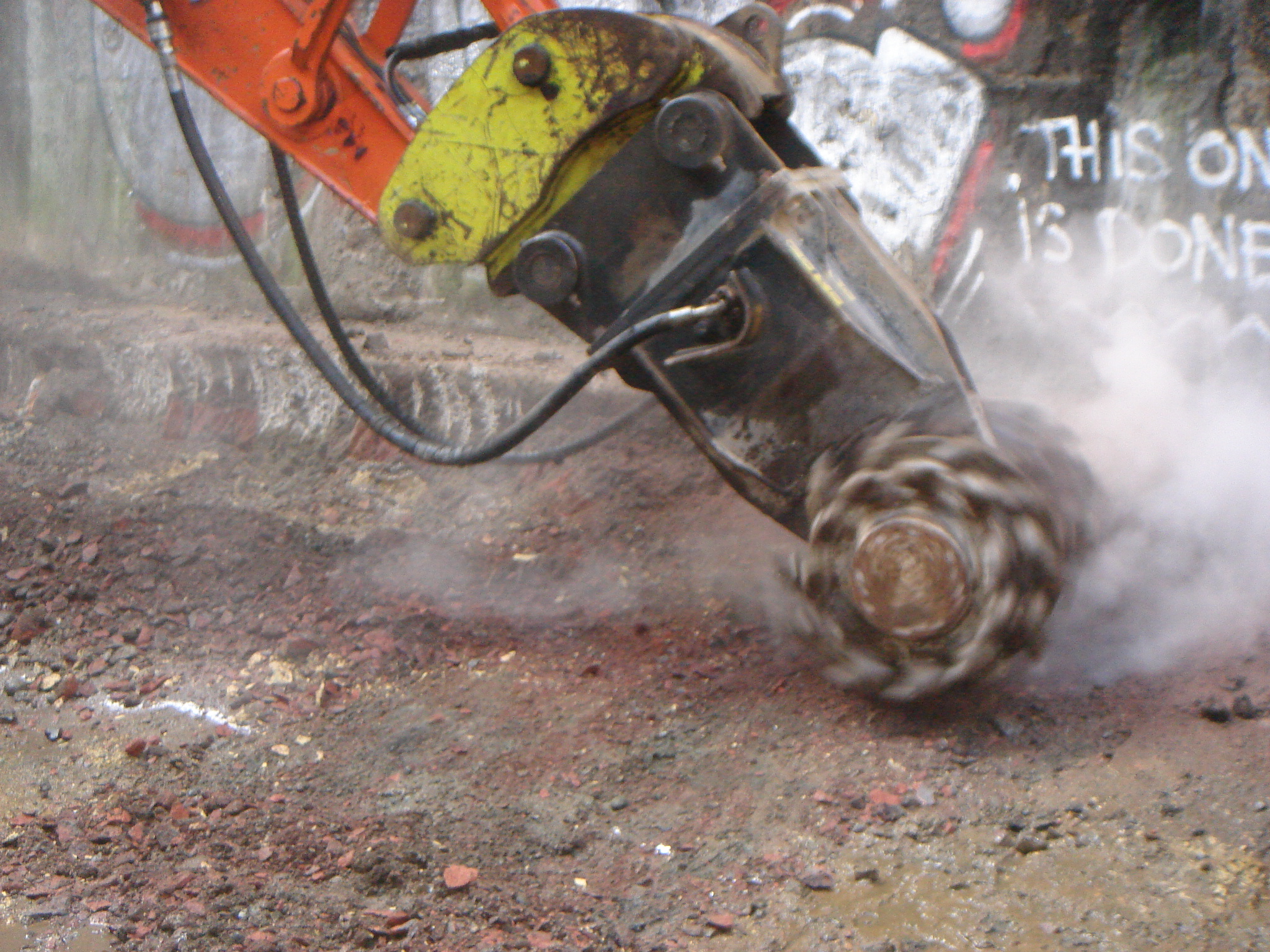
The Rock Wheel carrying out re-profiling
Clearly no works on this project would be complete without water, and the re-profiling does not disappoint. As a result of excavating concrete away from the existing concrete retaining walls, the surface area for seepage has been increased, and the flow path, permeability (due to removal of a relatively sealed surface) and opposing pressure from the slab has been reduced, hence the volume of water flowing onto the re-profiled slab has increased significantly. The presence of water on the slab makes re-profiling more difficult, and a temporary pump is being used to clear the surface of water until a temporary sump and drainage system is installed in the single tunnels, at the end of the re-profiling section.
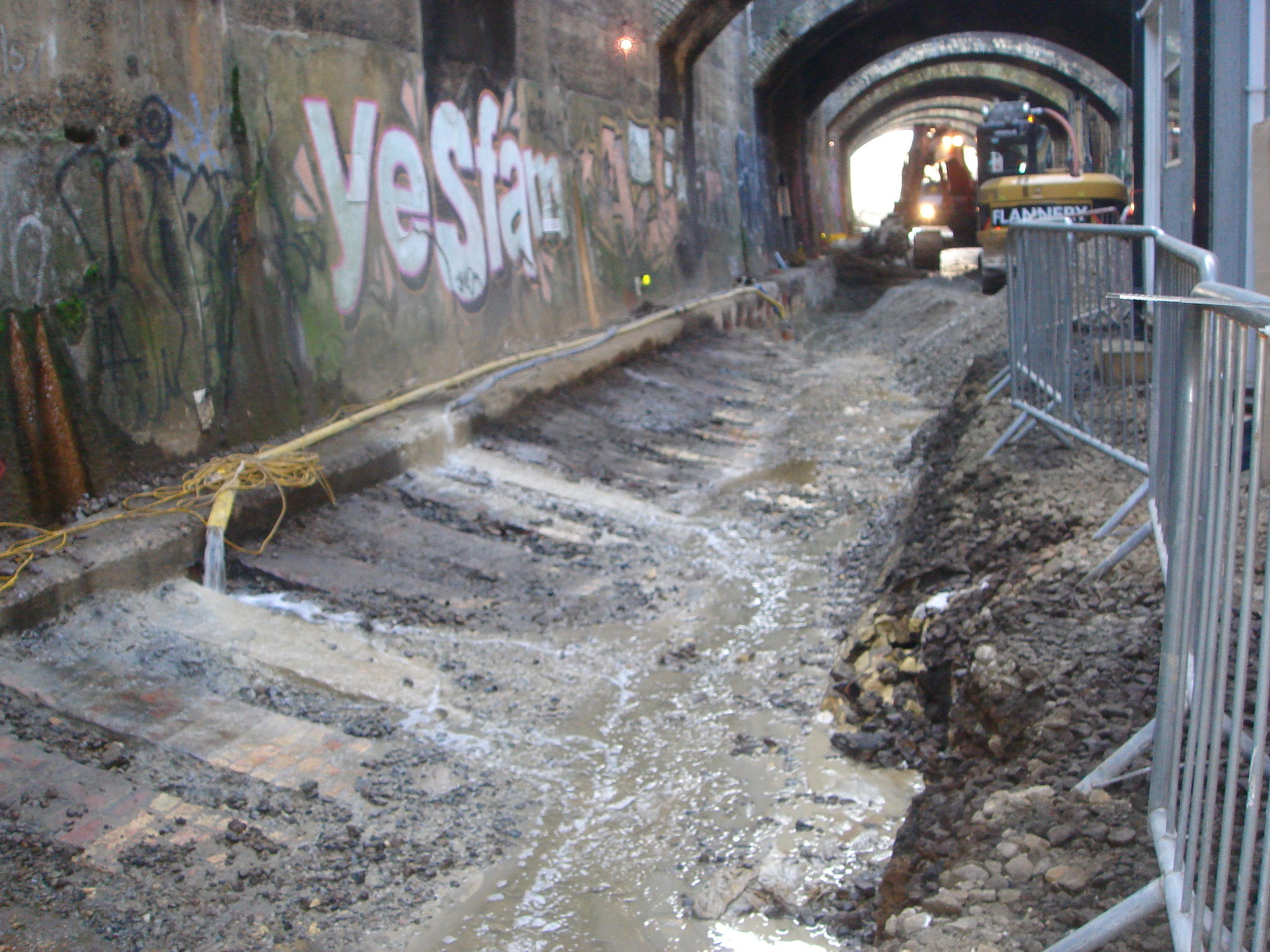
A pump is used to divert additional seepage away from re-profiling area
Temporary & Enabling Works
Sump and Drainage System (Part II) The aim of the temporary sump and drainage system within the single tunnels is to prevent any water flowing into the section where the concrete invert slab replacement is taking place. This will enable the construction of the Drilling & Grouting Rig Platform and subsequent grouting works, followed by the replacement of the invert slabs. It will also negate the requirement for the central sump and Pump House, in order that they can be de-commissioned and reconstructed. It also solves the environmental constraint that no construction water may be pumped into the Docks following installation of a temporary drainage system and requisite permits to divert the water into the sewer system.
The main constraints in design of the sump, is that it cannot be dug below the final slab design level, allowing only a shallow basin, well below the 700mm submersible pump originally ordered. Identifying the critical issue here (all this critical analysis is clearly paying off!) I requested that the VVB pump specialist come and scope a more appropriate pump. He has changed the order to a suction pump with a skirt, upon which I will base my design. I have also proposed the installation of weep holes in the existing slab (as per the final design slab) in order to relieve the water pressure under the slab and control seepage during construction (likely to sit in the wait until instructed category I suspect!). The construction of the sump will start immediately following re-profiling….which can take place as soon as the Rock Wheel can access the tunnel…which it will be able to do as soon as the Tally Huts (and generators) have been re-sited… which can happen as soon as the stagnant water by the generator has been disposed of……which can happen as soon as the sewage permit to discharge arrives…. not forgetting the permit to disconnect the generator….. the Crossrail submissions and acceptance procedures… the lead-time on the pumps…. and VVBs contractual hitch preventing them from laying any drainage pipe…..!
So What & What next?
A number of works packages that were neatly programmed during the tendering process, have gradually changed in scope as the full extent of the works and issues has emerged. Contractual arrangements and delays, as well as non-adherence to strict Crossrail procedures have had a significant impact on start dates. As a result a number of works packages are now due to overlap and critical path aspects are still yet to be confirmed, such as the installation of power. I also don’t believe that full consideration has taken place as to the impact of re-profiling on the existing structure, already reflected by the increasing scale of movement measured by the retaining wall monitors, and set to increase as works move further into the tunnel.
So what next? Continue with the re-profiling, (the risk of any adverse effects sit with the Client – am I becoming a contractor?!) and deal with the water in preparation for Drilling & Grouting. Generators and ‘Rent a Vent’ (yes it is actually called that) can substitute the installation of mains power and ventilation, but a fully functioning sump and water diversion system is critical.
Aside from that, keep the Rock Wheel within 45mm tolerance of the final design slab level, keep planning plans that never survive contact with commercial, remain flexible and prepare for change…and more water!

Maybe we could enlarge the tunnel enough for boats to pass through instead?!
 Holdfast Training Services Trial Blog