Reinforced Timber in Construction
Having written a TMR on Low Carbon Concrete and the difficulties of specifying it on site, I was invited to attend a MECLA (Materials and Embodied Carbon Leaders’ Alliance) event at the University of New South Wales (UNSW). MECLA are an Australian Government think-tank, combining industry, academic and government professionals, and as part of the conference were reviewing the latest research at the University. Part of this, that I thought would be interesting to the wider course, was research into reinforced timber using prefabricated composite elements by Prof Hamid Valipour. The intent is that these can be used as structural members in mid-rise structures (4-5 storeys).
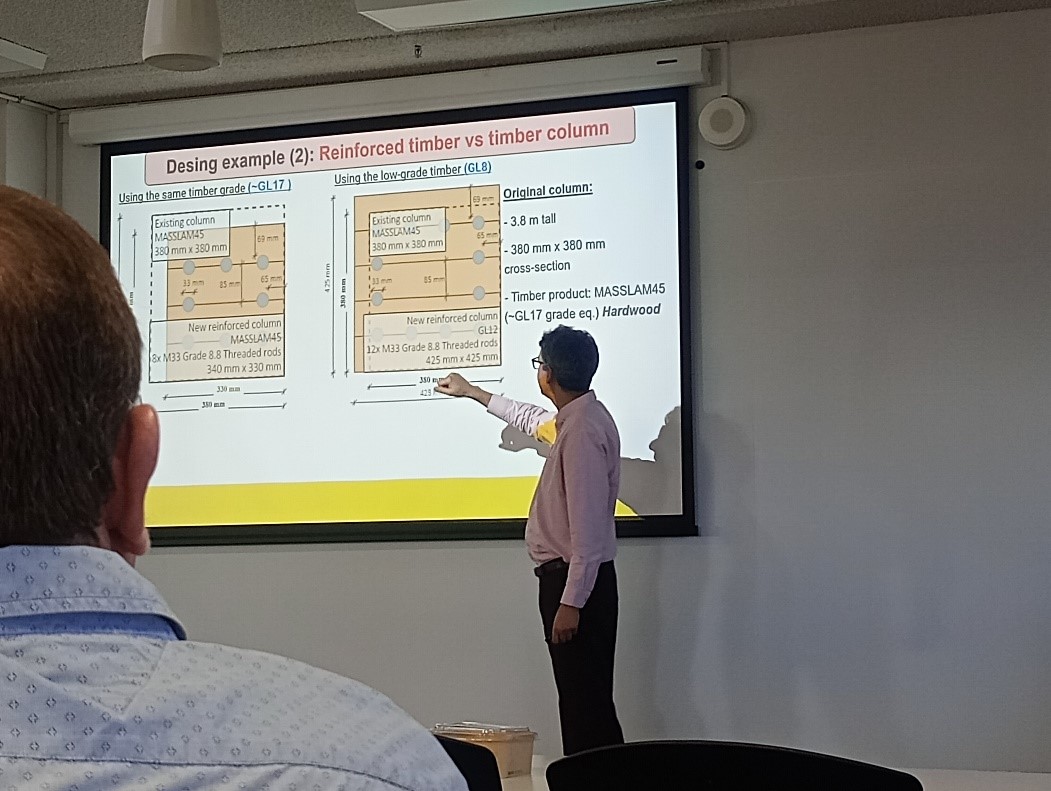
One benefit of the research was that a timber member could be replaced with the same quality timber containing steel reinforcing, leading to a significant reduction in required cross-section to resist load. However, the main sustainability benefit was that high quality timber could be replaced with low-grade timber, such as Douglas Fir. When reinforced with steel rebar, this low-grade timber would still have a smaller cross-section than significantly higher quality timber used on its own and allow lower quality, faster growing timber to be used for structural purposes.
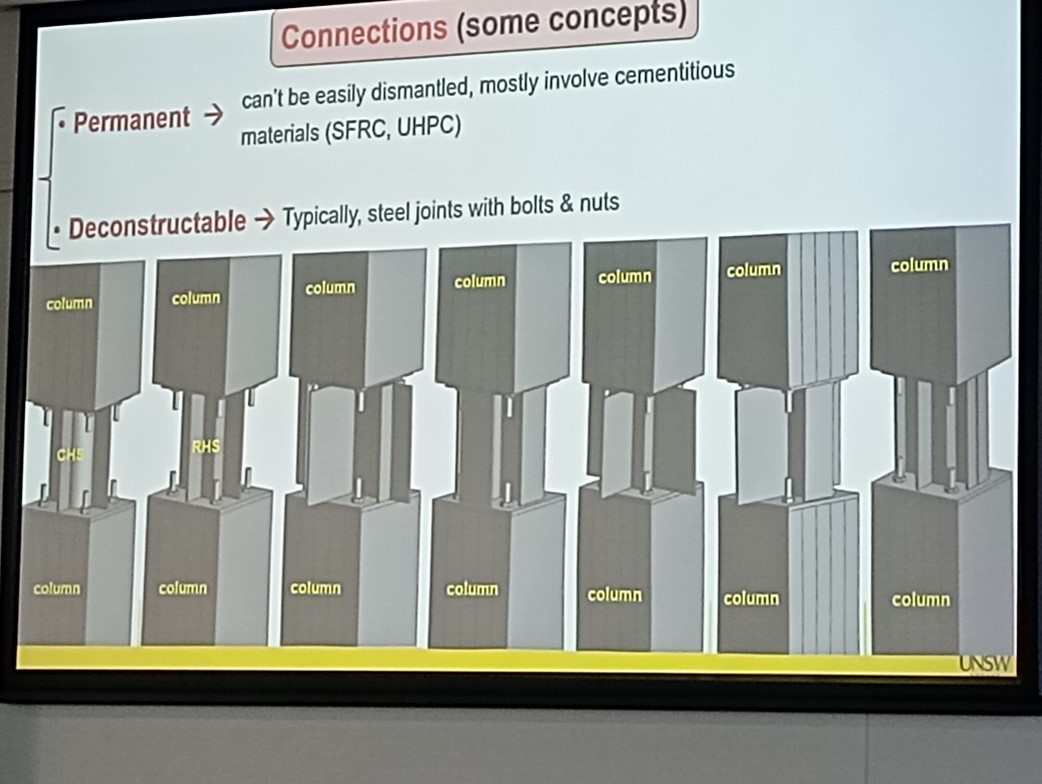
Connections could be de-constructable, created using steel plates (as shown above). These are bolted onto the end of the threaded rebar (the same bars as used in concrete) that protruded from the timber members, allowing the joints and structure to be dismantled at the end of its life. Alternatively, for more permanent structures ultra-high strength concrete, that cured within 48hrs to over 100MPa, was used to connect members, allowing the structure to be load bearing and built in a short period of time, as well as protecting joints from fire.
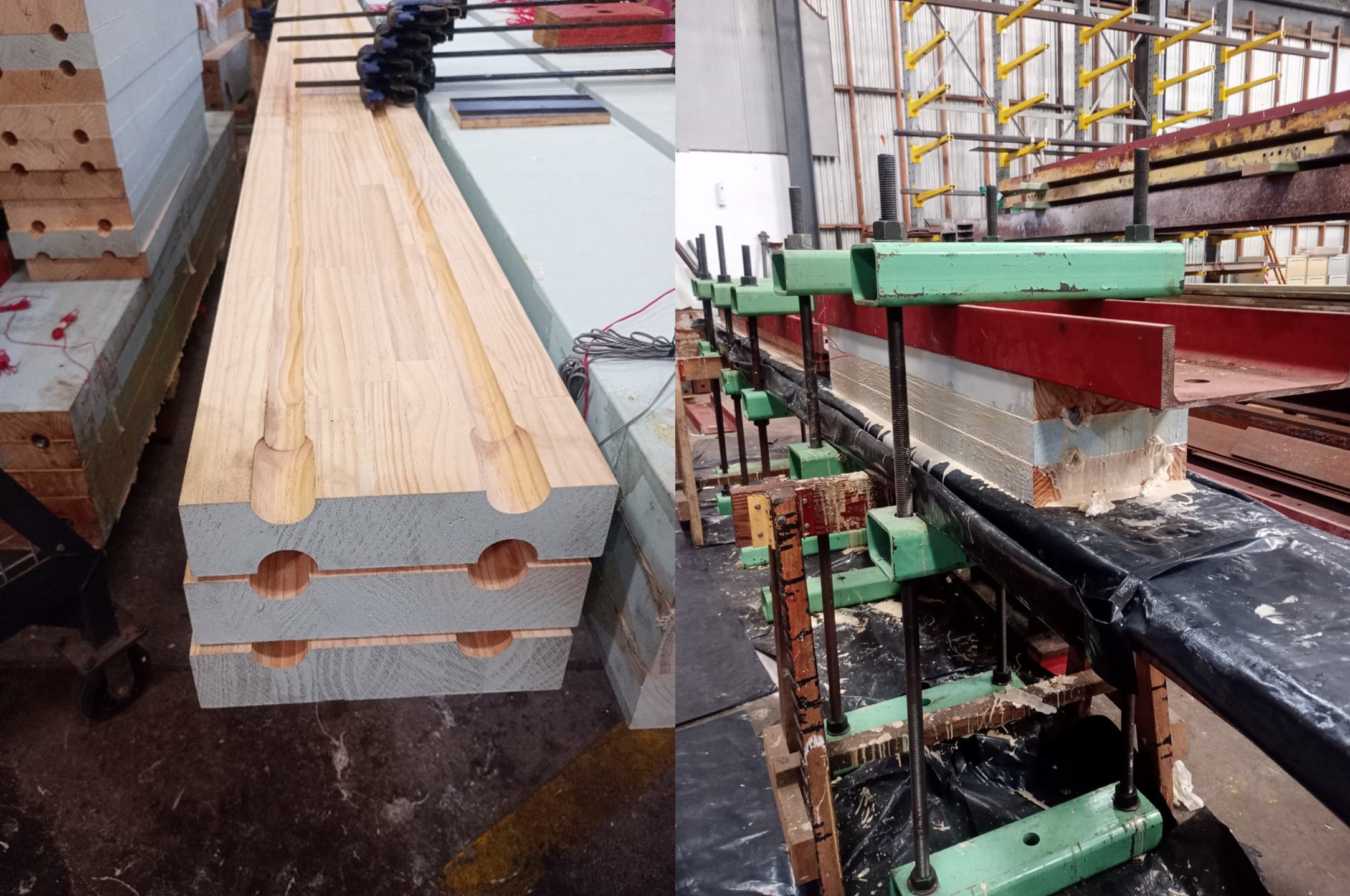
The members themselves are created form beams of glue-laminated timber with grooves cut into them using a router table. The steel reinforcement bar is then placed inside and a glue is poured into the joints to bond the bars and timbers together. These are then clamped and held in compression for 48hrs. Not only are the members very strong, but due to the steel being encased inside the timber, they also have a high resistance to fire.
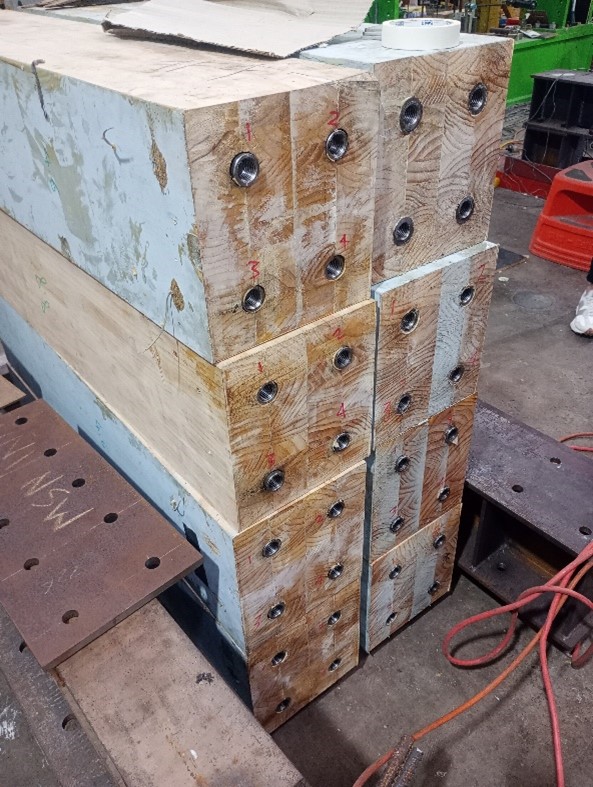
The rebar can either be threaded to be a male or female end as required. They can then be rapidly assembled on site.
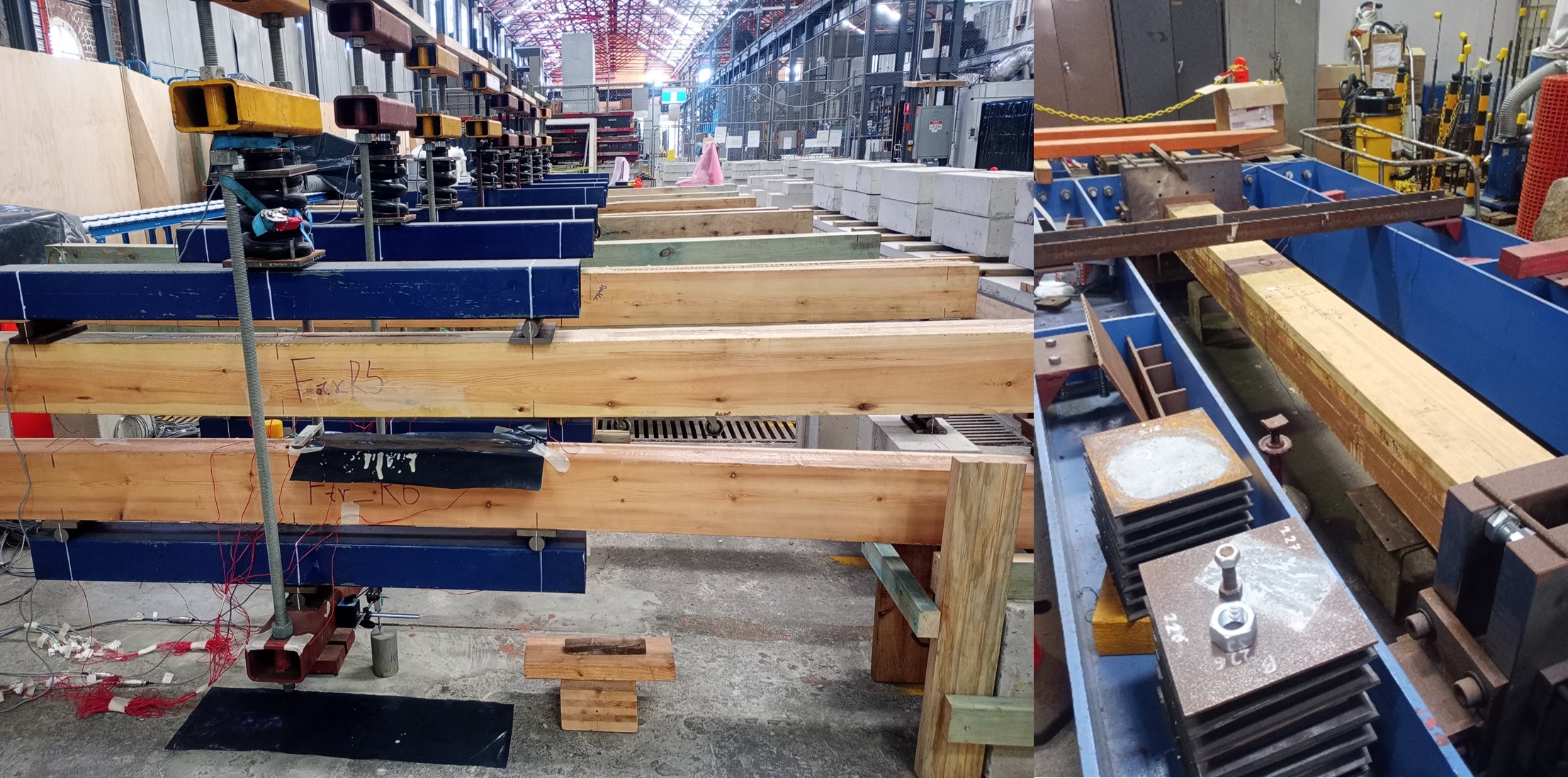
Using this method, beams and columns have been tested with some being left for up to two years to measure creep and verify the quality of the bonds. Beams were also tested for vibration and deflection. It was found that once beam spans were limited to 8.5-9m before vibration and deflection became the constraining factors.
The beams have also been tested as a composite in conjunction with concrete slabs to produce floors. One key consideration when used in this manner was that a membrane needed to be placed between the concrete and timber when the concrete was poured. This was because the concrete would chemically attack the timber, reducing strength by around 1/3.
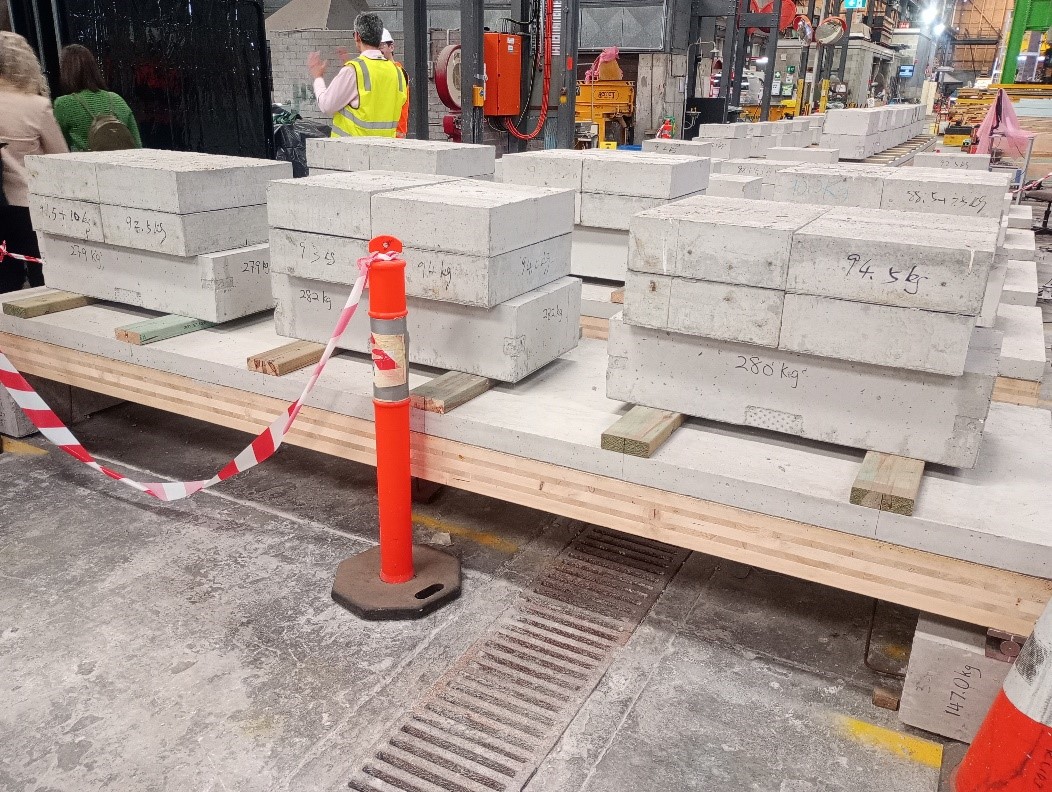
So far, the project has been a resounding success and Prof Valipour is trying to ensure that all of these members meet existing timber codes to allow a rapid transition into use. However, he did state that it will come down to design consultants to hold the risk of utilising them in design and identifying whether they can meet required design lives (the irony was not lost on me). This further demonstrates the difficulty of utilising new research and techniques in industry but may be something we are able to work with in the near future.


This is a really interesting concept. I assume the manufacturing process can take quite a while though and will face the same challenges as existing member sizes in that if there is a commonly used dimension, it can be prefabricated easily but anything outside the norm would be more costly and have longer lead times?
I was also interested in the idea that it is more resistant to fire because it is encased in timber. We specify a minimum depth of concrete when using reinforced elements to deal with the risk from fire but how can timber provide the same level of protection? Particularly is you choose to use a lower quality timber which I assume generally is less dense and therefore burns more easily. surely this does not provide adequate fire protection.
I think the thing that is taking the long duration at the moment is the testing – the glue itself is meant to be harden in 48 hours, so the turnaround should be quite quick. However, I agree that it is essentially prefabricated to a certain size (not dissimilar to steel beams) and then you can just pick the nearest appropriate size.
For fire resistance, from what I have read on the internet, concrete still has a longer resistance. However, large timbers (like glulam) are more fire resistant than steel. The wood will char on the outside creating a protective layer shielding the inside from further damage for a period of time. I found that the standard burn rate used in timber research is 0.7mm/ min and members are then sized to achieve a designated burn time such as 60 mins to buy time for inhabitants to escape.
Steel on the other hand loses load capacity dramatically at around 400 degrees C, meaning you reach a failure point much earlier than a heavy timber structure, so steel has to be coated or covered to increase burn time. From what I can find, concrete may still be a better choice in high risk (high rise) structures.
That’s a pretty succinct and broadly correct answer on the fire front. Concrete is necessarily the go to for fire resistance, particulalry when reinforced because of the heat wicking effect of the steel. The key is the different between buying time with graual loss of strength in timber verus to risk of sudden catastorpic deformation in steel. Given that it is deflection and vibration that introduce span limits I wonder what consideration has been given to prestress post tensioning, particully given the ease with which an acurate tendon profile could be generated and elements made continuous over supports (through columns).
I trust that you have all of this dicumented in your DAP and PDR…