Arial Drainage – Anyone?
Has anyone ever come across ariel drainage? I haven’t been able to find anything on it from my own cursory research. I’d like to know a little about it because the hydraulic consultant on my site is telling me that it is because he has employed an ariel drainage strategy that the soil stacks and vents don’t line up. This is a man who I’ve caught out telling me porkies a few times already so I’d like to know my onions before I challenge him about it. I had understood that it was standard practice to have a soil stack that rose from the sewer in the ground slab through all floors to the roof where it vents, and that the drains at each floor run into it. I know that sometimes the stack has to make a slight detour, because drainage falls below mechanical services and structural elements in the priority of change, but thought that any deviations would be minimal and with a big radius. The deviations I’m talking about use 90deg bends and are across many meters on a single floor.
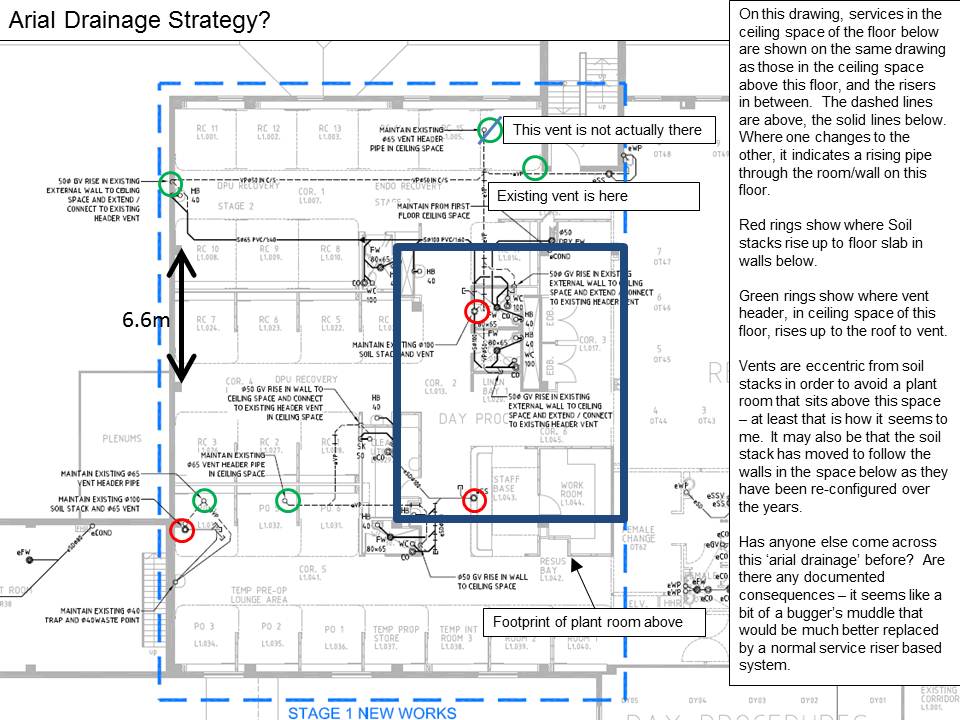
The job I am working on is a little unusual, in that there is no services riser. The section of the hospital that we are currently re-fitting was originally built as a single story, and then converted to a double, then a triple storey affair. Things seem almost to have been piled up on top of each other as the various re-fits and expansions have taken place over the years – even the structural columns have moved around (Mark, this probably answers your earlier question about the location of the med gas isolation valves – As is happening with this referb, they seem to be thrown in wherever they are needed to allow the next extension to be built). Here is a drawing of the new drainage system in my referb area, with my annotations of where the soil stacks are located on the floor below. The stacks and vents are linked by a vent header system in the ceiling above the floor shown.
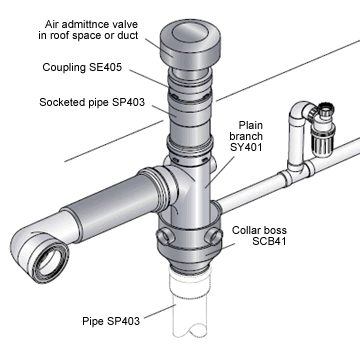
Do you think that the use of air admittance valves on top of the stacks might be a more economical arrangement than using the vent headers?
 Holdfast Training Services Trial Blog
Dan
I have been able to find reference to this system in a book called Laboratory Design Guide by Brian Griffen. In it he specifically refers to aerial drainage systems associating them with an Australian Standard 3500 (your plumbing code). Amongst the strengths he attributes to this system are the ability to drain fixtures within a 10m radius of the riser, but practically he limits the radius to 8 m. You probably need to do a little more research, but looking at your drawing and combining it with the text in the book, I reckon the guy is probably on the level, although I have never worked on such a system myself.
With regard to ARV, we used to put them in when we had a new facility without easy access to the soil vent pipes. House builders seem to use them in this country as well when they don’t want to penetrate floors and roofs. There is specific guidance on when they can and can’t be used, but I will need to remind myself of when these are tomorrow. Bottom line, unless AS 3500 comes up contradicting what has been designed, I would avoid suggesting ARV as you will be taking on the design liability if the contractor says he will fit them on your say so. Probably best just to do some research to reassure yourself and if it is OK, let them get on with it.
Jim
Not my area but…..there can be a different discharge stacks and ventilation stacks in a system .
The objective is to prevent large pressure fluctuations in the discharge stack as this:
Causes siphonage (trap sucking)- with the pipe exposed to the odours in the discharge…Hmmm nice
Causes blow-back; particulalry if discharge pipe outlets are not offset on the discharge stack….nicer still
Looking at your drawing
As far as I can see there is branch venting…i.e. the branches routing to the discharge stack are independently vented on a separate venting stack. Rationalise: if a discharge in one branch causes a pressure change in the discharge pipe can this change be released in an affected branch by venting?
Equally if a discharge causes a pressure rise is there a vent before the rise reaches an appliance outlet?