Archive
Careful What You Wish For…
C4ISR
Oh crap – be careful what you wish for. We requested that the contractor clarifies every single aspect of his Request for Equitable Adjustment and boy did we get it. A giant box full evidence and exhibits to prove that he is owed just over $3M by the US Government. If you stack up the A4 double sided papers, they reach over 3 feet in height. This is the amount of paperwork that now needs to be sorted and appraised and with only three people to do this, a coordinated and concurrent method is required. Enter stage left, McFry’s patented analysis tools. A request is in with the tech guys to re-visit their first (failed) attempt at generating the network environment needed to host the tools securely. The case is also to be sent directly to the USACE District commander to see if he can add some weight to it. It is clear that I won’t be around to see this one put to bed before phase 3 but at least I can still shape the response and begin the evaluations.
The subsequent work will now all be used to generate a negotiation plan to find some middle ground. Many of the contractor’s claims are sheer faced cheek and others he is definitely in the right. The grey areas are the ones that will cause us concern and this is where the coordinated thought is required. Further help and advice will be required from the Lawyers at District to keep everything in context.
EDC Solarwall
Relationships have now completely broken down and what was once a harmonious working routine is now painful and fraught with challenges…….but not between USACE and the Contractor…the difficulty is between the Huntsville and Harrisburg offices. Huntsville conducted the scoping and wrote the contract before awarding the job. We are responsible for the local execution of the contract, but after finding a number of errors with the contract (some of which could put us in hot water in legal and financial terms), certain personnel at the Huntsville office have become quite ‘anti’ to say the least. Some examples are as follows:
DAVIS BACON WAGE RATES: The department of Labo(u)r regularly publishes minimum wage rates that vary by trade and geographical location. These are to be published in site offices so the workers can compare what they are being paid to what the law states they should be receiving. This is enforced by myself and the Construction Representative through employee interviews. I was asked to check that the rates in the contract were the correct rates for the time of signature on the contract, and I found they were not. Upon raising this to the Huntsville office they just replied that ‘it’s ok – they signed the contract so it’s legal.’ After a lot of asking around and researching more thoroughly – we don’t have a leg to stand on. They must change the rates and recompense the workers accordingly (and one of the trades has a $14/hour difference!). It took about six attempts at raising it and threats to raise it to the contracting Officer directly before anything was done about it. Since then, everything I’ve raised with the Huntsville office is met with combative responses and unhelpful jibes…..All I did was point out they’d made a mistake.
PAYROLL INFORMATION: In order to confirm the information in the wage interviews (see above) I need to see the actual payroll information so as to corroborate all the figures before I can give the nod to the Contracting Officer’s Representative to actually authorise payments. I included this information in the Pre-Construction meeting and the minutes and the contractor was more than happy to provide the information. For some reason Huntsville decided that only the Contracting Officer needed this info and ordered the contractor not to send it to me or the ConRep. Long story short – we couldn’t approve the pay application and the contractor was not paid on time (Through no fault of his own I might add). There then ensued another protracted bout of quoting clauses from the Federal Acquisition Regulation (FAR) before I finally had to spell out (and I was very pleased with this) exactly how and why we needed the info and exactly where in the FAR it states our case. The person who takes pride in reminding everyone that they are a ‘contracting specialist’ had to accede. All in all this was a painful and time consuming process which was ultimately very unproductive in terms of project progress….so I had to raise it higher.
THE MOTHER CONTRACT: Another long one shortened – we asked for the mother contract and we were told we didn’t need it. After questioning how we are expected to execute the contract without an actual copy of the contract we still had no joy. Had to find an alternative friendly forces within Huntsville to obtain it. It doesn’t take a rocket scientist to see why this is not good. After seeking advice on the actual contract itself the response was a resounding ‘that’s a bit thin’ and ‘that would never have made it past first draft at District’. Having compared it to other contracts I also see how they achieve economy of effort by simple referring to FAR clauses instead of actually using them in the contract. It also appears though that they don’t read the clauses they quote!
1413 – CONTRACTOR INDEMNITIES AND INSURANCES: Again a pissing competition over why the Harrisburg Office is demanding certain procedures to be undertaken (because it’s the law) and Huntsville claim they never have to do them. More highlighter pen all over the FAR to prove our procedures aren’t just made up resulted in more blunt silences from the Huntsville crew.
Conclusion – the Huntsville team are more accustomed to working with service contracts where many of the issues we highlighted to them are never needed. There are some whacking great holes in the contract and now the contractor is aware of them. I feel another Request for Equitable Adjustment coming on…..and a headache. The working relationship between the offices is less than productive and severely unhealthy for the project. I put my thoughts down in a report for my boss to argue out with them. It came very close to us just pulling the plug all together and giving the whole thing back to Huntsville to figure out….and it’s a long drive from Alabama.
On the work front I had to issue a letter of concern about progress – the rate of work doesn’t match with the schedule. I’m not overly worried though because they are getting faster all the time as they get used to the procedures and materials. They also have no concurrent activity in the schedule and there is loads of scope to crash the programme.
Albright Avenue Closure Repair
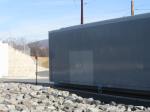
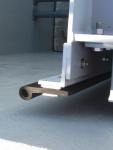
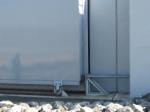
This was a great opportunity to look at the levee systems and how the gate closures are designed. At the Albright location it was found that an error in construction drawings made it past the checking phase. (Design was good – drawing was clearly cut and pasted and tweaked badly). The finished product is a flood protection gate that floats…..even a PET student can see the irony in that. Work covered an appraisal of whether the choice of gate was correct, reason why it happened the way it did, how likely a significant flood event is (statistically) and what short term and long term fixes we can offer….. The result of my statistical analysis was that we are already late for the next significant event and that the latest it is likely to happen is August 2013. Since the report was finished we have the small issue of Hurricane Sandy rapidly approaching our doorstep…..it’s obviously sheer coincidence, but I hope they got the memo.
Neil – some pics I owe you…

Other News
The Embassy called me in to attend compulsory briefings in Washington DC in relation to Army 2020, MS briefs and the role and agenda for liaison officers and exchange officers. Not being entirely sure how an engineering exchange officer fits into the same category as an LO or EO I was still keen to attend just to feel like I’m part of the Army still. Ben wasn’t on the distribution so I subtly snitched on him (with his consent) and it was nice to catch up in DC. Also met Major Wayne Meek (PQE) who is working in Alabama (or the like), I completely ‘dissed’ the old CRE (Now General Le-Gris) by having one of those “you look familiar” moments (thanks Ben for rescuing me) and I also bumped into Major Rich Reese and Colonel Charlie Thackway – other Engineers from my past. So all in all – a very nice re-union…..depending on who you ask.
Just a thought – is it worth giving the next round of PQE attachment folk access to the blog so they can see the exploits and experiences so far? Either way – can someone please pass on mine and Ben’s e-mail addresses to Nick? I’m sure we’d both be happy to start comms now if he has any questions at all. The Ausie folks may also have some good early pointers?
Hurricane Sandy is reportedly going to smash the East coast within the next 24 hours. We have all been placed on a state of emergency and have been told to expect to be without electricity and running water for days. I have set up a basher in the bushes and have been stockpiling beer for days. Ulli on the other hand is due to fly to Germany on Monday night – so this could all turn into ging-gang at the airport. Walmart is sold out of batteries and flash lights and I have essentially been out and purchased a big pile of stuff that I actually already own in storage back in the UK.
Really sick of the elections…..please kill me…. – oops, almost forgot – be careful what you wish for right? See you after the storm.
“It’s all good to go”
“It’s all good to go”: Magnus B Crane Changeout
The replacement of Magnus’ B Crane was one of Ish’s major projects, and handed to me “all good to go” following two Value Systems Analysis meetings with the key stakeholders and an external agency who were brought in to facilitate it. The first was to investigate what weighting should be applied to four considerations that between them would be used in ranking methods of the B Crane change out. This was done by rating the importance of one factor against another and saying if it stronger, much stronger or very much stronger than the other. The outcome of this was more extreme than expected and showed that there was a 62% weighting towards (not) impacting operations, 22% towards constructability, 12% to the importance of having a straightforward implementation, and just 4% to minimising the cost. In my eyes the absence of anyone from the business side of things was highly influential on the outcome that suggested “quick and straightforward at any cost”.
In the second meeting had a few more key players: Gav from Renewals whose opening line was “So, is this where we confirm its an HLV then?” and Tamara from the financial side who was amused to see that the real cost had such a low influence. The next part of the meeting compared the different methods of crane changeout based on very few hard facts; essentially peoples’ opinions based on what they’d seen/heard in the past. Even more interestingly, we compared two named stick-builds (Sparrows and LBO, who all had supplied facts and figures) with three notional ideas of how a Heavy Lift Vessel would work, rather than named HLV vessels themselves. Funny old thing, the notional HLV came out on top, despite none of us having a real idea of what the implications are.
A week after Ish left we got Ian Alexander from Sparrows (our preferred bidder for lifting operations) in to discuss how they have worked with HLV crane installations in the past (bearing in mind the lowering speed can be 0.5 m/s there are some impact forces to mitigate against, amongst other things). They gave us an excellent presentation on their enabling works with the HLV Saipem on the Captain platform. In this instance the ‘super-fast HLV method’ required a total of 11 weeks work from start to finish due to all the other works required, such as moving some items on the platform (the HLV had a 2m “obstruction-free” zone), jacking up the crane that was being removed, and shutting down the platform as must be done for all HLV work. This has made us re-think the HLV option, although having spoken to Herema today (and also Ish), they have a much lower requirement for enabling works. The problem I now have, is finding the best solution based on some maybe flawed parameters, and then convincing everyone that I still have the best option by all accounts. To give rough figures, the full cost of an HLV is estimated as £15-20m; a Sparrows stickbuild will be £7-10m.
What I’ve really learnt from this is the seemingly obvious reiteration of three important things:
- Have hard facts and figures for all options when doing any kind of comparative analysis.
- Ensure key stakeholders are present at meetings that affect decisions where options can have £10m difference.
- Always remember Rule number one.
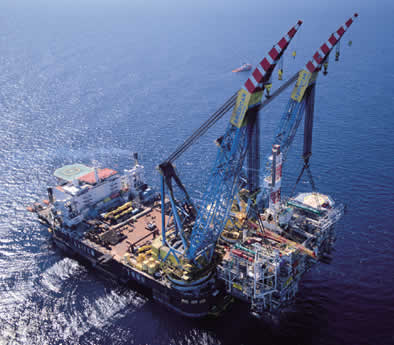
Figure 1. Saipem being used to install an entire platofrm. Is it overkill to use an HLV for a single crane?
Other jobs
ETAP ALQ. My Appraise report is nearly complete and having convinced my programme manager that we need to look at more POB, I have a feeling we may be asked more than the 30 originally planned for. To get the Area Operations Manager to attend my gate meeting I was given two windows this side of Christmas, but as I have found, I don’t want to make any decisions without the big-guns verifying it, so I have a date and time set. The go-ahead (looking at £15m for 40 POB) will be based on a business case that I’ve been told to not concern myself with, so all I need to worry about is the engineering of it. This will be an excellent job for my successor to carry on with the Define and onshore Execute of. The offshore Execute will be Summer 2014.
Magnus TAR jobs (5 of). These are all running OK, with the work on three of them being split to minimise the work done inside of the TAR so it can be completed after (outside of the time when a day equates to roughly £2m in lost revenue). My concern is that the work will be delayed so I am fighting to get buy-in from the platform for the project POB afterwards. The one that this is unlikely to be the case on is the Decommissioning work – there is loads more than expected (looking at <300 different parts of pipework post-TAR) and that is a lot of work: something like 300 man-weeks in the latest estimate! This non-TAR work will be surveyed in Jan and Feb so we should know more then.
And in other news.
I’ve hung up my running shoes for the year, having finished 4th (from 196 starts) in the 60-mile London to Brighton race, and 12th (from 150) in the Glencoe Marathon (gutted – was 2nd for the first 8 miles but piled in as soon as we started running downhill). Liz also did Glencoe and did amazingly, despite cutting her knee nicely in the first mile. Nearly £1000 raised for Combat Stress and the Muirhouse Youth Development Trust so that’s good.
Dougal is awesome but hard work – Roy Serevena, I really don’t know how you managed with all those dogs and children: Lisa must be a legend!

Figure 2. Dougal
Winter tyres are ordered and get fitted next week: it was -4 as I drove in last week (admittedly this was at 0500 hrs…). Perhaps a little cooler than things Down Under, but looks good for the winter climbing season!
Client, Contractors & Catastrophic Failures
SURFACE WORKS
Piling
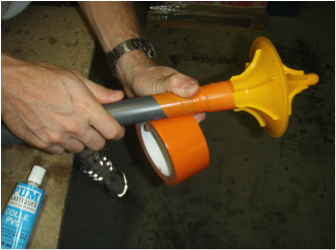
CFA and CMC piling continues, as does rectification works for non-conformance reports (NCRs) (raised by Crossrail and subsequently Vinci and the sub-contractor upon realisation that it is commercially advantageous to flag up your own defects) on 1200 out of 1800 CMC piles. The principal cause of these defects was the use of a crack inducer that had not previously been trialled on this scale. The plastic yellow cone pictured contains a wooden ball which, when filled with grout at high pressure from above acts as a non-return valve forcing the grout out through the sides and hence inducing a crack in the pile. The induced crack, combined with the use of an excavator to crop the piles proved highly ineffective and was eventually replaced by a pile cropper. A 67% defect rate has proved extremely costly, and unfortunately for the sub-contractor and Vinci, unlike the first few piles which disappeared into the river terrace deposits, these NCRs cannot be attributed to unforeseeable ground conditions.
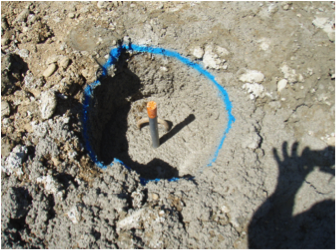

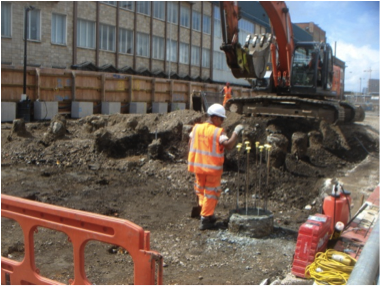
Those rectified CMC piles that have now been accepted by the Client have subsequently been overlain with the Loading Transfer Platform (LTP) and Load Tested in preparation for the reinforced track slab works. There have generally not been any problems with the CFA piles, which have been cut off exposing the starter bars in preparation for the track slab walls and overhead cables.
Reinforced Concrete Delivery
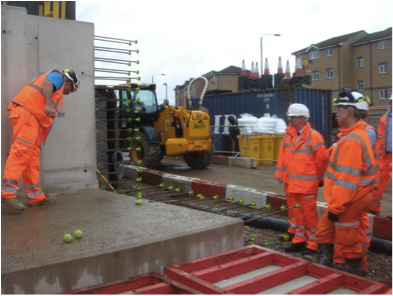
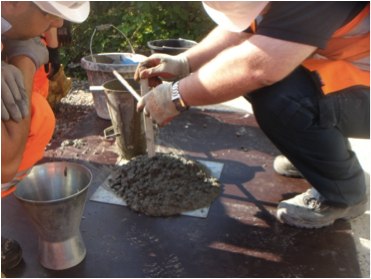
The Vinci delivered reinforced concrete track slab and walls are awaiting final ‘acceptance’ from Crossrail, and a trial has been carried out to refine methodology prior to works commencing. Making good trials will follow to establish best practice for the main works. With a large amount of concreting starting on site (and within the tunnel), Vinci engineers have been receiving in-house training to in order to be able to carry out re-bar and pre and post-pour concrete inspections.
TUNNEL
Temporary Services
Temporary Services have now been 90% installed, partially handed over and the sub-contractor is now in contract in a maintenance contract. Having seen a sub-contract ‘almost’ full circle my main observations and lessons learnt are as follows:
Sufficient time and resources (the right people) should be spent drawing up the scope and specifications – what will be needed during construction (what will be the maximum capacity + contingency) and for final handover (ability to reduce capacity for the Client)? E.g. Having to issue 6 x PMIs for additional power requirements.
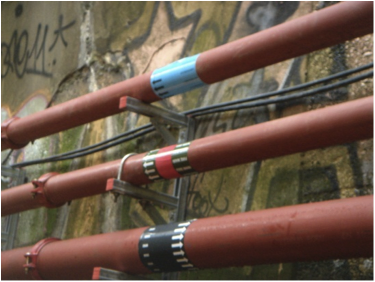
Planning should be continuous and communicated to the right people – how will other works interact with the installation, during and after construction. E.g. The Invert Replacement Trial required 4 x M&E services to be moved and the props and temporary works for the main works conflict with the fire main, compressed air line and drainage pipe.
And finally…. Final handover is extremely difficult! The longer it takes to sign and accept the works, the longer any defects have to appear and the longer the risk remains assigned somebody else! Not forgetting the difficulty in achieving the requisite level of quality.
However, I also accept that hindsight is a great thing and issues and snags often only become apparent during or after the work. And time = money at the start of the project, in the same way that time = money during and after the project. I would still argue however, that time (and money) spent in planning is seldom wasted, provided of course there is sufficient information to plan with…..which in this case may by a significant contributing factor!

On the issue of money, at an average of £100k a month to discharge water in the sewers either side of the tunnel, a re-design (including a filtration system) is now underway to construct a drainage system that discharges water from a central sump into the docks…… hence negating the requirement for 200m of pipe line and £500k in Thames Water bills….maybe that’s why they chose to do it like that in the 1890?!
Drilling & Grouting Works
Drilling suffered a further setback after high water pressures hampered the insertion of plastic TaMs, despite the additional contact grouting directly behind the tunnel lining. The design was reviewed and sacrificial steel TaMs with a conical end will be used, which can be drilled into the gravels allowing the micro-fine grout to permeate directly into the gravels.
In-Tunnel Well Points
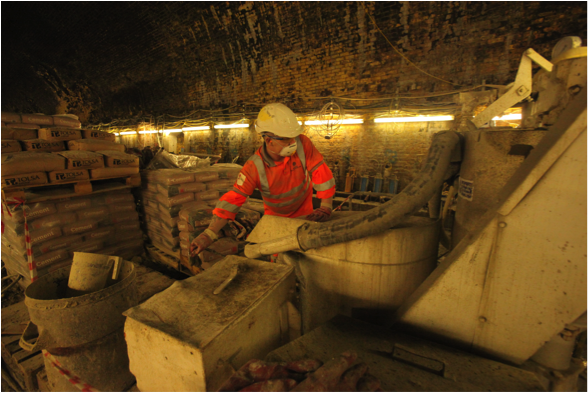
Localised dewatering was to be provided by well points drilled at 10m intervals, 4m below the invert into the Lambeth Group. All were found to be dry, however, in the event of any water entering the wells, a passive pumping system will be installed.
Invert Replacement
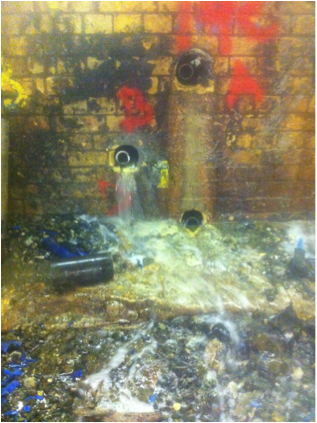
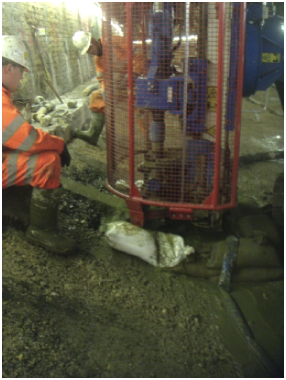
Prior to the replacement of the concrete invert, two 1.8m trail bays were required in order test the methodology and monitor the loads induced in the props as a result of the excavation. The trial got off to a bad start when a fully charged cast iron pipe (part of the original construction temporary drainage, but fortunately for Vinci and the subbies not marked on any drawings – good ol’ Clause 61!) was hit causing water inflow at a rate of approx 50l/s. A packer was eventually connected and 1000l of grout solved the problem 3 days later (the delay was a result of a drawn out Client decision to grant permission to break open the pipe for fear of inundation – despite not being able to stop the flow without opening up the pipe)!
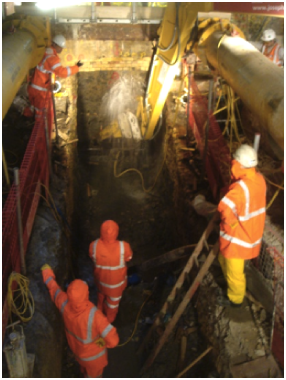
Pipe fixed, reinforcement installed and concrete poured. All that remains now is a prolonged battle between the Client and the Contractor regarding permissible bay widths and size of props for the main works. The Client arguing that whilst the loading in the props was monitored to be less than 2% of the actual capacity (less than the differential caused by thermal expansion and contraction), and that the tunnel, whilst extremely strong will act as a brittle structure and if failure does occur it will be catastrophic. The Contractor on the other hand is using the prop load data, combined with an independent consultants report arguing that the Ko used by the Client is far too conservative to allow for a feasible and cost effective methodology……
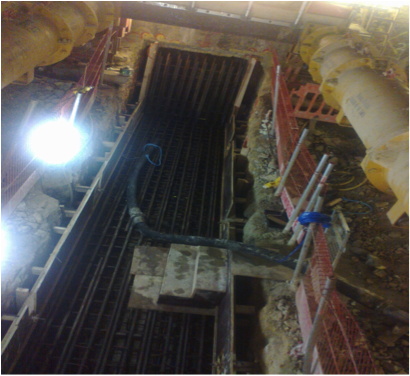
….in the mean time….. Central Box Construction through the Twin Tunnel, Cofferdam preparations and newly appointed Instrumentation, Monitoring and Dewatering Manager…. (I would recommend avoiding flying from London City Airport during my tenure!)
Type quickly – it’s Friday Afternoon!
C4ISR
Discussions with schedule specialist show little opportunity for progress without further input from contractor who has now requested another 3 week extension. The Office Engineer is adamant that if they delay any further that he will throw the whole thing out. I am skeptical that he has the authority to do so, however. My understanding is that under the Federal Acquisition Regulations, if the contractor is owed money he has the right to pursue it. I take the OE’s rants with a pinch of salt.
An additional submission from sub contractor for further adjustment has been received and has hit $1.5M – bringing total claim to $3M. This is a Big No No – as essentially it is asking the sub-contractor to do business directly with the Client. I have asked that the Prime certifies the request, but am curious as to whether or not they will – as I believe the sub has been ripping off the Prime. Main contractor must sign off on it before we can do anything with it…..it’s getting bigger!
ECIP Lighting Projects
Sat in on meetings reference energy savings produced from ongoing lighting project. Monitoring shows that project should pay for itself within 5 years…..just in time for the buildings to be de-commissioned!
Ashley Reservist Centre
Joy of joys – this is coming to an amicable solution. The petrographic testing has shown that in essence the concrete on the loading ramps is sound and therefore all of the problems witnessed on site should be able to be resolved using cosmetic upgrades….or so I thought. Subsequent concrete break strength tests (taken from other areas) are now showing that three quarters of the most recent test results are below strength. Why won’t this project die!?!? So we now have the Corps lab saying it’s too weak, the batch plant tests saying it’s fine and the independent lab tests (which have been accused by the corps lab of falsifying results) also saying they are fine. Additional testing from the independent lab is inbound soon and a decision will be made by the Contracting Officer’s Representative as to whether we pursue this further.
EDC Solarwall
I am still rattling the head of security to provide workable policy instead of just putting up barriers and being awkward. I ended up writing a policy which has now been adopted temporarily until they write a more comprehensive one (which I’m told may look very familiar when it comes back) but now we’re having bun fights about how staff are processed for security checking to actually get them on site now. Having upset the head of security a little more publicly this time I don’t think I’ll be taken for a ride-along in a police car any time soon.
Having extrapolated current progress on the wall against the various schedule items I see we are about to start slipping behind on schedule. Ordinarily I would prepare a letter of concern, but seeing as this contractor has been excellent at turning things around (and I see plenty of potential for concurrent activity etc) I saw no reason to escalate so quickly. I wrote a formal letter asking them to simply explain their plans for the COR to reassure him that we have no reason to worry. The COR likes the verbiage and intends to use this approach on other projects before slapping their wrists with the letter of concern. It’s more of a friendly prod while relationships are all still good……and there aren’t many of those around here! I intend to keep it that way as long I we can.
The Department of Labor issues minimum wage rates for various skilled laborers and these get updated quite regularly. It was noticed that the rates that are being used do not match the department of labour rates for the time the contract was signed. This means an administrative modification is required to the contract. Problem 1 is that the mistake was made by another office and must be rectified by the other office. The staff there seem not only unwilling to bring it to the attention of the Contracting Officer but also slightly confused as to why I’m banging a drum about it. (It falls to this office to do the pay interviews etc and we’ll have the fun of fixing it.) Problem 2 is that the rates themselves appear to vary quite badly, meaning there’s a strong chance we will need more federal funding to make sure the workers are paid their dues. More fun to follow.
Having fun with review of wind calcs and seismic loading calcs!
Am reviewing submittal of pay requests and processing them but keep finding that info is missing (but probably sent to the wrong government office). This is bad because the contractor appears to have two masters (a design centre and a construction centre) and neither are on the same page. This whole concept looked great on paper! I also find that we are re-learning the same mistakes over again form the last ‘joint’ venture.
Albright Avenue Closure Repair
This is a new involvement fro me on a levee project where the USACE designed a rolling flood gate…..which appears to float in the event of flooding! All just in time for a TMR. Site visits and historical data collection abounds.
Other News
Was nice to spend some time back in UK with family as my father is not too well. Typically my wife ended up in hospital in the USA while I was in the UK. Impeccable timing you could say. Thankfully all is well. Just as well as owe don’t have any life insurance on her.
The political machines are in full spin cycle in the run up to the elections. I’m pretty sure our voting cards that came through were sent by mistake.
I have developed a habit of seeing things in the shared calendar and inviting myself along…..which then turn out to be the commander’s visits. He doesn’t seem to mind. Most recently was a visit to Poplar Island – a man-made habitat for wildlife made up of dredge material from the Chesapeake bay. I’m keeping my eyes open to see if he’s hosting cocktails – see how far I can push this.
Stay safe y’all
Gas regulator indoors?
Hey everyone. Has anyone ever come across a gas regulator indoors?
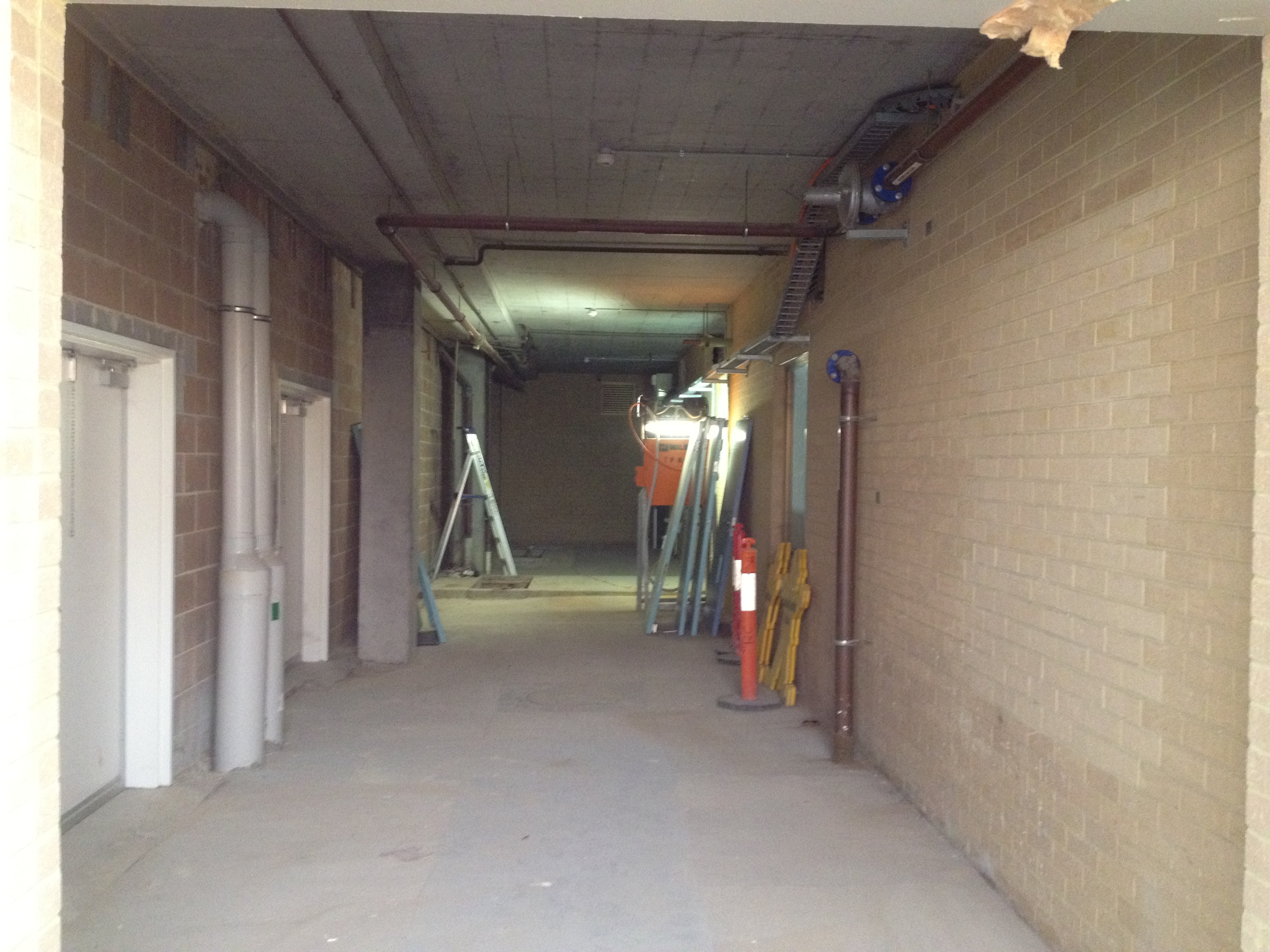
This one will soon have an AHU just below it that supplies air to an industrial kitchen. Is it even legitimate to have the regulator in an enclosed space? They work by venting gas to atmosphere – which in a plant room seems like a bad idea. The reason I’m worrying about it is that the Consultant, no stranger to a Spanish practice, says not to worry about it. Are the quantities of gas these things put out so small that it isn’t a problem?
I’ll dig out the Australian Standard, but if anyone has seen this before I’d be grateful for a heads up.
 Holdfast Training Services Trial Blog