Client, Contractors & Catastrophic Failures
SURFACE WORKS
Piling
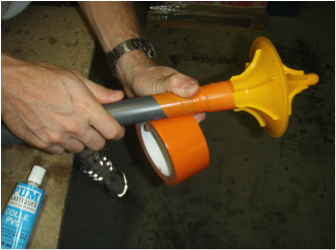
CFA and CMC piling continues, as does rectification works for non-conformance reports (NCRs) (raised by Crossrail and subsequently Vinci and the sub-contractor upon realisation that it is commercially advantageous to flag up your own defects) on 1200 out of 1800 CMC piles. The principal cause of these defects was the use of a crack inducer that had not previously been trialled on this scale. The plastic yellow cone pictured contains a wooden ball which, when filled with grout at high pressure from above acts as a non-return valve forcing the grout out through the sides and hence inducing a crack in the pile. The induced crack, combined with the use of an excavator to crop the piles proved highly ineffective and was eventually replaced by a pile cropper. A 67% defect rate has proved extremely costly, and unfortunately for the sub-contractor and Vinci, unlike the first few piles which disappeared into the river terrace deposits, these NCRs cannot be attributed to unforeseeable ground conditions.
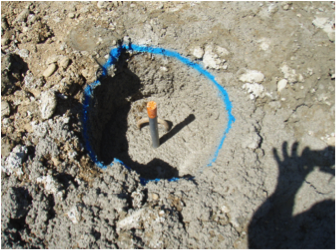

Those rectified CMC piles that have now been accepted by the Client have subsequently been overlain with the Loading Transfer Platform (LTP) and Load Tested in preparation for the reinforced track slab works. There have generally not been any problems with the CFA piles, which have been cut off exposing the starter bars in preparation for the track slab walls and overhead cables.
Reinforced Concrete Delivery
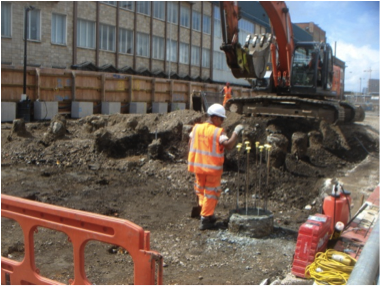
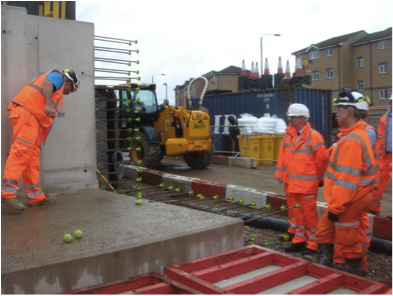
The Vinci delivered reinforced concrete track slab and walls are awaiting final ‘acceptance’ from Crossrail, and a trial has been carried out to refine methodology prior to works commencing. Making good trials will follow to establish best practice for the main works. With a large amount of concreting starting on site (and within the tunnel), Vinci engineers have been receiving in-house training to in order to be able to carry out re-bar and pre and post-pour concrete inspections.
TUNNEL
Temporary Services
Temporary Services have now been 90% installed, partially handed over and the sub-contractor is now in contract in a maintenance contract. Having seen a sub-contract ‘almost’ full circle my main observations and lessons learnt are as follows:
Sufficient time and resources (the right people) should be spent drawing up the scope and specifications – what will be needed during construction (what will be the maximum capacity + contingency) and for final handover (ability to reduce capacity for the Client)? E.g. Having to issue 6 x PMIs for additional power requirements.
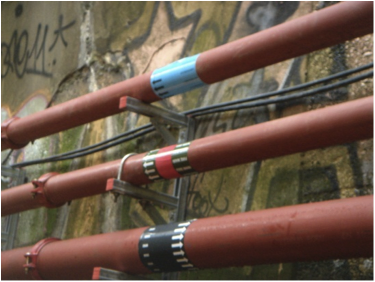
Planning should be continuous and communicated to the right people – how will other works interact with the installation, during and after construction. E.g. The Invert Replacement Trial required 4 x M&E services to be moved and the props and temporary works for the main works conflict with the fire main, compressed air line and drainage pipe.
And finally…. Final handover is extremely difficult! The longer it takes to sign and accept the works, the longer any defects have to appear and the longer the risk remains assigned somebody else! Not forgetting the difficulty in achieving the requisite level of quality.
However, I also accept that hindsight is a great thing and issues and snags often only become apparent during or after the work. And time = money at the start of the project, in the same way that time = money during and after the project. I would still argue however, that time (and money) spent in planning is seldom wasted, provided of course there is sufficient information to plan with…..which in this case may by a significant contributing factor!

On the issue of money, at an average of £100k a month to discharge water in the sewers either side of the tunnel, a re-design (including a filtration system) is now underway to construct a drainage system that discharges water from a central sump into the docks…… hence negating the requirement for 200m of pipe line and £500k in Thames Water bills….maybe that’s why they chose to do it like that in the 1890?!
Drilling & Grouting Works
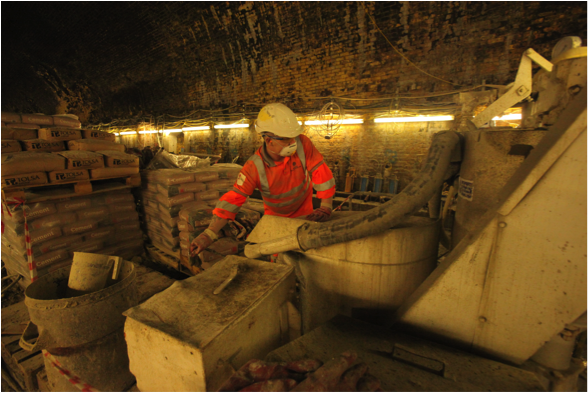
Drilling suffered a further setback after high water pressures hampered the insertion of plastic TaMs, despite the additional contact grouting directly behind the tunnel lining. The design was reviewed and sacrificial steel TaMs with a conical end will be used, which can be drilled into the gravels allowing the micro-fine grout to permeate directly into the gravels.
In-Tunnel Well Points
Localised dewatering was to be provided by well points drilled at 10m intervals, 4m below the invert into the Lambeth Group. All were found to be dry, however, in the event of any water entering the wells, a passive pumping system will be installed.
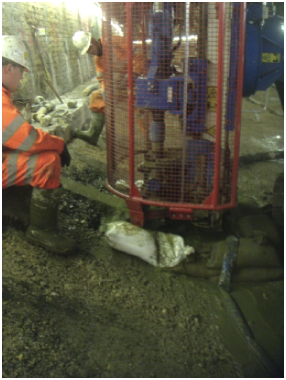
Invert Replacement
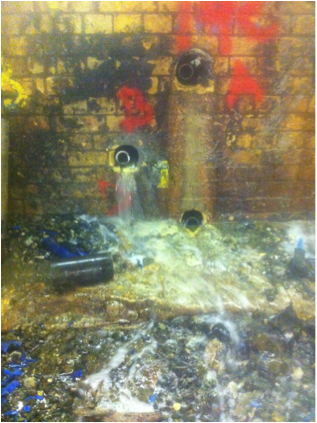
Prior to the replacement of the concrete invert, two 1.8m trail bays were required in order test the methodology and monitor the loads induced in the props as a result of the excavation. The trial got off to a bad start when a fully charged cast iron pipe (part of the original construction temporary drainage, but fortunately for Vinci and the subbies not marked on any drawings – good ol’ Clause 61!) was hit causing water inflow at a rate of approx 50l/s. A packer was eventually connected and 1000l of grout solved the problem 3 days later (the delay was a result of a drawn out Client decision to grant permission to break open the pipe for fear of inundation – despite not being able to stop the flow without opening up the pipe)!
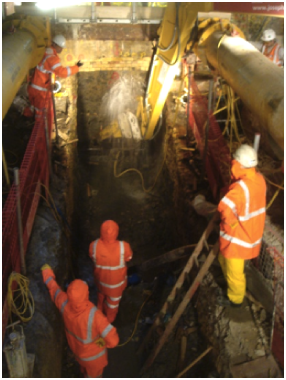
Pipe fixed, reinforcement installed and concrete poured. All that remains now is a prolonged battle between the Client and the Contractor regarding permissible bay widths and size of props for the main works. The Client arguing that whilst the loading in the props was monitored to be less than 2% of the actual capacity (less than the differential caused by thermal expansion and contraction), and that the tunnel, whilst extremely strong will act as a brittle structure and if failure does occur it will be catastrophic. The Contractor on the other hand is using the prop load data, combined with an independent consultants report arguing that the Ko used by the Client is far too conservative to allow for a feasible and cost effective methodology……
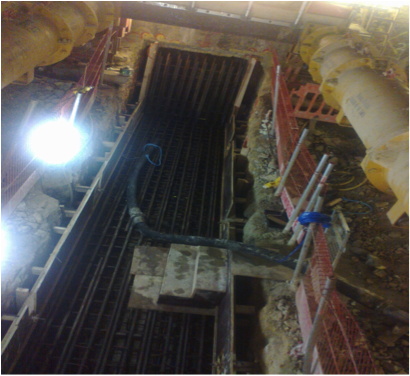
….in the mean time….. Central Box Construction through the Twin Tunnel, Cofferdam preparations and newly appointed Instrumentation, Monitoring and Dewatering Manager…. (I would recommend avoiding flying from London City Airport during my tenure!)
 Holdfast Training Services Trial Blog
Hi Rachel,
Great post – long gestation but worth the wait (I’m looking forward to seeing everyone else’s appearing soon given the time they’re taking to assemble!). Reflective piece on tunnel services – excellent; use it in the next AER!
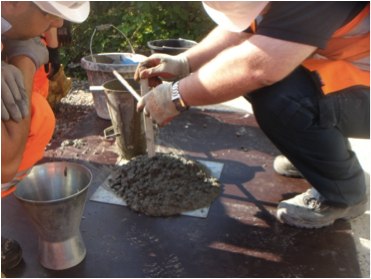
That photo under reinforced concrete can’t be a serious attempt to measure slump? It looks well up into the S4 range 160mm-210mm (BS 12350-2) surely at that consistence you’d be better off with Degree of Compactability testing (BS 12350-4) which is more suited to specification in either F4 or F5 ranges. Selection and communication of the appropriate consistence class and test are a precursor to getting the right concrete for the job and therefore achieveing the intended result. If you’re heading into this area let me know and I’ll put a few notes together for you.
Wrt the pipe in your invert replacement trials, did no one consider freezing the pipe either side of the cut before openning up and plugging? It’s a standard domestic plumbing trick…
Also, surely the client, if he agrees a more cost eficient bay size, stands to gain in pain/gain cost reduction but doesn’t carry anymore risk than he does now?
Instrumentation, Monitoring and Dewatering Manager! Now if there isn’t some fascinating technical background work to be done there that will double up as a technical TMR I’ll eat my red pen! Moreover it’s a levely position for and experience report and easy hook in a Project report 🙂 Trust earned early through hard work repaid in spades! Well done.
Richard.
Thanks for the comments.
You will be relieved to hear that the concrete pictured was rejected on 2 accounts. Firstly, it was the wrong mix and secondly the test for a self-compacting concrete (which was ordered) should have been a Slump-flow test. Ironically, when the correct mix came to site, SF2 C32/40 + 2kg ignis fibres, it proved to be too inconsistent to be a viable option. The decision to change to an S4 mix was largely based on the requirement to pump the concrete 100m and therefore consitency of the mix was critical. The S4 mix also contained the requisite fire resistant ignis fibres which must be extracted and weighed for each delivery – an evolving sampling process which initially proved somewhat too delicate for your average Miner! Concrete delivery has evolved exponentially across the site (tunnel and surface) but is still undergoing many teething problems so any advise you have is always gratefully received.
The reason the pipe wasn’t frozen was two-fold. Firstly, the Miners had already hit the pipe and casued significant influx of water, and since the pipe ran along the length of the excavation works, the Client wanted assurance that it was fully grouted before allowing works to proceed (even with modified levels to avoid the pipe).
And bay sizes….. the Client’s Design team remain unconvinced by Vinci’s proposal (a Byrne and Looby report) justifying the increase in Bay Size – in fact there were 17 points/queries from Atkin-Arup on the report which must be further justified prior to any progress being made. The underlying reasons are the Designer’s reluctance to accept the more conservative Contractor’s analysis; Crossrail/Bechtel’s reputation for bureaucratic, inflexible acceptance procedures, and perhaps a lack of financial incentive to reduce costs (whilst Vinci have every incentive to maximise the Gain, Bechtel, who will retain a comfortable profit margin either way have little incentive to have any risk passed back through acceptance of a proposal not fully endorsed by their Designers).
And monitoring – John you can tell your class that it is true that if you dig a big hole in Clay, the structure next door might go up!! But hopefully the big structure (namely a DLR station) will go back down again….uumm??!!