Archive
Cofferdams, Concrete and Coming to the End…
Cofferdams, Concrete and Coming to an End….
The last few weeks on site saw the start of the cofferdam preparations, which from a Monitoring Manager perspective I had a key negotiating and decision making role between third parties, the Client and Vinci. The main issue was the level and type of monitoring that would have to be installed prior, during and after the cofferdam works (sheet piling, dewatering, construction of cofferdam, de-construction and construction of tunnel) in order to satisfy all parties.
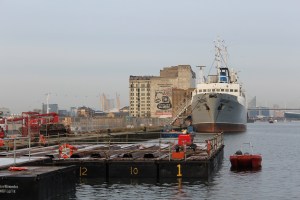
The Contractor’s consultant, convinced of the adequacy of his design did not deem any necessary, the Client was hinting at costly underwater scanning technology, Thames Water wanted the moon on a stick and London City Airport (originating from BA demands) wanted to charge 10 passenger seats for the additional risk of construction works in case of a plane crash! Cut a long story short, the Thames Water issue was one of vibration, resolved by rearranging the sequencing and location of sheet piling works and proving that the service tunnel was actually steel and not iron! A metallurgical test was carried out after we showed Thames Water a photograph of a drawing taking during a trip to the London Docklands Museum which showed the pipe as steel! This doubled the allowable vibration limits solving at least one the the problems.
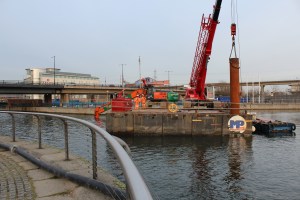
A monitoring proposal was eventually agreed which included prop , sheet pile, tie and dock wall monitoring. The designer was most concerned about deflection of the southern dock wall (which is sheet piled and tied following expansion works in the 50s) during dewatering. The siting and operation of the increased monitoring formed an integral part of the cofferdam planning process, since Crossrail will not allow any works to proceed without monitoring in place. This clause also lost a week of production days after a £25k Total Station was stolen from the West Tunnel Portal! Ironically this, and the Client EWN regarding monitoring requirements for the cofferdam, went a long way in getting the QS’s to acknowledge EWNs and CEs from the monitoring subcontractor (who were already owed over £150k)!
Monitoring issues increased exponential as works progressed elsewhere on the site, of note was movement of the DLR Prince Regent Street Station as a result of major excavation works adjacent to the retaining wall. Fortunately because the excavation was only 400m lower that the final structural slab level (in order to carry out pile remedial works before laying the Load Transfer Platform (LTP)), the designer was probably more worried that the Contractor! Hence, we had a number of very collaborative Engineer Review Meetings to conclude that the station was a piled box section, movement was conversant (albeit not entirely predicted) with the works and ground conditions and stabilisation was eventually established!
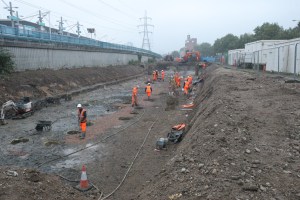
In addition to normal works, the Limo site a few kms west of the site (where a TBM shaft had been constructed) turned off their dewatering in November which had provided us with 3m of draw down. There was then a 2 week period before we were had planned to turn on our Thannet Wells in preparation for the Central Sump shaft deepening. It was interesting to monitor the effects, heave in the central section and increased water flow rates from our existing Chalk wells. When we started to get our feet wet in the tunnel however, I managed to negotiate the Thannet dewatering date forward (at a cost of £800) – there had to be some perks to the Monitoring Manager job!
After severe delays with piling, and a curious bout of concrete chicken pocks (eventually put down to admixture quantities, resulting in an entire bay strip out), the reinforced concrete slab programme started to progress well on both the east and west surface rail.
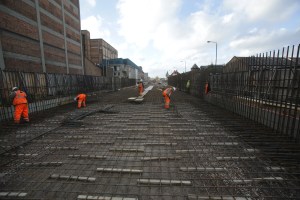
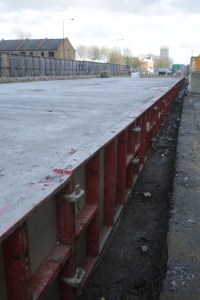
Drilling and Grouting works in the tunnel eventually finished at the revised extent (70m less that the planned invert replacement length (although the same as the OCI agreed length). The delay, largely due to ground conditions initiated a design review of the invert replacement extents. Vinci claimed it would cost £10m extra to do the extra 70m predominantly in the River Terrace Deposits (of which £4m were preliminary costs). Crossrail has their Designers go back to the railtrack designers and make every tweak possible to achieve the requisite rail alignment within the OCI extent. The Client won and as I left, were considering (albeit impossible to contractually implement) a pro-rata deduction based on the fact that Vinci were now not doing ‘£10m’ of work! An illustration on the ‘spirit of mutual cooperation’ by a Client on Cost Plus contract, and a Contractor experiencing the Pain aspect of the Pain/Gain share. After their 12 week (turned 6 month stint at Connaught), Bachy will be returning after Christmas to grout the base of the Dock Walls to form a seal with the Lambeth Group as the 3rd and 4th side of the cofferdam.

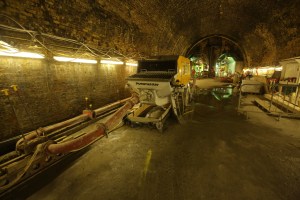
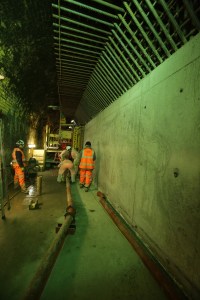
In the Tunnel, the negotiation of Invert Replacement Bay and Prop size continues, but Target Cost, progress bonus driven Gallagers are continuing at pace with the Central Box Section replacing the Twin Tunnels. The main issues have been timely issue of levels and reinforcement detailing. However, as Crossrail approach their Dock Passage Closure window (ironically not a Contractual date for Vinci), approvals and acceptances have been much more forthcoming! A major logistical problem was concrete pumping over long distances which was solved by driving the concrete into the tunnel to a concrete pump adjacent to the works. Production time was increased by bringing in additional formwork, mounting it on wheels and moving it from Bay to Bay without the requirement to re-errect it. A commercial issue has been questioning Gallagers on their ‘bonus’ scheme. They believe it drives production and ultimately saves the job money (which having seen the rate of work I would tend to agree), however our QSs do not believe it is conversant with the terms of the contract… the saga continues….

Aside from that, my last job outside the tunnel was planning the Parapet Wall removal which has Traffic Management (liaison with the local council), scaffold, crash desk, temporary propping and achieving requisite levels around existing arches aspects. However, surprisingly the works have been delayed and will not start until after Christmas… Easter… next Christmas… have I become cynical at the end of my Contractor placement??!!
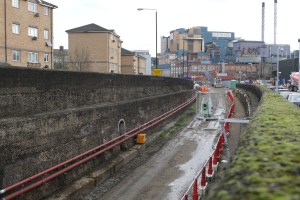
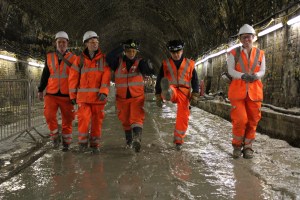
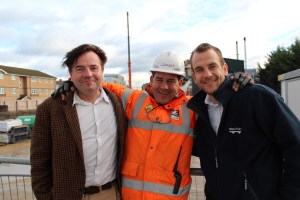
And finally, meet the Team….. my trusty Assistant Site Engineer Alex, the Tunnel Team (with left to right 2 new Assistant Site Engineers, fellow Section Engineer and ‘senior’ Assistant Site Engineer (vying for promotion) Alex…!) the Tunnel Construction Manager (left), mad Irish Foreman (centre) and my line manager the Tunnel and Central Section Production Manager (right), and the Works Manager recently turned Surface Construction Manager.

Happy Nicolaus!
Mon 3 Dec – Fri 7 Dec 12
The Transition
I have successfully arranged a time split for phase 3 meaning I get some access to Civil Works projects and also Engineering Division stuff – which is great. Both teams are very good to work with so far and all seem well motivated and understanding of the Development Objective requirements. There’s just the usual IT type stuff to tie up and I’m under way.
Civil Works:
Poplar Island
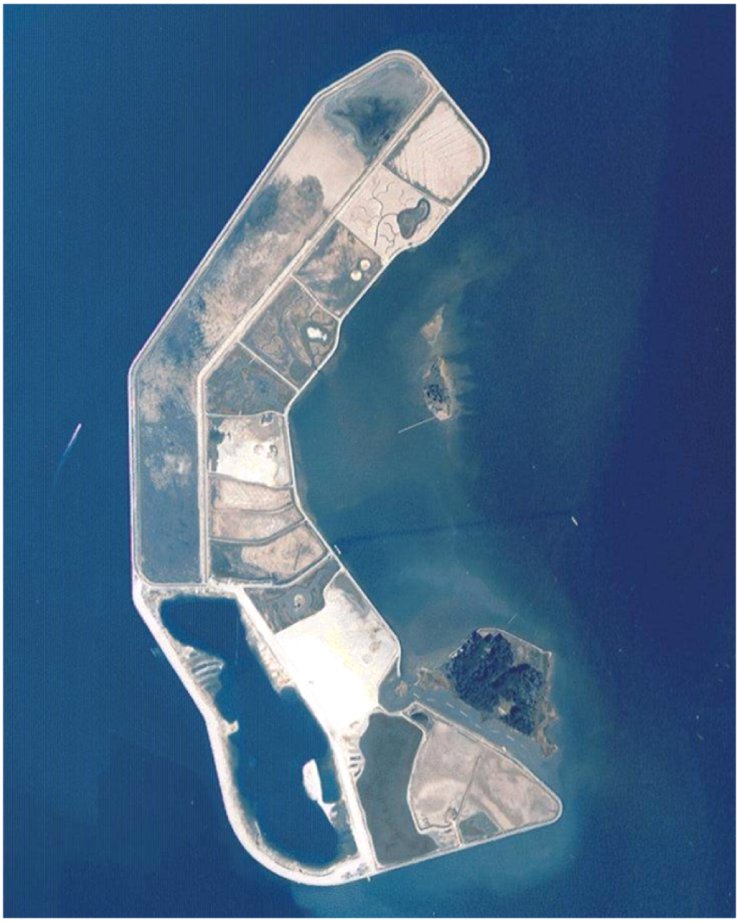
The poplar Island project is a ‘win – win’ flagship project for USACE. One of the key roles of USACE is to maintain all the navigation channels which involves a lot of dredging. They have been working for many years now with the Ports Administration, the Environmental Protection Agency and other local stakeholders and have been using the dredge material to re-build Poplar Island which was almost completely eroded away through natural means. This means that nature habitats are created instead of generating pollution by dumping at sea. They claim that savings are made as less fuel is required to ship the material to deep sea, but when you look at how expensive the project is in general – I don’t see this argument holding water (pardon the pun).
http://en.wikipedia.org/wiki/Poplar_Island_(Chesapeake_Bay)
For this project I am looking at the hydraulic structures that make up the spillways and inlets to see how they could be improved. I made a visit to the island this week to do an initial survey of the structures. I have laid out the structure of what I aim to achieve here and have met with all of the stakeholders respectively. I will shortly be entering a detailed research phase.
Engineering:
Damaged Bunker
I have been responding to a call for assistance from Afghanistan. Our American cousins decided they needed to build bunkers to house MLRS (yes…British MLRS). The required clear spans are too wide for any of the ‘off the shelf’ designs and so they got a contractor to design and build a bespoke system.
They used HESCO Mil7s stacked up to build a wall, onto which a concrete ring beam was placed before adopting a 3ft deep lightweight truss with blast protection (HESCO Mil5s) on the roof. A 3-bay option was approved and the design has been stamped by a professional engineer (yet to be determined who this was). As they were finishing the roof of the final bay, a catastrophic collapse occurred, injuring several people, three of which had to be med-evac’d.
The US Sapper Captain has to develop a report and an investigation and has requested our help. We have had the world’s supply of photographic evidence returned to us to pour over along with the designs. It’s clearly the lightweight trusses that have given way and many construction errors are visible (mixed use of screws, endemic over-tightening of screws, strap locations at the same place on every truss – potentially inducing a block failure etc).
My first area of research turned up some interesting data. It turns out they are mis-using the HESCO cells entirely. The Mil7s are not even meant to be double stacked – let alone have the additional roof weight on there. Many of the ground level cells are showing signs of extreme distress – irrespective of the fact that the truss collapsed. Along with all of the observations about construction, choice of materials in the truss – I am recommending that they tear down the remaining structure as opposed to trying to fix it with a recommendation that they adopt a more traditional design that incorporates an internal frame of some sort.
The initial report will go next week and I have recommended that we produce a sanitized lessons learned for wider distribution. I’m also trying to get some of the pictures released for HESCO to use in their education packages. I’ll post some pics once I get the all clear.
Other News
So all in all a very exciting, busy and productive first 4 days. I have managed to wangle a slot on a USACE event in Philadelphia tomorrow so I will have some new turf to explore.
I got to my new cubicle and started chopsing off about all the crap in there. I was throwing out masses of stuff – it’s as if someone just left and didn’t come back. Then I opened a draw and found stacks of food and coffee creamer and bowls that were growing mould before I really had a good whinge about whichever dirty minger was responsible for this. At this point the new boss came and apologized and tried to put it delicately that the guy I was talking about had recently committed suicide…..and nobody had been able to bring themselves to clear out the cube properly yet…… “So he won’t be needing the creamer then?” I replied brightly – happy in the knowledge that all this stuff is up for grabs…..not sure how well he took it. I am refraining from drawing a chalk outline on the floor….that’s a little dark even for me.
Ulli’s birthday this weekend – time to go out disco dancing Borat style!
Also – today is Nicolaus….like a mini Christmas that the Germans celebrate….not sure why or what the significance is. Traditionally you give very small gifts and everyone is happy…..so I look forward to a new pair of socks when I get home.
HAPPY NICOLAUS!
Now arrived in the Design Office in Baltimore
New Office – 10 South Howard Street, Baltimore
I have now wrapped up and handed over most of the work which I was involved with at USAMRIID and SSP sites over in Frederick, and am now daily commuting up the road to Baltimore to the District HQ, based out of the Mechanical Section.
Apart from the fact that the HVAC is broken (ironic, I thought) which makes the office about 30C everything else seems to be falling into place. I am about to go to their weekly meeting which details the existing and expected projects, hopefully will be able to position myself on a interesting yet modular project.
SSP
Back in Frederick, the SSP project is still treading water, though a new Bio-Challenge test has been conducted, which we are currently waiting…… It is expected that a test pass will alleviate many of the commissioning issues, though it is becoming increasingly evident that the “customer” does not want to be responsible for the plant, and so is “stalling” as much as they can, this is clearly making the commissioning, closeout and handover of the plant difficult. As a point in case, last week I had to reassure some of the USAMRIID customers that it was perfectly normal for clouds of steam to be coming out of the steam vent on the steam plant, and did not indicate that the steam condensate traps were broken, and so we did not need to launch an investigation and fix it.
USAMRIID
Construction is still continuing at pace. Several issues have come up, but are being resolved as quickly as possible. (1. Slightly flammable pipe insulation in plenum areas, 2. duct cleaning – cutting holes in ducts that are already tested, in order to clean them…, 3. continuing issue of accuracy of duct testing paperwork, thus throwing doubt about the results, 4. In ability to pull some of the coils out of AHU’s etc)
The main concern as far as I can see is that there STILL really does not seem to be a schedule. Despite this being the case for the entire time that I have been there, and various of us voicing our concerns about this situation, the Resident Engineer does not want to delay the project by calling for a stop work order, (realistically the only stick that would have effect) due to lack of adherence to the specification, so the situation rumbles on. Clearly this will become a more pressing issue when commissioning comes, also, from our inspection of what schedule there is, no time has been allowed for reviewing the submitted system tests etc, feasibly this may cause real embarrassment in about a years’ time, luckily (for him) the resident Engineer has said he will probably retire in 10 months time…
I am intending to continue to pop back to the USAMRIID on a frequent basis, to keep an ear to the ground to hear the outcome of these issues, and contribute to the lessons learnt.
Home Front
Sarah is doing well in her job, and getting used to the fact that she is firing about a person a day, but this is apparently expected when largely working with Ex-Cons.
My Beer is going well, I now have particularly smooth pumpkin ale, (the Americans have figured out a way to make almost anything from pumpkin – ale, pie, soup, stew )
We have now got a Christmas tree wedged into our little place, it is about 9 ft tall and 5 ft diameter, which actually may be a little too big, it does make it feel very forested in our front room, in a nice way. Needless to say, it looked smaller in the field.
 Holdfast Training Services Trial Blog