Archive
Week 3 – More of the same really…STOP PRESS – Brisbane Floods
This week has seen me focus my efforts on finalising a tender proposal to win an option study for the Upgrade of Port Drive at Brisbane Port. It was like being a 2IC all over again with the red pen (actually I used a pencil as it’s less aggressive) and really started to add some value, particularly on the commercial side of things. The most interesting element for me was starting to realise the urgent need to win work. Initially I costed up the job to just under $500k. I then had to make reductions to the works programme to reduce man hours and subsequently reduce rates to 70%. This reduced overall cost to $300k but it still wasn’t enough. After further slashing by the Project Director and devaluing me to nil cost (billed to work experience instead of my grade) the cost was brought down to $250k.
There is a clear shortage of work and the transportation group are very desperate to win this one!!! That said, it’s not solely based on price and there is a technical element to the proposal evaluation. GHD put together a reasonable offer with some strengths which will put them in a good position, not least the current works being undertaken for the Port of Brisbane (the client) and previous involvement with the Department for Transport & Main Roads who will be a large influence on works.
There is sadly not much else to report on less for social activity. I am part of the Transportation Group touch footy (rugby) group and once a week we run round Roma Street Parklands of a lunchtime for an hour in the ridiculous heat and humidity. I’ve lost a yard of pace since I was younger but still have a good side-step. I have signed up for a new training regime at the gym “kosama” which claims to “see the benefits in 4-5 weeks”. We’ll see, but going to the gym again after a 10 month absence is doing me a world of good.
BRISBANE FLOODS
Fortuitously I had not published the above as I was going to try to add more to it but since last week we have been battered by horrific storms and subsequent flooding! The state of Queensland is in tatters along the coastline following the storm damage caused by a downgraded cyclone moving South from the Cape York Peninsular. Our previous home of Gladstone was hit pretty hard and I know that there was considerable damage to the port and some elements of the GLNG site; the site was closed for 4 days and people were left stranded on Curtis Island. A few kilometres away in Boyne-Tannum my old supervisor had flood waters rise to the front of his house but fortunately not enter the property. The town of Bundaberg has been declared a disaster zone with the worst ever recorded floods and even the beloved rum factory (my favourite tipple since turning native) has been affected but fortunately the stock and molasses has been saved. The rest of the town however is in bad shape and will take months if not years to recover.
More locally, Brisbane has not suffered as badly as first anticipated with flood levels significantly lower than 2011. That said we live in the Oxley Creek flood plain and it was a little bit tense for a while. In 2011 our house was 2m under water so the neighbours were rightly excited and emotional about the potential of a flood again. We were advised (by the overly emotional neighbours) to empty the house and sand bag it as they had done but followed the Brisbane Council guidance instead, coupled with my own calculations based on Richard Farmers lectures on drainage and catchment areas! There was a risk of flooding but a low(ish) risk, but to appease Lisa who was slightly concerned, I drew the short straw on Monday night when the peak was meant to be reached and undertook flood watch for the house. As predicted we weren’t hit but the water got to within 5 metres away and about 0.5-1m below the house. Close enough for pushing our comfort zone but not close enough for panic stations.
Brisbane is now in recovery mode reconnecting power to the 200,000+ homes who lost it, cleaning up the debris, cutting up the fallen trees and trying to get life back to normal. All being well it’ll pretty much be there by next Monday but there is still a risk of more flooding in some lowland areas. Overall, not a particularly great Australia Day weekend on the East coast but a life experience all the same!
WSP and Dan – 2 weeks in
So it’s almost the end of my second week, and I’m thoroughly enjoying my new existence as a consultant. Having thought I knew a thing or two, towards the end of my contractor attachment, I’ve landed firmly back on the learning curve. Here is a little bit about my first two projects.
Lot 460 – Mechanical, hydraulic and fire design
My first job was to do the mechanical (HVAC), hydraulic and fire designs for a block of 40 flats. IN the end I have handed the mechanical design off to another engineer because the other two have turned out to be much trickier than they first appeared.

Architects rendering of the block of 40 flats – that’s me sitting on the wall 🙂
There was little water under the bridge here as this is a project that had received some preliminary work in the past before being mothballed when the developer ran out of money. Now he is back in the cash and so the project is back on. Unfortunately the engineers working on the design before me no longer work here at WSP. The upshot is that I’ve had to do a bit of back and forth with the client and some digging in the archives to find out what has gone before and to avoid repeating completed work.
The developer has been very keen on reducing the noise inside the flats as much as possible, and so hired an acoustic consultant to do a report. Some of the measures he suggests would indeed reduce the noise but would result in an extremely expensive building. The developer, as you’d expect, wants all of the benefits of the acoustic report but none of the costs.
One example of conflict of objectives between the acoustic and hydraulic performance has been in the design of the bathroom drainage. The acoustic engineer wanted separate branch drains from each fixture to a soil stack located in an acoustically treated plumbing duct. His idea is that by eliminating all changes of direction in branch drains, which sit in the ceiling void of the level below, no annoying swoosh sounds will be transmitted to the bathroom below when the sink of shower is used. I wanted to collect the fixture arms (not the toilet obviously) at a common trap to the floor waste and empty through a common branch drain to a stack in a normal plumbing duct. My idea being that this would ensure the floor waste remains charged and so make sure no drain orders escape into the bathroom. This is the standard drainage strategy in WA and can achieve relatively quiet performance when the pipes are lagged, though there can be problems with quality control and maintenance of lagging. By having only one 2 connections to the stack, my proposal also reduced the required size of the ceiling void. In the end I was able to placate the acoustic engineer by specifying all drain pipes be formed of Gerberit PP-SK (http://www.geberit.com.au/web/appl/au/wcmsau.nsf/pages/prod-drai-ppsk-1), a pipe with acoustic attenuation properties better than or equal to plain PVC. In my experience on site, the marginally higher cost of PP-SK over PVC is offset by the ease of installation, offered by its push-fit assembly, reducing labour costs. It also offers better quality control over lagged pipe – often a job given to the apprentice. As a result, the acoustic engineer, the architect, and I, are going to visit another job where a plumbing sub-contractor I have used before is installing PP-SK. Hopefully they go for it.

The fixture arms collect at a common trap to the floor waste to keep it charged. Fewer branch drains means a smaller ceiling void. Skew P trap pans allow the nastiest noise to be kept in the room of origin. Partial shot of the BIM built in REVIT.
Another interesting aspect of this job has been the design of the stormwater drainage system. The local authority mandates that storm water is disposed of within the confines of the site, so I have designed a series of soak-wells to sit under a car park on the ground level of the building. It has also been instructive to work with the structural engineer in specifying so pipework to be cast into the structure of the building without compromising the structural design.
Design of the fire hydrant system has been a little tricky. I picked up a design done by another engineer for the hydrants that had previously been sent to the architect. Unfortunately the other engineer had misread the Australian Standard and so had under specified the system. The developer, understandably with a prime focus on profitability, wasn’t too happy when I explained the system was going to be about 30% more expensive than originally planned. I’ve booked some time with a fire engineer next week so may be able to come up with some other scheme to reduce the costs, but I’m not hopeful.
The Red Barn – Rural waste water treatment
I am designing a waste water treatment scheme for a client in a remote area, where it is not possible to discharge into a public sewer, and where there is no watercourse nearby. I had been looking at a number of options, the most promising of which was to use a primary stage septic tank followed by a secondary stage reed bed then discharge, following a pass through a UV sterilizer (unnecessary but required in WA for reclaimed water), to a pumped irrigation system serving an adjacent vineyard. Unfortunately WA does not approve of reed beds. I spoke to the Chief Environmental Engineer at the Department of Health who told me, and I’m not kidding, ‘we don’t like new things here.’ In the end I’ve gone for a septic tank followed by a set of leach drains. I’ve positioned them uphill of the vineyard so that the water may leach in a useful direction.
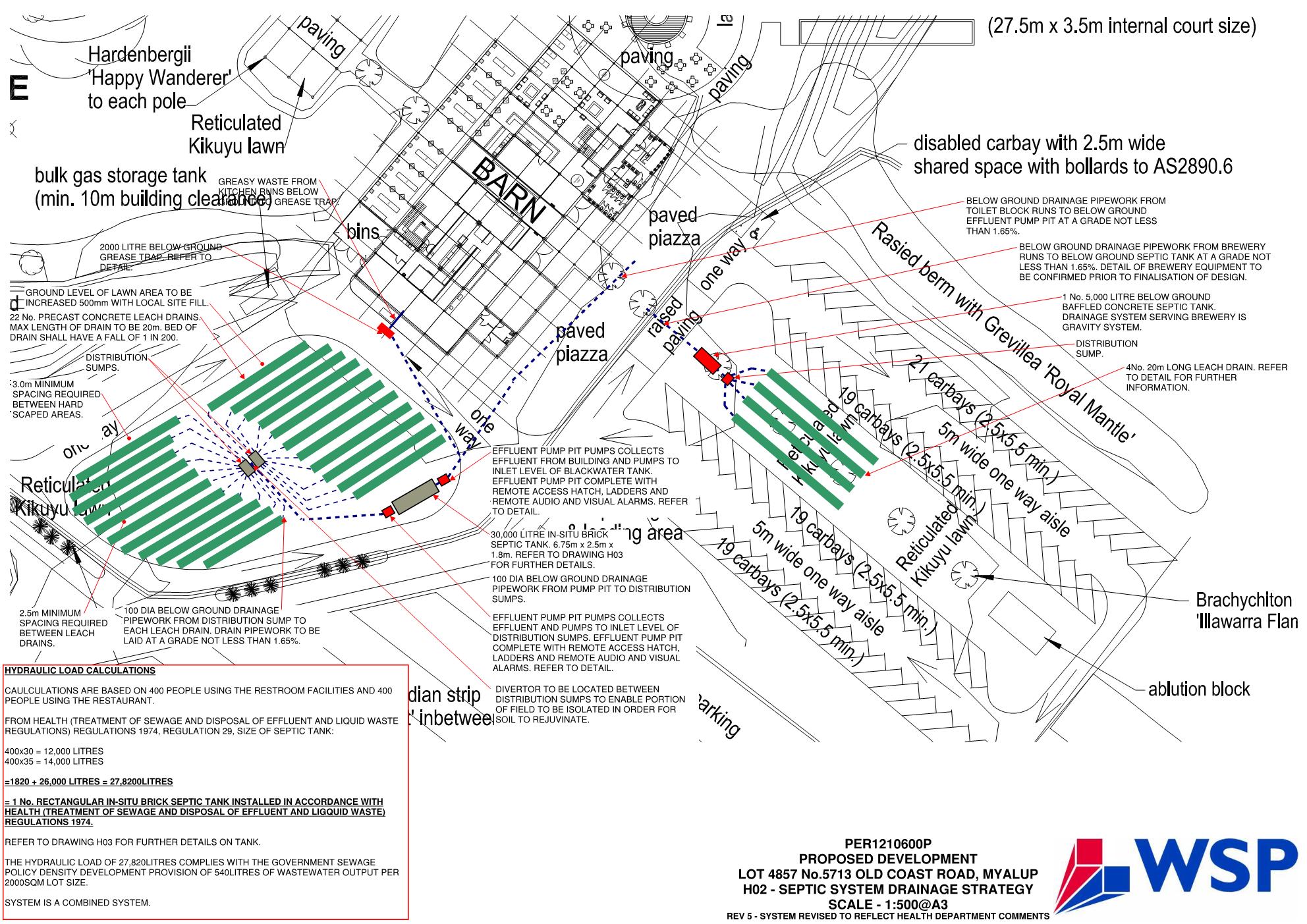
Using a septic tank and leach drains – surprisingly reed beds are not allowed in WA. My sketch for initial planning authority submission on top of architect’s outline sketch – the notes about Hardenbergii and Brachychiton are the Gardener’s.
Anyway, that’s it for now. I’m going to ask for a mechanical project next as I think I’m being used for all of the hydraulic jobs no-one else wants, but, as the wise man said, ‘society needs good plumbers as well as philosophers, otherwise neither the pipes nor the ides hold water.’ Boom Boom!
In other news, the weather has finally cooled down to something liveable for the last few days; over Christmas we had day after day of filthily hot weather. Tasha has got a new job at the Children’s Hospital (the one that the one Steve was building will replace – does that make sense?) near our house, and I’ve joined the office 5 a side team – we’re 4th in the league. I’ve also been roped into an inter consultancy triathlon. It’s pretty tame compared to the ones Chris does though: just 250,10,5.
Week 2 – 14-18 Jan 13
This week has again been fairly quiet with the office still missing about a third of the staff who have taken extended holiday post Christmas (bearing in mind that it is the main school break here as well). Despite the horsepower shortage there is still not enough real work available in the office to keep everyone busy so there is a fair amount of tension as people are (slightly) fearing for their jobs. This places me in an interesting predicament of not wanting to take someones work away from them yet also get amongst something to gain the full benefit of the attachment. I’ve got the balance right thus far but a couple more weeks of this may prove interesting…
What I have been doing is preparing (as part of a team of 4) a proposal to bid for an option study. This sounds a bit dry but luckily I have been digging into the depths of the commercial world and cost benefit analysis which is broadening my perspective of the engineers role. There is plenty to learn and with a bit of legal thrown in for good measure I have learnt that there are certain words/phrases banned from use in all GHD documents including “best practice”, “expert”, and “fit for purpose”.
I managed to get out of the office to a client meeting for the bid proposal and added some value which was appreciated by the team leader and am starting to find my level in the office hierarchy. The option study is for the upgrade of a road to a dual carriageway / motorway for the port and the main element is how to deal with a junction that gets blocked up during peak periods (apparently queuing in traffic for more than 5 minutes is unacceptable in Australia). I am currently of the opinion that the best solution is a burger bun roundabout but convincing the team is challenging and even if successful there, the greater challenge is convincing the department for transport and main roads that it’s not a wind-up, it increases traffic flow/volumes and would prove to be successful in the cost-benefit analysis. We’ll see how it goes but I don’t expect it to get approved in my lifetime…. if all else fails I could suggest a replica of the magic roundabout in Swindon!!! As one of the team keeps reminding us, you always need a “crap option” to make your preferred one look better!!!
Away from the trials and tribulations of the office I am pleased to report that a more favourable work-life balance (for now) has harmonized the Serevena household and I have joined a gym. Having undertaken a cost-benefit analysis of gym membership it was proven to be the way ahead and it is nice to get back running again. The weekend sees us doing not a lot (TMR 4 needs a bit of a nip/tuck) and thus nothing overly exciting to report on that front. Next weekend however will be slightly more exciting with Australia Day celebrations.
Lawyers – and other useless creatures.

Creating the staging area.
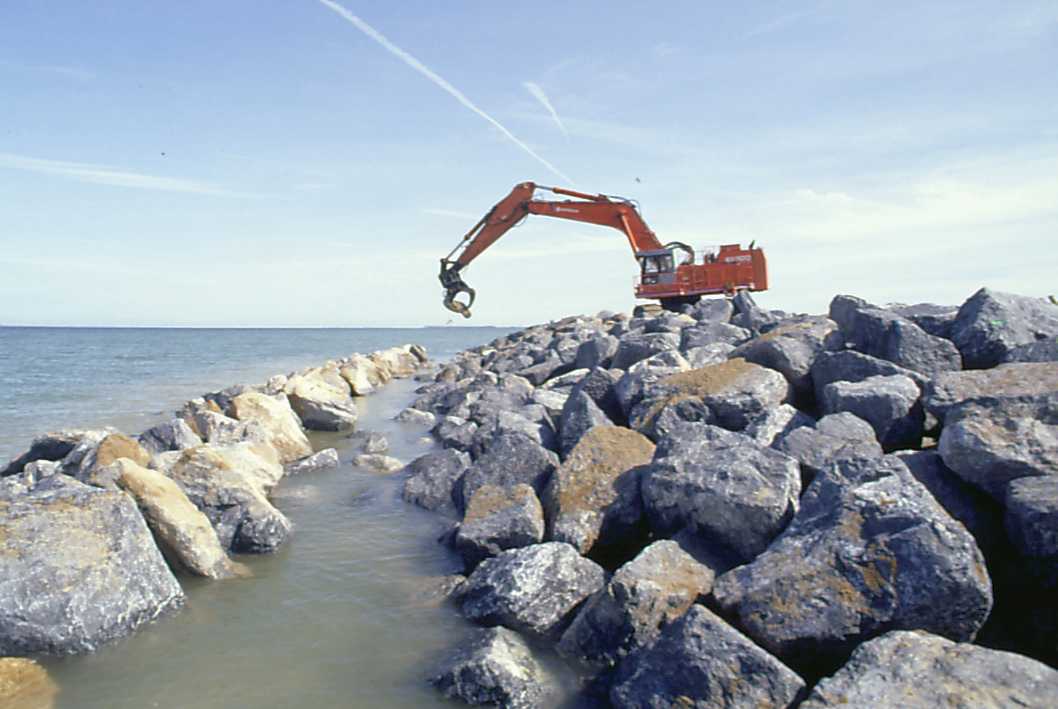
Placing the armour stone
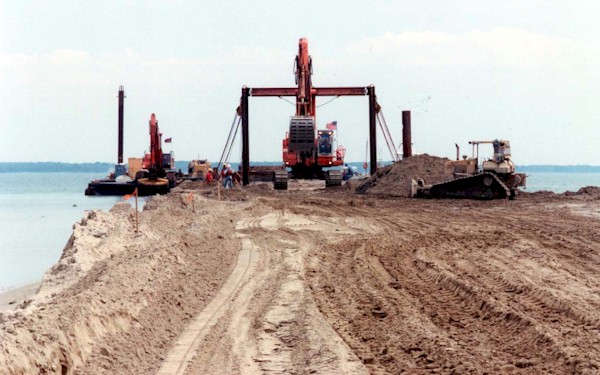
Expansion of the dike
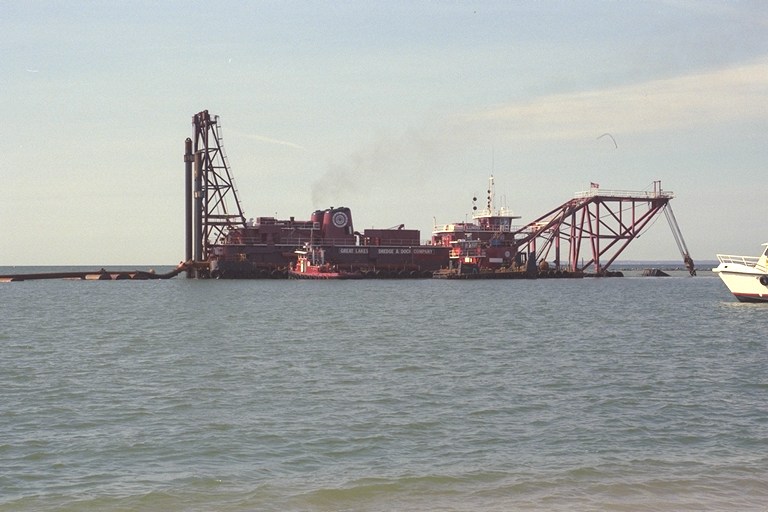
Dredging conducted to generate draft for vessels. Dredge material used to expand dikes.
Collapsed Bunker: After releasing the report back to the guys in Afghanistan I wanted to use the event as a lessons learned for wider consumption. Being of the military mind it is obvious that this is not possible without security vetting and authorisation, so I put in the request and it all went ominously quiet. I eventually discovered that one of the Corps Lawyers has been delivering ethics training, citing an example of a British officer who divulged potential security threats to outside contractors! Furious doesn’t even come close. Having put the guy straight he has now circulated a formal apology to all who received the ‘training’. My co-workers are stunned that I managed to get an apology from the Office of Council – they have a history of getting everyone’s back up apparently. Good news is that we should be on track to release limited information for wider circulation soon.
Poplar Island: My investigations for subsequent cell construction has thrown up the fact that we will need to adapt the construction sequence to include a double coffer dam as opposed to a single one as has been historically used. Traditionally, a staging area is built and then extended out to form the outline of the dike (photos not available at this time – I need to post from work). Once completed, dredge material is pumped in and excess water siphoned off using a spillway until the interior of the island is useable. At this stage a coffer is built on the external portion and the inlet structure is installed. To use a dual purpose structure as proposed, we will need to place the structure before the inner section of the cell is complete, meaning a wet gap on both sides, so I need to come up with a suitable plan to execute this without affecting the ongoing cell wall construction.
Building 45 Renovation: Myself and my mentor have been called in to help come up with the designs for the renovation of an existing brick masonry bearing wall building with heavy timber roof trusses and solid wood decking supporting a slate tile roof . Apparently anything over 100 years old is a big deal around here – I sometimes forget how ‘young’ this country is! Either way we need to get in there to identify the original construction methods before we can get stuck into the juicy stuff. It’s a much wider project with involvement of pretty much all the disciplines, but Preston and I are to address seismic and structural issues.
Levee Screening Projects: These are killers. I sit in a panel of experts to appraise the condition of the levee structures in order to help prioritise funding for repairs. We have a hydrologist, a geologist, a civil works rep and myself acting as the structural engineer. Between us we pour through all of the technical data, reports and photographic evidence to grade the levees. It’s like applying the ‘so what’ in the 7 questions. Some elements of the existing structures do not conform to the guidance, but it is down to us to determine what the real implications are and what the severity is likely to be. Our results will determine if townships remain within the protection scheme, whether home owners will be affected by insurances and what the priorities will be for funding (or removal of funding). It’s long and tedious, but important.
Officer Professional Development: I have volunteered to organise the next quarter’s OPD for the USACE after forging links with Philadelphia district and the crew of one of their biggest dredge vessels. This will essentially turn into the equivalent of OPD. It’s early days yet and I have more to coordinate as the ship has been called up for emergency work. In the meantime I have also volunteered to present at this quarter’s OPD on the Corps of Royal Engineers and the exchange program itself to help our cousins understand why we have folks with funny uniforms and posh accents floating around.
Other News: Enjoyed a vacation with the boys home for Christmas – so we had a long weekend in New York. Amazing place – some great photos to show for it and my wallet took a huge kick in the nuts…..but it was worth it. Evidence has also started to materialise of my involvement with the christmas corrol service. I now appear to be a regular feature on the front page of the USACE intranet…..all positive!…promise! – and before you ask – yes I’m normally lunging!
Happy new year
Happy new year!
Just a quickie as a “distraction” from TMR 4 as Dougal charges around the house and Liz packs for an MA module in Edinburgh next week. Unlike you guys I’m not really doing a separate Phase 4 so I’m developing what I’ve been doing up til now, with an aim to join some of our designers to get the A and B competencies ticked. This works for me, but I’m starting to feel conscious of the fact that I’ve not got overly technical yet.
TAR jobs. These are going well and materials are finally getting specced and ordered; I’ve made a few calls on materials for some of the lines that are being replaced so that’s always an interesting one! There are still a few outstanding issues mind, including the only remaining vendor pulling out of the fabrication of one of the emergency shutdown valves (ESDVs) on the cold boot upgrade. We’ve now got another procurement team on the case, as ESDVs have a 20-week lead time and the TAR starts in July…
The ETAP ALQ is moving forwards slowly, mostly due to it getting pushed down on my priorities list. This isn’t ideal and it may get “taken from me” if I don’t get some progress on it, but there are only so many hours etc. etc and the programme lead understands that. I’ve asked if I can keep it chugging along and give it to Imran when he gets in as it’s a nice and easy (albeit pretty big) one to start off on.
The Magnus Bravo crane. We have a decision, and the decision is… PIECEMEAL!!!!! After months of investigating and putting together arguments for different options we’ve going with a piecemeal/stick build approach (like a 6-piece lego set) to replace the 100 tonne Bravo crane. The reasons: essentially it’s because there are known-unknowns using a piecemeal approach, plus it is easier to modify if and when things slip. The HLV option is technically easier (once the cab’s removed, sail in a big ship with a massive crane on it up to Magnus to swap the cranes over in single lifts), but the unknowns remain unknown and it’s a lot of commitment that can easily change. For more details see TMR 4 where I investigate what drives the selection of the method!
And in other news: Christmas was spent at home in Scotland with the in-laws up for a few days and various other visitors here and there. We got another day of skiing in on Cairngorm which was good fun, maybe best described as “better than some days I’ve had in the Alps”. I also got the axes out for a play on Lochnagar which was exciting, but the ice was melting rapidly so we didn’t get too much done. Lots of good walks on the beaches, woods and over the hills though. Looks like the weather is starting to chill again over the next few weeks, so hopefully get some routes in between the thesis and everything else.
Liz is loving life in RHQ right now – with a Regt 2IC on resettlement courses and the RCMO gapped it’s not the easiest of lobs for her so we take it in turns to complain about our workloads. She normally wins hands down during the week, but I champion it at weekends!
Week 1 at GHD – 7-11 Jan 13
My first week has been very calm and I am being eased in gently to the Transportation Business Group. Within the roads section, where I am initially placed, life is relatively quiet whilst awaiting the tender proposals submitted prior to Christmas to come back with responses whilst at the same time waiting for the business community to fully get back to work after the festive break in order to offer up the potential of some new work.
This week I have been undertaking a series of e-learning modules as part of the induction process but also a series of educational modules that teach new employees how to effectively use the GHD systems in place and my part in them. I have been very impressed by the quality of the training and wish that John Holland had a similar system for when I started with them. (Note that JHG may well have this but it was not something that I was shown/directed to complete).
My first “real” work has been the involvement in a proposal to secure an option study for the “Staged Upgrade of Port Drive including Intersection with Kite Street”. Basically this is a 3.4km section of road that needs to be upgraded in order to provide sufficient capacity for the forecast 400% increase in port traffic over the next 15 years. How it works is that GHD do a risk analysis and authorize a set amount of money to be invested into the proposal at their own risk; in this instance approximately $12,000. Then they put together a proposal as to why they should win the work, how much it will cost and how they will go about it, backed up by recent project experience and CV’s of the staff. I volunteered to take the lead on commercial and legal matters to gain more exposure for the benefit of my DO’s and the team were happy for this. I’ve also picked up responsibility for generating the program of works and fee estimating. It’s an insight and enjoyable thus far.
Other items from this week has been the preparation of AER 5, finalization of my TMR 4 first draft and joining a gym. The benefit of working off of Curtis Island is that I can now leave where I work and do some phys in preparation for my return to green skin and there are actually gyms open outside of my working hours, a novelty compared to Gladstone!!!
Family is all doing well, Austyn has 3 more weeks before starting school, Elliot is enrolled into a nursery and Harrison is almost ready to walk. Lisa is just happy to see me for more than an hour a day and have a conversation with an adult, although this can sometimes prove to be debatable as she’s not overly keen on either project management theory or concrete quality assurance.
The weekend sees us going to a dinosaur petting zoo for Elliot’s belated birthday trip (the downside to a birthday on Christmas Day), I’m catching up with an old friend who was a BGE when I was his Sqn 2IC who’s successfully moved over to Oz last year and I’ll be finishing up my Course work in readiness for the thesis onslaught.
Until next time, stay safe and have fun!
The end, a particularly painful move and a new beginning
So after a long absence from the blog I have made it back online just in time to start Phase 3 tomorrow. The absence has largely been due to the volume of work prior to my departure from Gladstone coupled with administration associated with our house move but after finally getting the house semi-sorted in time for Christmas we have a consistent internet connection and a few moments to jump on here.
The MOF project eventually got going again following the collapse of the main king pile wall for the LoLo section. For the final few weeks we started to make some progress with the capping beam by using internal scaffold and mirroring the external temporary work platform internally where possible. The majority of my effort was focussed on the Dolphin reinforcement and concreting methodology; this was a particularly pertinent issue following a spill of concrete (approx 0.8 cu.m) by our sister project on QCLNG into the great barrier reef marine park. As the project started to pick up some steam the inevitable “challenges” continued to pop up ranging from poor logistical planning through to not having the required man power or tradesmen on site as well as some extra-large spring tides flooding the lower portions of the site as it lapped over the top of the king pile wall where the capping beam had not been completed.
My involvement was gradually reduced as the project engineers were reorganised to allow for a strategy change yet my work load increased significantly in order to effectively hand over. My main effort was closing out my commercial responsibilities and work lots for the civil crew works. Fortuitously I had been working on my subcontracts for a few months so managed to clear the commercial side relatively smooth over and handed over a portfolio with sufficient budget for the remainder of the project and all materials scheduled, ordered and a delivery schedule publicised. The work lots however were not so easy. I was responsible for 26 in total that I had opened and preparing these for closure was relatively simple. The real challenge came with the 40+ lots I inherited from my predecessor that had not been touched since being opened.
My final week saw me hand over to a mechanical engineer (which meant a bit of tutoring in the world of reinforced concrete and how to understand what the lines meant on the reinforcement drawings), closing out my final few work lots and ensuring that there were no hidden treasures left on my departure. This must have been successful as have only received one phone call from site since!
Leaving the site was slightly disappointing for a couple of reasons. First was that I didn’t get to see the project finished and moving to Brisbane will not allow a quick site visit upon completion. I did hit several personal targets though which was good. Secondly was the absence of the PM from site in my last week. Unfortunately for me he took a last-minute holiday which meant that I was unable to have a departure discussion with him and receive any feedback. Despite numerous attempts I have still been unsuccessful in contacting him and will keep persevering in order to achieve closure (for me) on the MOF project.
After finishing work on the Thursday, early on Friday the removals company arrived and lifted our possessions for the Brisbane move. This made us homeless for the next few days whilst in transit (what takes a day in the UK takes 5 in Queensland) which was not ideal but manageable. We finally moved into our house and had everything up and running just in time for Christmas. We have had several significant challenges that have caused us heartache but we have hopefully managed to work through them all.
Over new year we managed a short trip to Sydney and had a good time, managing to catch up with the Dollimore’s for a few hours at the harbour. That was pretty much the only downtime we had with the move and the admin nightmare it created.
Today I have started with GHD and despite initially them having no knowledge of my arrival, I’ve subsequently been given a desk, computer and told that I will no longer be working in the rail part of the transport division but roads instead. Unfortunately the main players for transport and roads are both on extended leave until the end of the month meaning that the plan for my employment is also away from the office!! Tomorrow may prove to be better once people have cleared their desks following the Christmas break and I’m hoping for some more direction on what I’ll be doing. For now though I have managed to complete this blog entry and sort out some general admin, as well as enjoy a lunch break – something I had never had sight of on the MOF!!!
With any luck by the end of the week I’ll have enough detail to cobble together the content of AER 5 and from next Monday should be hitting the ground running, if not earlier. Until next time, happy new year to all!!!
 Holdfast Training Services Trial Blog