WSP and Dan – 2 weeks in
So it’s almost the end of my second week, and I’m thoroughly enjoying my new existence as a consultant. Having thought I knew a thing or two, towards the end of my contractor attachment, I’ve landed firmly back on the learning curve. Here is a little bit about my first two projects.
Lot 460 – Mechanical, hydraulic and fire design
My first job was to do the mechanical (HVAC), hydraulic and fire designs for a block of 40 flats. IN the end I have handed the mechanical design off to another engineer because the other two have turned out to be much trickier than they first appeared.

Architects rendering of the block of 40 flats – that’s me sitting on the wall 🙂
There was little water under the bridge here as this is a project that had received some preliminary work in the past before being mothballed when the developer ran out of money. Now he is back in the cash and so the project is back on. Unfortunately the engineers working on the design before me no longer work here at WSP. The upshot is that I’ve had to do a bit of back and forth with the client and some digging in the archives to find out what has gone before and to avoid repeating completed work.
The developer has been very keen on reducing the noise inside the flats as much as possible, and so hired an acoustic consultant to do a report. Some of the measures he suggests would indeed reduce the noise but would result in an extremely expensive building. The developer, as you’d expect, wants all of the benefits of the acoustic report but none of the costs.
One example of conflict of objectives between the acoustic and hydraulic performance has been in the design of the bathroom drainage. The acoustic engineer wanted separate branch drains from each fixture to a soil stack located in an acoustically treated plumbing duct. His idea is that by eliminating all changes of direction in branch drains, which sit in the ceiling void of the level below, no annoying swoosh sounds will be transmitted to the bathroom below when the sink of shower is used. I wanted to collect the fixture arms (not the toilet obviously) at a common trap to the floor waste and empty through a common branch drain to a stack in a normal plumbing duct. My idea being that this would ensure the floor waste remains charged and so make sure no drain orders escape into the bathroom. This is the standard drainage strategy in WA and can achieve relatively quiet performance when the pipes are lagged, though there can be problems with quality control and maintenance of lagging. By having only one 2 connections to the stack, my proposal also reduced the required size of the ceiling void. In the end I was able to placate the acoustic engineer by specifying all drain pipes be formed of Gerberit PP-SK (http://www.geberit.com.au/web/appl/au/wcmsau.nsf/pages/prod-drai-ppsk-1), a pipe with acoustic attenuation properties better than or equal to plain PVC. In my experience on site, the marginally higher cost of PP-SK over PVC is offset by the ease of installation, offered by its push-fit assembly, reducing labour costs. It also offers better quality control over lagged pipe – often a job given to the apprentice. As a result, the acoustic engineer, the architect, and I, are going to visit another job where a plumbing sub-contractor I have used before is installing PP-SK. Hopefully they go for it.

The fixture arms collect at a common trap to the floor waste to keep it charged. Fewer branch drains means a smaller ceiling void. Skew P trap pans allow the nastiest noise to be kept in the room of origin. Partial shot of the BIM built in REVIT.
Another interesting aspect of this job has been the design of the stormwater drainage system. The local authority mandates that storm water is disposed of within the confines of the site, so I have designed a series of soak-wells to sit under a car park on the ground level of the building. It has also been instructive to work with the structural engineer in specifying so pipework to be cast into the structure of the building without compromising the structural design.
Design of the fire hydrant system has been a little tricky. I picked up a design done by another engineer for the hydrants that had previously been sent to the architect. Unfortunately the other engineer had misread the Australian Standard and so had under specified the system. The developer, understandably with a prime focus on profitability, wasn’t too happy when I explained the system was going to be about 30% more expensive than originally planned. I’ve booked some time with a fire engineer next week so may be able to come up with some other scheme to reduce the costs, but I’m not hopeful.
The Red Barn – Rural waste water treatment
I am designing a waste water treatment scheme for a client in a remote area, where it is not possible to discharge into a public sewer, and where there is no watercourse nearby. I had been looking at a number of options, the most promising of which was to use a primary stage septic tank followed by a secondary stage reed bed then discharge, following a pass through a UV sterilizer (unnecessary but required in WA for reclaimed water), to a pumped irrigation system serving an adjacent vineyard. Unfortunately WA does not approve of reed beds. I spoke to the Chief Environmental Engineer at the Department of Health who told me, and I’m not kidding, ‘we don’t like new things here.’ In the end I’ve gone for a septic tank followed by a set of leach drains. I’ve positioned them uphill of the vineyard so that the water may leach in a useful direction.
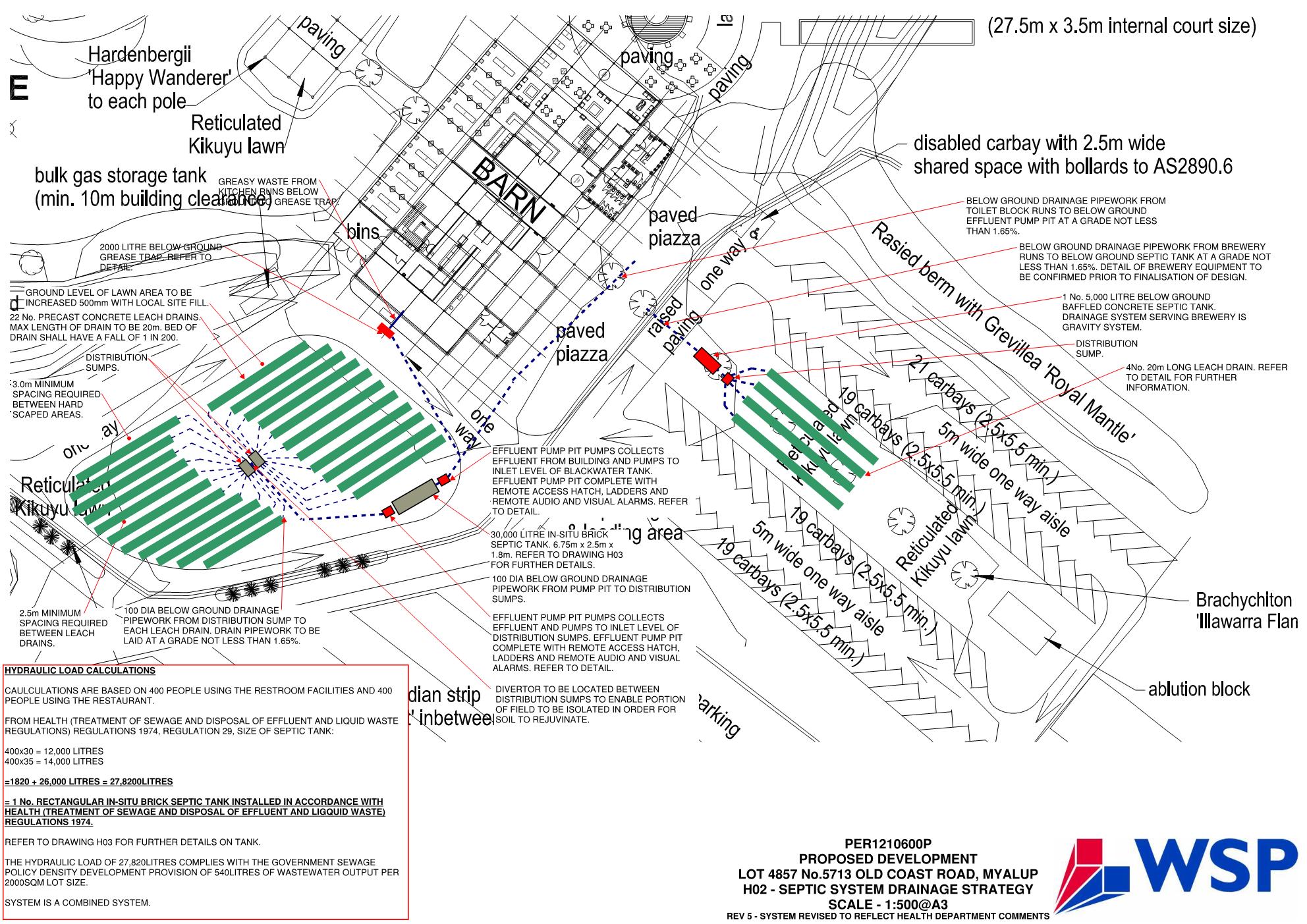
Using a septic tank and leach drains – surprisingly reed beds are not allowed in WA. My sketch for initial planning authority submission on top of architect’s outline sketch – the notes about Hardenbergii and Brachychiton are the Gardener’s.
Anyway, that’s it for now. I’m going to ask for a mechanical project next as I think I’m being used for all of the hydraulic jobs no-one else wants, but, as the wise man said, ‘society needs good plumbers as well as philosophers, otherwise neither the pipes nor the ides hold water.’ Boom Boom!
In other news, the weather has finally cooled down to something liveable for the last few days; over Christmas we had day after day of filthily hot weather. Tasha has got a new job at the Children’s Hospital (the one that the one Steve was building will replace – does that make sense?) near our house, and I’ve joined the office 5 a side team – we’re 4th in the league. I’ve also been roped into an inter consultancy triathlon. It’s pretty tame compared to the ones Chris does though: just 250,10,5.
 Holdfast Training Services Trial Blog
Hi Dan,
Enjoyed reading that! We had an issue with reed beds due to biological cross contamination (non native species) in St Helena or more simply they didn’t want anything new and were happy with sub standard instead. The final solution invoved septic tank to tiered fish ponds – very happy fish and suprisingly no odour at all but don’t drink the water and think twice about the fish and chips option at the burger van… Leachate infiltration fields is an interesting option and I’d like to see the design calcs because I’ve always come up against several different sets of design guides that you can choose to apply but which are incomplete and, in parts, contrdictory. Presumably the SI is available and gives infiltration rates for anisotropic soils?
Good luck with the footy.
Richard