Home
> Uncategorized > Peaks and Troughs
Peaks and Troughs
This week has been particularly variable in the level of activity. The project has very definitely been split into 3 separate blocks now with 3 distinct teams, I have found myself on Block B which is the largest at 17 storeys. Being the highest pretty much puts my block on the critical path, and rather critically we are running about 4 – 5 weeks behind depending on who you talk to, the high level of liquidated damages on this job £500 000 per week brings the delay into sharp focus, the week commenced with my project manager under considerable pressure, I think I was one of the few people who started this week with a guarantee of employment by Friday.
- Last Friday the sub-contractor stated that the first slab pour on my block would happen on Wed 20 Mar 13, even my inexperienced eyes knew this to be a complete work of fiction from the outset, hitting that timeline required the laying of all the drainage on the basement level, pouring of a further 4 pile caps, installation (once receipt of the finalised design and materials) of a pump chamber that will raised the foul water into the main sewer on the road outside, the steel fixing of the slab (thank God for the industrious Eastern Europeans, although not when I’m the one locking up as they always leave last) and the fixing of the internal walls and slab step up. Funnily enough the slab pour didn’t happen until today (Fri 22 Mar 13). The problems encountered along the way have been interesting, some of which I’m kicking myself as I feel I should have seen them coming.
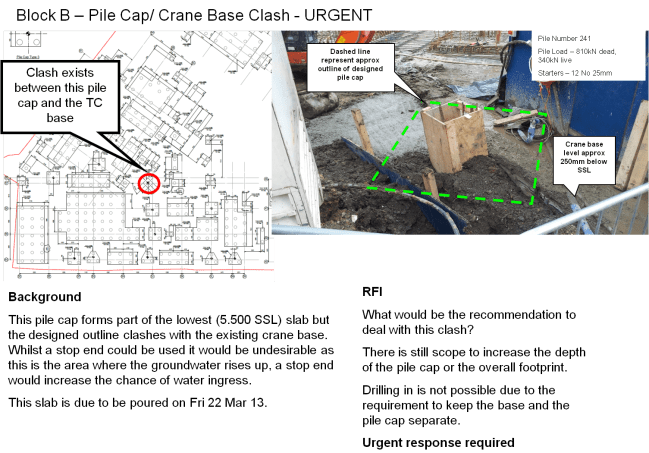
- Crane Base and Pile Cap. The crane base for my block sits just below the finished slab level of the basement, inside the basement itself but outside of the final structural walls. Somewhere along the line, either in design or tolerances during construction the base was constructed very close to one of the structural piles and overlapped quite severely with the pile cap as designed. Due to the artesian water conditions on the site we wish to minimise the number of joints in the concrete and therefore wished to include the pile cap in question. I was brought to my attention by the sub-contractor’s foreman. The design engineers have been somewhat overwhelmed with RFIs on this job and as such a response is not guaranteed in a timely fashion, I decided on a new approach. The world of construction doesn’t seem to have seen a quad slide before, it works. The response was received in good time to implement the solution although in the end time simply got the better of the pour and that particular slab pour didn’t include that pile cap.
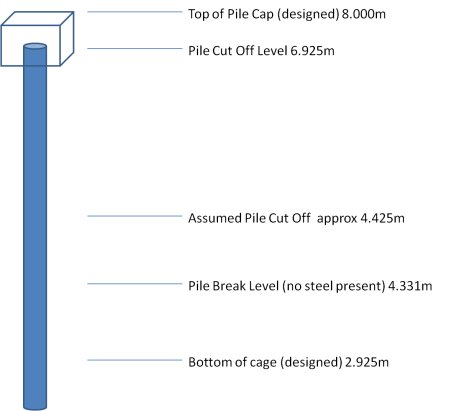
- Mistaken Pile Cut Off. Those of you that know me know that diplomacy isn’t a strength of mine and it took all my effort to remain as neutral as possible during this incident. In the rush to get the slab poured on my block, the sub-contractors normal MO of banging in RFIs constantly about the most minor of items fell by the wayside, they assumed that a pile cap drawing was wrong, not just a bit wrong but wrong by 3 metres. They believed that a pile cap with a top of concrete level of 8.000m was wrongly detailed and so have read 5.500m and commenced pile trimming, right up to the point where there was no reinforcement left in the pile and so on the final pile crunch they lifted a 1.5m lump of concrete out of the ground. The problems that this has brought to light are:
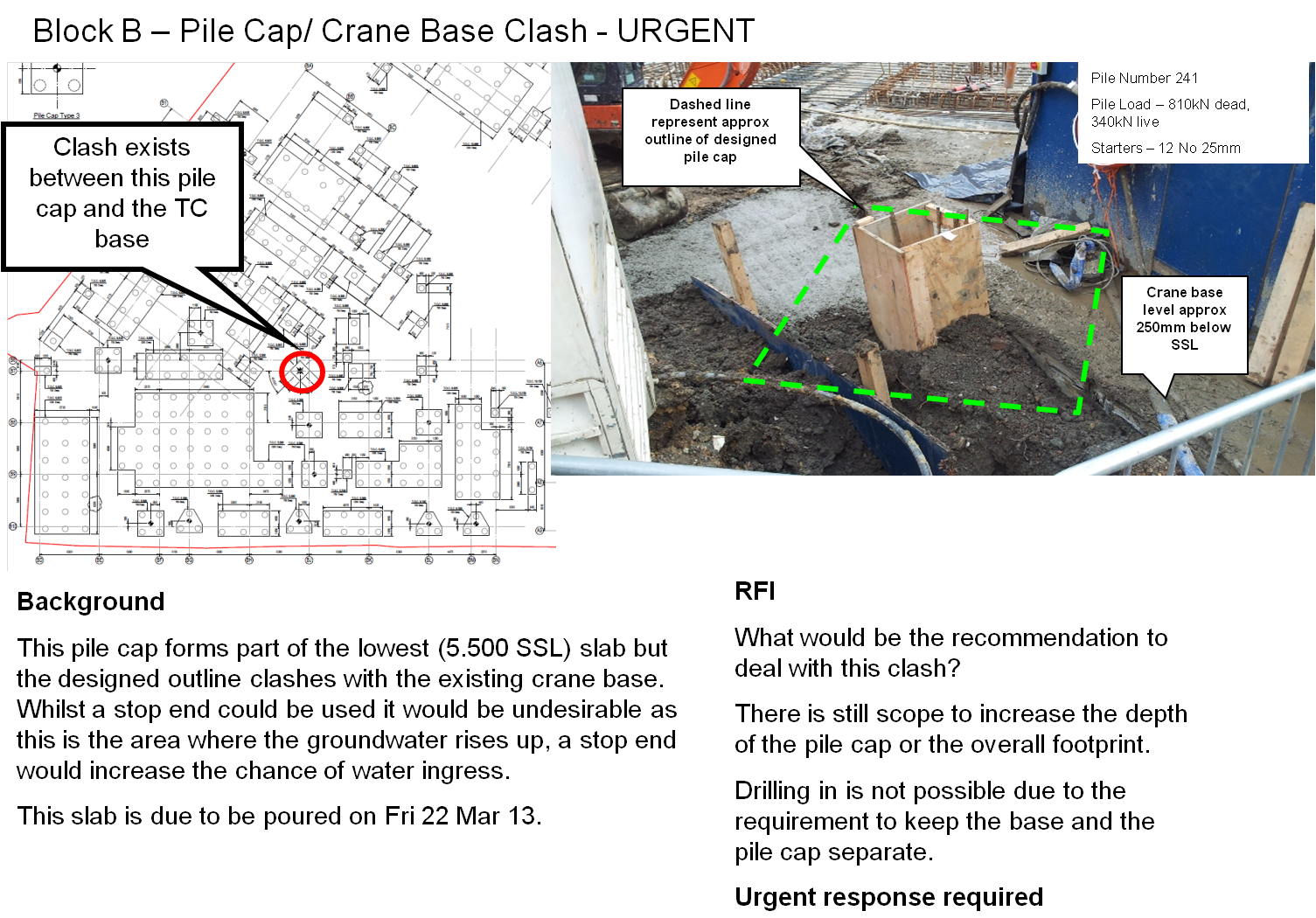
- What to do with the broken pile? How to tie any remedial work to the pile as there is no steel left in it.
- Who pays for the solution to be implemented? A couple of issues here as it seems the steel should still be present in the pile at the break off level which raise QA concerns about the piling contractor, we are now looking at the possibility of having to try to use a cover-meter on piles that are exposed to check the length of reinforcing.

- Pour Day Panic. This is the one that I absolutely know I should have picked up sooner, I had been doing the checks to ensure the drainage was in place under the slab, but I had been guilty of assuming the sub-contractors knew what they were doing and of not thinking it all through. With the concrete deliveries 45mins off I realised that the drainage that was in wasn’t as it had been previously the soil and vent pipes for the foul system and therefore a pipe that continues up throughout the floors but in fact an open top gully that needed to sit flush with the top of slab. Thinking I must be wrong I asked the question about the absence of the gully pots and saw a foreman’s face drop. So disc cutters out, panic ensures and ground workers installing gullies as the concrete is poured no more than 5 or 6 metres away. Rich earns himself a breakfast.
Categories: Uncategorized
 Holdfast Training Services Trial Blog
Well I understood some of that.
What the hell is a quad slide?
Tried to sketch the basement pile-cap conflict but I’ve just taken it that the crane base
disrupts the continuity of concrete below the standing ground water level. I know you are aware of the various forms of water bars that can be used to seal the gaps in concrete pours.
On the missing pile reinforcement cages…there are 5 reasons why there might be a cage in a pile)
1. The pile may act in tension under a particular load case ( piles beneath a shear core, for example). Or the pile might be designed to provide tension anchorage for a load test frame.
2. The pile may be expected to anchor against heave ….either elastic rebound or swelling heave
3. The pile may be designed to resist lateral /bending action – pretty rare in non-marine environments and unheard of for CFA’s ( I’d have thought)
4. The reinforcement may augment the compressive strength of the pile column ( I’ve never come across this- but it is possible)
5. The reinforcement might ‘cover’ for throat anomalies- this is never a design selection but I suspect CFA companies might bring it into play if pushed
By and large piles are simple compressive members. Especially so of CFA piles. Since you’ve the Cordek (or whatever compressible lining you are using) beneath your area there is really only reason (1) and that would be limited to lift core areas
Cages are part length often because any lateral resistance is generated in the near-surface upper part of the pile.
I’ve often found that piling companies sling in a cage….because they …well…do and if you ask what it is for you’d get some strange answers
So it might be worth establishing what the cages are designed to achieve
That said NDT testing should be able to detect the end of the cages. There are two methods and you’d not be a able to tell the difference as they both look like a bloke with a small rubber hammer. One is Sonic Echo and the other is Impulse Response. I’ve never used them to concentrate on the steel but it should be possible.
On the pour circus. I was wondering how a pour is q.a’d? When the cleanliness, cages and covers are checked I assume openings and service entries are also signed off?