Archive
Big buildings, banks and basements
Project Armada
I have been assigned to The London Development which is the design and construction of a nine storey, one million square foot Goldman Sachs headquarters building. The project is at stage C-D and I have been tasked with the basement, retaining walls and raft foundation aspects.

Architects image: the maximum height of the building is limited by the Greenwich Park to St. Paul’s viewing corridor, creating a demand to maximise the floor area .
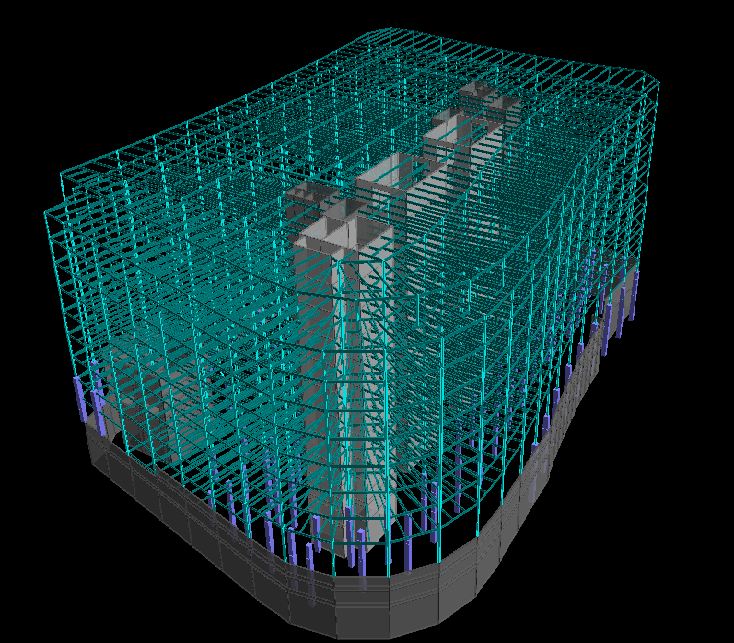
The initial superstructure model with 9th iteration of core walls layout and 4th iteration of column grid layout!
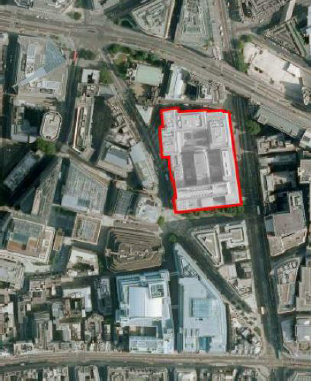
Site on Fleet Street in the City of London currently occupied by 2 buildings.
In addition to the above ground site constraints, The London Development is underlain (aside from the old Fleet River) by several below ground tunnels, chambers and utilities. Of which three substations and a access lift shaft have to be maintained within the basement, making the construction sequencing a critical component to the design.
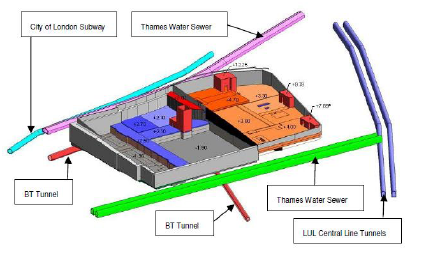
Design Lessons Learnt
Having completed 6 days of Structures Graduate Proficiency training over the last couple of months, it is clearly apparent that aside from the core syllabus of revising first principles and Eurocodes, the priority is to teach graduates how to design to save money and make money! i.e. how to incorporate economy into design and how to get the right answers (to an appropriate level) in as little time as possible! Given the size of buildings WSP Structures department generally deal with, this skill is key to maintaing a profit margin – time is most definitely money all the way to the 70th floor! Perfecting the art (certainly during the initial design phases) as far as I have ascertained, seems to be rules of thumb first followed by optimisation through software. The first comes naturally to those with experience, or eventually with a bit of guidance for graduates or newbees! A few new designers lessons learnt so far:
1. Apply rules of thumb (i.e. quick designers assessments of member sizes and configurations) to the problem first, just to get an idea of what the loads and forces are likely to be so that you know if your answers are at least in the right ball park. These are contained within most guides but do not require trawling through the Eurocodes and should only take less than an hour to produce.
2. Understand the geometry of the problem fully before embarking on any design. I have found drawing lots of sketches and asking colleagues if that is what is required saves a lot of time in the long run. This will firstly ensure your part of the design fits within the overall structure (and you are using the same parameters) but also basic components like the slab is spanning in the right direction for example!
3. Consider construction aspects in the design Intrinsically tied to the cost of materials is the cost of construction. Whilst the consultant does not price the construction, the client will soon establish how economical the design is when the contractors submit their tenders. In my case, I had to give the Client a ribbed slab vs composite slab solution for a bespoke 100 person conference room. Whilst the ribbed slab came out considerably deeper, the additional cost of bringing steel into the construction sequence to maximise clear floor to ceiling height will have to be weighed up by the Client. Another aspect which I hadn’t initially considered was additional opportunities for temporary works savings, for example ensuring the beam is the same height as the ribbed slab, thus increasing the width with a set depth of the beam to reach the required capacity. Where the designer employs these techniques however, it is often then necessary to explain the reasoning to the QS who may only be looking at the cost of materials!
4. Initial design = initial design After spending hours producing reams of detailed designs, the client would then want a column grid change or an adjustment to the proposed floor plan! Whilst this should theoretically stop after the agreed “design freeze” date, either the date continues to slip or it will happen anyway and a concurrent commercial debate about whether it is design development or a change in specification will ensue! The answer at engineer level is to minimise detailed calculations at this stage and maximise use of spreadsheets or software where parameters can be easily changed. This also ensures that unnecessary time is not logged to the project which will be required during the detailed design stage.
Site Visit
I visited the One Blackfriars site, a 170m residential and commercial tower with the geotechnical and structural engineer responsible for the groundworks phase of the construction. Much like the Shard, construction will be simultaneous top down, bottom up construction, hence the requirement to install a series of plunge columns and cast the ground slab prior to further excavation.

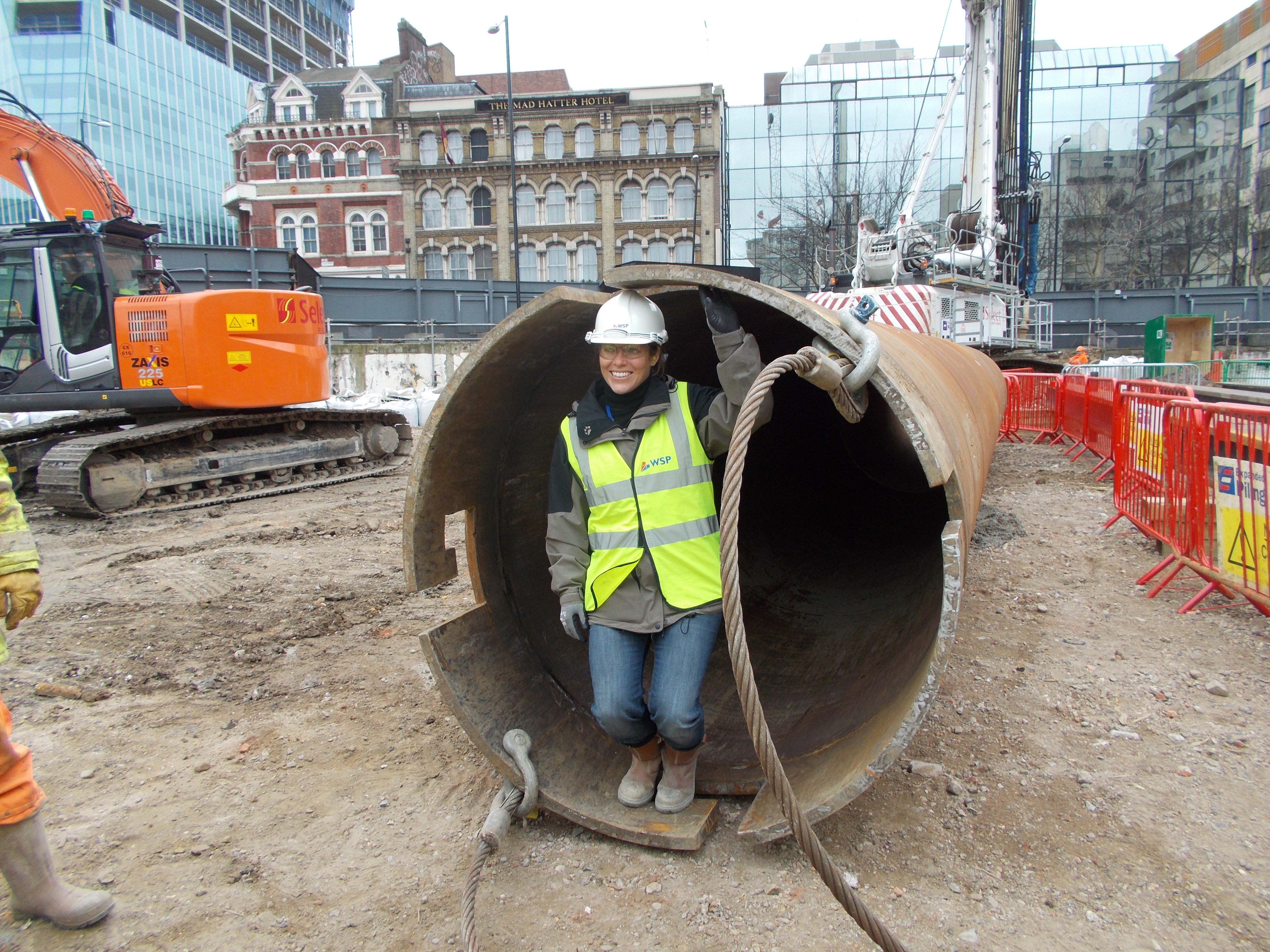
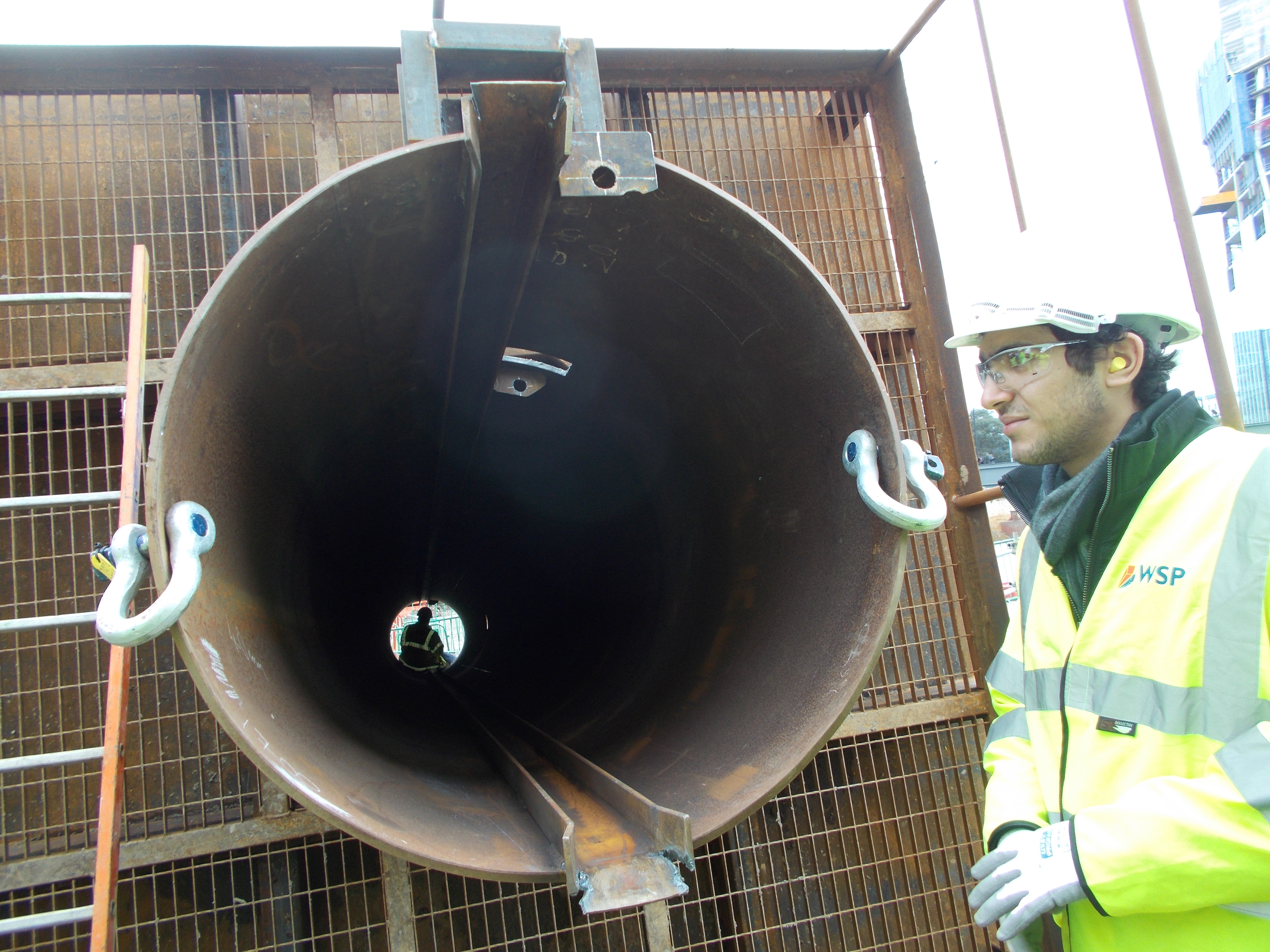
A plunge column casing (of which I was asked to demonstrate how tall is was…almost 6ft…?!)
The contractors were in the process of installing the plunge columns using a best practice technique developed by piling contractors. A bespoke casing was fabricated with guide rails which allowed the column (also fitted with guide posts which can be fabricated to the required length) to be fed into the casing, levelled and hung from a steel beam until the concrete has reached the minimum strength requirement. The size of the columns is dictated by the loads as well as the levels of tolerance required.
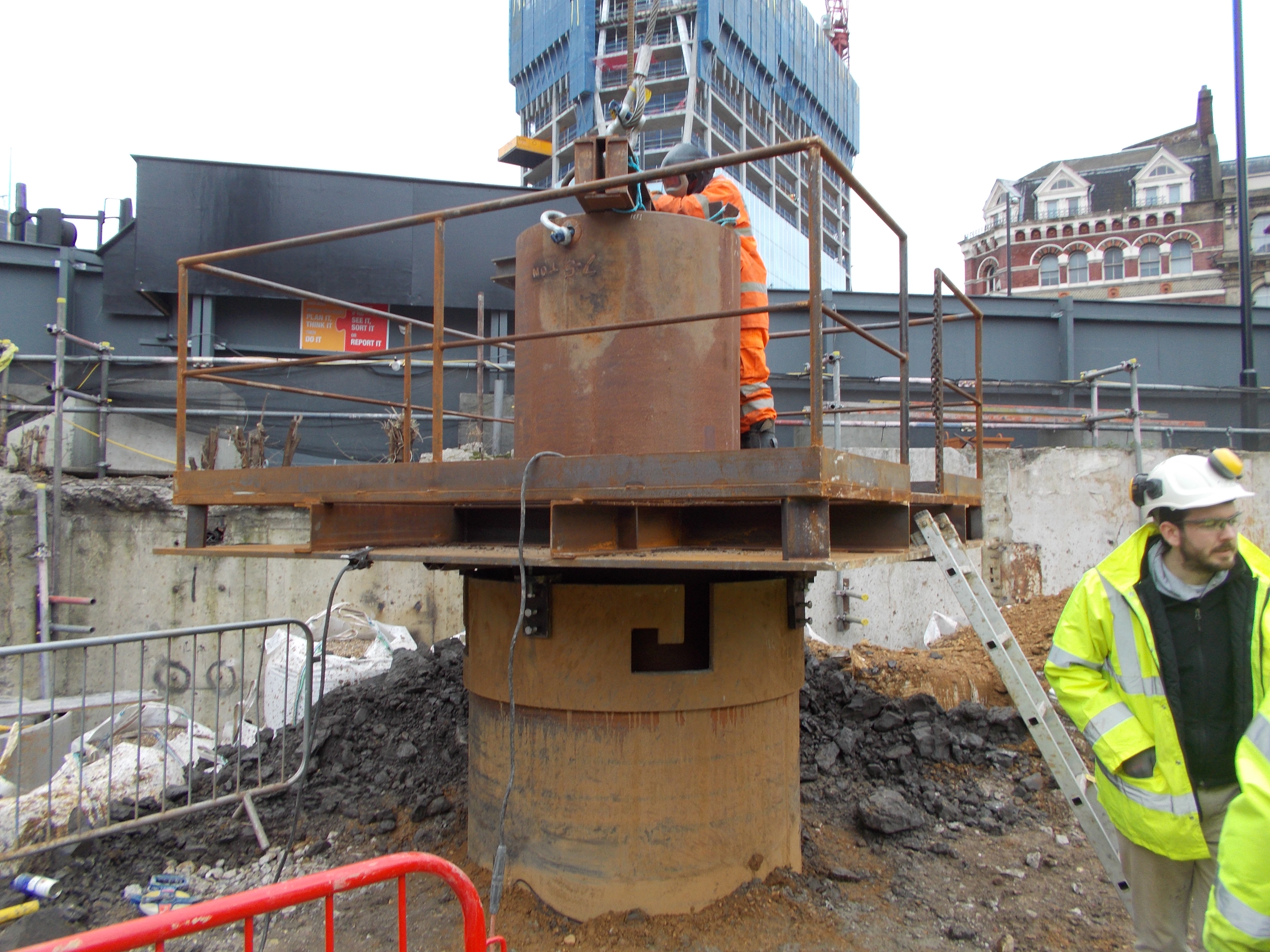
The plunge column installed in the concrete filled pile, hung from the beam shown and welded for security until concrete reaches required strength.
Another best practice technique used on the site was bags of shingle as temporary propping following excavation adjacent to the road, saving on bespoke temporary works and utilising the shingle in the final layer of the plunge column piles. Very Royal Engineers I thought!
Phase Three coming right up…
Phase Three coming right up?
After months of wrangling about me getting some real technical experience (A and B competencies – aka design office experience) to complement the wealth of project management, team leading and communication skills (C, D and E competencies) I’ve amassed over the last 11 months, I’ve finally got somewhere – but a little further afield than working upstairs for WG PSN who are our main contractor for our technical engineering…
The reason? Well, it seems that although WG PSN’s mechanical engineers are incredibly busy, they don’t really have the work here [in Aberdeen] that their Engineering Manager, Ian Maycock (FIMechE) thinks is suitable for me to develop the competencies that I require to be able to sit and pass chartered review six months from now. And my management (the Team Lead, Peter Neilson and our Engineering Guru, Martin Fragell, also a FIMechE) agree.
But what they (BP and WG PSN) do require, is someone to go and work alongside one of our suppliers, Flowserve, who are currently falling behind on a rather large and quite expensive, produced water re-injection (PWRI) pump. It’s not completely clear what my ROE are just yet, but it seems like I am to go and work with them at the factory/design office in Breda for a few days a week, analyse the problems, and then come back to communicate these problems with the BP management and WG PSN engineering team in Aberdeen, with a view to being able to resolve the problems quickly and effectively back in Holland the week after. I’m told that it is excellent engineering, very mechanical and really technically detailed and complicated, so it does tick the A and B boxes – mostly because I will have to get well and truly immersed in it to understand, and develop, the damn thing! From what I understand, this is one of ETAP’s big process concerns right now (and notably, will be one of the biggest pumps in the North Sea upon completion), and there is plenty of engineering to see me through til Phase Four.
Good thing or bad thing?
Well, if I’m honest, Liz and I do quite enjoy living together, so starting the weekly commute in March rather than August is going to be a bit of a blow, but the hard facts are that working on my jobs hasn’t (in my eyes) given me enough technical clout to sit chartered review right now, nor by July. Could I have done things differently? Well, I’ve worked well (by all accounts) on the jobs I’ve been given, it’s just that BP don’t do the detailed engineering themselves, we just assimilate the information from our teams.
The technical piece is something I’ve been pushing since November, and pushing strongly since January, but with changes of management it has fallen by the wayside and I’ve let it go on, so maybe it’s just me to blame (sob, sob). The weekly commute will be a pain in the arse, as will living out of a hotel week-on-week, but hey I’m not here for an easy ride, I’m here to become a chartered engineer! Hua!
Anyway… other jobs as follows:
ETAP ALQ: Getting handed over to Cat B projects this month, or possibly next, on completion of a structural engineering review by AIG
Bunkering Lines, Cold Boot and Post-TAR decommissioning: Getting handed over this week
Decommissioning, DBBs/SIRPS compliancy and Glycol Balance Line – I’m keeping these as I just can’t let go! This way, I will see them from Appraise through to Offshore Execute. (Well, not decom as I inherited that, but it’s been my most hassle-free project, so I’ll keep the coals burning til offshore execute and “tick off” three TAR jobs).
And in other news:
Liz and I went out with REMEC last week to their Winter Meet based near Fort William. As well as outstanding conditions, it was also good to meet up with Lachlan Robertson and Paul Golding, who are both due to assume STRE command this summer. With the meet being an informal part of the Himalayan expedition selection (Sept – Oct 13) it was good to chat to them about my odds of being able to get away from work to be a part of the expedition; clearly, a lot depends on being in the ‘right’ STRE – and not theirs, as they want to be going away too! Fingers crossed…
Oh, and Dougal the “wonder pup” has passed 30kgs. He’s going to be a machine…

Liz climbing onto the Sgurr a Mhaim as part of the Ring of Steall (eagle eyed viewers will noe the angle of the sky…)
 Holdfast Training Services Trial Blog