I got piles!
This blog covers the last two weeks as it has felt like a continuous week with one aim to get 10 piles completed for the foundations to Dickson Rd overbridge. There was Fri and Mon off of course for easter and all ‘non salary’ personnel had last Thu off as well so that was a non productive day.
MGI piling were the sub-contractors who we brought in to carry out the piling and the main realisation of the last two weeks is related to the AMS and site control. MGI piling arrived the Tue before Easter and the AMS was briefed to everyone so that they can ‘sign on’ to the method, then a services brief was carried out and the permit to excavate signed (this permit is about 50 pages long with 98% of the content irrelevent to my actual site and has remained on the back seat of the Ute ever since!). It seems an AMS is similar to an “Admin Instruction’ in the Army where the Engineer/Officer spends a great deal of his time to produce a document that very little people read unless I suspect an accident/incident happened where it would be scrutinised with a fine tooth comb. Even though everyone on site had signed on to the AMS to say they agree with it etc, a sub-contractor will invariable do what he has always done regardless! I have no big specific gripe on this issue it has just been an observation throughout the piling works.
As we had ordered oversized cages in the event we had to drill further than expected the Geotech Engr and subby concluded we would just drill further anyway to the depth of the cages so that we would not have to cut and weld on site – we had already got the welder on site ready to go before this was decided to the slight annoyance of the superintenedent who had to re-employ the welder that day and is another case of the sub-contractor deciding something without consulting either the suprervisor or myself, having already agreed to the methodology. A possible concern with this was if the sub-contractor would charge us more for drilling further and pouring more concrete but the time saved would be of more benefit in the longer term.
Each pile was drilled through the road surface and was fairly straight forward, I remained on site for the majority of the works in order to check off the Inspection and Testing Plan (ITP) checklist as the works progressed for QA purposes and to control the concrete coming on to site. We encountered water at about 9m of a 9.5m depth drill and in some it was only about 50mm at the bottom once the bucket had cleaned the toe out so on most occassions I eneded up calling the concrete forward so we could pour the pile before an excessive amount of water could trickle in through the shale below.
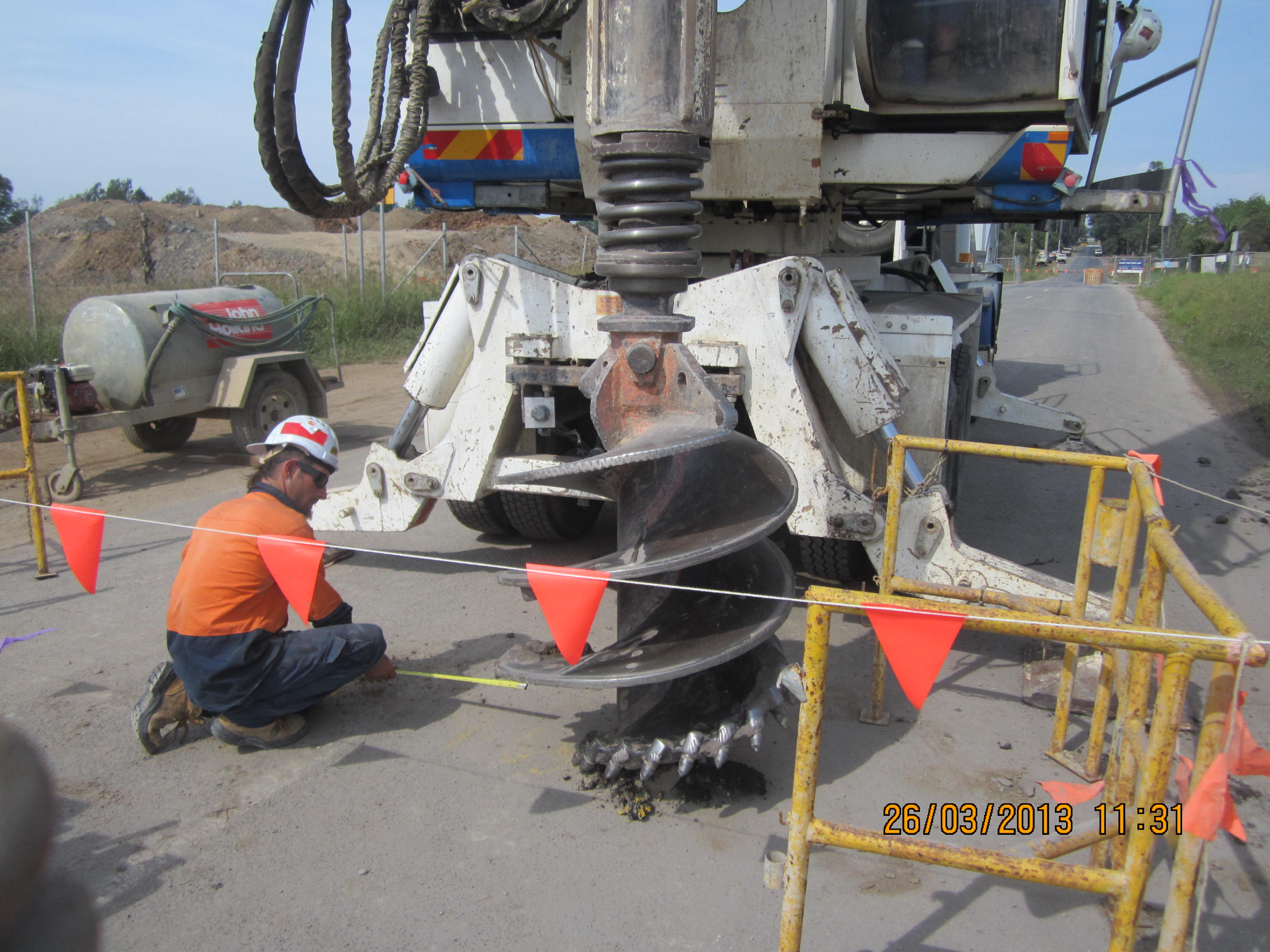
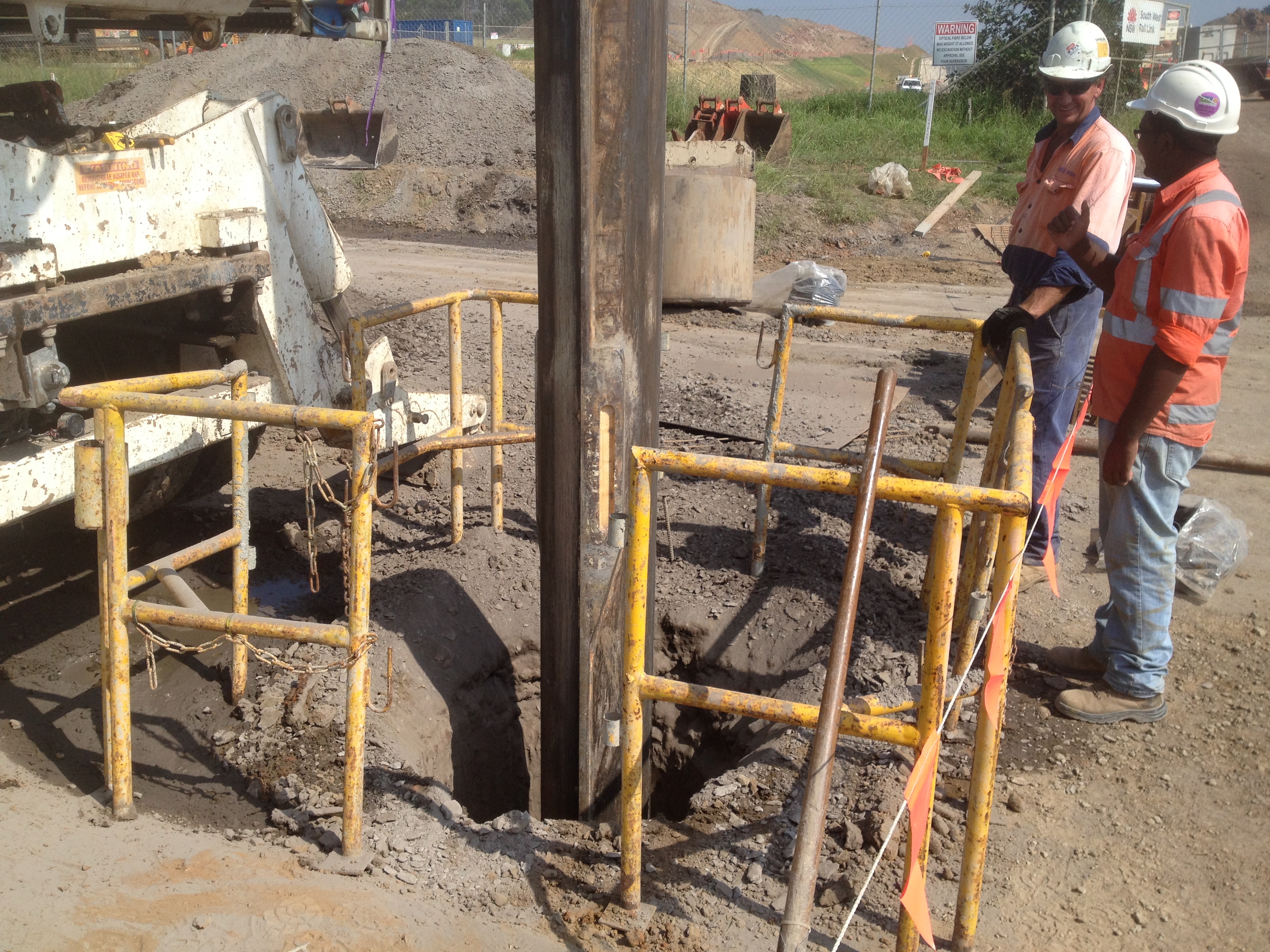
The sub-contractor arrived on site with a different rig (T-108 rather than a Mait 130 if your interested) than what we were expecting which meant the whole works took an extra day than we thought. As the reo cages did not need cutting we did save time here and each cage weighing 1.7T were positioned to the rear of the rig with a Franna crane and easily lifted by the rigs winch and lowered into the pile hole. Concrete placement was done by a ‘lay flat’ hose as opposed to a tremie pipe due the lack of water although on one or two in my very inexpert opinion it probably should have been tremied. They would check the water level in each hole before we poured and inform either myself or the supervisor depending who was there and we would be happy to expect about 100mm (65 litres of water) with the lay flat. On one pile post pour I observed water about 100mm below the top of the reo and considering there was a 1000mm projection and 400mm overpour this meant we had a least 400mm (320litres) of water in there. Water being lighter than concrete means it probably isn’t an issue providing the ‘lay flat’ worked like a tremie as they assumed.
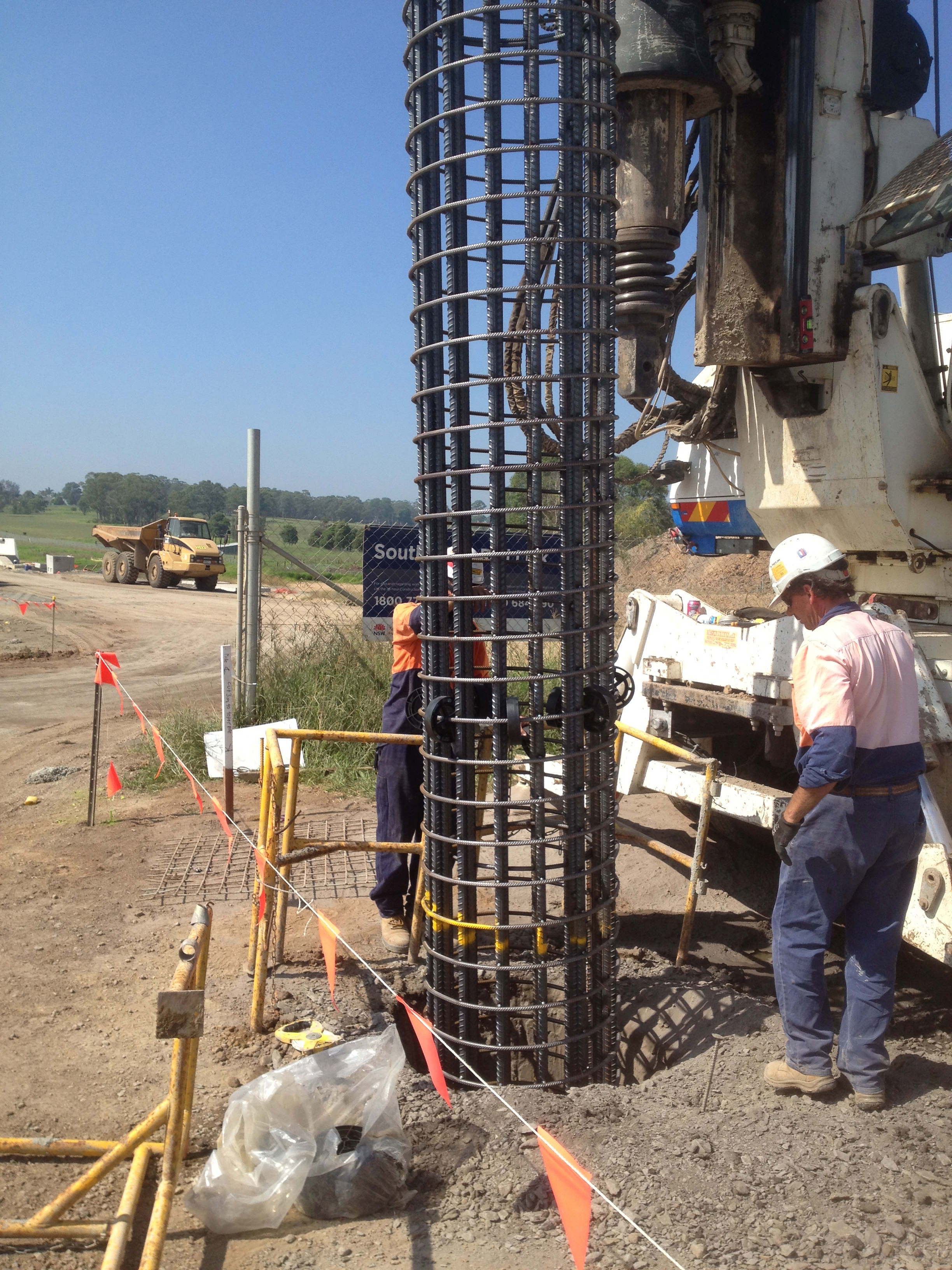
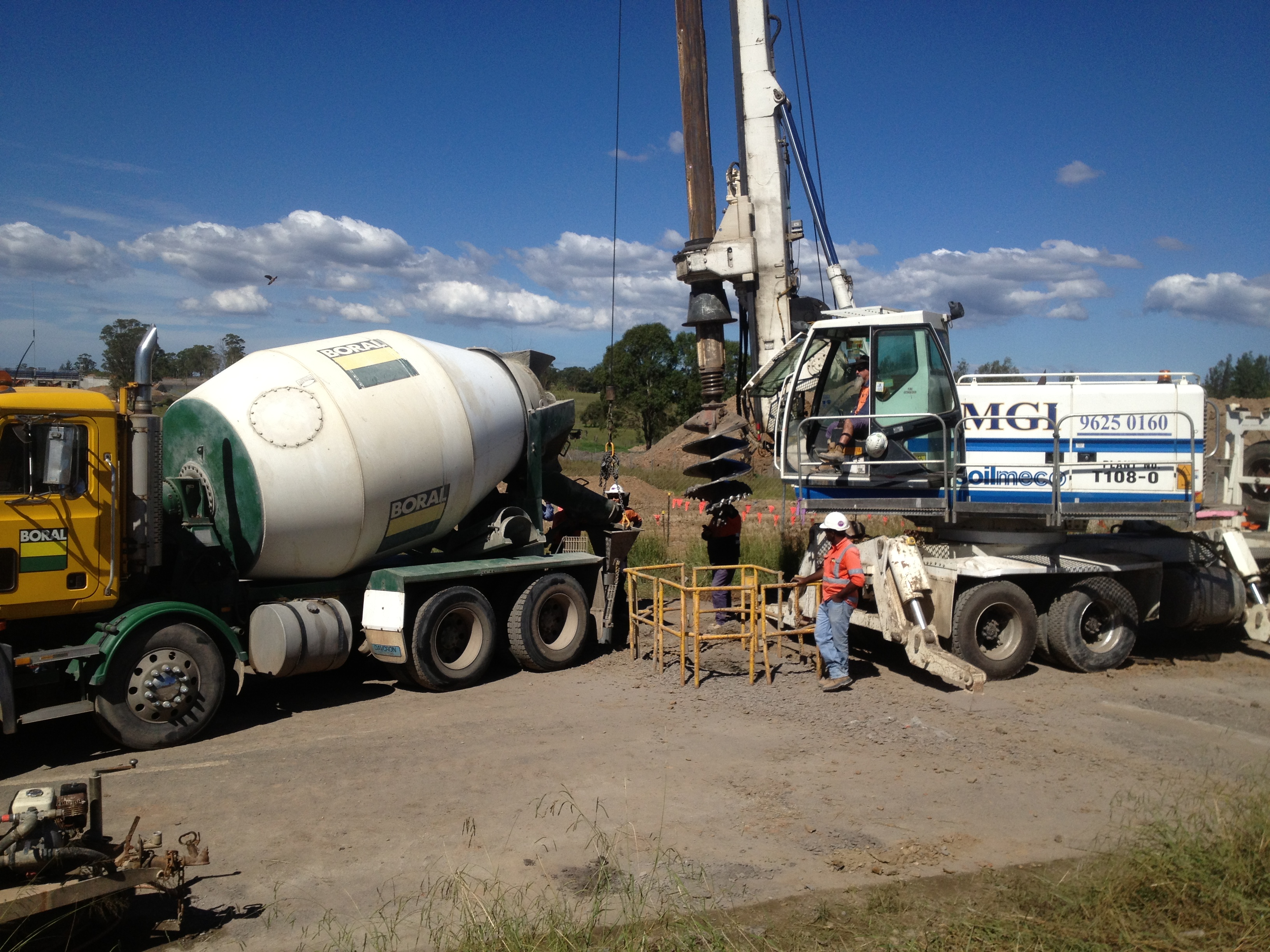
I learnt a great deal about the practical issue of placing concrete this past couple of weeks. I had calculated 4.7m3 per pile and thinking that this figure was not allowing for the displacement of reo an order of 9.4m3 for the first two which we poured together would be alright – it was just! There was nothing left on the last truck and we just managed to fill both piles but I didn’t want it to be that close again so ordered 5 per pile/truck for the rest. I also learnt that you can never underestimate the stupidity of a concrete truck driver. One decided to drive past the site twice after us flagging him down but he still decided to go on a personal tour of the entire alignment before realising he had legs and could get out of his cab and ask someone where he should be! This meant the concrete was an hour old before it arrived and we had 30 mins to place it which wouldn’t have be an issue if it hadn’t failed its slump test twice (tremie mix 180mm slump). We ended up ready to pour just before the 90 min mark having added the maximum amount of water we could so not to affect the w/c ratio, it was 1645 in the afternoon and the Project Verifier had just arrived to witness the pour. In the end I decided that we had been fairly quick in placing the concrete with the other piles and we wouldn’t get another truck until tomorrow so I decided to go ahead thinking if we start to pour on 90 mins it will be alright. It went alright up until the last 0.5m where the concrete was fairly unworkable and kept clogging the hopper. With hindsight I wish I had just turned that truck away and even if we poured the next day we still would have completed all works on the same day. A Non-Conformance Report (NCR) may have to be raised although the PV has not mentioned anything about it and I have got his signature on the ITP checklist already. As we are overpouring by 400mm this will help and I think the top will be where the problems may lie but we can visually check the top of the pile once we excavate and trim. Although the tremie mix is self compacting we could have also tried comapcting the top 1m or so, another lesson learnt.
 Corporate pose – inclonometer readings.
Another annoyance was the back-filling of the holes as we had at least a 1.5m drop to the top of the cages from ground level we were to backfill the holes after 24hrs for safety reasons but the sub-contractor was quite keen to do this after about 3 hrs which included covering the inclonometer tubes. Fortunately I had made sure they were capped but having to dig them out again to take readings was a little irritating. I have taken readings on abutment B (24-72 hrs after pouring follwed by a second 24-72 hrs after the first) but have been unable to take the second reading at abutment A as the civil team have arrived and on Fri morning I went on site to see abutment A piles with a little earth covering them!
 The 5 piles of Abutment A are under there somwhere.
Some interesting local Sydney news for you over the Easter weekend: “Police were called to a domestic disturbance of a retired couple over the weekend. A 64 year old male has been discharged from hospital after having superglue poured into his ears and eyes. A 62 year old female is also accused of beating him with her prosthetic leg!”
 Holdfast Training Services Trial Blog
I take it that the leg was arrested and it now exhibit A?
Now about your piles….
I can’t see and guide tube in attached to the reinforcement cage i the piccie….?
How are the inclinometer readings to be used….is there some sort of observational method employed in your contract?
John, this is terrible England “I can’t see and guide tube in attached to the reinforcement cage i the piccie….?”. No guide tubes used, do you mean at the mouth of the hole so debris doesn’t fall in? The ground was very compacted and we didn’t have any issues especially as we poured each pile more or less immediately after completing the hole and once the Geotech had verified the toe depth.
The inclonometer is starting to take up most of my time this week! Having done the initial readings on both middle piles I was able to do the second on one but not the other due to the civil team pushing large piles of dirt everywhere. The tolerance of subsequent readings must be within 1% of the base reading and I am required to take readings every time we make a structural change (pile cap and abutment wall). The civil team decided to excavate through the brighht yellow tubing yesterday and then it rained heavily so I now have an inclonometer case with 3m of water in it and quite a few lumps of clay! To end this day the handheld PDA has decided to die so I have got to send this off down to Melbourne for repair. It is now 6 days since the frst and the second reading should have been done within 24-72 hrs of the first.
Hi Jon,
Good stuff. No spacers on the cages? I’ll tell my mother to behave next time she visits.
Regards,
Richard
Spacers galore, providing 70mm cover. Used about a bag (50) per cage! Had to tell them to calm down abit as we had only planned for 3-4 every 2m.
I heard that story on the radio at 0600 while driving to work after easter, it sounded painful yet hilarious at the same time!
Every time one of you mentions piles it makes me snigger. Must be Mondays.
That doesn’t surprise me, your placement involves building toy cars does it not!
Not quite mate, we are in the business of pulling go juice out of the ground! 😉
Inspiring future engineers is just a hobby!
Ooops yes I had lapsed into an unknown vernacular
What I meant was…… are the inclinometer guide tubes attached to the reinforcement cages ?(couldn’t see anything in the picture AND what are you actually monitoring and how is the monitoring being used?
John, yes the casing was attached to the inside of the reinforcement cages with wire. We are monitoring the vertical alignment of the casing (pile) by taking two base readings to determine the crookedness of the casing at the start. A second reading was taken within 3 days (2 weeks late on one of the pile as the inclonometer PDA went tits up and I had to send it down to Melbourne). Any subsequent readings must be within 1% of the base reading and the results must be presented to the client. If they are not then the piles may be moving and we have issues. As it has taken alot of my time and I am interested in looking into the inclonometer testing further I want to make this the topic of TMR1.
So its sounds like the issue is the verticality of the abutment support piles? Strange if it is. Are there particularly tight execution specifications on the contractor?
Yes the use of inclinometers for this control and what you’d do if they go out of trigger level values might be interesting…if you Google Moran and Laimbeer you wil find that I once bungled my way thorugh an investiagation with my PhD student in this subject area