Archive
Organisations need a direction….if only someone could tell us which one!
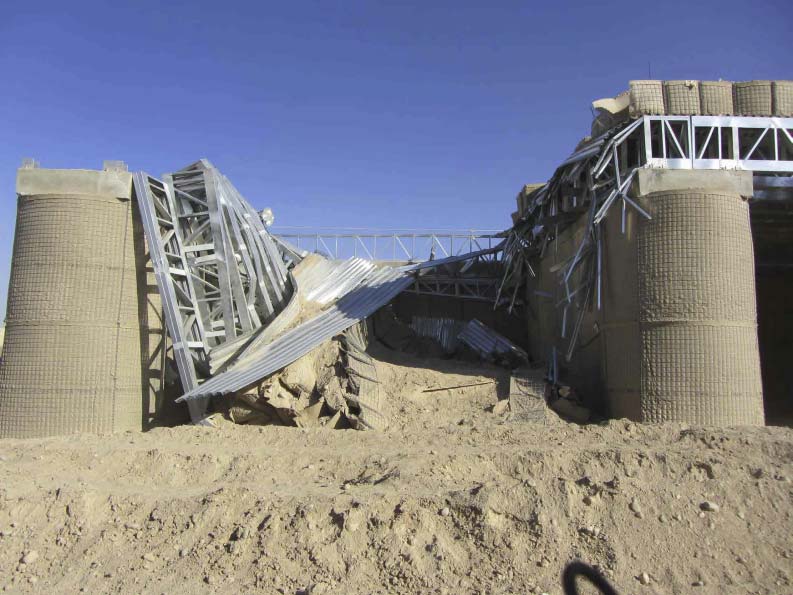
Afghanistan Bunker Collapse:
After some additional feedback from Richard Farmer I re-visited this report (as it had kind of become my favourite drum to bang on). Just to add some more murk to the mire I went through some of the background information such as the early statement of works and it would appear that the mad design was almost dictated to the contractor by the USACE. It detailed that the walls would be of HESCO and would support the roof structure. There is sufficient verbiage in there to be sure that the contractor shoulders all risk but now I am of the mind set that the contractor was pretty much set up for a fall. I have had further battles with the USACE Engineering and Research Development Center (ERDC) to get them to carry the torch on this and sort it out. BLUF = Put actual numbers in the design guides for what loads the concertainers can safely carry (bearing in mind poor local construction methods and materials) and we’ll have more peace of mind.
I finally got authority to release sanitised photographs to HESCO (Jake McQueen) so that they can use them to educate the RE, the USACE and the industry in general. Subsequent contact with Jake has highlighted that he has been invited to go and visit ERDC with relation to loading tests on bunkers…so even though they haven’t admitted it (to us) it seems the ERDC are actually taking my comments on board.
Poplar Island:
Here’s the pop-quiz: water flow over a crest, into free fall, to then land in a crash zone before flowing into a pipe which has an existing (variable) tidal level which then has to normalise under gravity….. Having tried to develop a model for what appears to be the most complicated fluid dynamics question I could have possible attempted – I gave up in favour of identifying common features for identifying and comparing various designs that will allow me to decant the top layer of a dredge material through a level culvert and into the sea. At least it gives me comparables to make decisions. If anyone is feeling clever – please feel free to give me a hand!
I suppose the question would be something like “A lake is 1000m by 1000m and 4m deep (assume a datum of 0). A 2m wide weir is used to allow water to flow into a 2m by 2m square chamber. At the bottom of the chamber is a 2m by 2m square culvert with a zero incline. The culvert opens out into the sea which is currently filling the culvert to a depth of 1m. What is the maximum allowable release depth of the weir that will maintain efficient flow through the system?”…….well I’m buggered if I can figure it out…..and the hydrologists here at work make excuses or fake heart attacks when I present it to them. I think I’ll stick to my stick and string engineering for now!
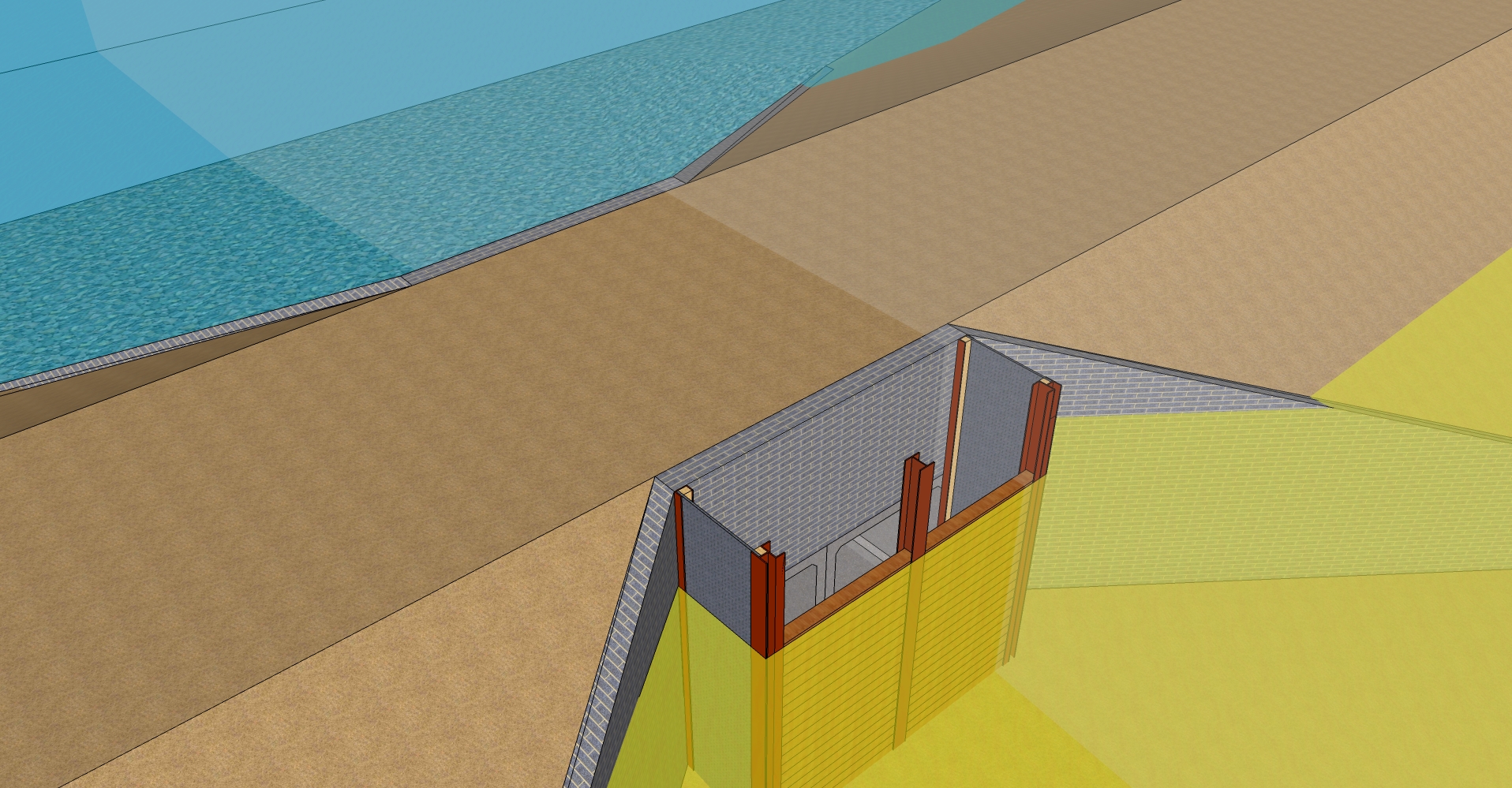
Model showing high chamber to release dredge material into concrete culverts and out to sea.
I am now confident that the entire operation at Poplar Island has never had any kind of plan for emergency discharges into the bay (for if the main dikes were in danger of being compromised – we need to be able to balance any head differences as quickly as possible). Having applied some thought process to this I now see that traditional methods of using stop-logs to create the weir crests would actually be too dangerous to operate in such a manner. The more logs you remove, the quicker the velocity of the water (and the deeper the water) gets, making it extremely difficult and dangerous. So the answer to the emergency discharge question is ubiquitously ‘it’s never happened….yet’. If the need ever arises – they are currently screwed. I’m looking at some ways around this – none of which have ever been tried before by anyone in USACE at least. One idea was for a large scale mechanical roller-shutter device. Whilst the idea is probably a non-starter for a silty environment, it may have a wider application on flood defences where space and access issues are a concern. I discussed the idea with a roller shutter manufacturer – warning them that if they stole my idea I’d hate to have to hunt them down and kill them! Another idea which I am trying to develop uses an array of flexible tubes that will increase the flow into the structure…but more to follow once I get my own head around it first.
Building 45:
One Colonel promises another Colonel he can get his staff a lovely new home because they are being cruelly kicked out of their current offices. His staff prepare a request for some dollars from congress to re-fit building 45 for the purpose. They balls up the estimates but it gets approved. All wheels are now in motion but now it’s kind of clear that they will not be able to get what they promised congress they would be able to for that money. A bunch of the funding has already been spent on looking at options and now it falls to USACE to try and fix the issue. Make savings of about $2M by ‘getting creative’ so that the project manager that screwed it up doesn’t get sacked and the colonel doesn’t end up breaking his promise.
My role has been to do the seismic analysis which has demonstrated that the building does not currently fulfill the code requirements and I am designing a bracing system to overcome this. A number of structural defects are also present that will need to be repaired and I am drawing up some specifications to allow the work to be bid for. The drawings are proving a little challenging even though we had that really long CAD course at PEW.

Lovely water damage to floor joists. (over 3cm penetration with a trusty screwdriver)
The really interesting thing in this one for me is the way in which everyone is now in complete denial about how this is going to turn out. The Project managers are continually trying to come up with creative methods of mixing and matching different sources of funding to make up the numbers – but this is where people go to prison. “Dear Mr Congress man – I asked for a bunch of cash to build X but I actually borrowed from Y and Z as well and gave you less than we promised we would in the first place.”. More than a month has passed and the brass are still unable to come to terms with the fact that someone needs to put a copy of the yellow pages in their breeches and go and take the spanking. All the while we have been cutting from the electrical, mechanical, architectural and fire control systems to the point that we aren’t actually doing anything except make the building structurally sound… Others are worried we may be leaving too much money left on the table, to which the response form the Branch Chief was ‘don’t worry – it will be a sole source bid so they’ll spend as much as we tell them to”!!!! WTF!!! Reminding people that this is tax payers money seem to be un-cool apparently. The final straw for me was when I asked sufficient questions to basically get them to admit that while ever the Client (Army Support Group) can’t make up their minds, we are happily employing people and spending ASG money because there is little work elsewhere for the architects…..again – we are wasting tax payers money for no other reason than we can’t generate work from other sources. We now have internal Government organisations screwing each other over so they can get the money….which all comes from the same pot…..shoot me now.
I keep offering to go and be the bearer of bad news and even help the Client look at other options (like how the re-shuffle could be accommodated by moving other personnel etc) but if I do that I will dry up their source of tax money sooner rather than later… so this is not the preferred option (even if it’s the ethical option).
Costings Briefs:
In an effort to get a better understanding of the costing problems I saw with the canopy project for Ft Meade, I liaised with the head of costing to see if he could give myself and Ben a run down of how they do detailed cost analysis. This essentially turned into a CPD session and was extremely beneficial. He showed us how the contingency that is added is reduced further into the project development to account for unknowns and level of clarity. He showed us his sources of info, from means spec to direct quotes and how his software builds up the analysis to include estimates for contractors overheads, sub-contractor overheads, contingencies and tax.
I have since seen his data spectacularly abused by the project managers on the building 45 project. “it says here base price of $1.8M which puts us on budget.”…..well if you want to go to bid with no contingency, expect no modifications or changes or unexpected surprises, for the prime to do all the work and not sub anything out AND get the best dollar on all quotes from a sole source……be my guest. The result will be no bids within your budget and a colossal waste of time effort and money.
Internal Quality Assurance:
I have finished preparing a Quality Assurance system for use within the structures section and delivered training to the group on how it is to be used, monitored and maintained. This involved getting to grips with all kinds of tasks that the section undertakes, from civil, military, domestic, overseas, bridge inspections, dam inspections and levee inspections to be able to come up with a method of making sure that a simple, effective, user friendly structure was achieved. There were several iterations with user feed-back before going firm and handing over the product which is now being used across the section.
Officer Professional Development:
All of the District Officers (14 in total) attended a mammoth OPD spanning 3 days and camping out in -6 degree weather. The development included a battlefield tour of the Gettysburg civil war site with specific reference to the principles of war (the yanks have 9 – and they aren’t really like ours), a tour of the 23 mile long recreational lake that USACE maintains at Raystown PA, a tour of the level 4 biomedical research facility that is currently under construction at Ft Detrick, a tour of the Raystown Dam facility, a tour of the Raystown hydro power station and a bunch of environmental briefs (it seems the environmentalists are hell-bent on killing stuff….perhaps it’s an american thing). The highlight was a dining in function which Ben and I coordinated with more than a hint of British tradition and an opportunity to make some presentations on behalf of PEW and MKC for the ongoing partnership between PEW and USACE. At first I was pretty pissed off when they decided to make me Mr Vice – until I found out the role is slightly different to back home. I was basically in charge of keeping the entertainment going and dishing out fines to all and sundry. It’s probably the first and last time I will ever get to give forfeits to full colonels and get away with it! The Commander here has said he would like to fly me back to do it again for next year’s OPD – and I might just try and hold him to it!
REVIT Weakness:
The penny dropped whilst working with some drawings that appeared to have varying details depending on which set you were looking at. Upon questioning this with the senior structural engineer it turns out that REVIT doesn’t deal with multiple skinned walls. As a result we appear to have a window over a column that has gone unnoticed for a while and a modification is required. I was immediately reminded of my earlier role as Project Engineer on a reservist center where exactly the same thing happened. Many RFIs were sent back to the architects and engineers at District who continued to reference the drawings that seemed to make sense (inner skin drawings) – whilst all the while on site there was quite clearly a beam showing through one of the windows (outer skin drawings). In the end it was the contractor’s fault and he made the mods himself. There were many bad words said by both parties on site about the apathy from District on that occasion – but I now see how this comes about. There is insufficient residual knowledge and training to ensure that this is resolved for future projects and I’m sure we’ll see it again.
Developing Future Engineers (and me!):
I have observed that there is a great divide between the experienced ‘old guys’ (of which there are 2) and the ‘young bloods’ in need of training (of which there are 5). The experienced guys are so overworked they have too little time to help develop the young bloods, but without the young bloods taking on more work, learning more and becoming more independent the situation will never change. Speaking with the head of department it seems they lost a load of experienced guys and not all were replaced. Those who did join the group are young graduates with little experience. I have outlined a plan with the boss (for after the thesis deadline) to start a mentoring process and to formalise the interaction between the experienced and the junior engineers. I have begun to find other engineers from outside of the group to be able to mentor the group and offer ‘lessons I wish they’d taught me before I got here’. I will report more as it takes shape.
And in other News:
It was great to welcome Nick Colvin to the fold and help him start getting his clan settled. My wife is still plotting on how she can kidnap his children. I am working on how we can harness the energy they produce as it might solve some of the worlds power issues. It has highlighted however, how little time is left before the big push and CPR.
It’s great to see all the new blogs appearing and to be kept up to date with the new round of activities – best of luck to you all.
The kids are in their last 48 hours with us before they go back to the UK and back to school. We just got back from a mini vacation with them to Canada where we visited Toronto and Niagra Falls. Lukas did some of the driving and Ulli and I did all of the panicking and screaming. (Just for Richard – road kill along the way included raccoon, deer, a bird (difficult to gauge other than a ‘big black one’) and you’ll be pleased to hear we saw our first flattened beaver in the carriageway. As spring is coming we also clocked several ‘yellow splats’ on the windscreen and some ‘red splats’ on the windscreen. I thought we’d discovered and immediately wiped out a new species of ‘purple splat’ but it turned out to be a red on yellow coincidence.)
I now realise that this blog is becoming thesis avoidance (whilst maintaining clear conscience because it’s work……honest) – so I will leave you be and get back to my scale model of ‘fluid mechanics for idiots’ using the sink bowl, a set of straws, a toilet roll tube and some sticky back plastic. Who said engineering can’t be fun?!?….although Ulli’s going to kill me when she sees the mess I’ve made.
McFry
Wanted: Dutch boy for permanent position under a ground floor slab
This week has seen a number of changes, specifically with the sub-contractor, a number of new black hats have been handed out (the mark of a supervisor on our site), civilians don’t seem to get the phrase ‘You’ve changed!’
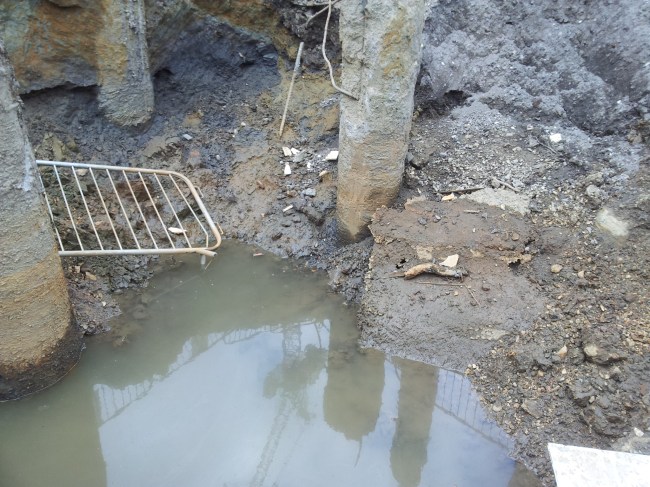
Artesian water continues to flow, sometimes I feel like we’re de-watering Southampton, without the help of a pump. The visit from our geotechnical expert was pretty unsuccessful, in truth he was an environmental expert that was going back to report on what he had seen to his geotechnical experts. The geotechnical experts have said ‘You’re F*$!ed’ clearly I’m paraphrasing, the best solution that has been suggested is to try and over bore, or encapsulate the former borehole location with a hollow casing allowing it to find a level and then backfilling with a tremie pipe using a grout, they are fairly non-committal on the possible success rates of such an undertaking and there will be a significant cost associated with getting something done and getting a specialist to deal with it. This would be all very well and good to try except for a couple of problems:
1. We don’t really have time to experiment, this is now holding up the build, I find this situation pretty frustrating because everyone seems to have ignored it for quite sometime now.
2. The attempt to cap the water with the concrete plug means that to execute this plan would require breaking out of about 6 m^3 of C50 concrete, so we’re going to get hammered for dayworks.
This leaves us with the french drain option, drawing the water off to a point where it can be collected and enter the drain system, the Environment Agency don’t seem too worried about the situation but winning over Southern Water might be a harder sell. A conversation with the Great Orator has helped, but in reality nobody can be sure of what may happen. I’ve done a bit of research and the waterproof joints that have been put in use a product that’s certified for 80m, we’re only talking 3m on my site and therefore it should shrug it off as long as the workmanship is up to scratch.
Such a seemingly simple problem has become quite a big issue, it is made so much worse considering the option to cap the piezo on the first place was offered up for a mere £600 per borehole, I would say we’ve easily spent that in fuel to run the pump. I think next week will see an attempt at the french drain option attempted, perhaps we’ll pull it off.
Who ever knew that starting the construction phase would require so much paper work.
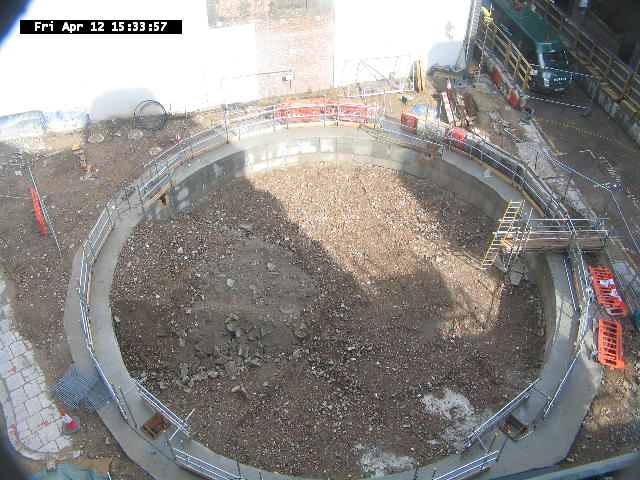
We are now only 2 weeks from starting the shaft excavation. The Section 61 noise consent form has been accepted by the council. The predicted water discharge consent form has been approved by Thames Water even the British Heritage have signed off on the refurbishments to the office building. It looks like we may even hit the Crossrail Milestone of starting the shaft excavation by the 2nd May.
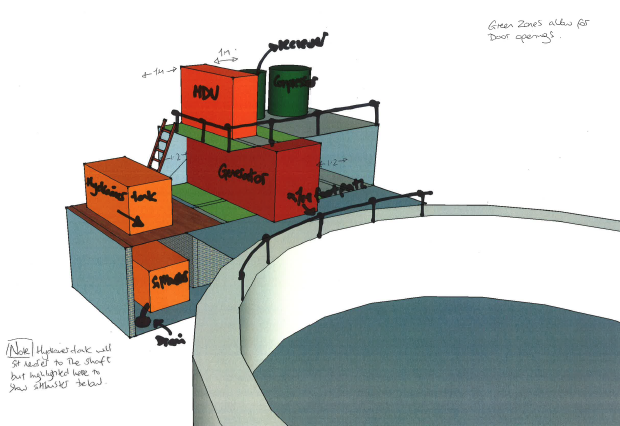
The major issue for this site has been its restricted site. The amount of equipment necessary to excavate an 8m radius shaft 80m deep has been enormous. This has led us to produce extra space in the form of 2 storey steel platforms. Rich Phillips would be proud of my Google sketchup concept sketch that I used in the Temporary Works Design Brief. See below Rich.
After being volunteered … I have now been nominated as the site Temporary Works Co-ordinator after successfully passing the Kier ran Temporary Works course 1 and 2 and a scaffolding course.
This has meant that a number of site issues have been left to me to resolve, the one causing the biggest headache is the muckbin area.
Muckbin Area
Unfortunately, no one joined the dots together and realised that for each 1m of the shaft excavated there would be approx. 370m3 of soil. Where to put it on such a restricted site?
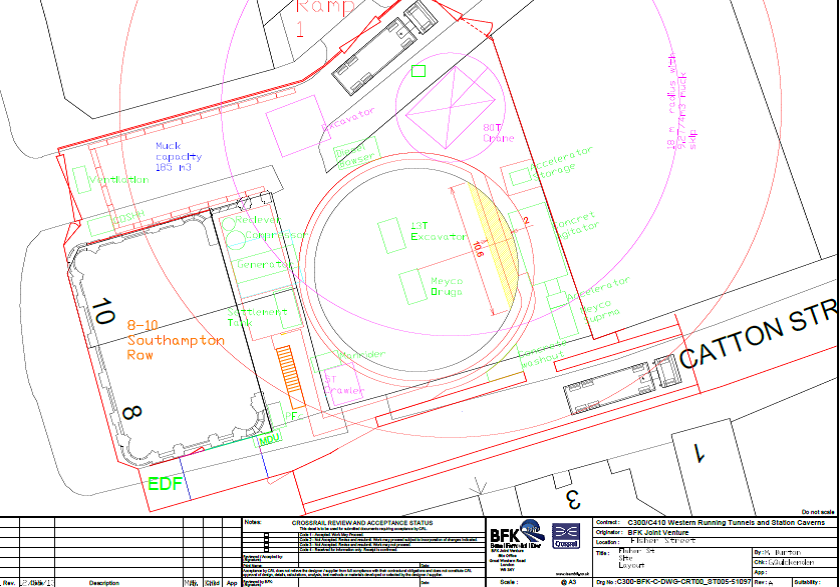
The only place to store the soil is on a road between two existing buildings. However both buildings have basements and sub-basements that would require propping due to the additional loading. Anyway a solution has been found, the sketch below illustrates the concept.
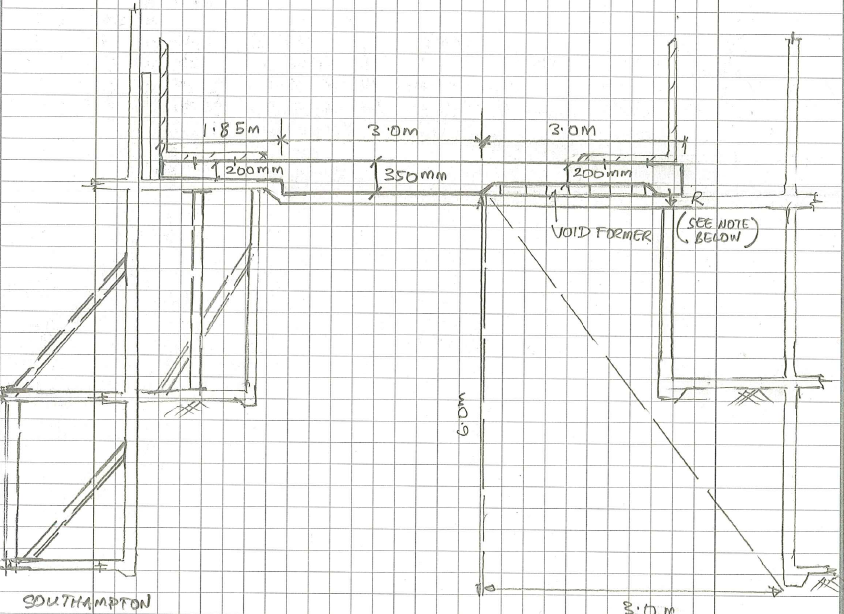
With the addition of a void former the additional load can be carried pass the adjacent buildings basement and sub-basement. The only issue now is deferential settlement on the unknown services that run below the road. However we will resolve that next week.
The Temporary Works Co-ordinator role has been quite an eye opener. In recent weeks we have had to produce briefs and partial designs for: sub-basement propping, muckbin area, 80T crane platform, 2 storey steel platform to house the generator, compressor and receiver and a single storey steel platform to house the concrete remixer and concrete pump.
The next 2 weeks are extremely important. All of the temporary works must be in place before we can start the main excavation. Hopefully between now and the 2nd May you will see some big changes to the site.
 Holdfast Training Services Trial Blog