Bull$h*t Baffles?
The latter part of last week and the former part of this week have been spent preparing for the pour of Upper Basement Zone 4, oh and dealing with the aftermath of the Zone 3 pour. We called in a professional slab scanner to assess the perceived cold joint and had the lads from Cut’n’Break take a couple of core samples along the join. This involved a nifty little radar car (not dissimilar to Imran’s efforts on his attachment) that was rolled around the surface taking scans of the slab. This was initially done to locate the core samples in the dodgy areas and do so missing the reinforcement – not entirely successful but it seems nothing ever is. The radar car then spent the following day taking cuts across the centre line at 1m intervals in order to build a picture of the state of joint. Both sets of results came back in whilst I was on course but I have yet to have a good look at them. What I do know is that of the 6 core samples at 7 days their strengths (for a 32MPA mix) range from 25 to 10 – so I would hazard that it doesn’t look good for zone 3. The next stage is working out exactly what to do. The initial suggestion is to chip out the joint and either side of it and re-pour but the ultimate decision rests with the structural consultant.

The GPR scanner car
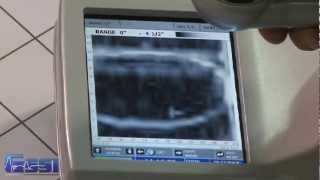
Example of GPR output (low point of curve = reo location)
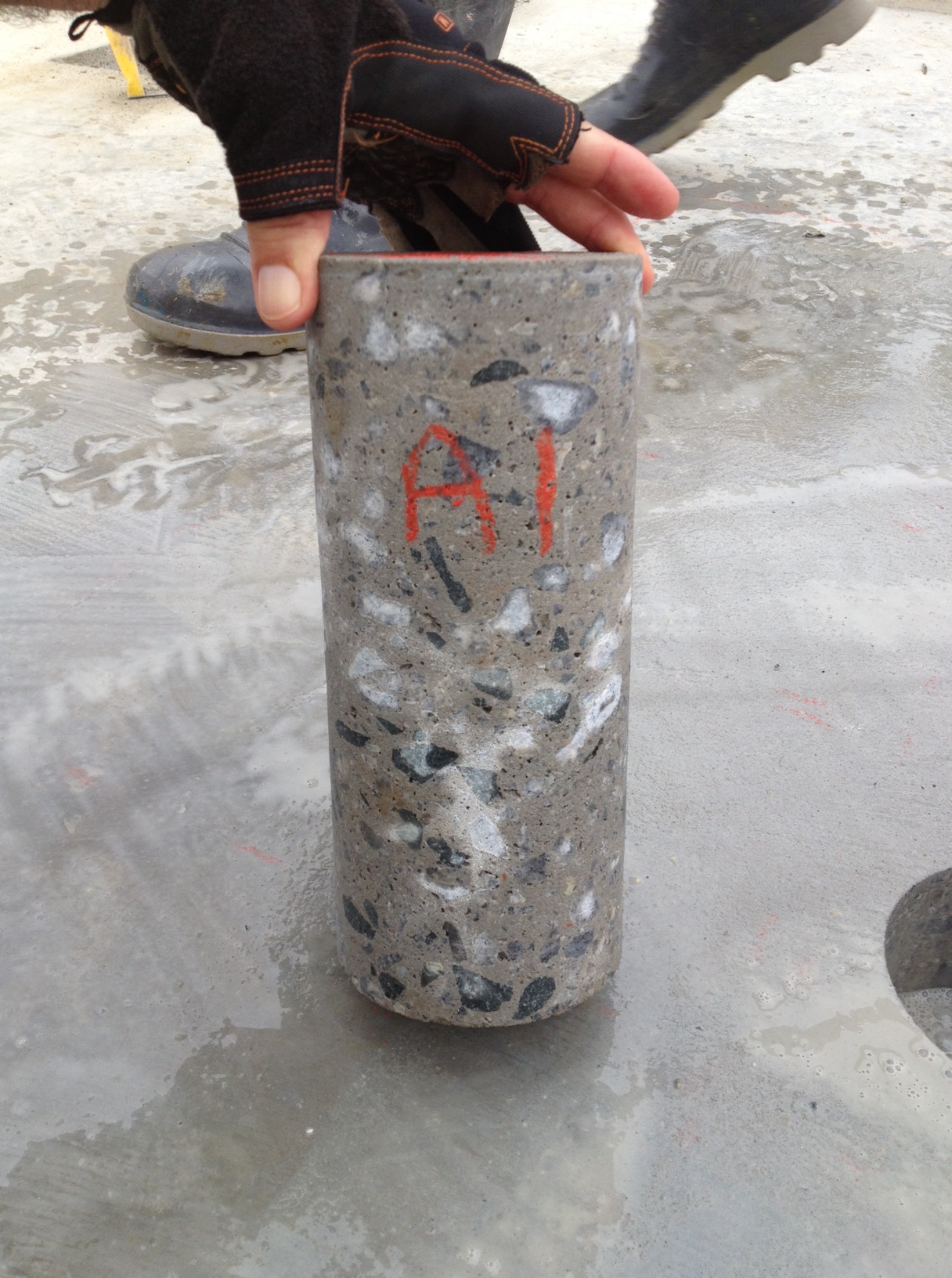
Cored concrete sample
The fallout from this situation is that the client’s representative (CR) is not convinced that JHG are taking quality seriously and placed a suspension notice on the pouring of suspended slabs until it was proved that the processes are in place. This notice will remain indefinitely for all suspended slab pours which will be cleared for construction by the CR on a individual basis. What this means for me is not much really, I keep doing what I was doing before but just pay a little more attention to the presentation of my pour card, and ensure that site looks the part.
On Thurs and Fri I attended the Operational Safety, Quality and Environmental (SQE) Risk Management course. I was expecting a typical half-arsed training course that nobody wanted to be at but was pleasantly surprised. Aside from a couple of days respite ‘off the log’ from site it was actually a very full and well structured course. The attendees were a mix of JHG supervisors and site managers from across the spectrum of business units as well as a couple of additional blokes who were working as contractors with JH (one of whom was a 30 year soldier in the Arty/RAPTC). The programme was loose for the 2 days but this allowed a lot of talking around the topics which for me was good to gain an understanding of how the different units and workers approached the systems that JHG uses. The syllabus basically ran through the SQE process from Tender to Site and explained all the process’s and roles throughout. I found that it built upon the subjects that were merely touched on in the inductions, and I left with a better understanding and the confidence to implement and question the processes on site.
Whilst I was away Zone 4 was poured through an intricate system of pipes, pumps and towers. The original plan was for a 0700 pour from a mobile pump in the slip-lane which was feeding a tower pump that rises out of the slab through a penetration. This all worked fine in principle, (calculations were put together to ensure the load of the mobile pump was not too great to compromise the integrity of the piled wall) but in reality, feeding 260m3 of 120mm slump concrete through a 150mm diameter pipe for 130m and expecting it to be of a consistence (they still use workable here) that can be poured is not an act of war. I had to request a new mix from the concrete supplier which then had to be cleared through the concrete pouring contractor and the structural engineer before we could send it to commercial for pricing and order the material for the next day. A surprisingly long winded process but it covered all the bases and was completed in a couple of hours. I am told that there were issues with the pump, but nothing that wouldn’t have happened anyway (My ‘Actions On’ section of the pre-pour meeting come into their own and the delay was assessed and concrete paused at the batching plant), and also that the main hold up which delayed the pour till 1400 was because of the Unions holding their members back from site due to a H&S issue the day before. The H&S issue was one that their own union members had caused through blind stupidity – instead of waiting for a bloke to finish surfacing a poured concrete edge or going a different route, they decided to carry the concrete pump tube over him, inevitably dropping it on his head. This initial delay meant that the slab was not finished until 1900!
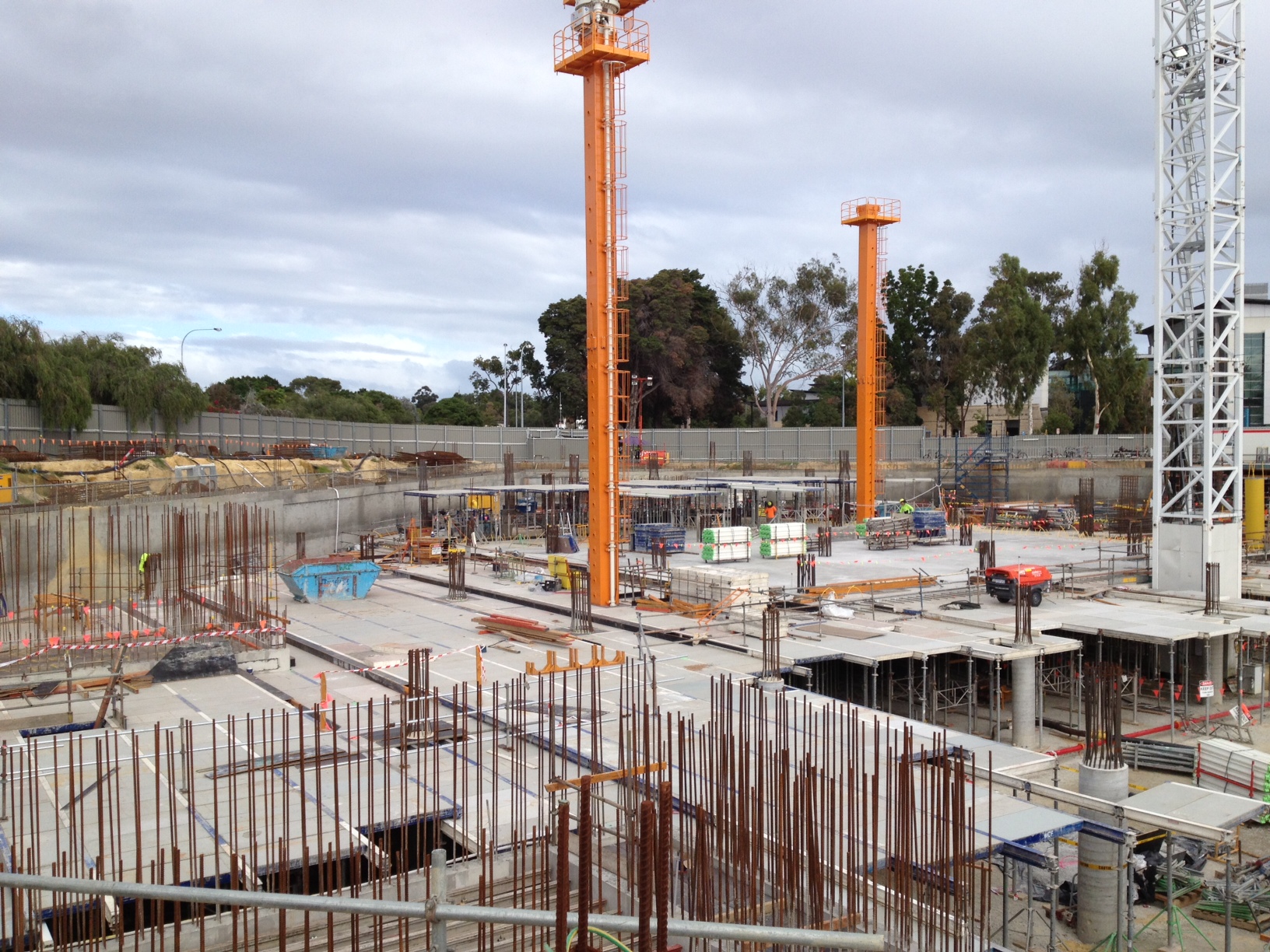
Zone 4 (poured) between 2 Tower Boom pumps
The CR later said that the zone 4 pour was one of the best prepared zones they had seen yet which leads me to think that they don’t really know what they are looking for. In my opinion, as the bloke coordinating both slab preparation, they were identical in preparation and only separated by trivial but obvious issues such as concrete splatter on reo. Maybe it is true that “Bull$h*t Baffles?”
 Holdfast Training Services Trial Blog
Not sure what a cold joint is…perhaps you could illuminate?
The core shown is interesting
a) The aggregate is angular- Looks like a crushed basic igneous rock of some description… generally a good thing but not when long pumped lengths are necessary. They often use more rounded agg – particulalry when the target strength is modest.
b) I’d say that the grading is what’s called 4/40 large maximum aggregate sizes are used so that a lower fines proportion can be used (because of the lower surface area of , say 40mm aggregate site by comparison with a 10mm size) . However large maximum aggregate sizes can lead to problems where reinforcement is congested.
c) The fines content controls the balance between segregation ( too little) and stiffening (too much)
The 120 slump is not really that high for a concrete pumped that far
Would be good to know how the mix design was altered
John, Apologies for the delay in reply.
A cold joint can occur when there is a sufficient delay in the flow of concrete (Hours), that the poured surface goes off leaving a join in the concrete. The join doesn’t allow the concrete to act as a completely homogenous material and hence will be structurally inefficient.
This was the last pour that occurred with the S32/20/120 (Strength/Max Agg/Slump) mix. The Agg was crushed (not sure what variety though).
The new mix was initiated by me on a proposal by the contractors on the assumption that it wouldn’t make it through the pump. I spoke with the Structural Engineers and then emailed Hanson (Concrete Supplier) to provide a mix design capable of producing a finished material to the same structural properties as the original mix, but capable of flowing through 130m of 150mm diameter pipe. Their solution was a S32/14/150 (which ended up as a S32/20/150 on the dockets – I wasn’t there to monitor), which the contractor still wasn’t happy with, but the Structural Engineer was. It was then ordered and delivered the next day.
To compare this with the 40MPa mixes used on the Core walls, they have a design in the vicinity of S40/14/180, and will no doubt be utilised in the upper levels of the hospital when they will be pumped through potentially longer pipe networks.
We are currently in the process of installing a fixed concrete pump, located in the slip-lane to get over the issue of not being able to access the base of the hole. It is more of an issue than expected.
On a side note, it is potentially the force of pumping the concrete through 130m of pipe that split one of the mobile concrete pumps pipes during the pouring of Zone 4. Just lucky there was a welder on site who saved the pour, otherwise we may have been looking at a repeat of Zone 3!