Archive
Embracing Egan
If you can cast your minds back to your original degree courses (PET students amongst us) they probably mentioned something about the Latham and Egan reports. Greg mentioned them during his lectures during Phase 1 from a mainly contractual perspective. But what other areas of this business we are playing at did they touch? If I find myself with enough time I may expand on this blog and look at other areas in the future but here I will focus on the part of the Egan report that talks of standardisation and pre-assembly, if this morphs into an AER or TMR perhaps I may spend time on the stuff that went before but here I’ll look at a few bits on my site that seem to have embraced the message.
My project is a relatively simple group of 3 RC buildings for student accommodation, given our high levels of liquidated damages and the tight timeline speed of construction is more important than quality. If I was building a high end hotel or apartment block I might be looking out the window at a very different scene but here is a snapshot of the stuff that is streaming construction out here:
Structural Insulated Panels (SIPs) – These are being provided by another trading arm of the Osborne Group, Innovare. The function that they are fulfilling here aren’t their primary purpose and the project manager that visits talks of their strength in house building, they have been approved for construction up to 5 stories (which no other structural framework) but in theory will go up to 8 stories. On site they are being used as an infill panel that will form the internal skin of the building. The construction can be seen in the photo below; a high density polystyrene laminated to a timber external skin, plywood on the long edge and timber on short edges. Acting as a composite it is remarkably strong although this strength isn’t utilised in this construction. The SIPs panels are the first things that get installed after the falsework has been struck. They are all pre-designed and manufactured and arrive in loads corresponding to whole floors (each individual panel has a specific home on a floor and is usually identical to the panel directly above and below is) they are then lifted directly from the wagon to the floor where they will be used. Installation required ‘carpenters’ to attach a timber baton to the floor slab to locate the SIPs and then a bracket to secure them to the soffit of the slab above.
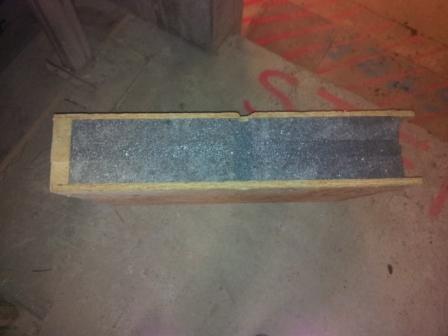
Section of a SIPs panel
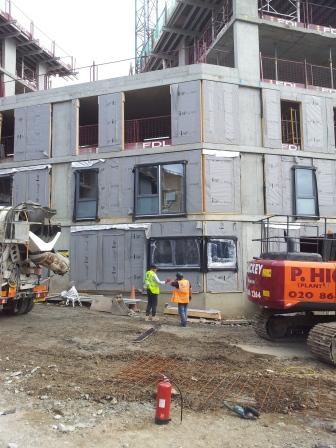
SIPs panels used as infils (the things wrapped in grey plastic)
Windows – Less ground breaking but each window is designed to go directly into the space left in the SIPs panel, the glazing is then installed and that completes the internal skin of the building.
Bathroom pods – Because each room is en-suite you can imagine the amount of time fitting 1104 showers and toilets would take. Each of the rooms will be equipped with a pre-manufactured bathroom pods, it is made of fibreglass and inside is a fully fitted an functional system, all that is required is for it to be lifted onto the correct floor and then positioned next to the riser, the pod is then wired up, plumbed in and fitted with the duct for the extractor fan and it is ready to go, finally they are surrounded by the dry liners to build them into the room.
Twin Wall – I expected to see the usual pre-cast stuff on site (stairs, drain rings etc) but had not heard of this before, whilst it doesn’t necessarily make the job go faster it certainly helps. The main thing this achieves is a saving of hook time on the tower cranes. If you imagine constructing the walls around a stair core using traditional methods you get something like this:
- Lift large bundles of steel to a place where the reinforcing cage can be pre-fabricated (2 lifts)
- Lift pre-fabricated cage into position on the starter bars in the slab (3 lifts)
- Lift formwork panels into position in sections on the inside of the core (perhaps 4 lifts in total)
- Lift formwork panels into position in sections to the outside of the core (another 4 lifts)
- Use crane-liftable concrete skip to place concrete (say 0.675m^3 per metre run say 10 lifts)
- Wait to go off
- Strike formwork using the reverse of the 8 lifts at steps 3 and 4 (8 lifts)
- Total crane lifts approx 31 lifts
Contrast with twinwall
- Lift twin wall sections directly to point of use (4 lifts)
- Place twin wall starters in wall sections (1 lifts of 12mm bars)
- Use crane-liftable concrete skip to deliver concrete to half depth of the twin wall (say 0.125m^3 per metre run say 3 lifts)
- Allow to go off
- Fill remainder of twin wall during slab pour
- Total crane lifts approx 8
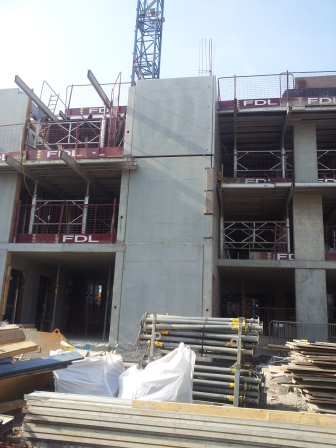
Twinwall used to construct stair core.
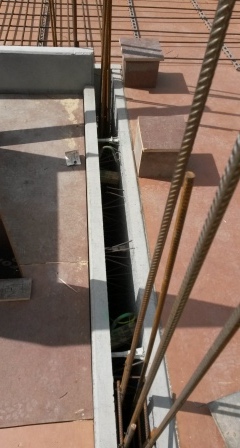
Twinwall in place with decking (note skinny starter bars, internal structure and that only approximately a third of the wall will be cast in situ concrete hence the reduction in crane lifts in concrete placing)
A huge efficiency saving on crane time which means the columns can be put up at the same time as the walls and reduce the floor to floor turnaround time. The efficiency saving is such that it is obviously economical to get twinwall pre-cast in Ireland (presumably by the proportion of the population who lack the intellect to work on a building site in the UK or OZ) and ship it to Southampton although the carbon emissions are probably questionable. The other benefit is the finish, the walls are all spec’d as Plain Finish which allows for a +/- 3mm local deviation because these are big panels there are fewer joins to finish making for a smoother finish.
 Holdfast Training Services Trial Blog