Hot salty fluids
As previously mentioned I have been supervising bringing the utilities onto site, so far it has gone fairly well I had to decide to abort the BT ducting as there simply wasn’t going to be enough space for the work to go on, this will be revisited in the future as the disruption will only impact on site activities rather than the public. I had to deal with a complaint from the Southern BBC Engineering and Operations Manager which was quite an uncomfortable phonecall, it felt a little like OPTAG where the SIMPRESS are sticking a camera in your face and trying to trip you up with questions.
The geothermal element of the installation is quite interesting, what I didn’t realise is that the Southampton geothermal borehole is the only functioning one in the UK. The original project was started as part of a Dept of Energy experiment in the late 70s, the DoE decided that it wasn’t a viable option but Southampton City Council decided to pursue it and went into partnership with private enterprise and started the Southampton Geothermal Heating Company, there are some other complex company arrangements that involve Cofely GDF Suez that I still don’t truly understand but it’s just minor details. Because the City Council are still involved in the scheme it seems that connection to the scheme is often a planning condition, bribery by another name.
Anyway the scheme works something along these lines (see Rich aged 5 sketch).
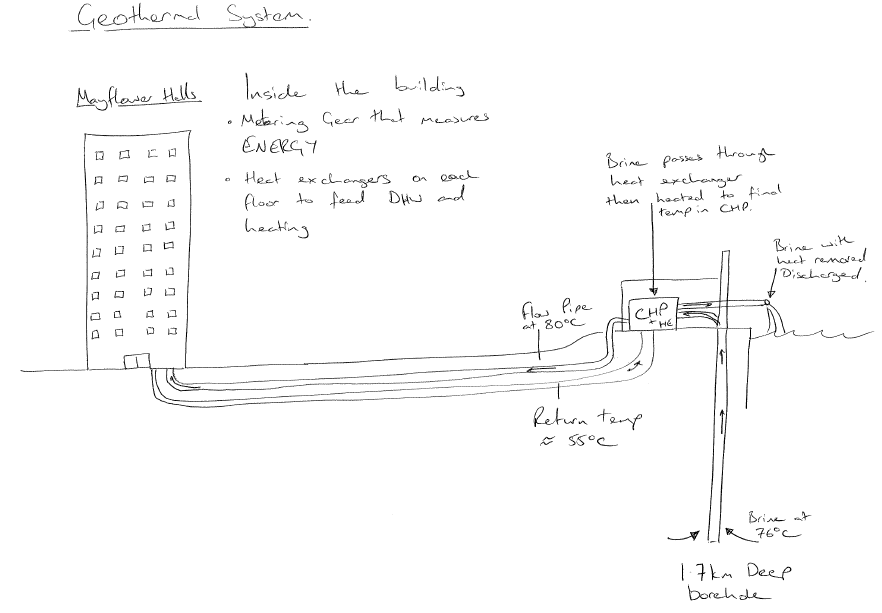
The borehole is 1700m deep and taps into a geothermal aquifer containing ‘ancient’ brine at 76 degrees Celsius (the bit I can’t quite get is why it needs to be ancient and if it is it must take a while to recharge) a pump at 600m deep draws the water to the surface it arrives at about 70 ish degrees. At this point it goes through a heat exchanger to with fresh water and the cooler brine is discharged into Southampton Water. The fresh water temperature is now topped up to 80 degrees using some combination of Combined Heating and Power plants (CHPs) conventional boilers and biomass boilers. Once the desired temperature is reached it is them pumped around the distribution network that runs under Southampton. In key buildings such as the Civic Centre there are additional boilers that maintain the temperature of the network.
A building that is using the system has a flow and return pipe plumbed into a metering rig. Crucially the metering rig allows the provider to measure energy used, by monitoring temp in, flow through and temp out the clever computer works out how many MWh of energy have been used, I guess this has something to do with specific heat capacity and other such stuff that GCSE physics mentioned. The demand is controlled by the BMS which decides to raise or lower flow as required. There is a limit on the return temp and the contract specifically states that it must be around the 55 degree mark.
The flow pipe can flow in both directions (not simultaneously for the confused Civils amongst us, I stopped short of asking the stupid question of how that works, instead choosing to nod sagely) depending on demand. So if a sudden demand occurs near the civic centre CHP and pump it will be fed from there and the CHPs and pumps are the other extremes of the network pump water inwards to fill the ‘gap’.
Once inside the building I think ( though need to check) I think it goes through a big heat exchanger in the plant room which pumps it around what I suppose could be described as a ring main and then on everything third floor smaller heat exchangers steal heat away for the DHW and heating systems.
All the connection has been made onto a live system in what they refer to as a ‘hot tap’ the provider have been banging on about it for weeks now and made it sound really exciting. It wasn’t, just a couple of blokes all the way from Scunthorpe with a drill, no steam, no blowback nothing.
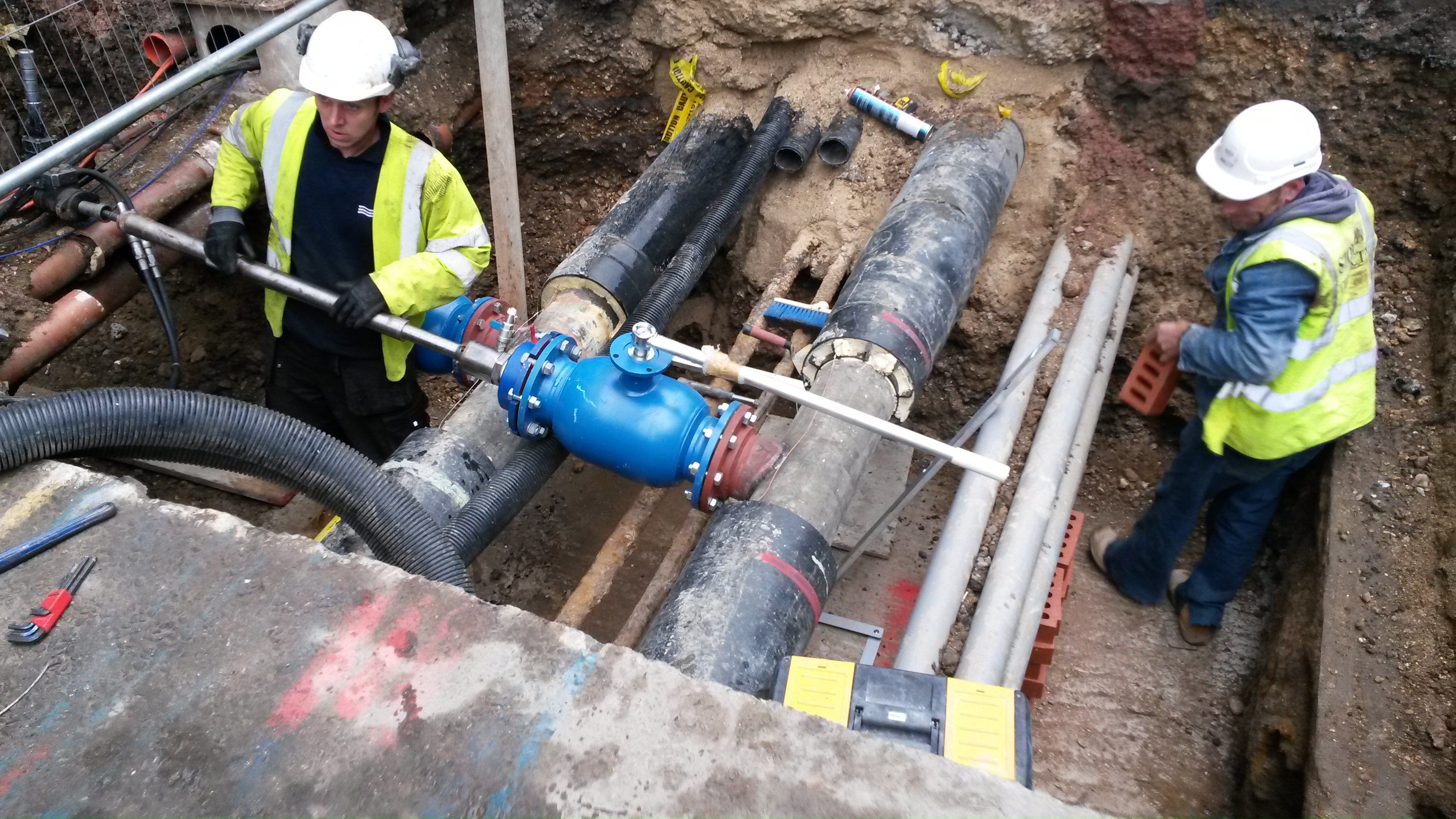
What a big shaft. Note all the services running through the same small area of road way, at least half of the ones seen behind the guying drilling shouldn’t have been there.
M’s I prepare for the questions I can’t answer.
Mark, in all seriousness if you’re excited by this they’d be more than happy to have you come and look at all the engines and other stuff that moves.
 Holdfast Training Services Trial Blog
Genuinely your most interesting post yet!
I recall you having said that …just in case… your building contains a boiler room?
There were a number of regional heating schemes constructed in the late 60’s early 70’s largely to communally heat ( in a conventional manner) public housing schemes. The ones I know generally really never worked; but I don’t know why.
I would guess that the issues you raise with the Southampton energyu scheme is a microcosm of the National ‘problem’.
Investors in energy schemes see payback over decades and therefore rely on market certainty….would you invest in nuclear with the spectre of beardy people with open-toed sandals coming to power? So one of the only possible investors might be the ‘owner’ of planning consents able to ‘fabricate’ market conditions.
John,
True, the original spec says that the plant room must have space for future boilers should the district scheme become too expensive, which is the origin of louvregate where we’ve had to remove a significant amount of concrete retaining wall ‘just in case’.
Your second comment is so cynical even I couldn’t hope to attain that level, how ever in all, it’s probably true, I don’t know how much ‘kick back’ the council get.
The Kincluny village project in Aberdeen is a proposal to build a ‘sustainable village’ where energy is supplied by a mixture of solar, wind and ground source heat. The concept establishes a social enterprise between the community, the developer and the council. Seems like quite a big gamble, but the idea of a village as business model appeals to me as an interesting approach to combining social and capital ideals in some kind of harmony. I think part of the solution to the energy problem is distributed generation, spreading the financial risk and engaging with the community in the generation and use of power.
I always thought half of the battle with running an efficient boiler was sizing it correctly to meet demand. Doesn’t this lack of predictability and potentially increased range of demand all fly in the face of that?
Not really, the aquifer is a large energy source that is happy to give you its heat or hold onto it as demand dictates.