Archive
Please tell me this is a worldwide phenomenon!
Has anyone else noticed a tendancy for the entire office to get up to go to the toilet between 1650 and 1657? It seems that everyone is so bored all day long they don’t even want to urinate on their own time for fear that it will delay their exit from the office. Please tell me it happens everywhere.
Retaining wall supported with a buttress
It seems I do have time to add another blog.
As I have discussed in previous blog, the pile group for the buildings were next to a railway track. In order to excavate the ground next to the viaduct, a retaining wall was required. However the retaining wall could not be supported by props as there was nothing to prop against. A a result the retaining wall was supported by buttress’.
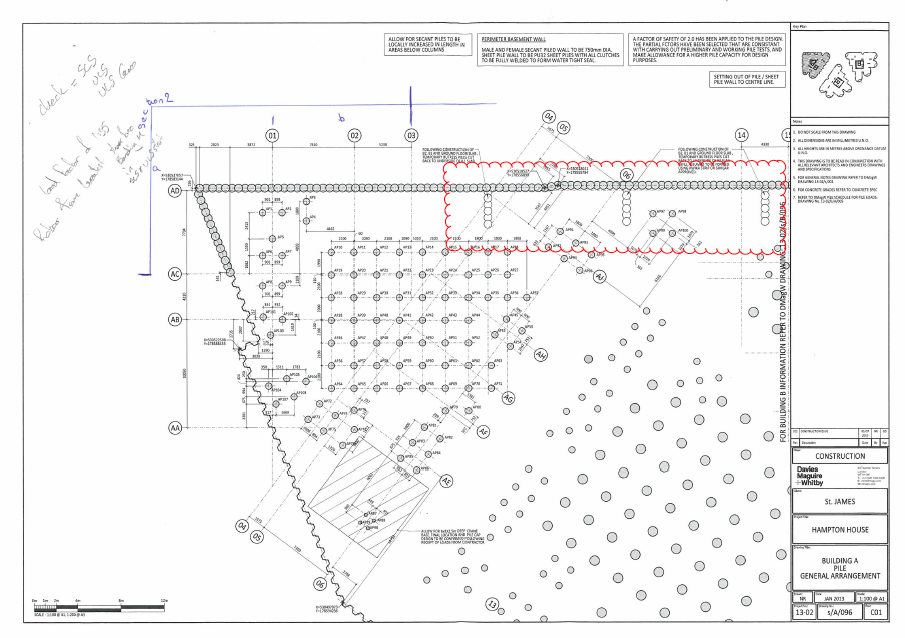
As you can see from the drawing above, the buttress’s are spaced by 13m and comprise of 4 x male piles and 3 x female piles. The spacing between the males are 1300mm. The original design allows for the female buttress piles to be installed to the depth of the retaining wall piles, allowing the male ones to go deeper to provide the stability. I was interested to find out how they had designed the buttress wall toe depth for the male piles. Here is a quick sketch of the way I calculated the resistance of the buttress piles.
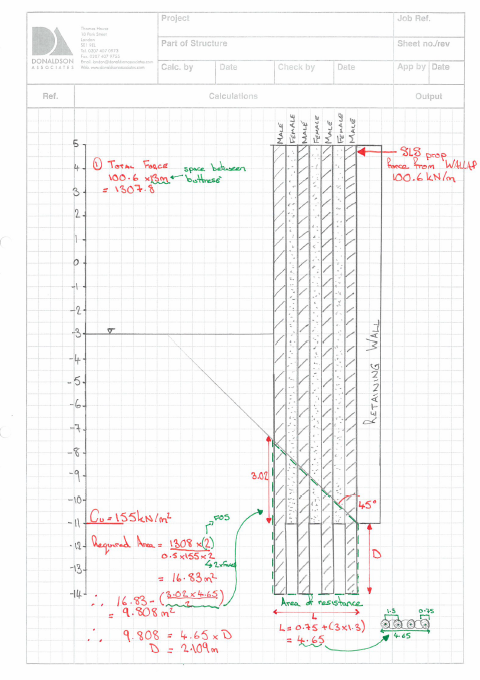
It seems to agree with Skanskas approach. However they had a toe depth of 11.6m, different to my 13m. I soon realised that they had made an error in their calcs, they had forgotten to work out the area of resistance correctly. Secondly I was concerned that if they were using L=4.65m, they should extend the length of the female piles to the same length as the male ones. The soil that is caught between the male-male piles would not create the same friction as male female pile combination. These factors have gone back to Skanska, I await their decision. I hope my suggestions are correct!
Piling Cat 3 check complete
This is only my second post since being on Phase 3. The reasoning for it has been this bloody Cat 3, external check, on a pile design. The deadline for it was the 14th, and then I took some time writing up my TMR 4, which happens to be about piling.
The pile design was completed by Skanska, for 3 x 30 story buildings. The buildings were sandwiched between the River Thames and a 4 track main route into Waterloo.
The first considerations that I looked into where the geological conditions. As London is located on, what use to be a sedimentary basin some 66 million years ago, much of the immediate ground is made up of clay. The clay is formed of both London Clay and Lambeth Group. What does that mean for the design? After some detailed revision of John’s notes and a little research I released that there is the potential for two events: Overconsolidation and Artesian pressure. The next question was, how can these effect the design.
Overconsolidation in the clay meant that there was a high probability of anisotropic properties in the soil, this translated into a Overconsolidation Ration (OCR) of potentially 5-6. Hence I could have differing values for soil properties such as strength and stiffness, depending on the plane in which I was analysing. This also meant that as we excavated the soil, we could expect much more swelling than would otherwise be expected. This would cause excessive swelling, much more than would be expected from elastic swelling. Hence there would be heave on the piles, however the piles would experience differing amounts of heave as the stiffness of the soil would be greater, the deeper the pile was. This would cause a stretching effect on the pile, which would need tension reinforcement.
Secondly if Artesian pressure was present in the lower aquifer, which is contained in the Thanet Sand and chalk, there might be a need for dewatering to reduce heave on the piles. Clearly this would only be necessary if the piles where penetrating the lower aquifer, hence they would have to be long piles. As a side note, the Shard has 200ft piles which did penetrate the lower aquifer, however there was no Artesian pressure in that area (due to historical welling taking place).
On top of both of these geological considerations, I was dealing with Clay. Therefore I had a long term and short term analysis to consider. In the short term (undrained) I would be using total stress parameters, such as Shear Strength (Su). In the long term (Undrained) I would be using effective stress analysis and properties such as Effective Cohesion (C’) and Effective friction Angle.
I knew that the pile resistance was calculated using the Shaft Resistance and the Toe bearing capacity. Hence I needed to use:
Shaft resistance = Cu N
Toe bearing = alpha.Cu or a more accurate effective stress analysis equation which I can’t write down as I haven’t got time (John you will see it in my TMR)
So the first step was to conduct the same stages as we did on Ex Cofferdam. Look at the boreholes, compose a worst case scenario of the cross-section the piles would be penetrating. From there, I created a spread sheet. The columns included, depth, depth of strata, soil properties, end bearing resistance, shaft resistance etc. The next step was to apply the factors from EuroCode 7. This gave me the ULS 1, ULS 2 and SLS combinations. It turned into a mammoth spreadsheet, I might get it framed.
I then looked at the actions on the piles, from the column loads. Applied the factors giving me SLS,ULS1, ULS2 and compared these to the previous results. If the actions where smaller than the resistance from the soil, the piles where OK.
The last check was the structural capacity of the pile. I needed to check the reinforcement in compression, bending shear and tension (as previously described). This required the use of the Broms equation, to turn the horizontal loads (given in the piling schedule) into moments. For each check, I used Eurocode 2 and Rich Farmers notes on column design to guide me through. I designed the piles as short stocky piles, as the effective length was minimal as the soil supported the column/pile the entire length. As John Moran suggested, as long as post holing does not occur, this design method seemed appropriate.
The next stage was to analyse the retaining wall, which was supported by buttress’. I have got time to do this justice, so I will explain this in the next blog next week. It was surprising interesting, so I will produce a few sketches.
Burton out!!!
A bit like pulling teeth!
Well, its fri afternoon and I am coming to the end of my second week at the design office and have come to the conclusion already that this is not for me. The office is entirely open plan even the managers are scattered about without any sense of order but it is a pretty soul less place. Everyone seems very focused and confident in what they are doing and it almost seems like an event when someone gets up and goes to the toilet – which is me the majority of the time as I am now back on coke zero to try and get through the next 6 months so I piss regularly!
As for the actual work, on my second day I was given an Invitation To Tender for a rail job and was told it needed to be in on 15 Jan and as the company is taking 3 weeks for xmas that means 6 working days. My first thought was that, thank god I don’t have to design anything yet and maybe this will be a good job to get stuck into and learn about the tendering process. The job was to relocate some 11kV feeders from OHW to undergroud and construct a new switch room and access track. Not a big job, but having thought I was going to the structures team to probably design bridges I suddenly found myself on a rail job tendering for an electrical job. I am actually part of the structures team but within the rail structures team and so this small project landed at my feet. In the end it was such a manic 6 days I am not sure I leaned as much as I was hoping as it seemed to turn into a bit of a phase 1 design exercise scenario! – not as bad as I did go home every evening. It has emersed me into costs again and how a tender is priced which was my main focus as well as pulling in all the relevent specialists to get there input. The tender required about five seperate sub-consultants and the same number internally from SMEC who all had to produce a methodology for their input along with assumptions and exclusions. I have learnt that if you have any doubt in your understanding of the tender documentation or just can’t be bothered to read it all then cover your self my saying exactly what you are providing within the lump sum cost. I was rather surprised at how rushed, or late the tender was issued before it needed to be submitted but I think this was more down to SMEC than the client. I suppose you need to be quite ruthless with the time you allocate to a tender as it is unpaid work with no guarantee of a win. I attended the client site inspection on day 3 still not really knowing what was going on and having had very little time to read the 965 page tender document issued by the client. An electrical engineer from a sub-consutant we were partnering with was going to attend with me but pulled out at the last minute and when I got there I think all the design consultants of Sydney were present. Having chatted to a few of them it became apparent they hadn’t read any of the tender docs and I think one guy was only there because he saw a a queue of people on the street and thought he would join us.
I managed to get the tender together with a few hours before submission and then had to present it to the Regional Manager to justify the price so he would sign it off. In simple terms, the in house costs or Direct Labour Costs as well as the reimbursables (sub-consultant fess) once a certain multiplier is thrown in gives you a contribution percentage. Corporate and regional overheads come in at about 36% total so anything over this is profit. Most jobs certainly in transport over the last year have had to be tendered at about 40% contribution to have a chance of winning and this tender was settled at about 42% with the total at AUS$ 716,000. I think the general consensus was that the price would need to be more like 650,000 to win but the electrical sub-consultant we have used is a little pricey. We just need to wait to see if we get this.
Following from that I have been given a RC structure where the basement column reinforcement has coroded and caused the concrete to break away. My job at the moment is to assess whether the structural capacity of those columns is sufficient. More on that next week I think.
Otherwise, the hours are so far pretty reasonable and I get to drive or cycle in every morning over the Sydney Harbour Bridge which is a pretty good view.
 Holdfast Training Services Trial Blog