Water, water everywhere….
There have been quite a few developments since my last blog, the most recent and dramatic being the 200mm of rain we had in about 48hrs, but more about that later. My concrete thermal tests have finished on both the 40MPa and 50MPa mixes and happily they both passed the temperature test reaching 62oC and 71oC respectively (the limit was 75oC). Happy days I thought, however this does not fit with a computer model that the Project Manager had commissioned from a consultant. He is concerned that the 2oC difference between results will mean we go over the limit in the real pours. I’ve now spoken with the chap who did the computer analysis to see what the score is, and he confirmed it will be fine. This was what I had thought all along, plus when our batch plant is finished the agg temp will be lower than that in the trials (shaded stockpiles and cooled water passed over the coarse agg, which wasn’t used for the trials). CIRIA report 135 was very handy in giving guidance on temperature reduction for larger volume pours.
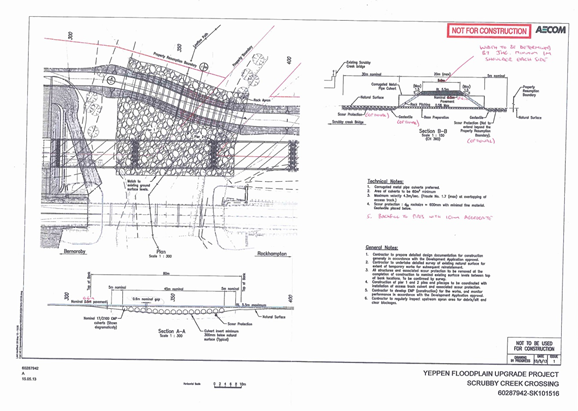
The temporary works for crossing scrubby creek were progressing well with the temporary bund 2/3 complete when the environmental rep for the designers drove past on route to a meeting. Her passing comment “I don’t think you’ve got a permit for that” threw the cat among the pigeons. We did have a permit, issued by them. The reply was “we thought you’d just drop them in” . What she proposed for us to “just drop in” are 14 x 2.1m diameter, 15m long culverts that need to sit on a bed of engineered fill into a creek filled with water. The lack of consideration given by the designers to how we would build a fairly critical part of the facilitating works astonished me. Has anyone else had any similar occurrences?
I met with the steel fixers for this job and now have a number of RFIs to submit to try and change the design to make it possible. I found the note from the designer rather amusing – pilecap reinforcement not shown for clarity – probably because it isn’t possible to fit it in! Some changes are possible to make it work, but in some cases it means a splice and we will end up out of pocket for the extra steel. The change will hopefully make prefabricating the steel easier, and the saving in time may outweigh the cost of the extra tonnage. In the same meeting we also discovered that the steel fixers were using pre-construction drawings from the tender phase. Not good. The correct drawings have now been issued from the document management system (incite) and hopefully we’re back on track. I think this arose from the steel fixers not having been contacted since the tender phase, as it is the contract has still not been signed.
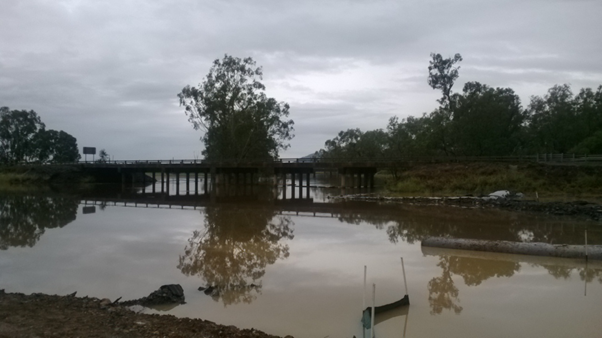
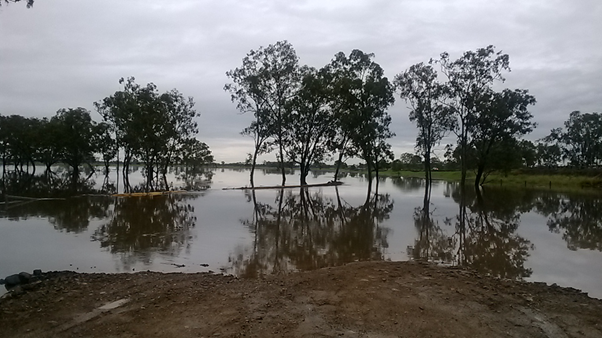
Back to the weather. The site has gone from pic 1 to pics 2 and 3 in just a day. This is not so good for the program. As this is a fairly normal rain event (less than a one in 1 yr rainfall) there will be no extension for time and no extra costs for John Holland to claim as this is not unforseen. As I see it John Holland gambled with putting fewer rain days in their program than all the other bids, who are likely to have included substantial costs for delays due to rain. The largest of those costs will be the piling subcontractor, who will charge $30000 a day if we delay without a minimum of 2 weeks notice (the cost drops to $5000 a day). There is no pain/gain share in this contract so as we were facing some heavy costs the plan has now been flipped on its head. Instead of starting at the southern end of the bridge and heading North we’ll start at the North and head south. This gives us about 8 to 10 weeks work to get the rest of the access track completed and the whole site linked up. Why this wasn’t con-planned before I don’t know.

Paperwork for the concrete works continues, and I’ve talked down some of the bids from the concrete pumping companies with a view to awarding that contract next week (still have to finish the tender evaluations). The first piling rig is also due to be transported here next week along with the additional cranes and associated gubbins.
Phrases learnt this week:
“Fair dinkum” – straight up or fair enough, “no joking”
“ fair suck o the savaloy” – same as fair dinkum
“eat the arse out of a low flying duck” – to be rather hungry.
 Holdfast Training Services Trial Blog
Pete,
I though we’d taught you all that things can be wished in place? Or was it that this is a lesson we do mange to convey that for some reason the text books and too many consultants don’t touch on…
The form of contract might be worth understanding if you are raising an RFI that should lead to a design change because as MC, unless it is D&B the client should cover the necessary uplift and if it is D&B or DBO (or the Aus equivalent which I forget) then you have a claim against your designer. A fly in this would be if you propose a change as opposed to asking for a solution wherupon it might become a requested design change i.e. at your expense and your cost for any design effort. Interesting.
I thought ‘fair suck o the sav’ usually meant you’ve had your turn i.e. shut up and listen to someone else for a change! but slang is far from immutable. Following your foray into concrete curing and heat gain/loss, do you have views on Ryans thermal measurement for establishing stength gain in sprayed concrete?
Pete
Sorry but I have not been on the blog for some time. the site looks good for underwater concreting etc.
All the very best
Neil