Honey Comb Concrete
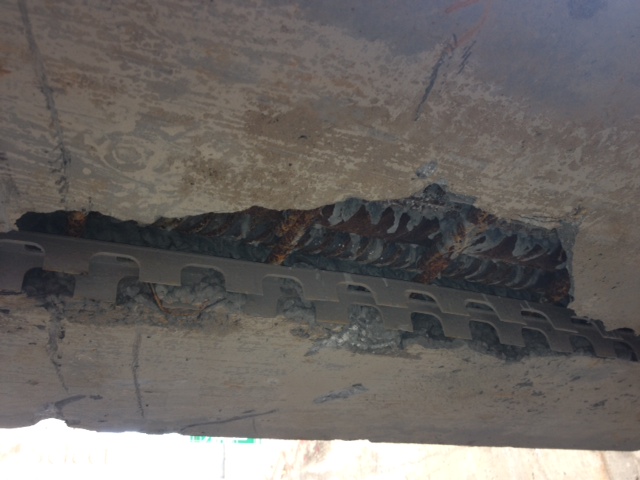
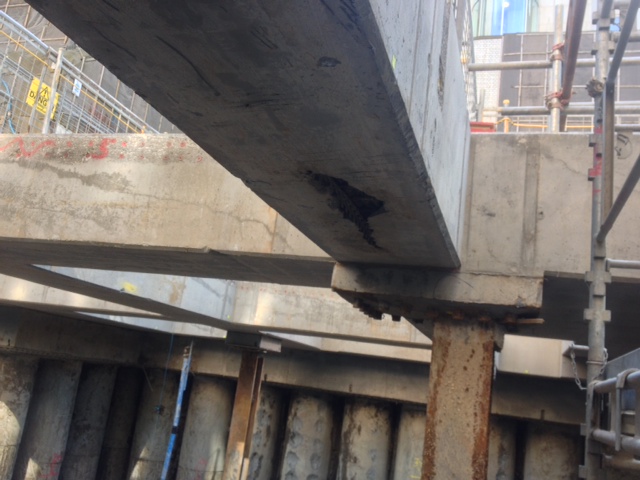
I have learnt today that this week that the term “Honey Combing” on a construction site has nothing to do with the thick sweet substance that Ryan pours on his porridge in the morning. Honey Combing is in fact the term given to poorly Lid concrete that results in voids in the finished surface of concrete.
Removing the form work during the excavation revealed a large area of steel rebar that the concrete had failed to cover. The cause was determined to be number of factors:
1. The operatives were instructed not to compact, vibrate and tamp the concrete excessively during the pour as the beam in question contained Geo Thermal pipes that were at risk of being damaged.
2. The concrete mix was not loose enough to allow it to flow around the steel to fill the void. In fact some of the slump test during the pour revelled stiffer then required concrete. The slump had been determined at an average diameter of 550mm and we had loads that varied between 650 and 400mm. The result was the expected dismissal of the concrete and a reshow for the concrete contractor it was a case of working the concrete a little harder. This was principally due to the fact that the concrete was already being pumped by the time a slump had been completed. Poor practice in my mind.
3. However ultimately I feel that pour steel fixing was the principal cause, although it is not a theory accepted among the entire site and principally not by the steel fixers. The pictures below clearly show that steel bars are packed too tightly and have prevented any concrete from passing between the bars to fill the void. The steel should in fact be lapped one bar on top of the other with the use of a cranked bar. In this case the bars were allowed to lie next to each other.
The upshot of all of this has been not and engineering problem more of a contractual problem. The making good of this void would seem fairly straight forward. The use of a fast setting cementitous mortar although it must reach the same strength or better then the surrounding concrete. My fag packet engineering behind why I feel this is a minor engineering issue is that the missing area of concrete is in fact only cover concrete and that the concrete within this region is concrete in tension with and in fact it is the steel that is carrying the load. Given that the beam is a rectangular section the area of concrete that could be removed would be half the depth of the concrete as all below the centroid would be in tension. The greater issue is that this section is typical in terms of steel across the site. A more worrying concern is that there may be more voids that can’t be seen. If a void is within the compressive section of the beam, typically here it would be the upper half of the beams, this would significantly reduce the load that could be carried across the beams. The quality control during the steel fixing was fairly stringent and while most of the team on site are confident that there would not be any further voids I looked into how one might determine if there were any further voids . The solution that I had come up with was the use of a ground penetrating radar. These appear to be fairly available for hire by many companies on line and are a very simple non invasive method of detection. Unfortunately the confidence of the team and the reluctance of the expense and delays to the programme means that we won’t be playing with any GPR systems and a non compliance report has been raised, once the making good has been completed the case will be closed.
 Holdfast Training Services Trial Blog
Nice blog….know almost nuffink about concrete but here’s a bit of Poirot for you
anyway ( to be read in an apalling mock Frenchish Belgian Anglo accent):
Zee (Ok that’s enough of the Poirot…Ed) location of the loss means it is unlikely to be a bleed…so your guess at poor compaction is spot on….you see hoeycombing form fine bleeds near formwork joints)
Zee ( I said enough ! Ed) location of the defect looks fairly fortuitous….joints and ting are usually place at about one third span (for continous spans/ spans with end moments) becuse it’s a min location of the ‘doing strustural stuff’ scale.
The cover does a couple of things….yep looks after the durability by not allowing an obvious cathode to exist. ALso it might provide the anchorage for the reinforcement to do whatever reinforcement does
It’s never crossed my mind that there might be internal voids in poorly compacted conrete..here I’d say..what’s poured into the form (less any bleed) stays in the form; so the QA is what was poured(with a little shrinkage ) v what was the free form volume?
Reminds me of a piece in the Crocodile Dundee films: “Honeycombing, call that honey combing, why where I come from…”, see Nik Wests blogs for sever honeycombing!
I don’t buy the excuse ” we were told not to over-vibrate…” unless it was a site instruction the contractor bears the responsibility for placing the concrete correctly without damaging any included services; and it’s not hard to get right, just as it’s not hard to get wrong. It’s a contractors issue so – suck it up sonny!
Concrete consistency is, as you might recall, one of the best indications that your delivered concrete had the correct w/c ratio and is as specified. Slump, albeit crude, is one of the best measures of consistency and you need to be very aware of the requirement and the specification lmimits of you recieve concrete – it is usually +-40mm of a specifid value and you should reject loads that do not meet spec or you will have issue like this and worse… but it’s up to the concrete contractor to deliver the finished works to specification so he should chck slumpso back to it’s your problem sonny…
Lapped bars are quite frequently placed side by side and bars can be bundled up to four as a group two on two so I don’t think that the steel fixing looks like it is the root cause of the issue. the steel should have been checked and signed off as ready for the pour and the danger here is clouding the ewater in terms of responsibility and profesional obligation. if the concrete contractor was concerned there might be an issue in him delivering the product he should have raised it so….
I think I’m fairly clear where I see the problem lying and as it is the concrete contractor that will ultimatly do the repair I’d be suggesting he get on with it and let the PM and QS teams worry about the contratual bits and how they haggle. Your concern that there migh be more voids is not unreasonable, you may be right, but the norm is to find voids beneath bottom steel because nearer the surface of a pour their bouyancy usually means bubbles rise up and breack the surface.
Interesting is your view that the concrete here is durabiility cover only. It looks to me as if you are pretty close to a support so direct shear is a failure mode to consider and this relies on the total section area.
and there was me, knowing less than nuffink about concrete, wondering
1. Why were the pipes put through in the first place and not just sleeved to allow the beam to be properly compacted. Were they already in place and operational ? Please say that they were not running the length of the beam!
2. Who is putting pipes in that can’t stand a little concrete compaction around them?
I think Richard’s “suck it up” comment just about says it all……….::