Archive
My props are bigger than yours!
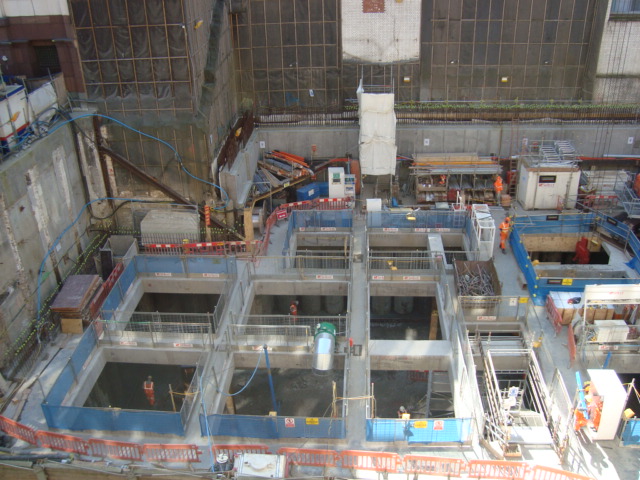
I have finally got my foot in my work boot and hobbled round site this week to find an exciting progression at the end of the basement. The diagonal props are in, the excavation completed, piles have been munched and the walers, bracing frames and thrust blocks are going in. To add to the excitement I keep hearing concerned conversations in the office between the basement section engineers about how the sheet piling has moved 20mm and is only allowed to move 5mm more and that a thrust block has been cast touching one of the piles and may need to be ripped out. All the talk about deflections, passive forces, failure and other key engineering terms attracted my attention and would make very interesting work if I wasn’t OIC drains, power, water, comms and road!

Back in the world of utilities, this week has been dominated by the incoming HV cables and Battersea Park Road Wall. 2 weeks ago it was decided that the electricity providers SSE were to bring the incoming ducts to the HV substation we had built. Last week they decided that they didn’t fancy burrowing under the brick wall and the Employers Agent T&T decided to send us a Request For Change at around 1800 Hrs the day before Good Friday. The wanted us to dig a trial hole to find the foundations of the 2m high antique wall, cat scan the area outside the wall on the footpath and then tunnel under the wall to meet the incoming service trench. I started looking at this on Tues and realised that their new proposition would remove manpower from our Network Rail Access Road work, involve getting permits to work on the footpath and then require a specialist to look into supporting the wall whilst tunnelling underneath which would also involve more TW designs, RAMS, etc. I spoke to our project director about it and he pulled out the big guns and sent it back saying it will take us 6 weeks (the power needs to be on by 1st May!). So this made my Client Utilities meeting extremely fun yesterday which I was left to chair on my own by Carillion. I went for the good old simple squaddie approach and suggested knocking the wall down as part of it was getting knocked down already and after much debate everyone decided that was probably the best plan. I then went out with the Buro Happold Design Engineer and we started to formulate a plan to give to the client. With things going seemingly well the installer from SSE threw a spanner in the works today saying that he was still working to the first revision of the drawing (we are on number 8!) and that he must bring the cables into site at 45 degrees not the 90 degrees. Cue another 45 minutes looking at the wall debating the best way to do it and not mess up the water incoming water supply or the yet to be built comms pits and ducting. I think we now have a very inefficient solution to knock down a part of the wall, bring the HV in and worry about the water and comms. Here is the wall of doom, HV was meant to come in on the left near the substation, then water in the centre and comms on the right. Now the HV is going to come in on the right, go straight over and next to the water (to make it nice and lukewarm for everyone no doubt) and comms TBC!

So why is getting things through a wall so difficult? Well my meeting uncovered a few issues; firstly a gap in scope where Buro Happlod have been contracted to design to the meter/substation/comms pits near the boundary wall and the incoming supplies were design by others. Secondly the client’s agent T&T have failed to get the utilities companies on board early enough to detail how and what needed to be done to get their kit into the site. Thirdly, Carillion and Buro Happold have been revising drawings but not as a request for change from the client which is why the utilities companies are 7 revisions behind. So despite their being no technical engineering issues I have been baffled by contractual language and experienced first hand the great arguments behind who will eventually be to blame/will pay for it when the power doesn’t go on in time!
Concrete beam supported on 26mm bar……WHAT??
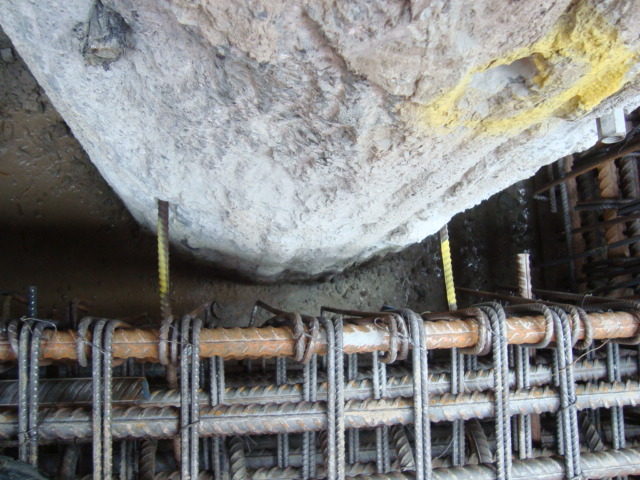
Having been working on the RC detailing drawings it wasn’t until I saw the shear quantity of steel and the congestion that I realised the magnitude of the work faced by the steel fixers. I noticed too that the interface between the pile s and the ring beam was by a poxey couple of 26mm bars. This has got me thinking that the next level of concrete is not held up by the connection between the piles and the ring beam.
In this case my thoughts are that the ring beam is in fact a whaler beam and the intermediate beams are acting as props. In this case the whaler beams are being loaded by the deformation of the piles and is acting like a compression ring. The load is then transferred into the beams axially loading them and putting them in to compression rather then acting as first thought purely in bending.
This theory is supported by the pile shape arrays (monitoring system) clearly showing that the piles are in bending and have in fact deformed by up to 6mm in some cases. In addition when looking at the distribution of the steel through the beams the steel is fairly evenly spaced. My thoughts are that the top and bottom steel is in fact designed to act in tension and compression in order that they can be axially loaded and resist buckling upwards or downwards. All comments, thoughts and pearls always welcome.
 Holdfast Training Services Trial Blog