I’ve got piles…in the ground
I’ve spent a lot of my time checking and re-checking steel reinforcement schedules the past 2 weeks. I have very little confidence in the scheduler appointed by the steel makers (Onesteel), and I have picked up numerous mistakes. Some of them may be innocent, but others are obviously in hope to sneak in extra steel as they are paid by weight. Our client will only pay us based on minimum lap lengths, and have issued what they expect the schedule to be, however I have found mistakes in their schedule too (wrong diameters of bars that do not match the drawings issued to us). This made me dig deeper and it seems they are also not following the bar bending sizes in their own standards. There is also some incredibly difficult reinforcement to make work in the headstock. This has been put off for some time due to firefighting other more pressing issues, now it is crunch time. Everything is complicated due to it needing to sit in a glorified bathtub 6m up in the air (just a really big 20 tonne, 12.5m formwork bathtub). SO I’ve been trying to draw lig sets that sit inside other closed ligs (The magic trick with 2 steel rigs that click together springs to mind).
Piling progress has been painfully slow. The brand new hammers that came from Singapore have not been dropping consistently. We thought that one was fixed on the second rig (the manitowok), but then it started to blow hoses. So 3 days were lost due to replacing all the cheap Chinese hoses with high pressure ones made in Australia. Thankfully, it now seems to be working OK, so its moved to pier 3 and started on the Southern end. This is where the critical path is, and where the bridge needs to start getting built from. The casting yard is to the South of the main site and the sequence for girder casting has always started at pier 3. The work done on the North of the site was just to keep the piling rigs busy till the access track was completed. In effect buying us time.
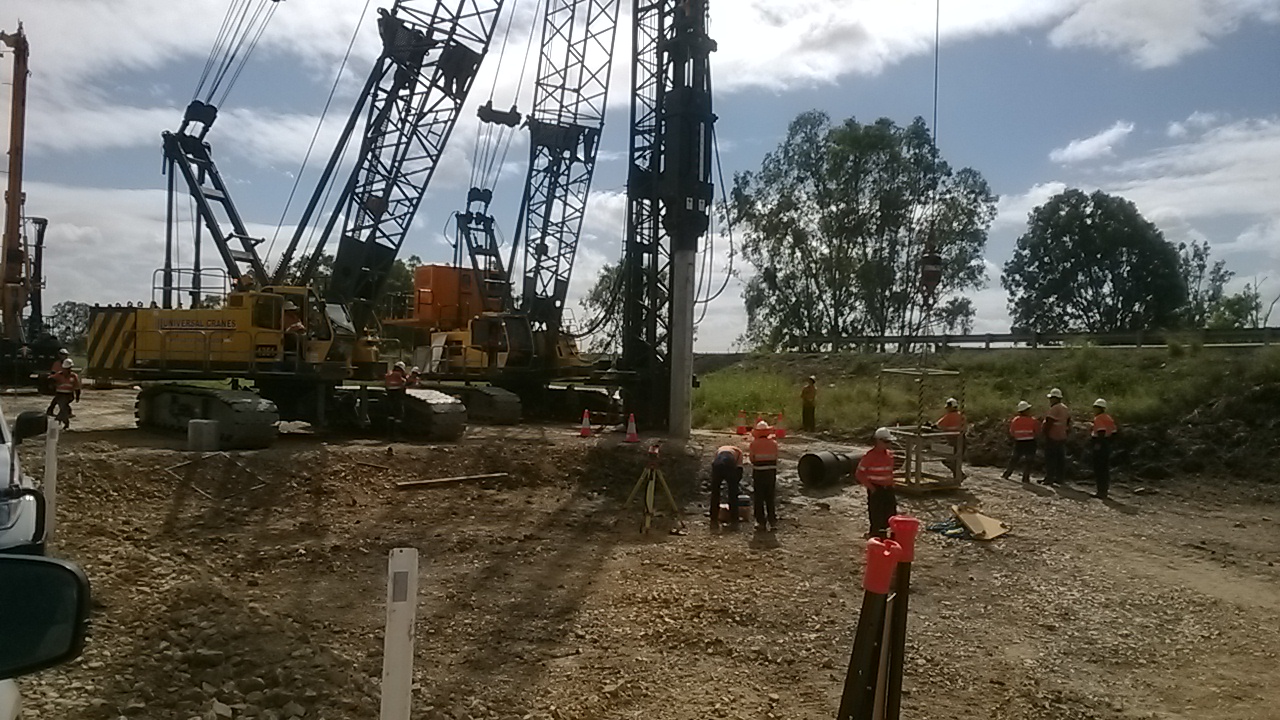
Rig 1 (the Waltman) is still suffering from inconsistent blows every 50 to 100 strikes. After 3 experts have been flown over from Singapore, all with a boxful of parts it seems to be getting better. As I type it is moving from the North to the South of the site to start working there on Monday. By my count the pilers are now 2 and a half weeks behind schedule. I’ve lost time how many iterations of my program I’ve gone through now, constantly changing the plan to meet what can be delivered by the pilers.

The 2 test piles that need to be tested with PDA were finished by rig 2 yesterday. The first one came up well with about 4000KN once it hit the weathered rock layer we were aiming for, however the second one hasn’t (Its at the opposite end of the pier). It could be that the rock layer is deeper here). I called a stop to the driving at the limit of the overdrive allowance as if we drove any deeper there would need to be a lot of remedial work done in fixing up pile to ensure sufficient splice length in the pilecap. While there are ways to deal with such an event it has not been covered or costed in the contract. As such if the client want us to go further than their design we will need to be instructed to and will cost the works accordingly. I’ve also learnt how to use the PDM machine, in the event of someone being off sick or on holiday. It’s a fairly simple bit of kit – I just need to get better at the calculation done following the data gained. And learn CAPWAP for my TMR…

Running parallel to this I’ve been finishing the beast that is the substructure methodology and AMS. This needs to cover all the risks involved with everything from breaking down the piles, excavating, formwork installation (for pilecaps, columns and headstocks), concrete pumping and then stripping the forms. This will take up a lot of my time in the coming week as we near the first pilecap excavation. Oh and the pile cropper should arrive this week, I’m sceptical as to how much time it will save us, but I will let you know in the next blog…
Oh, and the crossing across Scrubby Creek is finally finished.

 Holdfast Training Services Trial Blog
I would be good for all to know what the QA regime is on the piles… as I recall this is a strange specification where the Q’land Highway Dept specification specifies by method ( n blows of an nnn kg hammer etc) AND specifies end result ? I presume that the dynamic pile analysis results are calibrated against static load tests?
The QA is rather extensive John, the hammer size was specified in the contract as 16 tonne and we’ve also been set a design toe depth (with an over and underdrive allowance). There isn’t a specified number of blows, but there is a criteria for pile refusal which is defined as 10 blows at full drop height for the hammer giving a total set of less than 20mm. For a 16T hammer that will likely destroy the pile.
There is no static load testing on site at all. Each pier has 2 test piles that have strain gauges attached for the entire length of drive, in addition to this when approaching capacity (or final set) the last metres worth of blows are monitored with PDM to obtain set and rebound per blow. A CAPWAP analysis is conducted on the results from these test piles and then compared to the PDM results. This then gives the set per blow that we aim for at the end of drive for the remaining piles in the pier. If we don’t achieve this target set as we approach the toe there is a bit of a decision point for what to do next. If the pile is end bearing we will keep basing it in the hope of reaching the rock strata that was found in the borehole study. If its a friction pile we may leave the pile for a few days and re-strike in the hope that the capacity has improved. This limits the blows that we can strike to find this extra capacity as if we hit it too many times the soil will go back to the residual shear strength. Its normally about 10 blows max, but even then the strength starts to tail off in the last few blows. Does that make any sense?