C620?? Done. Blog No 5.
As I mentioned in reply to my previous blog comments I am now running with the construction of a 619.310m retaining wall but before I discuss the details and issues already surrounding this wall I will conclude with a few more details on C620 and another reflection.
I will also add a few photos to the shopping list style of activities I included for Blog 4 as I now have a working phone again!
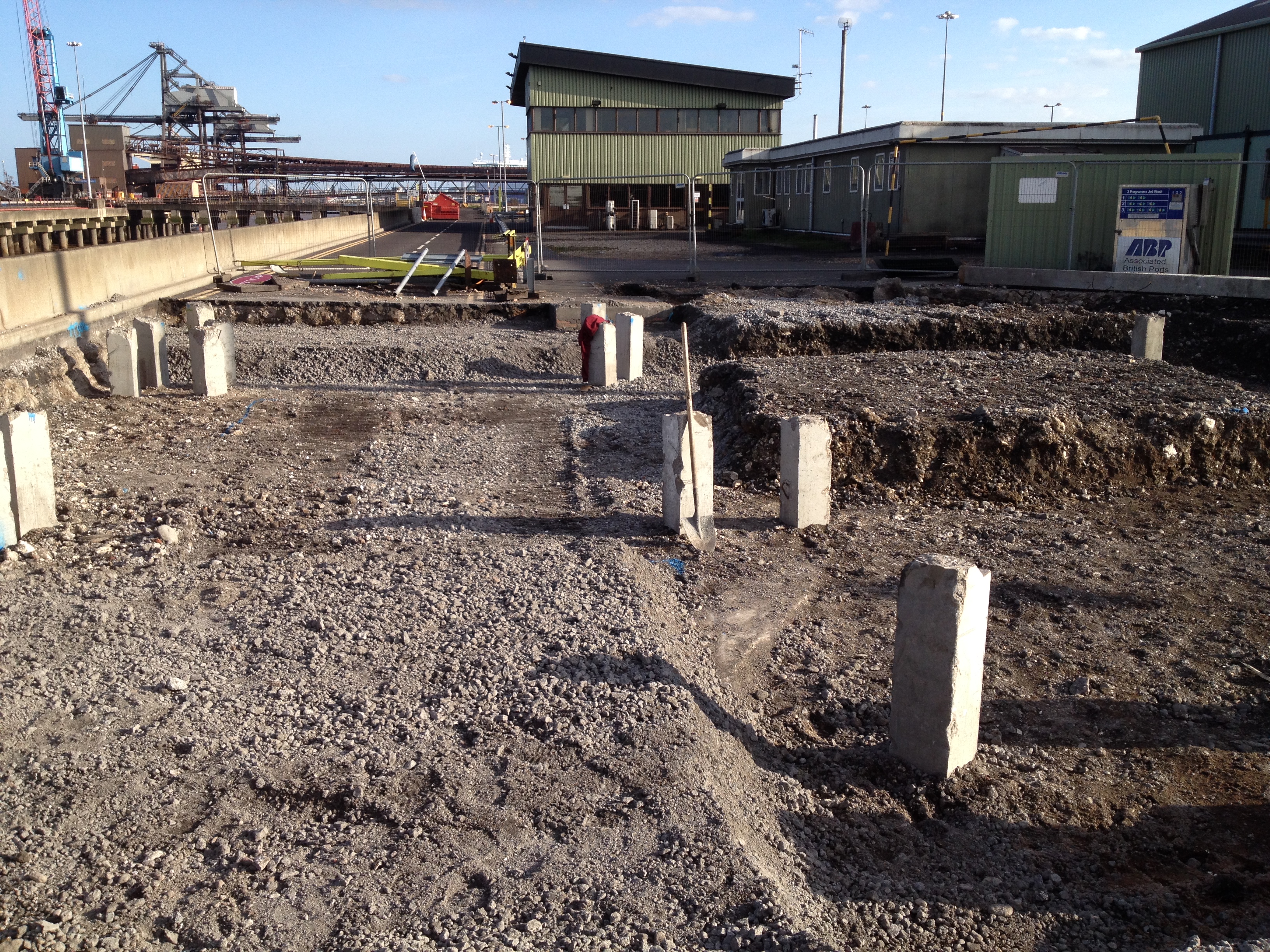
The foundation for Transfer Tower 535 (shown below) gives you an idea of the main foundation bases constructed (x3) and the type of layout of the services, deluge pipes, transfer beams, cladding upstands, gravel POL pits for the mechanical services, plinths and irregular off set bolt pads. All reasonably complex for a first timer!! The first picture below is taken from Blog 3 just after I had finished the excavation of TT535, the second picture shows the completed foundation.

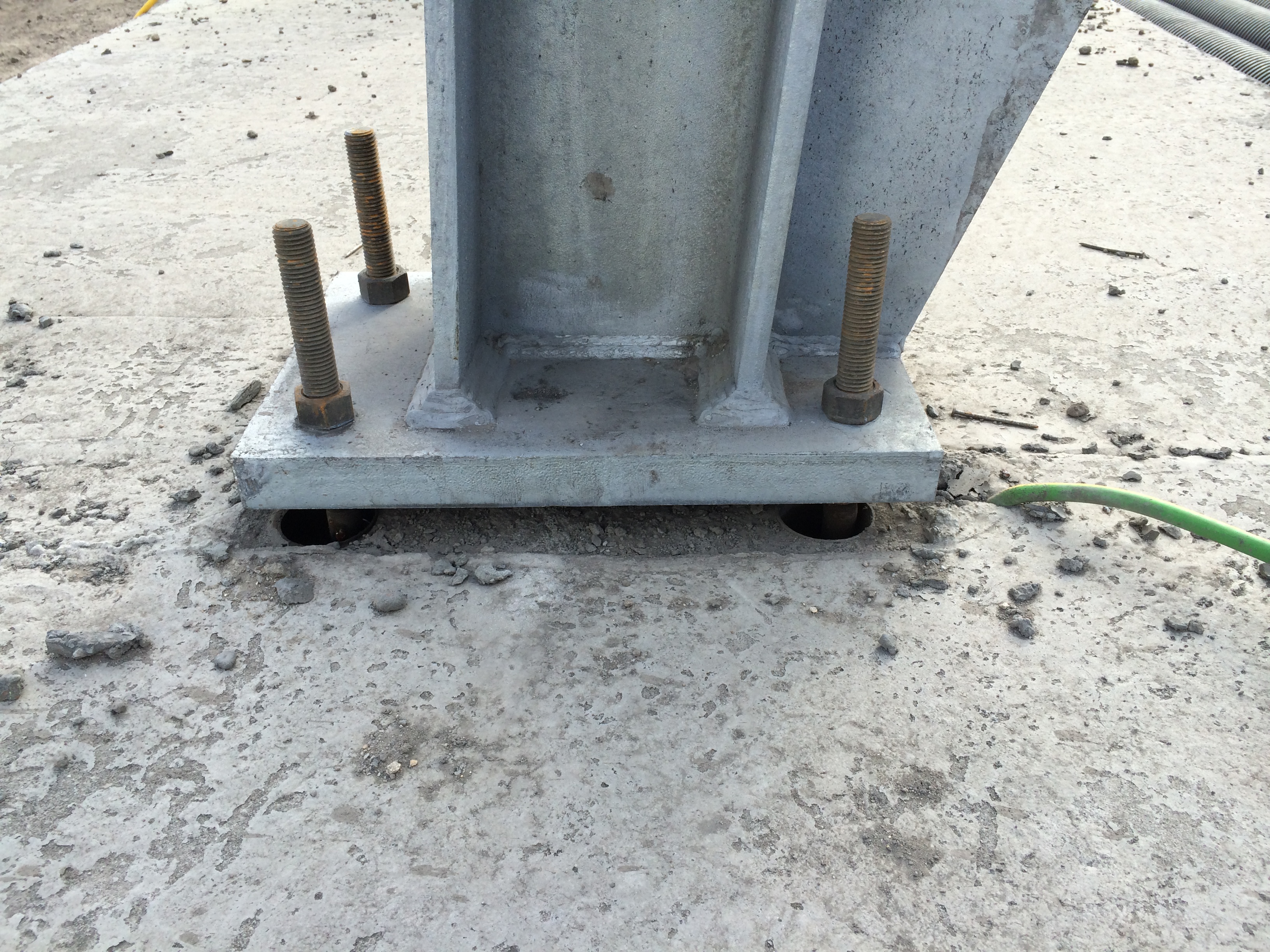
The steel trestles are now going up in earnest on the smaller trestle bases (4 of 8 to date) and they continue to fit – fingers crossed for the rest. The first photograph below shows a Trestle 10 column base plate fixed into position. The 25mm gap below the plate has been packed out and will be grouted to set the position. The photograph below that shows the exposed elements of the foundation for Trestle 10. Each slab had a deep foundation of 8 x PC RC 26m piles and housed 2 x bolt pads. They were connected by 2 parallel transfer beams running between the pads (now buried) that provided the platform for the small plinths, accompanying bolt pads and the stair beam. More importantly they reduce the risk of differential settlement across the 2 pads that the intolerant mechanical structure and services placed onto them cannot take.

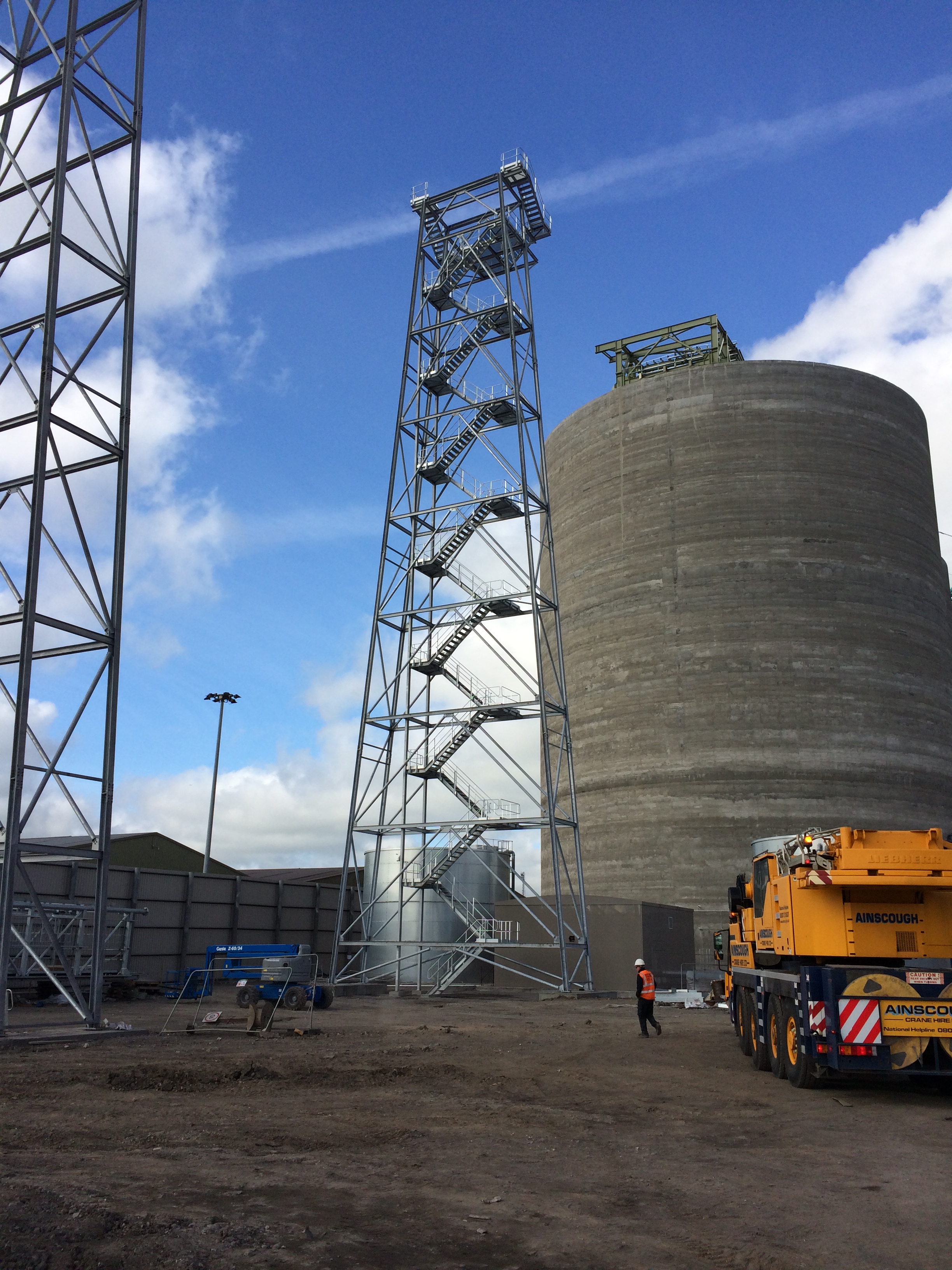
Trestle 10 is now complete and is the largest of all the trestles taking the conveyor up to the top of the Biomass storage silos.
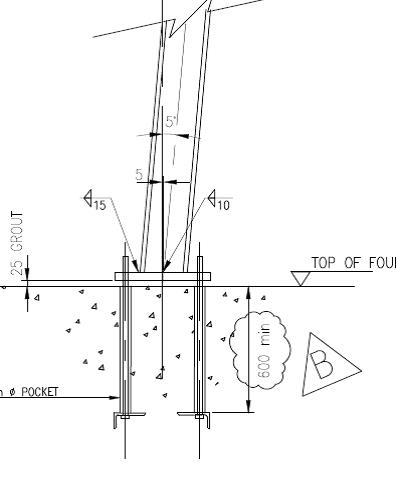
The bolt pads are made in advance and fixed into plywood templates that match the column base plate exactly. The bolts are placed into 60mm drain pipe cut to length acting as a void former to allow some horizontal movement for ease of placement and take out any setting out error. The trestle foundations were designed for compression and tension (predominately due to the wind loading on the high structures) and as such additional steel right angle plates were fixed to the ends of the bolts to increase the resistance to the tensile force. The design and finished in-place bolt pad (template removed) can be seen below.
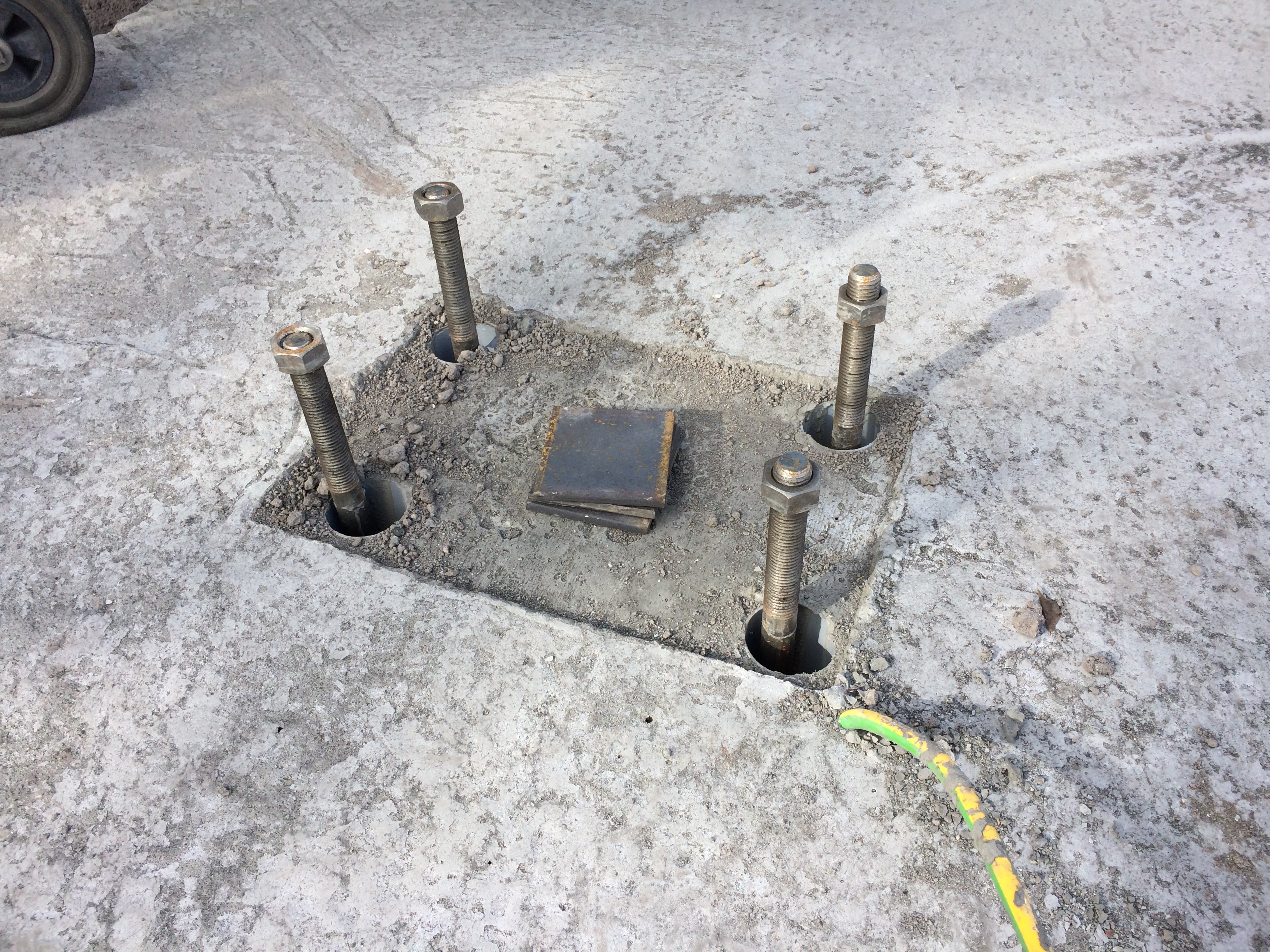
These were a pain to place as the steel cages had been pre-fabricated and lowered into place prior to the placement of the bolts and trying to attach the heavy steel right angle plates onto bolts through and 700mm deep into a 1000mm deep steel cage was tricky.
I set out the nails for the placement of the bolts, stringlines were used to set the correct position and wooden cross bracing was used to fix the pads to the correct height and location. On the first foundation featuring these plated pads we used the addition of steel tying wire to hold them into position. I quickly discovered this was not enough.
Issue. The specification for the C32/40 concrete used in the C620 foundations was for consistence class S3 and a max W/C ratio of 0.45 giving a target slump of between 100-150mm (-20mm, +30mm) and generally the team liked it at 150mm+ for ease of placement. On one of the initial pours where these particular plated bolt pads were used we had an arrival slump of 90mm which I said was acceptable, as per the guidelines, and instructed the team to begin pouring. Due to the plates on the pads and the stiffer concrete mix the bolt pads rotated and moved significantly causing me a real headache as we quickly reset the lines and used various levers and improvised methods to work them back into position. This was all to the continuous backdrop of ‘I told you it was too stiff’ from the concrete team. Thanks.
Solution. For subsequent pours I held the lorry until the slump test was conducted, used a Graham Construction slump adjustment chart to get the predicted slump to around 150mm, tested it again (if there was enough time) and poured with much greater success. In addition I insisted that steel Z bars were used to brace the bottom of the plates to the top of the steel cage and they were quickly tacked into place by the welder. This resulted in a much smoother pour and significantly less stress/abuse for me.
Reflection. The reflection from this issue was one of quality control and the difficulties surrounding it. Enforcing it has made me unpopular on a number of occasions. This site is over 18months through the project and the team of sub-contractors have been together since the start, working with LaFarge the concrete suppliers. ESG are sub contracted to conduct a slump test on all loads and 1 cube test per day or every 10 lorry loads however it has become site practice to get the cubes done every 20m3 (approx. 3-4 lorry loads). I have witnessed poor practice on a number of occasions across the site as a lorry would turn up, the slump and cubes would be taken and then the mix would be wetted up to suit the pourers and placed. On my section, to prevent this, I would have to physically stop the wagon, insist on the slump being taken, adjust the mix as required, slump test it again and then get the cubes taken. As long as I kept it within the guidelines stated above, which at the upper end was more than workable enough for the concrete team, I could not understand their reluctance to do the right thing? Quality control and assurance are vital in this a marine environment and I could only put it down to the additional time (probably no more than 10mins) it took to complete as they just want to ‘get it done’ as the subcontractor is paid per m3 of concrete poured.
There were obviously more learning points and issues that I have captured for my DO’s but having discussed responsibility, speed and accuracy, services, piling problems and solutions, more piling problems, construction methodology, ground investigation, risk, concreting and quality control I feel I can put C620 to bed for the blogs and save some final bits for AER2.
I will now start drafting a blog for another issue I already have for my retaining wall!
 Holdfast Training Services Trial Blog
Thanks for that one Joe, Glad your phone/camera are back in action. I suspect the reason your concrete team are keen to test and sample and then wet up is because it is a complete falsification of the records and will return a greater stregth in testing than the poorer quality of concrete they are placing therby reducung the risk of non comliance and being forced to break out. You are testing the as placed mix which is correct and hopefully not resulting in failures. How do your cube results compare with others I wonder.
Joe
Overall a good blog with lots of good points for locating bolts and sorting out the concrete testing. How many lifts/sections is trestle 10?
Kind regards
Neil
Interesting points re QA/QC; is the prime contractor (you?) not employing ESG in a QC role – as such, they should be reporting errors to you, and act according to the Quality Control management process in place – they should be the ‘moral compass’ on site…can you not hold them to account…QC the QC!. The only reason I raise this as it’s something I have been looking into on my site, and understanding how to deal with redneck subcontactors who think they know best, and have been giving our QC inspectors a hard time for doing things properly…which is what they are employed to do! Just as a contrast point from yours to mine; we’ve been using air-entrained concrete in order to raise it to height, thus have been using lightweight concrete (pumice as aggregate) with a slump of 180-230mm…exceptionally easy to place.. Our specs dictate 28-day test strength of 27500kN/m2, but have been getting 28-days test results of 53800kN/m2!!!
Howard, thanks for the comment. I will definitely look into it and establish exactly what ESG are contracted to do – as you’re probably right that they have slopey shouldered some responsibility. At the moment they take the slumps and the cubes but the physical quality control is by us as the engineers. The ESG guy will let me know the slump and advise on water to be added if required, I check this on my conversion chart and authorise it. Again if a load is too wet on arrival, its my responsibility to turn it away. I’m convinced that if we were not there the concrete would go in every time, as wet as possible, regardless of quality – ‘just get it in!’ As I mentioned in the blog I think some of this is a product of the familiarity of 18 months working on the same job as the 4-5 faces delivering the concrete to the same 10 concreters through the same 2-3 ESG guys have all become very familiar. Would the ESG guy turn away overly wet concrete?…I doubt it. Ill get on and QC the QC – it’ll no doubt make me even more popular come pour days but c’est la vie!!
Sounds like a good strength as our cubes have a specified 28 day strength of 40N/mm2 (40000kN/m2) and most have been achieving around 48 – 60N/mm2 (48000 – 60000kN/m2) for C32/40 with max 20mm aggregate.
Neil, the trestle is approximately 54m high with 4 vertical sections housing 2 sets of stairs each. None of it was actually prefab’d and lifted into place, in was constructed by individual structural element from the foundation up. I’m unsure as to the number of individual components and lifts. However the conveyors that are supported by the trestles have been constructed already, minus the cladding, and they currently sit parallel to the line of the trestles awaiting a lift into position. The trestles go up remarkably quickly and trestle 10, the largest of them all, went up in about a day and a half.