Hobnobs and concrete
I’ve spent the last couple of weeks bouncing between office based negotiations to continue to try and get the Danville flood protection project off the ground and the HQ site. The former continues to be frustrating; I have spent many hours checking through submittals for USACE approval from the contractor for lift plans, labour training, concrete mix designs, schedules etc – the majority of which I have rejected as they just don’t meet the USACE construction specifications or our Health and Safety requirements manual…frustrating when they have the same documentation that I do to work through and cross-check! They are either trying to cut corners at every opportunity or are still trying to get their heads around defence contractual requirements and rigidity (this is their 1st) – I am optimistic and think it’s the latter, but having seen some of their method errors I am starting to worry about their ability. Work plans to start 7 July, and end Dec.
The HQ site is starting to look remarkably different now that pre-cast curtains are being installed. In a non-official manner I have been assisting the QC team as the QA inspections tend to be purely the final product which quite rightly contain few issues so I am learning far more hitting issues immediately after or during construction alongside the QC team – this has actually made the QA inspections even smoother, plus having a uniformed guy, with a British accent and a USACE hard-hat emblazoned with safety control logos tends to create confusion in the ranks of hard-nosed tobacco-spitting sub-contractors resulting in less-arguments. Despite being ‘qualified’ inspectors, it is interesting how little structural knowledge they have, and I impress myself at explaining to them why rebar is placed where it is as they ever keen to learn as well. I have noted that the QC has a non-purposeful habit of swaying towards areas that the QA inspects the most – for example QC checks on rebar prior to a concrete pour tends to focus on cleanliness of the deck surface and rebar ties, rather than what I’ve continually brought out – ensuring drawings are abided by (and rectified if needed!), spacings are correct and dealt with correctly around vertical conduit, and rebar has the correct clearance vertically and horizontally.
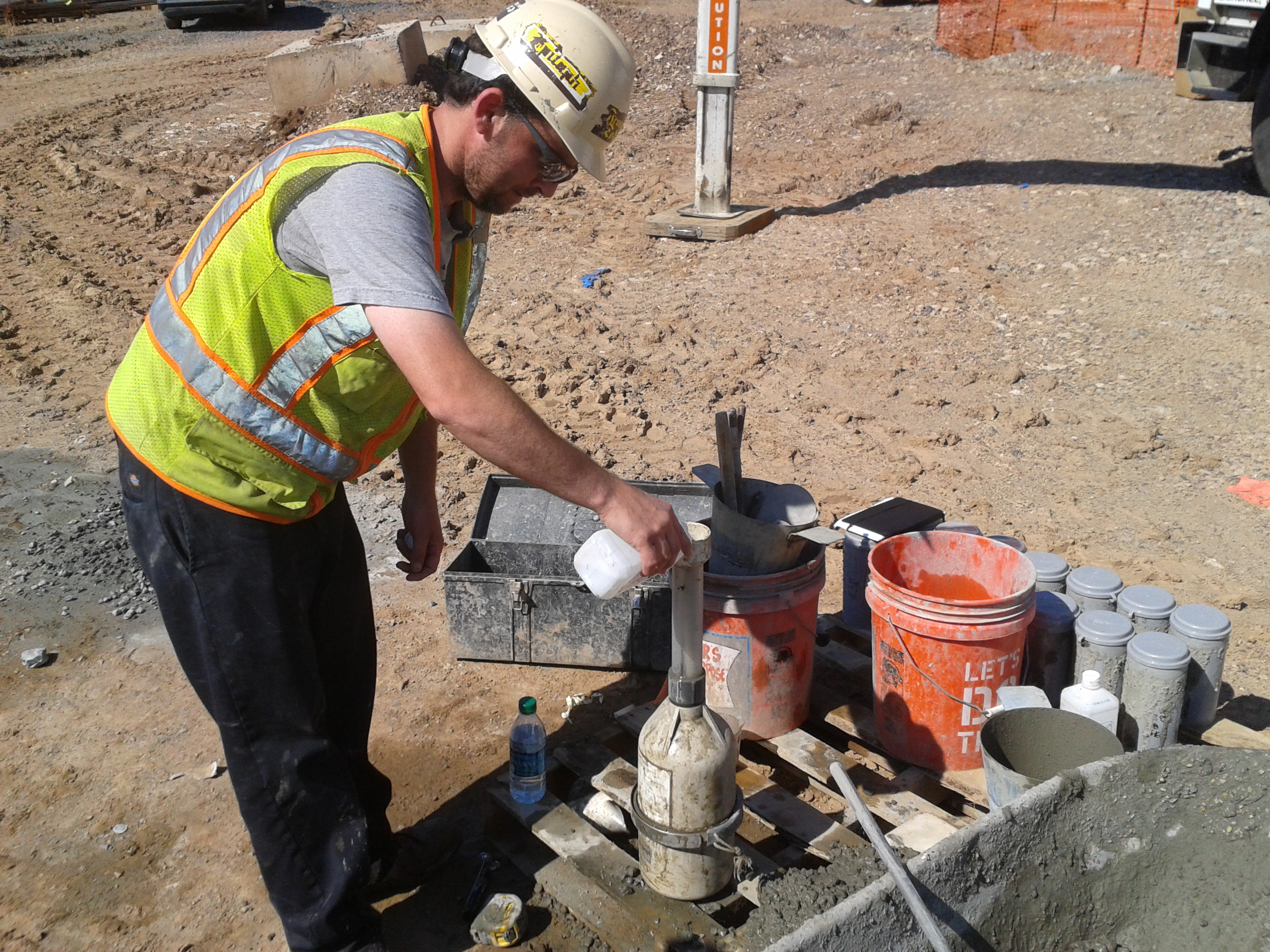
Conscious the blog is a means of sharing in order to educate, rather than just a site-diary I thought some may be interested in some of the testing methods and concrete I am involved in. Deck concrete has to be pumped to three floors high so we’ve used air-entrained, lightweight concrete. This has used pumice as the aggregate – a featherweight volcanic porous rock. Slump tests have been done, as standard, on every 2nd truck, aiming for a slump of 180mm- 230mm, making it very easy to work with. 28 day tests have given a strength of 52000kN/m2, when all that’s desired is 27600kN.m2 – this has consistently been the case! The second on-site test we’ve been doing is to measure the amount of air-voids as it’s air entrained – the specs require 5-7%. Air entrainment tests take one of three forms:
1. Pressure testing: using a pressure device, you measure the air content of fresh concrete based on the pressure-to-volume relationship of Boyles Law. Pressure is applied to the sample to compress the entrained air in the pores, then measures the change in air volume to detremine the air content. We couldn’t use this due to having porous aggregate.
2. The volumetric method or roll method (pictured below). Relying on an instrument with an in-built gauge, it is filled with fresh concrete and agitated with an excess of prescribed water and alcohol.
3. Air Indicator Kit: This kit provides a quick and easy method to check air content. A sample is placed in a vial and alcohol is added to free the air. The change in level of the alcohol in the vial stem indicates the air content.
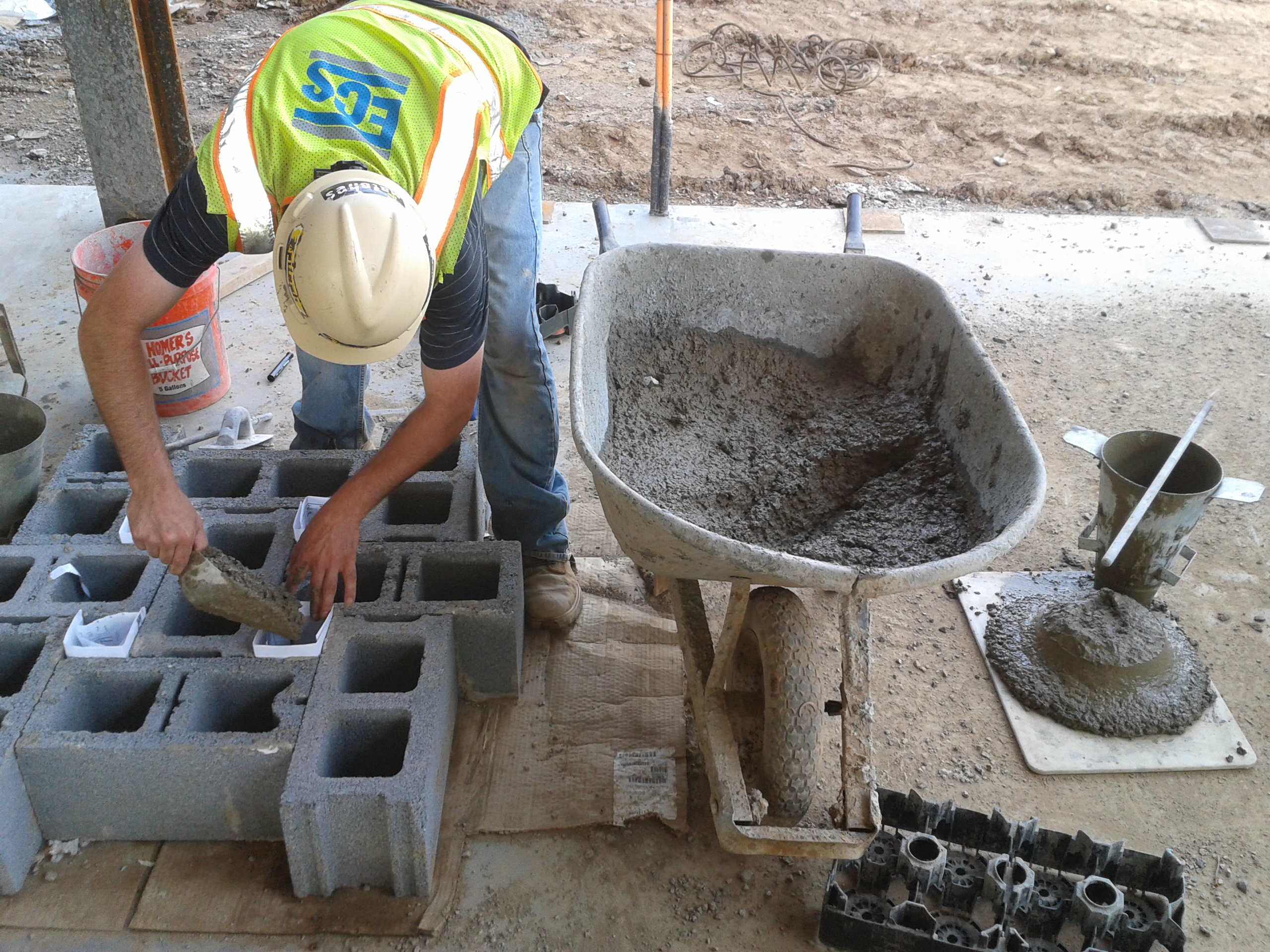
I have also been conducting grout testing for the stairwell masonry – this has involved the rather non-tech grout block testing pictured below. The paper enables a cube to be moulded whilst also allowing a transfer of water out of the grout to simulate the grout in-situ where the bricks absorb some of the water with cementitious materials in solution. We are still awaiting test results but we require 20500kN/m2; slumps 200-280mm.
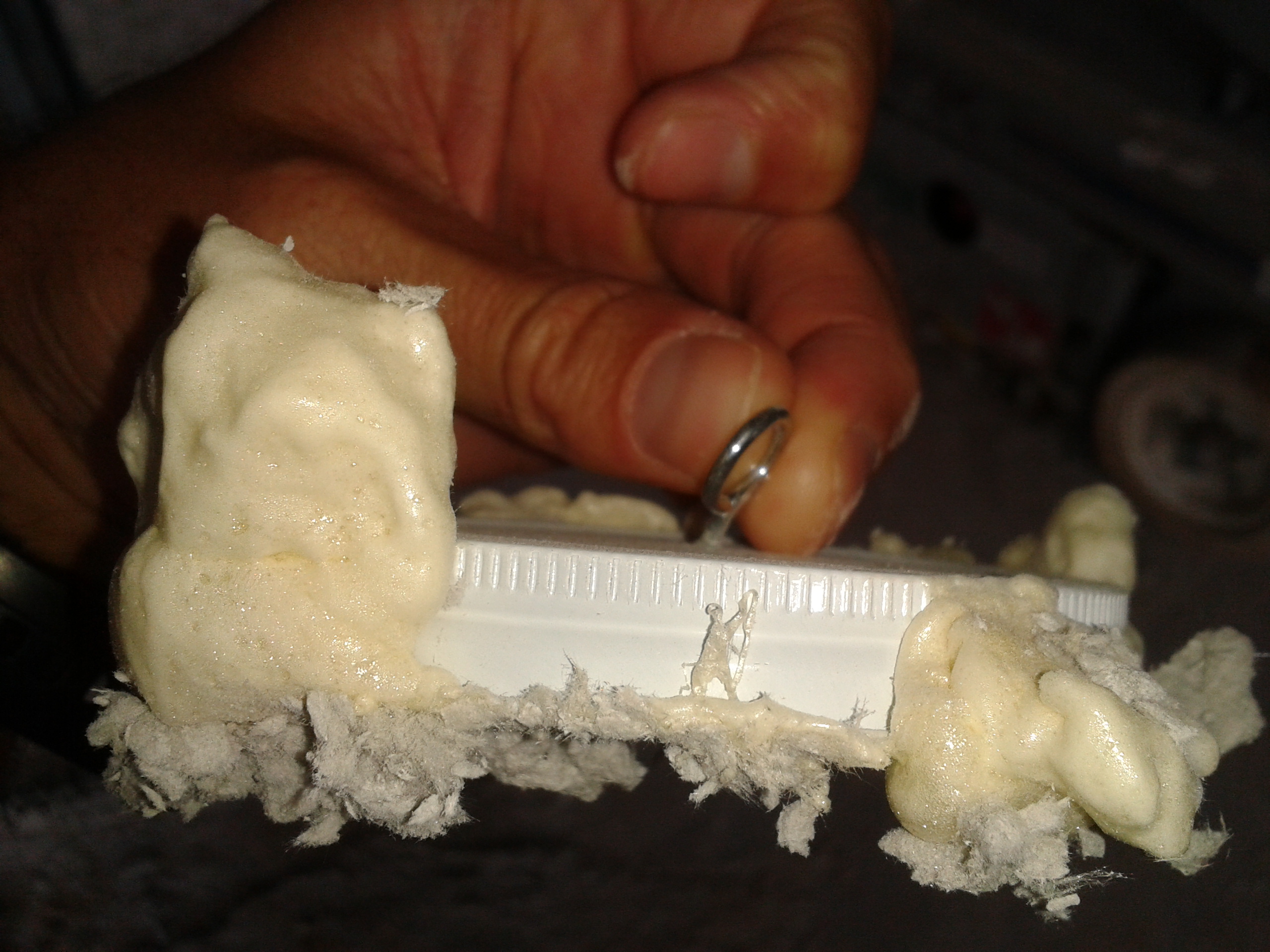
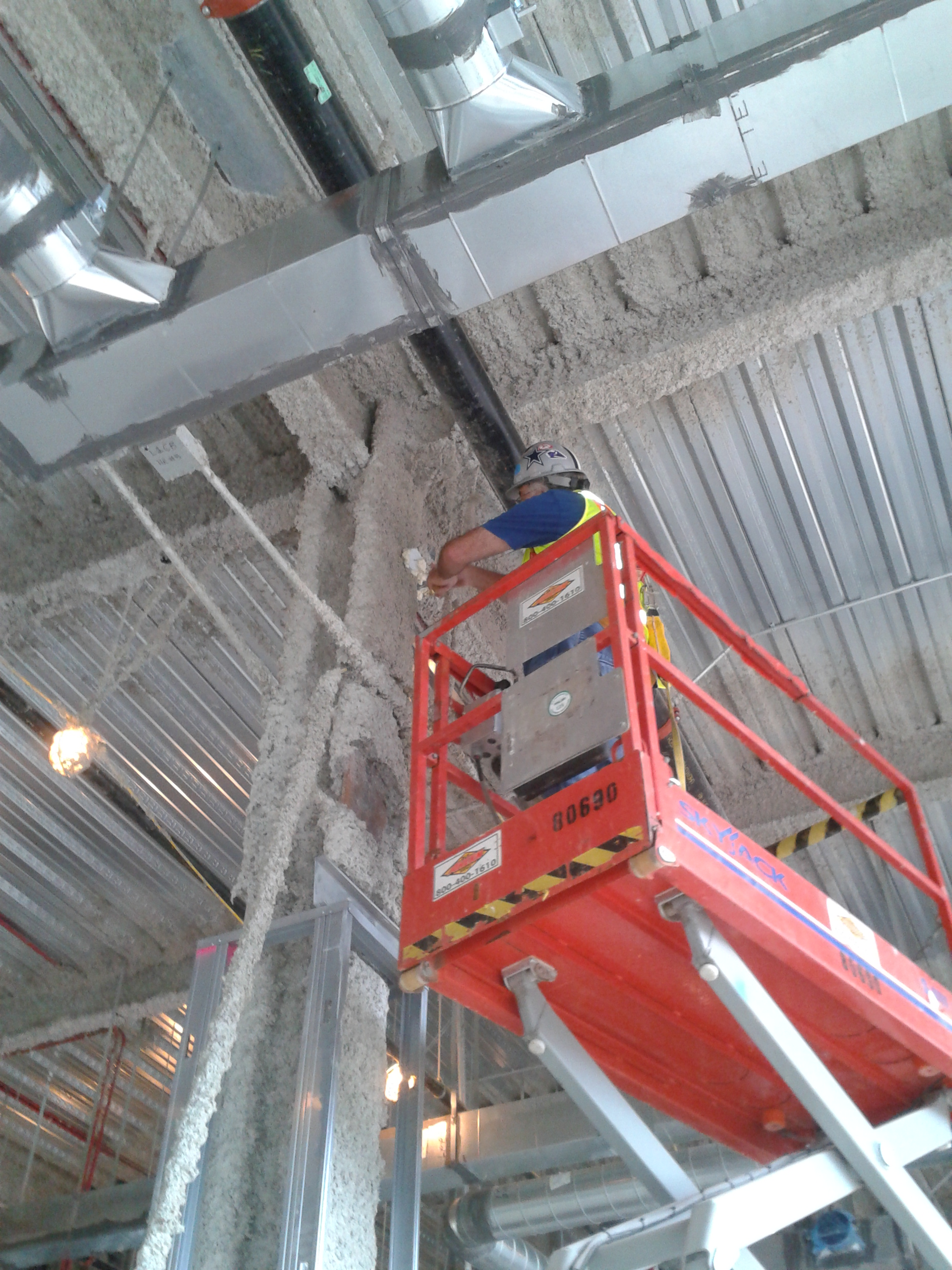
30 days post steel beam fireproofing we’ve jumped onto testing them for density and adhesion. Again, a very crude method but clearly laid out in the ASTM (EC equiv). The density test is done with a 12×9 inch removed area and lab-tested, while the adhesion test is done as follows: a mason jar-like cap with a hook is mastick’d onto random vertical and horizontal areas. After 24hrs of setting, the hook is pulled. In our case with a 1,75 inch thick material it must withstand at least 12psi of pull, unfortunately the material itself broke apart with a mere 5psi….oh dear! This has quickly shot up the pay-grades and we await a plan forward and response from the fireproofing manufacturers!
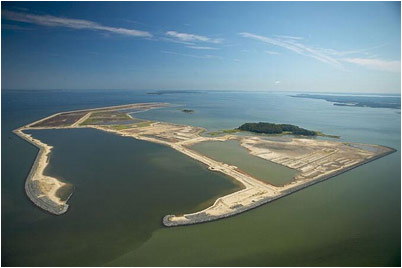
On a side, I made the most of being able to jump on the back of the District Commander’s diary so tagged along for some hobnobbing with a US Congressman who wanted to see the USACE island restoration project in the middle of Chesapeake Bay – Poplar Island. I was blown away…sustainability and PPP’s at its best…reconstituting an eroded island with rock armour and dredged material from Baltimore and Virginia ports and Chesapeake Bay that enables deep water harbours to remain open, prevents open water dumping, all whilst making a carefully balanced ecosystem haven that harbours 1000’s of terrapins and over 180 species of birds acros 7km squared. 2.4million m3 are dredged each year in the areas mentioned; the island at its present perimeter can house 30 million m3 of which 19million has been used; an expansion of the island is being applied for which will enable an aditional 23million to be used.
 Holdfast Training Services Trial Blog
Welcome back Howard! What density is the lightweight concrete achieving? Are you using an admixture to avoid water loss into the aggregate or is it pre soaked? Very pleased with the air entrainement tesating. this will stand you in good stead if you ever need to deal with air operating surfaces or plant yards. Poplar Island featured in Matt Fry’s experiences. Did you have chance to see the overflow controls at all? Do you get to enjoy country and western radio?
The density attained is c.1840kg/m3; the aggregate is presoaked – admixtures besides air-entraining agent are purely for workability, water-reduction and early age strength. Matt’s overflow controls haven’t yet been installed, but are certainly known about amongst the island fraternity…the intent is to incorporate the design into another structure which is still being worked on. The novelty of listening to country and western, particularly in my government chevvy driving to my levee (repair!), has quickly withered…largely as a result of nigh on every song’s theme consisting of one or all of the following: my empty beer bottle, my truck or my girl’s tight-jeans!
Do you QA the density at all? I wouldn’t anticipate any issue in the US given it is aggregate derived but I’d be suspiscious in some regions that aggregate cost might tempt some switching or blending! My reading of the application is that this concrete is thin section on steel deck so the early age strenght, which suggets high heat of hydration, isn’t giving thermal shrinklage issues and associated cracking. How does the cost of you pump mix decking concrete compare to Joe’s Conveyor gantry bases?
Richard – we don’t QA the density. Cost of pumped concrete is c. $110/cubic yard which is approx GBP80/m3
Hello Howard
Out of interet what is the fire resisting material being applied ? My guess at the reason for the testing is that in the 9/11 collapse one of the things that went wrong was that the fire resistance was effectively blasted form the underlying steel in the burst…had it not been it is pretty well agreed that the progressive collapse of the cotre would have been avoided
Hi John,
The material is called Cafco Blazeshield HP; spec: http://isolatek.com/productinfo/CAFCO%20BLAZE-SHIELD%20HP%20PDS.pdf
The immediate comeback from the manufacturer was that the material was still wet as a result of high regular humidity (80%+) hence the failure; they are going to oven bake it and retest it.