Come back Mike Burton…all is forgiven!
I am very proud to say that I am following in the footsteps of Mike Burton. I don’t mean drinking too many ‘Quad Vods’ at Jester’s nightclub, telling war stories to impressionable students…I mean in making my mark CrossRail’s Fisher St shaft. Good to finally be on site full time…
Overview
The Fisher St project consists of two distinct sections of works;
Phase 1 was the excavation of a large access and maintenance shaft, 25m in depth running from ground level to running tunnel. Adits on the northern and southern sections of the shaft adjoin the east bound and west bound running tunnels. Mike saw this section of works completed throughout his time here. Its function during concstruction is to act as access and egress for equipment (including the removal of 2x1000tonnes tunnel boring machines), material, spoil and personnel aswell as a mean of escape. In operation it will act as a maintenance shaft and proivide ventilation to the running tunnels
Phase 2 is the construction of the cross over section. The only point throughout the 42km of line that the two tunnels interact, the section will be used for train maintenance, in the event of a breakdown, in order to clear the line. Work is underway to excavate the ‘binocular sections’…essentially the section on each running tunnel where the tunnel divides in two to form the crossover section. My part of ship from here on in…see the overarching plan for the picture to paint my 1000 words.
Ground
I remember the Great Orator mentioning that the ground is actually quite fundamental….he mentioned it once or twice. The nature and engineering behaviour of the ground in tunneling is obviously critical to the design considerations of the underground structures. Crossrail tunnels have been bored at an average depth of 25m along their length, with the odd fluctuation to avoid existing underground structures. The tunnel boring machines and station tunnels and caverns have been bored/dug with relative ease due to the excavations being conducted largely in the London Clay Group. Having looked at some of the ground investigation data, it seems that this consists of stiff or silty clay ranging right through to mudstone. These Palaeogene marine deposits, I’ve been assured, make for an excellent tunnelling medium, due to their relative homogeneity offering some predictability, and their short term stiffness, which allows brief unloading without collapse, ahead of stabilisation with SCL.
However, in the Fisher St/Farringdon area, the base of the London Clay sits at approximately 30m below Ordanance Datum. This area coincides with a ‘busy’ underground infrastructure network (proximity of Central and Piccadilly Lines, aswell as numerous underground services) which constrains the allignment depth. You will see from the Geological section above that just at the point of constructing arguably the most complex section of works in the allignment, we pitch head first in to the Lambeth Group.
At this stage, its probably worth thinking back to the days of the McGuirk Bluffing Face…a slight nod of recognition toward said lecturer as if I was following, when internally I was in a flat spin. Well, the same thing happened when I was told this; as if I understood immediately the implications of it…I didn’t. So I did some reading!! Yea alright, stop laughing….
This is what I learnt….we’re predominantly in the red/brown or green/grey ‘Upper Mottled Beds’, but there is quite a bit of other stuff (technical term); from fine silty sands, shell beds and sandy flint. Bottom line, its a bit of a mess; in contrast to the relative homogeneity of the London Clay belt, this material is vertically and horizontally inconsistent. For tunneling, this presents risks; potentially water bearing, the excavations could cause a flow of material along failure planes as they are uncovered, major face instability prior to concrete spraying, and greater than expected surface settlement with associated damage to surface structures in prime central London real estate.
The Tunnel Boring Machines have passed through the allignment, without reported incident, and as such I have had a few raised eyebrows for asking what the perceived risks are in relation to our excavation. This would be ok…but I since discovered that the TBM has no means of recording the nature of the ground that it passes through, for its properties, contamination or indeed the ground water regime. So essentially, we’re operating solely on a triangulation of two boreholes located 30m and 20m distant from our crossover section, and a baseline statement in the Geotechnical Baseline Report that the lower aquifer on our location is approximately 30m below the excavtion and is therefore of no significance.
Groundwater
I think that the proximity of the borehole data gives us a fair idea of thewhat the enlargement excavation will uncover, so the primary risk will be in the groundwater regime. We are aware that the Lambeth Group is likely to bear isolated pockets of water; so the water is anticipated but the quantity is unknown. So this leads to a number of risks, (based entirely on ripping off Johns notes…)
- Potential for inundation into the tunnel as a pocket of water is uncovered.
- The Lambeth Group is non-cohesive, so this may lead to an increased risk of heave in the tunnel invert if the resistance to this uplift is less than the head created by this water
- Instability in the face due to ground movements caused by pore water pressure.
I must admit, I’m not yet sure what we’re doing about this, if anything, and so I will revisit in future blogs….
What next?
A part of the Phase 2 works, the binocular section on the westbound tunnel (WBX) has been excavated and the primary lining sprayed.
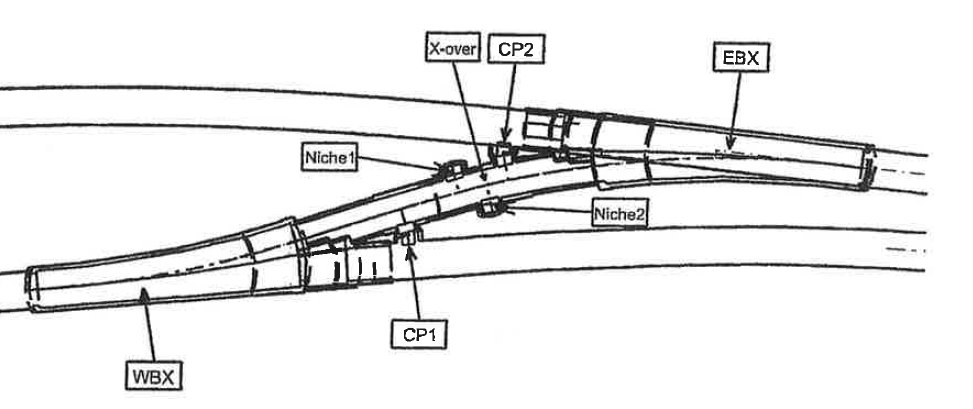
The construction of the cast in situ secondary lining works will now go ahead, with me firmly installed as the section engineer! Blog to follow….
 Holdfast Training Services Trial Blog
So to go over it agains
CLAY is a fine grained deposit (sedimentary from deep water) when you unload fined graiined mateial ( dig a tunnel) the response is a drop in total stress ( to zero on the inside face unless the tunnlling is in compresed air – frowned apon there days) the posre stress dops so the strength stays much the same and the thing doesn’t drop on your bonce.
The Lambeth Beds a re a mixture on fine and coarse grained. In coarse grained the pore pressure drops and returns in the same instant and the stuff tend to ……..(completethe missing phrase) ;.. so ther’s one problem
THe London Clay is an aquiclude above an aquifer… that’s why we had loads of breweris in ‘the Smoke’ …..go beneth it into the Lambeth and the water pressure is mighty high….moreover the Lambeth Beds are highly anistropic ( the clue is ‘Beds’) …..put this lot together and you never know when it’ll be pissing in from the face or the base
…so have fun!
Hi John
Thanks for this. After months of you explaining this, you’ll be pleased to hear I’m beginning to get it. Your point about the aquiclude, and a high pore water pressure strikes a note with me. I had asked this question, (remembering the discussions about breweries it stuck in my mind!), but it was largely dismissed due to the baseline statement in the GBR refering to the depth of the lower aquifer not affecting us. Still not comfortable with this, I checked the method statement for groundwater mitigation measures. This is the only reference:
A.3.7 Ground conditions & Groundwater
From site investigation included in the works information all tunneling at Fisher Street should fit within the London Clay limits, with clay cover to heading/bench invert varying across the works. There is the possibility that the Lambeth Group may be encountered in the invert or in close proximity. The geotechnical baseline report suggests mottled beds may be encountered in the western sections of the WBX (Wesbound Crossover). The face will be logged for each advance to monitor ground condtions.
Am I missing something? If we are saying we are likely to break into the Lambeth Group, should we not be doing something to confirm it? Is there a method of probing or similiar to check whats ahead before you excavate? Seems odd to not know, then stick a poor old Geotechnical engineer at the newly excavated face to log it?
This section of works has been completed without incident but my questions have unsettled the horses. Really keen to hear what you think however, as an excavation of a small cross passage is coming up. This will occur further east and into the Lambeth Beds proper.
Ryan