Services Engineering with John Holland – Part 2
So, having had mixed feedback on Part 1, I will forge ahead with Part 2….
The Project
Comprised of 3 Lots; Lot 1 – additional works to the plant room in a neighbouring building to provide chilled water AC to the new buildings; Lot 2 – a 6 storey high-tech arts and dance building with acoustic sound studios; Lot 3 – the renovation of existing heritage military barracks into a student arts centre. An AUS$60 million project with intricate architectural detail, a lot of off-form white concrete, acoustically isolated studios and state of the art AV systems.
From what I have heard of other projects, there are advantages and disadvantages to being on a relatively small project. In the time I have been here, I have been able to develop a sound understanding of the services for all 3 Lots, and have been immersed in the structural, facade and finishes aspects of the project as well. The amount of off-form concrete means that there are vast numbers of cast in conduits that are later used to carry power and communications cables, and the accurate location of cast in penetrations for services is vitally important given the exposed concrete.
Perhaps the negatives are that there is not the extent of different services in this project compared to those you would find in a larger project (e.g. a hospital). For example I have had nothing to do with HV power; something I know Ollie has been heavily involved in at the Perth Childrens Hospital.
Being in a small team (c. 16 people) in one site shed means that I have really got a good feel for the politics behind decisions made and the contractual ‘game’ that is played out between subcontractors, head contractor, client and consultant.
The Project Team
The basic team org chart is shown below. The team has changed considerably over the last 8 months with all bar 3 of the project team members changing over. The only team members who have survived from the start are the PM and my services colleague. Some of the turnover im sure can be explained by the uncertainty over the future of John Holland (JH). They are up for sale and the buyer is as yet unknown. Nobody knows for sure if the buyer will keep the building side of the business. There is also a lack of work in Queensland; with a couple of other projects finishing up in the coming weeks, we are soon to be the last JH building project in Queensland. There are more projects in the pipeline though, i’m told.
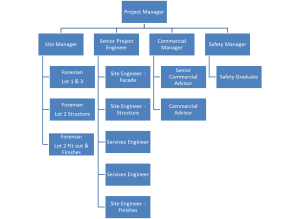
The military equivalent of the foremen would probably be somewhere between a Cpl and a SSgt depending upon experience. They drive the subcontractors on site, but rely upon the engineers to ensure the necessary design information is available and to resolve issues as they arise, such as services clashes. I was surprised to find that there are actually no ‘proper’ engineers (either chartered or with an engineering degree) on my site. We are referred to as ‘Pretengineers’ by the foremen. My PM has got to where he is from being a chippy and the Safety Manager is an ex Australian Army RSM.
The dynamic has not been at all what I expected. On my site the foremen run the show and the engineers do the administration as required. This, in my opinion, makes the team very reactive rather than proactive, particularly as the Senior Project Engineer resigned making it harder to gather the engineering team to do any forward planning.
Roles & Responsibilities
Despite the lack of knowledge of drawings and general terminology, responsibility came quickly. My primary responsibilities are below with a rough percentage of my day allocated to the task.
- Services Co-ordination Meeting – With the services trades still very much clearing up design issues and generating shop drawings in the early weeks, I took responsibility for running the weekly services coordination meetings. At this stage the meeting was attended by each of the services Project Managers; Electrical, Mechanical, Hydraulic, Fire and AV Systems. The principal aim was to provide a forum to discuss clashes and design issues identified during the shop drawing process. In the last 2 months, the meeting has become more of a site coordination meeting between services and finishes trades with attendance primarily at the site supervisor level. (5%)
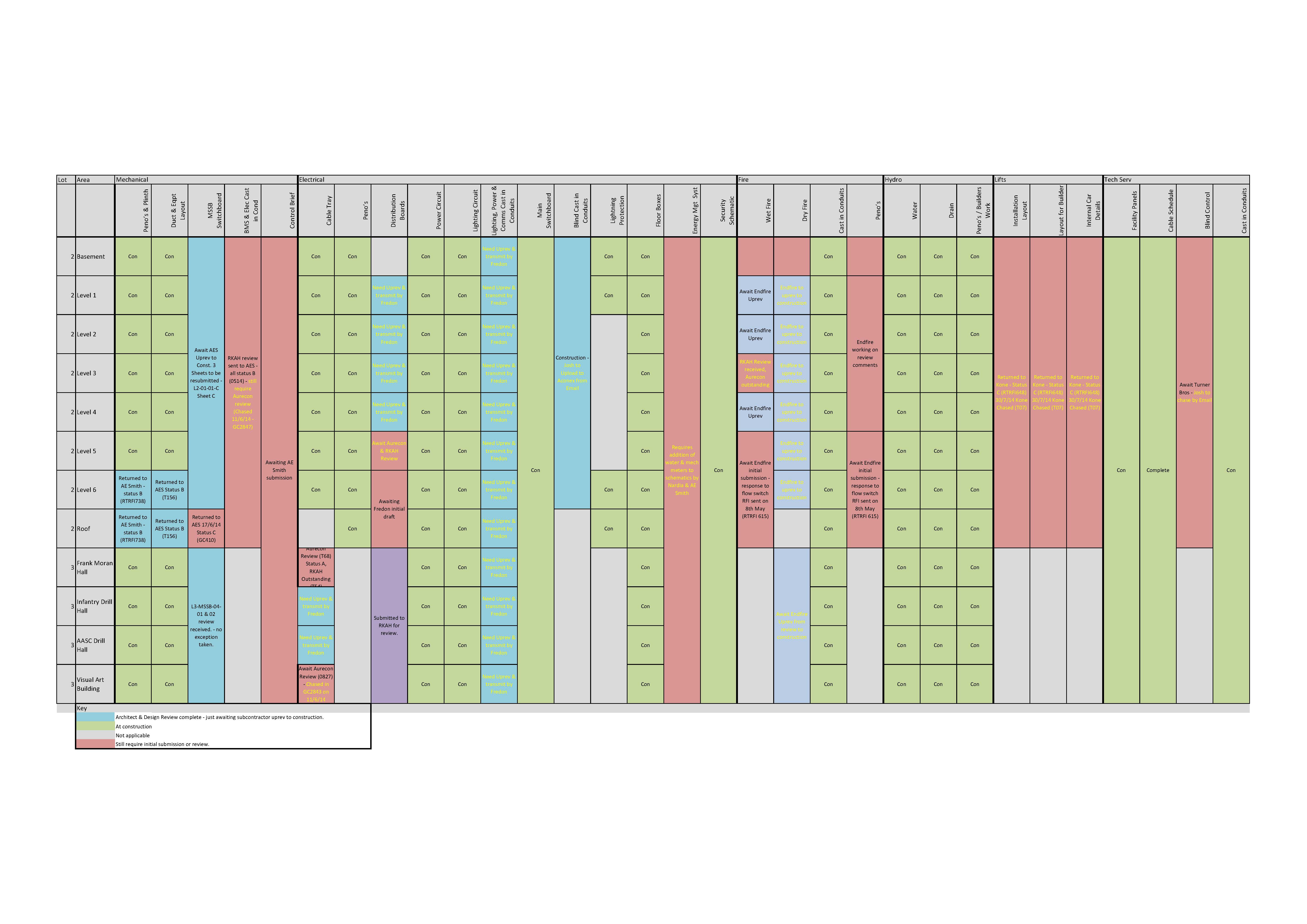
- Managing Services Shop Drawing Reviews – The specification documents call for certain shop drawings to be submitted to both the Architect and Consultant for review. These need to be chased, and tracked, a deceptively complex task given this involves in the region of 400 drawings from 5 trades, each of which may need to be revised and resubmitted anything up to 6 times. I developed the spread sheet below to capture the status and relevant Aconex correspondence numbers. When I arrived on the project we were probably about a third of the way through the process. (20%)
- Services Correspondence – Responding to requests for information from the subcontractors. I have nothing to reference against, but I’m told that this job had an unusual amount of incomplete design. Throughout the shop drawing process and during install, these gaps in the design such as areas on ‘hold’ and missing set-out for services have generated a significant number of RFI’s, each of which need checking (to ensure we definitely don’t have the information) before they are sent on to the Client / Architect (as the lead consultant). I have no idea how this compares to other sites and would be interested to know, but I have sent over 200 RFI’s to the client / lead consultant (the other services engineer around 480), and nearly 1000 other related correspondence. The project uses Aconex to track correspondence which is pretty good once you work out how to use it. I did spend the first couple of months tracking correspondence through a spread sheet though, before I got the hang of the software. (40%)
- Quality – Managing the services trades ITP’s. This involves checking cast in conduits and penetrations in slabs before they are poured and getting trades signatures on the ITP. The same checks must be carried out before walls and ceilings are closed up. Each trade should then provide a copy of their own ITP as an annex to ours. As you can imagine, this is not top of their priority list. There is also a requirement to understand what the specification documents call for so as to check the trades are not taking short cuts to save a buck. (10%)
- Checking Variation Prices – Ensuring subcontractor claims for variation costs are legitimate and checking the prices against the schedule of rates. This can be time consuming as subcontractors will regularly chance their arm at recovering costs that do not constitute a variation and are quick to jump on the fact that due to our high staff turnover, we struggle to retain information on previous conversations etc. As such time is spent trawling through correspondence, meeting minutes and drawing revisions to determine where cost should lie. (5%)
- Safety – Various site safety requirements such as routine hazard inspections, reviewing subcontractors safe work method statements, issuing concrete penetration, excavation, isolation and hot works permits and periodic reviews of the Activity Method Statements (AMS). (5%)
- Clash Resolution – On site resolution of small clashes that are not design related. Usually takes some diplomacy as each trade thinks the others should move their services around them. (10%)
- Occasional Tasking – Researching and delivering solutions to problems such as ensuring sufficient fire hydrants are installed to maintain fire code compliance during construction and developing a solution to providing temporary ventilation through the building once the façade is installed. (5%)
The Routine
- Site opens at 0630hrs – arrive at work.
- Get a brew and quickly check last nights emails.
- An early site walk, which will inevitably generate safety or clash issues to be resolved.
- Deal with correspondence and chase outstanding RFI’s
- Another site walk.
- Team meeting.
This should lead on to Part 3 where I will try and summarise key lessons….
 Holdfast Training Services Trial Blog
Thanks Ben,
An interesting and enlightening read. I’d be interested to know how this compares to the experience of the other E&M attachments as well as hearing a civils view point. From my slightly too long off site desk position it looks very project mangement centric with little engineering appreciation or modelling required, no real risk mangement or down and dirty technical. The latter you should be able to recover in the design office but this still doesn’t cover contract mangement and evaluation of solutions to engineering problems. I would expect civils to be thinking about and writing the AMS not just reviewing it. How do you feel your present role sits with IPD and the attainmanet of Engineering Competencies?
Incidentally, having not joined the fray earlier, I’ll add that I thought your remarks in part 1 about drawing office practice and knowing what to expect of a fully integrated information mangement system before arrviving on site were aposite.
Thanks Richard. Useful feedback! Whilst I have managed to get my fingers in most aspects of the project, I have been struggling to gauge the level of involvement I should be getting. Your comment about not having written an AMS hits the nail on the head. I have been actively involved in reviewing them but have not written one – probably not something i can change at this stage either. The AMS’s for the current ongoing activity were written before I arrived. I have however been involved in meetings to update current AMS with the necessary detail for the lift install….
I have been concerned about the lack of ‘down and dirty’ technical experience I have been getting. This is a construct only project and as such, contractually, most of the problems I have encountered belong to the consultant. The uneasy dynamic between JH and the consultants also means that I am unable to recommend solutions. As such the best I can really do in terms of evaluating engineering options is to understand the issue and try to establish the options for moving forward for my own personal benefit. I must still raise an open question to the consultant, and direct the subcontractors to build the response (even if there may be a better one) as this is how the PM has told us to play it. As ever, the reason for the PM’s stance on RFI’s is because we were knocked back on a variation claim for additional design work. Now we have gone to the other extreme and do not contribute to design work at all.
I would appreciate your advice on the contract management piece. I routinely use the contracts and specification documents to determine where cost should lie in disputes, have chaired meetings to resolve disputes, carry out assessments of subcontractors variation claims and assist in assessing subcontractor progress claims. I have not been involved in tendering or letting a contract. Is this the level I should be operating at?
Ben, As long as you are able to appreciate the drivers in producing AMS I don’t think you will suffer. Looks like you are getting reasonable exposure to mangeing the contract. From my perspective I would want you to consider how different forms of contract might have worked i.e. could problems have been resolved more easily using a different contract form, has the contract form used shown significant benefits for manging risk or resolving issues: Equitably (both parties happy) or unevenly and therfore potentially unsustainably? In terms of adequacy, Mark H is in a better position than I am to comment on level of reflective comprehension required for IMechE so I’ll pass the buck on this one…
Thanks Richard.
Ben, writing the AMS from scratch shouldnt be necessary providing you are having significant input in the review, which it sounds like you are of course if you can get into a position to write some up then all the better and I suggest you highlight this to JH, its part of the trianing agreement I believe (check with David).
You’re in the right ball park with contractual review, leading meetings and approving variations and Richards advice about consdiering alternatives is equally valid on the Imeche side. You should however be getting some exposure to tendering and letting contracts even if that can only come in teh form of vraiations led from your side of the fence, dont be too concerned about value but go after JH again to get you in a position where you are driving the procurement process rather than be driven by it.
Mark
Thanks Mark. I will see what I can get out of the last couple of weeks.
Good blog Ben. I’ll get my act together and write a bit on my experience which is very different (mostly due to the PM and snr project engineer having had a PET student on a previous project). I think the flow of information within John Holland was a bit hit and miss, with my PM being critical of the info passed to him by John Reddie. With his previous experience of PET students it was well set up when I arrived and I’ve had plenty of responsibility from early on. A lot could be down to the personalities involved though. In response to Richard, yes I have written 2 AMSs (driven piling and bridge substructure) and have a third to do by the end of next week!
Hi Ben,
You mentioned that projects for JH in Queensland are drying up but you think there are more in the pipeline… Any additional info/feedback you hear of would be greatly appreciated as I’m very keen for a placement on the East coast.
I’m on leave at the moment Fran but will do some digging when I get back.
Fran.
I have done some digging on upcoming projects with JH Queensland. I’m afraid it isn’t a rosy picture. The project I am on is due to finish up in June 2015, this is the only building project at the moment in QLD and there are no future building projects on the books at the moment. As far as building is concerned, there is an outline chance of a couple of military projects up nearer Darwin in 2016. In terms of civil projects rather than building, there is a water treatment plant at Rubyana but that doesn’t go into construction until July 2015 and there is a tunnelling project in Toowumba again starting in July 2015. Both would have mechanical and electrical involvement but you would need to spend the first 3 months in a design office.
The closest you would get to Brisbane is the Lismore Hospital project. It’s in New South Wales but is closer to Brisbane than Sydney (approx 2.5 hrs from Brisbane). The project went into construction phase about 2 months ago and is due to last just shy of 2 years as I understand it.
I am currently in the last standing building team with JH in Queensland and most of these guys will need to be looking inter-state or to jump ship come June.
Ben
Ben,
Thanks very much for the info – I’ll need to get on Google Earth to find out exactly where these locns you mentioned are in relation to each other and wrt the east coast but the Lismore Hosp looks like the best of what you mentioned. Maybe a design office start might be the answer? – will need to chat that over with the SI.
Cheers for your help.
Fran.