Danville can sleep safely!
The ‘wall’ is now complete…inspected, handed over, warranties issued and snag list complete. The only outstanding issues I still have to deal with are working through the red-line drawings, chasing up failed submittals and rebutting some anticipated REAs. A good sense of accomplishment, particularly having finished a month ahead of schedule so smiles all round. Looking at it now, one could never imagine how much toil went into a relatively simple and small structure…but one that is key to saving life, and sustaining a major transport route through Pennsylvania. I compare this (on a far smaller scale) to a similar feeling probably felt by engineers involved in the Dawlish SW train track repair – a mammoth task which at the end looked pretty undramatic, but was neverthless paramount to both safety and sustaining transportation routes, tourism, economy etc etc.
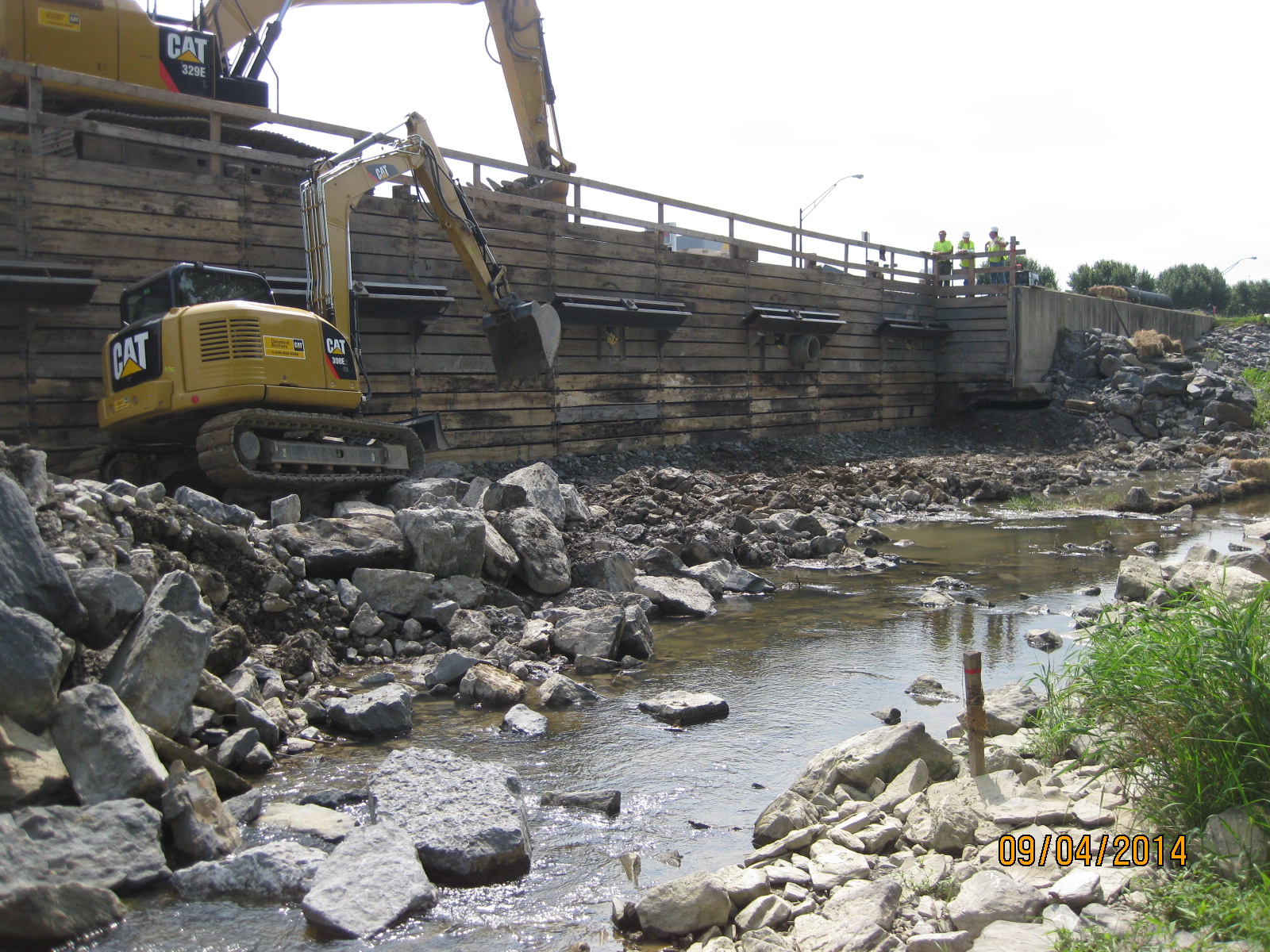
Excavation and shoring system – 2 months prior to completion
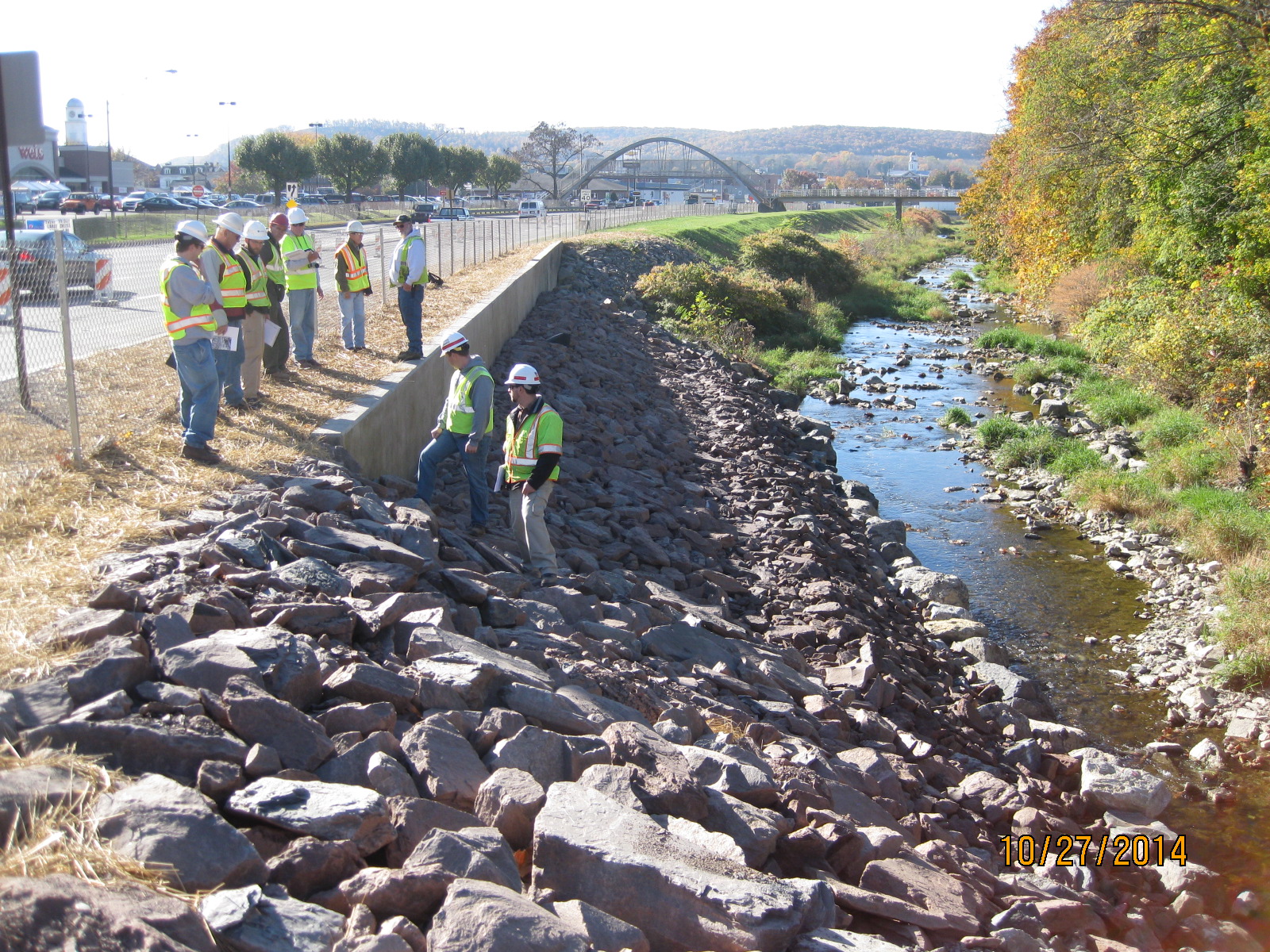
Inspection and hand-over
I have now switched the majority of my focus to the on-base warehouse project; I’ve been really impressed by the management, work ethos and professionalism of the contractor on this site – one of the advantages of the USACE posting is being able to observe and contrast management styles across different projects, but also to gain knowledge from a large pool of contractors. My focus comes at a time of large internal slab-on-grade pours incorporating underfloor heating systems; the base has suffered in previous projects from concrete curling issues so I’ve spent a lot of time digging through codes, specs, technical reports, and working closely with the QC manager to ensure that the mix design, conditions, and handling eliminates this problem…so far so good on floor flatness tests. Temps are due to drop down to 0degC next week; consequently we have been working through a cold weather plan to ensure everything continues on track – some of the research behind TMR1 has proven its worth!

The highlight of this week was the testing of rescue procedures of a man-down on the roof! Clearly the on-barracks fire brigade were warned off, because the whole wild-west turned up on-site within 2 minutes. Despite my muffled laughter of handle bar moustaches (this wasn’t Mo-vember!)and denim jackets, the serial proved valuable in testing the procedures…or lack of! Following a debrief, I essentially rewrote the entire actions-on procedure for the contractor who, to be fair, didn’t really have a starting block – for once, some practical non-engineering military knowledge brought to the fore.
 Holdfast Training Services Trial Blog
Hi Howard,
Glad Danville creek is now due to run in bank for the forseable future. You carefully drop the hook of “concrete curling (sic) issues”, which I take to be curing, into this piece. This is exactly the way to get a reviewer to ask questions about it at CPR, so if that’s the intention, nicely done. What were the problems and were they curing or placing and compaction problems?
Sadly no planned error – ‘curling’ is exactly what I meant! Previous problems were largely from poor design, a lack of understanding of curling and its causes, poor QC, lack of defined/robust specifications…all issues I’m now trying to iron out for this project.
For the benfit of my ignorance and the collective education could you expand upon the causes of curling…
Sure, exert from my TMR4 draft…curling is the the distortion of an originally essentially linear or planar member into a curved shape, such as the warping of a slab due to differences in temperature or moisture content in the zones adjacent to its opposite faces. The distortions, in internal slabs, can lift the edges of the slab away from the subbase resulting in an unsupported section, which can result in cracking when loaded, edges chipping or spalling from traffic use as well as safety and visual issues.
The predominant cause of slab curling is differential shrinkage due to differing temperatures and moisture, and resultant shrinkage variations across the depth of a slab as it dries and cures. Shrinkage can also be as a result of the autogenous shrinkage that occurs as cement paste hydrates within cement-rich high strength concrete mixes.
Thank you. And the significant findings in terms of what should/must be specified and delivered through QC are:…..
On a side, the ACI stipulates that control of curling is a designer’s responsibility – this begs more discussion. However, in absence of robust specifications, QC is the last line of defence…
– Limit over-trowelling – typically used to produce a hardened layer, but encourages aggregate to sink and cement to rise causing differential shrinkage.
– Limit the amount of water in a mix iot reduce shrinkage, through:
+ use as large a size of aggregate as possible (reduces cement req)
+ use well graded aggregates, limiting fines.
+ ensure clean aggregate
– careful sleection of water reducing admixtures
– careful selection of subbase material and vapor barriers
– limit excessive haul in transit mixer, too long a waiting period at the jobsite and too many revolutions at mixing speed increases.
– monitor concrete temperatures upon discharge (lower temps = decreased differential temperature losses AND increased workability)