The Joule-Thompson Effect
Since arriving at BP I have come across the Joule Thomson (JT) effect a couple of times. I even thought about doing a TMR on it but I couldn’t really find the correct angle. It is where a gas goes through a restriction orifice (RO) and expands. The expansion of the gas results is a reduction in pressure and the gas accelerating. Both the expansion and acceleration lead to a decrease in temperature of the gas. It is worth noting, not all gases lead to a decrease in temperature, and some like helium expand and involve an increase in temperature due to the nature of the chemical changes occurring during an expansion. However, hydrocarbons end up having a drop in temperature following an expansion. The resulting temperature drop can take the minimum temperature outside the minimum permissible temperature of the materials involved.
Consideration of the JT effect is usually incorporated into the design process so you’d think that this should not be a problem. However, my recent experience has proven that this is not always the case.
The problem can come from several different factors. One explanation is that there are some rules of thumb which are not so good and some rules of thumb that are quite good. For example, how much the temperature drops depends on how big the drop in pressure is. Also, a gas that starts at a lower temperature is likely to suffer a larger temperature drop for the same pressure difference than a gas that starts at a higher temperature. The rule of thumb is that a gas will reduce in temperature by 0.5 degrees for every bar. However, in reality it could be between 0.2 and 1 degrees for every bar. This is a poor rule of thumb.
Another, industry rule of thumb is that the temperature creep will not go further than 1m back up stream from the RO. This is a conservative estimate and in reality it is likely that it will not get beyond 0.23m back upstream because of the warmer gas fluid flow upstream of the RO. This is a good rule of thumb but not one that seems to be widely known.
BP have never had a low temperature brittle fracture in the North Sea due to the JT effect. However, since Deep Water Horizon there has been a shift in culture towards checking everything. So much so, that in safety meetings such as HAZOPs, it is often asked whether during a blow down to ambient pressure (ie the greatest pressure drop and therefore the lowest possible temperature), will there be a low temperature brittle fracture. It has become a fashionable question to ask. It is like a junior officer coming up with the implied task of liaison during JOTAC. It is said without any thought for how to do it. This serves in creating work for other people like SPAs. I have spent a considerable amount of time reading on this and discussing the matter with purported experts and have finally got to the bottom of the problem.
For my HP discharge cooler project I inherited a HAZOP action of this nature and I have drawn a simplified schematic of the system in order to explain it. I am replacing the heat exchanger (or cooler) and the question was would the minimum temperature reached during a blow down damage the new cooler. Ultimately, this is an idiotic HAZOP action and I will explain why below. However, it has taken me a long time to realise this was stupid.
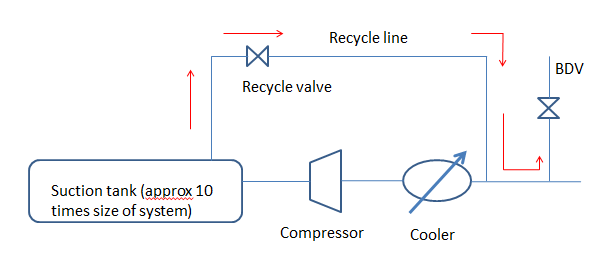
During a blow down to ambient temperature the flow of gas would be from the suction vessel through the recycle line to the BDV, as shown by the red arrows in the schematic. It would not go through the HP cooler because the resistance of going through the compressor is significantly higher than going through the recycle line. Also, the recycle valve is a control valve that would be set to fail open. Furthermore, the RO is significantly further away than 1 m from the cooler so there is no chance of low temperature creeping upstream to the cooler. This is according to the rule of thumb.
However, there is sometimes a good reason for why the JT effect has been overlooked and they cannot all be discounted so easily. The North Sea is a mature oil field and the designs were completed up to 40 years ago when the hydrocarbon composition coming out of the ground was different. Initially, it was mainly liquid that was produced. More recently, as the field has matured it tends to be gas. There is no JT effect with liquid so things were not designed as rigorously for the JT effect. Instead the considerations are different, such as a liquid stream will carry much more debris and cause corrosion so they select the materials for what was the situation at the time or the foreseeable future. Furthermore, the operating conditions are different from start-up conditions so the design needs to incorporate the worst case. Prior to start-up of a well, the hydrocarbons in the caisson will settle under high pressure so that less dense gas is on top of liquids. Therefore, when the well starts producing again the build-up of gas in the pipe comes through an RO first and if it is a big build up in can take a long time to clear the RO and hence create a low temperature that the pipe specification was never anticipated to see
There are also other considerations. Mechanical engineers need to be provided with the lowest temperature a line may see to ascertain whether the line will fail or not. If the line is LTCS it is fit to -29 degrees. To say the liquid will be lower than that is unhelpful. How much lower, -100 degrees or -30 degrees and for how long. There are other factors too, such as ambient air temperature and wind speed. Just like in a heat exchanger a forces air flow of a temperature that creates a large temperature gradient will combat a low temperature brittle fracture because it will raise the temperature of the pipe. Therefore, engineers need to start to look at the likelihood of conditions combining to make the worst case scenario. It is a very complicated matter and one that it is unsurprisingly overlooked during design. It also makes things hard to prove are safe because you may be trying to prove the absence of a set of conditions or that worst case scenario is unlikely. The JT effect should not be thrown in as a fashionable buzz word to make people feel like they are contributing to safety meetings. But it does need proper consideration for the full life cycle of a well.
In other news
I have just been on holiday to Brazil, and it was really nice to get some sun in what has been a genuinely long winter. It was a bit of a shock going from a humid 40 degree paradise back to a -5 degree freezing cold Aberdeen. Although given the fact that I was sunburned on the first day and looked like a crab stick for the majority of the holiday I need to accept that I am more suited to cold weather rather than the sun. Check out the tan lines, it looks like I’m still wearing a white t-shirt.

As you can see from the picture, my kids have inherited my propensity for tanning.

 Holdfast Training Services Trial Blog
NIck
Glad you enjoyed the holiday, questionable whether you look like you’re wearing a white t-shirt or a cut off orange boiler suit but we’ll leave that to another day……….
Interesting stuff the J-T effect and your observations are worthy of comment – is the problem in the HAZOP or is it in the HAZID? Could that potentially be a better TMR topic?
If the accepted risk is any plant within 1m of a site where the J-T effect may cause problems then surely anything outside of that should be identified at the earliest stage and not transferred to the HAZOP as anything other than a manageable risk? In this case you have to ask (and do) why is this being considered? If the BDV were attached to the pressure vessel, then would it be worthy of consideration? The J-T effect occurs in an adiabatic system so there is a conversion required for any isothermal system and, if the valve is exposed the J-T effect can only be considered a part of the overall problem – ergo the location of the valve is important not only from a spatial viepoint but also from a thermodynamic viewpoint.
With the J-T effect knowledge of the inversion curve is key, helium is observed to heat because the inversion curve is small, the lower inversion temperature is about 30K at atmospheric pressure and only slightly higher at maximum inversion pressure. The maximum upper inversion temperature is only about 150K for Helium but for hydrocarbons how does it differ?
If risk is an occurence, the likelihood of the occurence and its severity then is the real question “what is the impact of varying conditions occuring at the BDV when it operates?” operating the system as far from the inversion curve as possible will minimse the J-T effect so the BDV is the obvious risk in the system as you highlight.
Thanks Nick, I think I actually followed most of that – not bad for a civil! Surely one of the more important aspects which you touch upon is the concept of proving safe versus the acceptable risk profile throughout the asset lifecycle. i.e. therecognition that even doing nothing carries risk such that safe is a null concept!