Archive
Job cuts in the North Sea
I thought I’d spend a few moments putting pen to paper on the recent announcement by BP to cut 300 out of 3,500 jobs in the North Sea. (This note only refers to BP North Sea Global Operations Organisation.)
This was formally announced last Thursday in a Town Hall, i.e. get yourselves to the Gym for a centralised briefing (except this wasn’t three line whip). Whilst not directly influenced by this announcement I had a certain amount of interest, having been an observer during the recent military job cuts.
The Town Hall was delivered by the Regional President of the North Sea, Trevor Garlick, supported by the VP of HR, David Conway. In contrast to the military redundancy briefings it was not delivered from a script, however, it was clear that the brief had been prepared and was supported by a handful of slides. As can be expected the tone of the brief was also considerably different, in that it was softer and laboured on the fact that the decision to make the cuts was not linked to the cut in the price of oil but is a measure that had been under review and developed since Q4 2014.
So how did BP come to the number 300? The business driver is a simplification and efficiency agenda. In recent years BP has seen a 50% reduction in production, with an increase in costs of 37% and personnel by ~20%, all leading to a level of efficiency that is not competitive in the North Sea. Therefore in an effort to improve efficiency BP has scrutinised the activities in 2014, as it is the engineering, design, fabrication and execution of the activities that is costing the money, not the employee head count. With the activity set reduced the corresponding reduction in associated employee and contractor headcount was calculated. The 300 is split into 200 employees and 100 contractors, though the final numbers and split is still subject to consultation.
The execution of the redundancy programme itself does bare some similarities to the military redundancies. BP is openly inviting those that will take voluntary redundancy to come forward, through a process called expression of interest. It is not guaranteed that an individual will be selected, but it is hoped that it will reduce the number of compulsory redundancies. This process in open for a few more weeks and will close in February. After this point the VPs of each function will conduct a selection process and identify those individual that will be given voluntary redundancy and those that have been selected for compulsory redundancy. It is expected that the selection and announcements will be early in 2015 with those selected for redundancy leaving by end of Q2 2015.
One of the points laboured in the townhall was safety and how that will not be compromised during this process and this has led to certain trades being ‘ring fenced’. In simple terms all offshore worker have been excluded from the redundancy process as a cut in the offshore workforce was considered detrimental to safety. The impact of this is that half of the 3,500 is exempt from redundancy with the remaining pool approximately 1,750 strong. This relates to a 17% cut in the eligible workforce.
How does this affect me in the Project and Modification Team? At the moment I haven’t seen any direct impact in BP, though I expect that in the coming months the team will see some people leave as 80 of the 300 job cuts will occur in the Operations function, in which Projects and Mods sit. Some of this will be through redundancy though I expect some contractors will walk before being pushed as they look for other opportunities before the axe falls. Where these opportunities might be I don’t know, as many of the other operators and service companies are cutting jobs with considerably more gusto.
In terms of activities, I have seen little change in the desire to execute the work that I am responsible for as a significant amount of it is safety related and therefore tied to consent to operate. The remainder of projects have comparatively large operation efficiency impacts and so the business case that supports them remains valid, even with the depressed oil price.
Outwith BP I am starting to see some impact in the delivery of my projects. A number of senior Projects Engineers and discipline engineers in WGPSN have already made the jump and more are preparing to move on. The resultant churn as WGPSN attempts to balance resources will undoubtedly place pressure on the project schedules. In the coming months it will be important to spend more time with the Project Teams, which are unfortunately geographically remote, to keep the delivery on schedule / mitigate any impact that the churn has.
In closing this note I thought I would share Bob Dudley’s (BP CEO) comments at the World Economic Forum in Davos, Switzerland. He said: “We have got to plan on this (the oil price) being down for certainly a year, probably two and maybe three years.” Difficult times ahead for the oil industry and I expect that we will see more in the news.
Concrete Cracking I never knew it was so exciting…..it isn’t!
Background and problem. Within the design specifications for the Riyadh Metro there appears to be on the face of it an oversight in terms of the concrete specifications. The design specifications state that the maximum 2. allowable concrete crack width is 0.15mm. From my now understanding of concrete cracks this is considered to be exceptionally low with the BS and EC specifying a more usual crack width of 0.3mm. The only time that a smaller crack width is usually specified is for water retaining structures. As part of the team and as I showed an incline of interest at one of my first meetings I landed the role of leading small team (myself and on other) in the study of concrete cracking and the means to control it.
The reason behind the particularly strict crack widths is the durability of reinforced concrete within the particularly harsh environment of the Middle East. In the last couple of decades, the region has experienced significant growth in construction with a increased use of reinforced concrete as a construction material. Despite the generally accepted increased durability of concrete over other materials many of the structures are showing signs of deterioration within the 5yrs and the majority will not last the intended design life. A lack of understanding of durability factors in the initial design and construction combined with the use of unsuitable materials, poor workmanship, and lack of knowledge of the environmental affects on the concrete are considered as the underlying factors that lead to the two primary means of concrete deterioration within the Middle Eastare (que dramatic music);
1. Reinforcement Corrosion
2. Sulphate Attack.
In both cases the permeability of the concrete and the exposure of the reinforcement to the harsh environmental conditions is a key factor. Key to the permeability of the concrete is crack width.
Crack widths are a function of the tensile forces within concrete and the inability for concrete to carry tensile stresses (not strictly true, but very low). There are a plethora of mechanism that cause cracks within concrete, however as the designers for the minute we are tackling the one we have most control over first, flexural cracking.
Flexural caking occurs due to loading of the concrete. As a length of reinforced concrete is loaded the tensile stress cause the concrete to strain at the point at which the concrete cannot strain any further a crack forms and the tensile stress is reduced to zero. The tensile stress then builds at a distance from the crack until the concrete can no longer strain and another crack occurs. As the tensile stress continue to build cracks are further opened until the stress is taken up by the steel reinforcement.
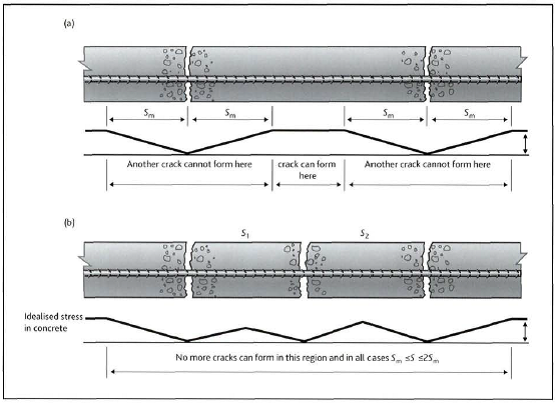
The principle factors affecting the number and width of cracks are
1. Cover – the greater the cover the greater the area of concrete that must strain prior to transfer of tensile stress to the steel.
2. Ratio of effective steel. The greater the amount of steel within the effective depth. This can be achieved by using a greater number of smaller bars.
3. Using smaller bars. Smaller bars have smaller diameter so can be placed closer together reducing distance between bars and so reducing concrete outside a zone of influence. Smaller bars also have an overall contact perimeter with the concrete.
4. Use of higher bond bars or reduce the tensile stress within the concrete. Fairly obvious however in our case the materials used are 355n/mm2 steel however the concrete is only C35 and that is considered good in Saudi Arabia.
Solution. The solution has not been entirely obvious or easily negotiated. The obvious answers of adding more steel and reducing the cover are not quite so straight forward. Reducing the cover would expose the concrete and reinforcement to the risk of cracking during curing due to thermal shrinkage as well as plastic settlement and plastic shrinkage cracks (both not discussed here). A reduced cover would also make the concrete vulnerable to chemical attack.
Just adding more steel is also not viable as the greater the amount of steel either the concrete section needs to get larger which will exacerbate the problem or the steel must be stacked in layers. As the steel gets further away from the surface the less affect it will have in the prevention of cracks as the lever arm to the centroid reduces. Greater layers of steel will also reduce the effective depth (distance to centre of steel from centre of compression zone) of the concrete section and eventually the steel will enter the compression zone and no longer be effective in crack prevention.
The solution has been to look at the use of stainless steel as the outer layer of steel and reduce the cover. This will increase the effective depth and reduce the amount of steel required to reduce crack widths. The results of the study I have been leading on are below.
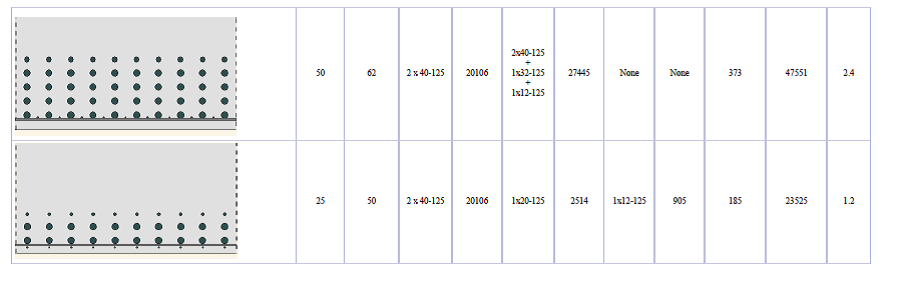
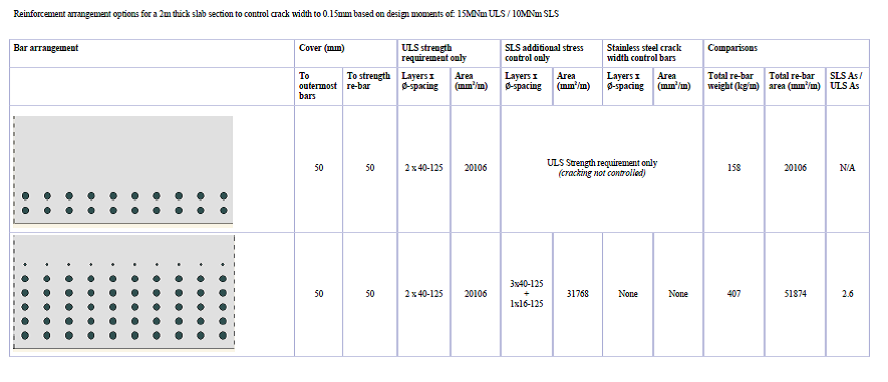
Sections in order 1-4 (top to bottom) all show a section of concrete subjected to a bending moment of 15 MNm a fairly typical load case for the Riyadh |Metro project
- Shows the steel required to carry the tensile loads within the concrete section
- Shows the additional steel required to control cracks to less than 0.15mm with a cover of 50mm. Note that the addition of further steel having a decrease in effect in reducing the crack widths, with further layers of steel only reducing crack widths by a smaller and smaller fraction of a mm.
- The addition of smaller bars in between the larger bars but maintaining the cover reduced the steel requirement as the effective depth was increased. Cover was maintained at 50mm and cracks widths were limited to less than 0.15mm
- The addition of stainless steel within the original 50mm cover reduced cover to 25 mm but further increased the effective depth and allowed the removal of further crack control steel from within the concrete section.
Conclusion
Conclusion to the study was that while stainless steel may be more expensive the use of stainless steel would remain cheaper then the use of additional steel to control crack widths.
In other news the office had a jazzy shirt to work day to raise money for charity. After a rather uncomfortable journey on the underground I arrived to work to find that I was one of only a handful of people to have participated and ended up looking more of idiot in a client meeting then I normally do.

Yep the design office really is that exciting.
 Holdfast Training Services Trial Blog