Archive
Starting with Laing O’Rourke in London, another muddy hole!
Overview. I am working on a Laing O’Rourke project near Elephant and Castle Station. The site previously consisted of an 8-storey office block which was mostly demolished prior to site handover. It included a one-storey basement and therefore the start state for this project is at one storey below ground level. The project endstate is the erection a 40-storey residential tower complete with two basement levels, along with a separate office development of eight storeys.
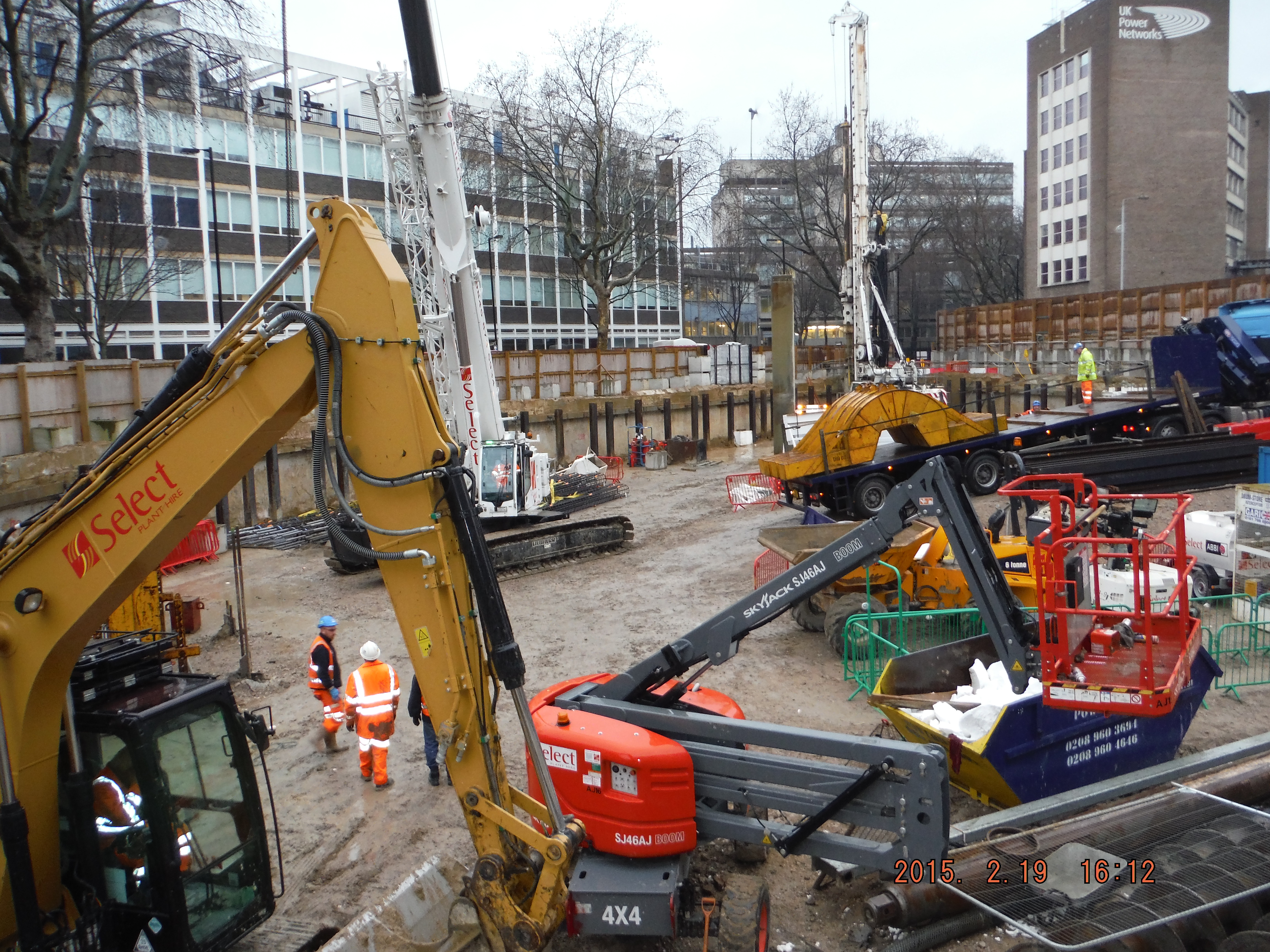
The existing (confined) site
Contract. The project is currently running on a Letter of Intent to achieve enabling works which comprise of the secant pile wall and capping beam, construction of part of the bearing piles, realignment of mechanical and electrical utilities and demolition of an existing sub-station. These works total £4.4M with a provisional sum of £1.1M to effectively close the project if the subsequent superstructure contract is not approved. The enabling works would give a future developer opportunity to construct something of their design, hence making the site attractive to other investors. This staged approach also gives the client time to ensure the remaining programme to build the tower meets their time and cost drivers. Quality is also important, but the balance is very much cost, then time and quality.
Pile load test. The design of load bearing piles for the tower will be finalised based on the results from the static load test that was carried out this week. The soil profile is generally 7m of river terrace deposits, 20m of London clay and then a deeper band of Lambeth Bed sands. Toeing into the sand (circa 30m pile length) will give the end bearing resistance needed but the number of piles will be determined from analysis of the load bearing test. Having heard John bang on about these types of soils I have now seen them and a static load bearing test rig in action – all making sense.
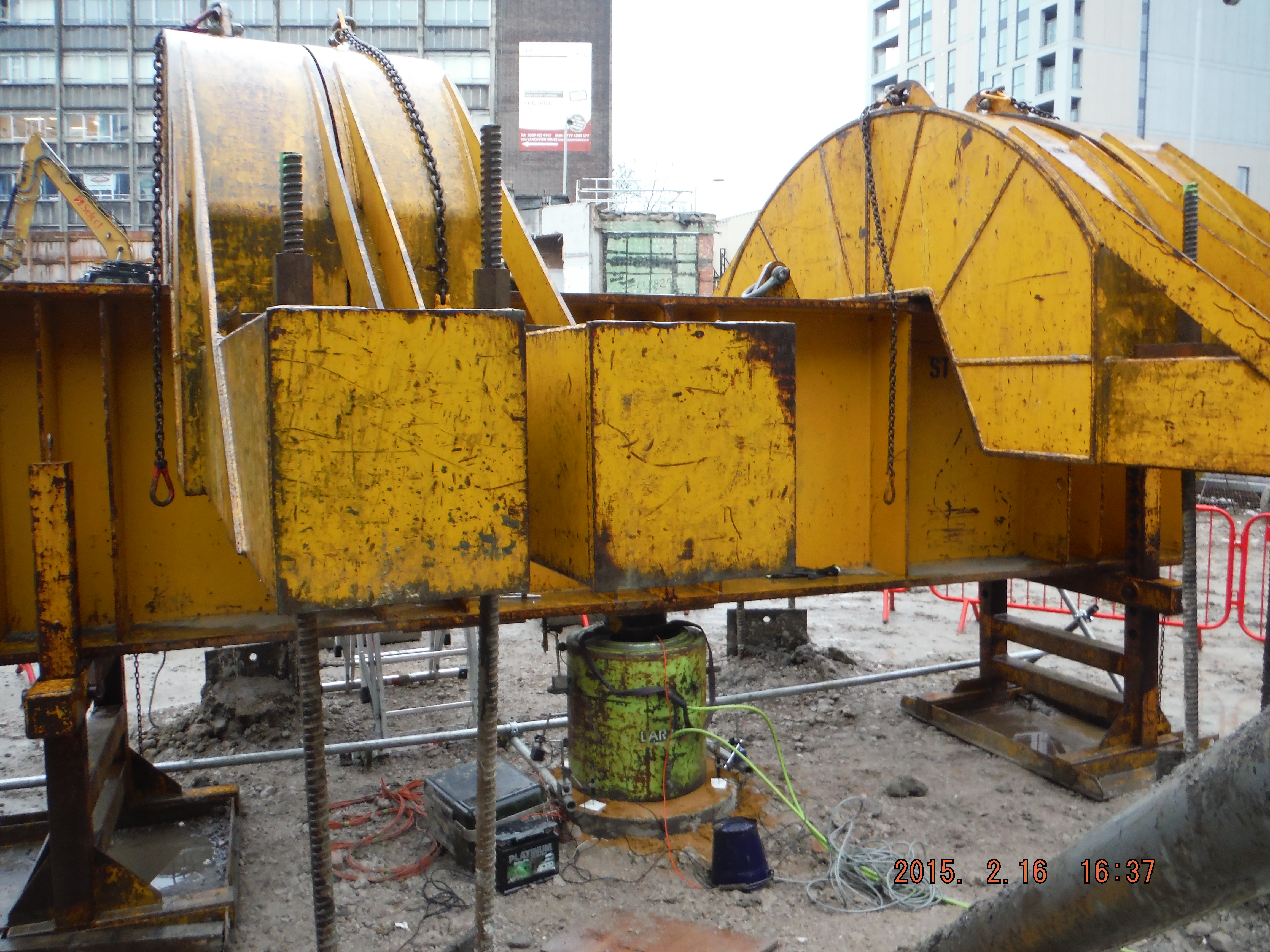
Pile load test. Test to 10MN or 75mm settlement.
There are two proposals for the load bearing piles:
- Individual large diameter piles (41no 1500mm diameter rotary under bentonite)
- Raft foundation (comprising 124no 750mm CFA piles).
The confined nature of the site means the bentonite option is not preferred because the amount of equipment would mean little else could happen concurrently onsite. Therefore the raft option is likely to be adopted, notwithstanding the outcome of the load bearing test, although it will mean excavation around the piles is pretty tight.
Sustainability. Laing O’Rourke are keen to demonstrate adoption of the Construction Logistics and Cycle Safety (CLOCS) initiative. It was brought home as I read an article in the Evening Standard which talked about the death of a cyclist after being hit by a HGV yesterday
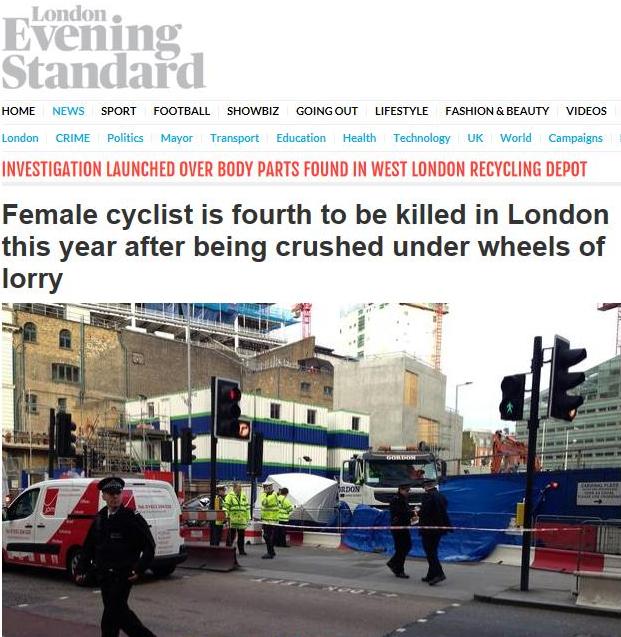
Evening Standard reporting of cyclist death
The statistics point to HGVs being responsible for a high proportion of accidents considering their number compared to other road users. Furthermore, the HGVs were often construction vehicles such as tippers or mixers. I then picked up the NCE magazine to is see an article on “Cyclists’ safety is now critical”. There are levels of adoption of CLOCS going from using CLOCS compliant supply companies (see photo below of tipper with side protection rails and warning signage) to running Construction/Cycle days where cyclists can come and get a mini bike service and have a chat about cycle safety. The question is how is this best achieved on this site to show adoption of the scheme, especially as the site is adjacent to one of Boris’s cycle superhighways.

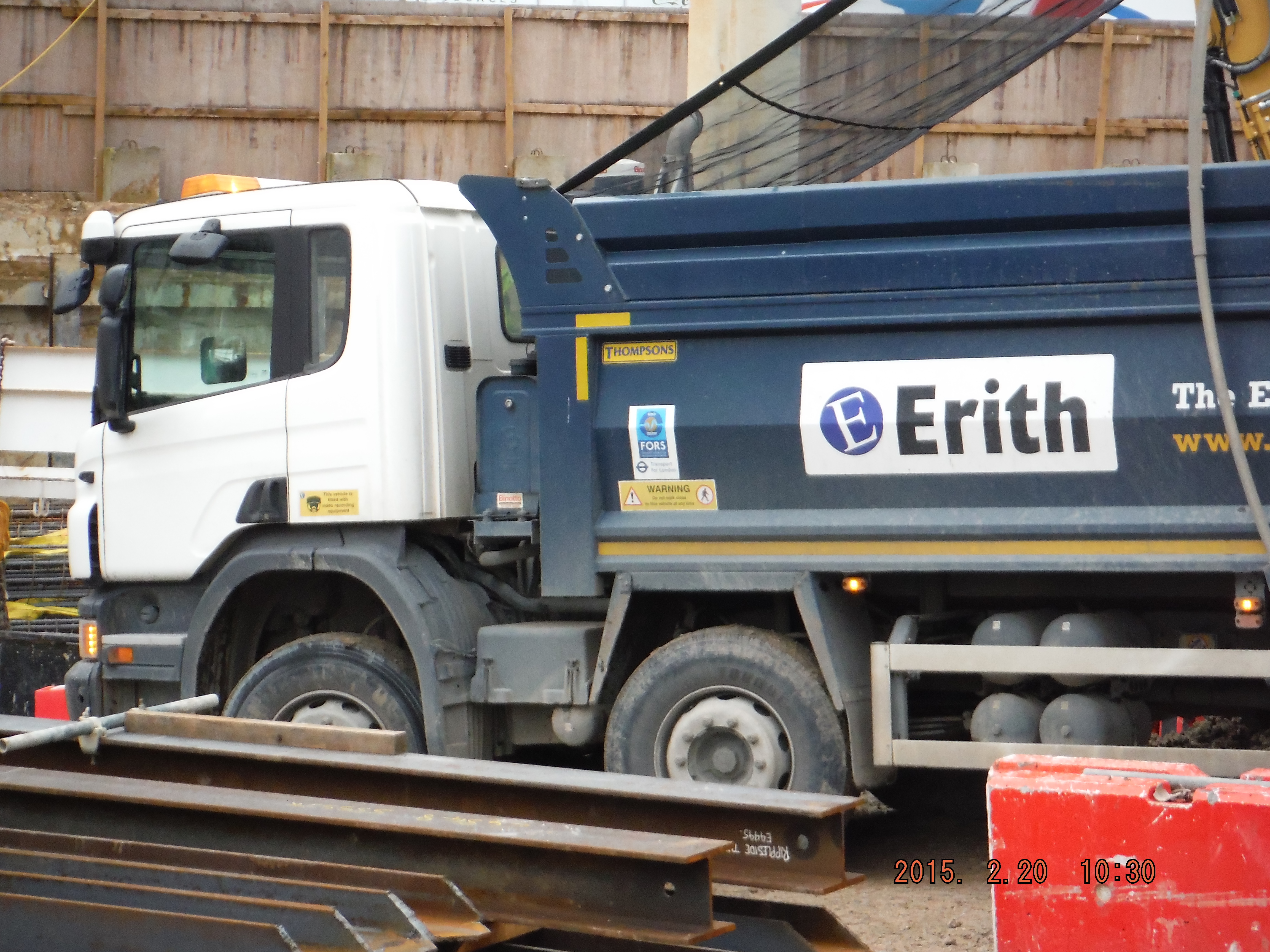
CLOCS Compliant tipper vehicle on site
The digital age. At this stage of the project the understanding of how best to implement BIM and realise the benefits of digital engineering is yet to be determined. There have been some point cloud (3D image survey) productions of the site (see below) but how this can be advanced is being established. The Laing O’Rourke Leadenhall Project (Cheesegrater) modelled the construction process of the whole building to refine the method in order to make it more efficient. Other advantages of digital engineering include cost and time savings by being able to demonstrate exactly what is required and the sequence in which the works would need to be carried out. At a more refined level, 3D modelling of reinforcement in the capping beam is an area which is likely to be explored due to the variation along the length of it on this particular site, not to replace drawings but to be used alongside them. The capping beam is an area I am to be responsible for so more to follow.
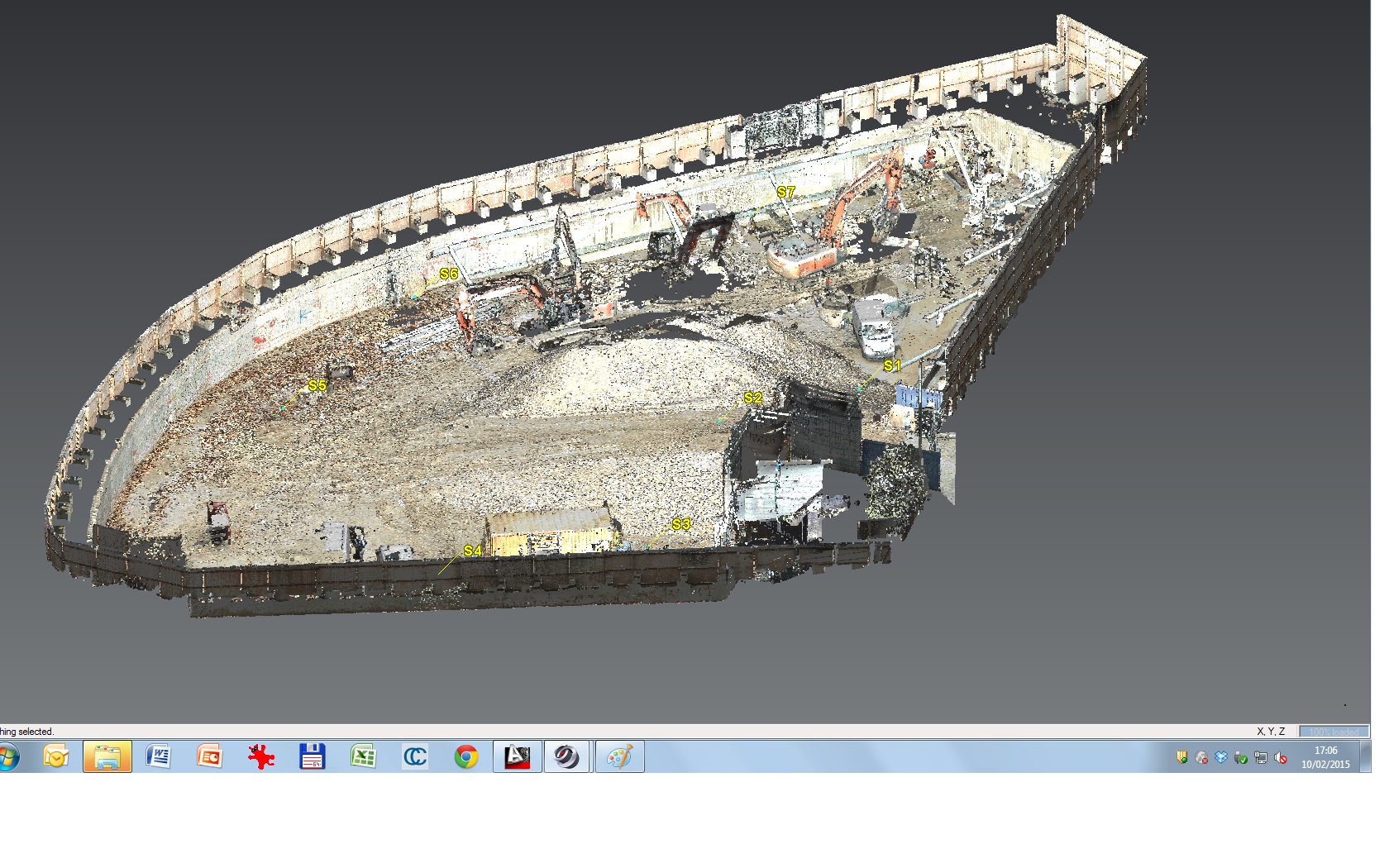
Point Cloud Survey of the site.
What the hell is 6F2?!
It’s a been a bit of a crazy week, and it’s all P C Harrington’s fault! So much has happened it’s difficult to pick one thing to chat about.
I could talk about this…
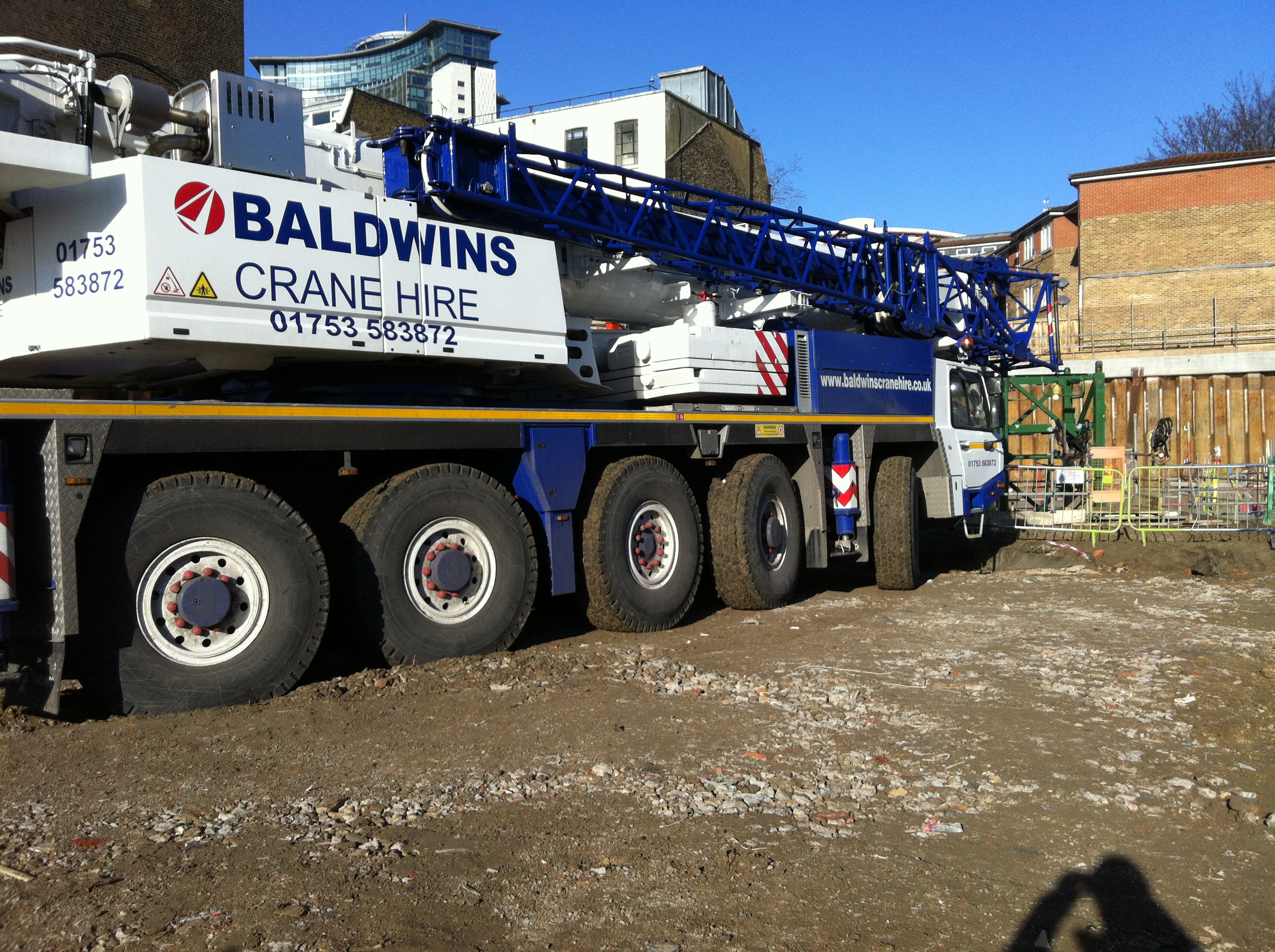
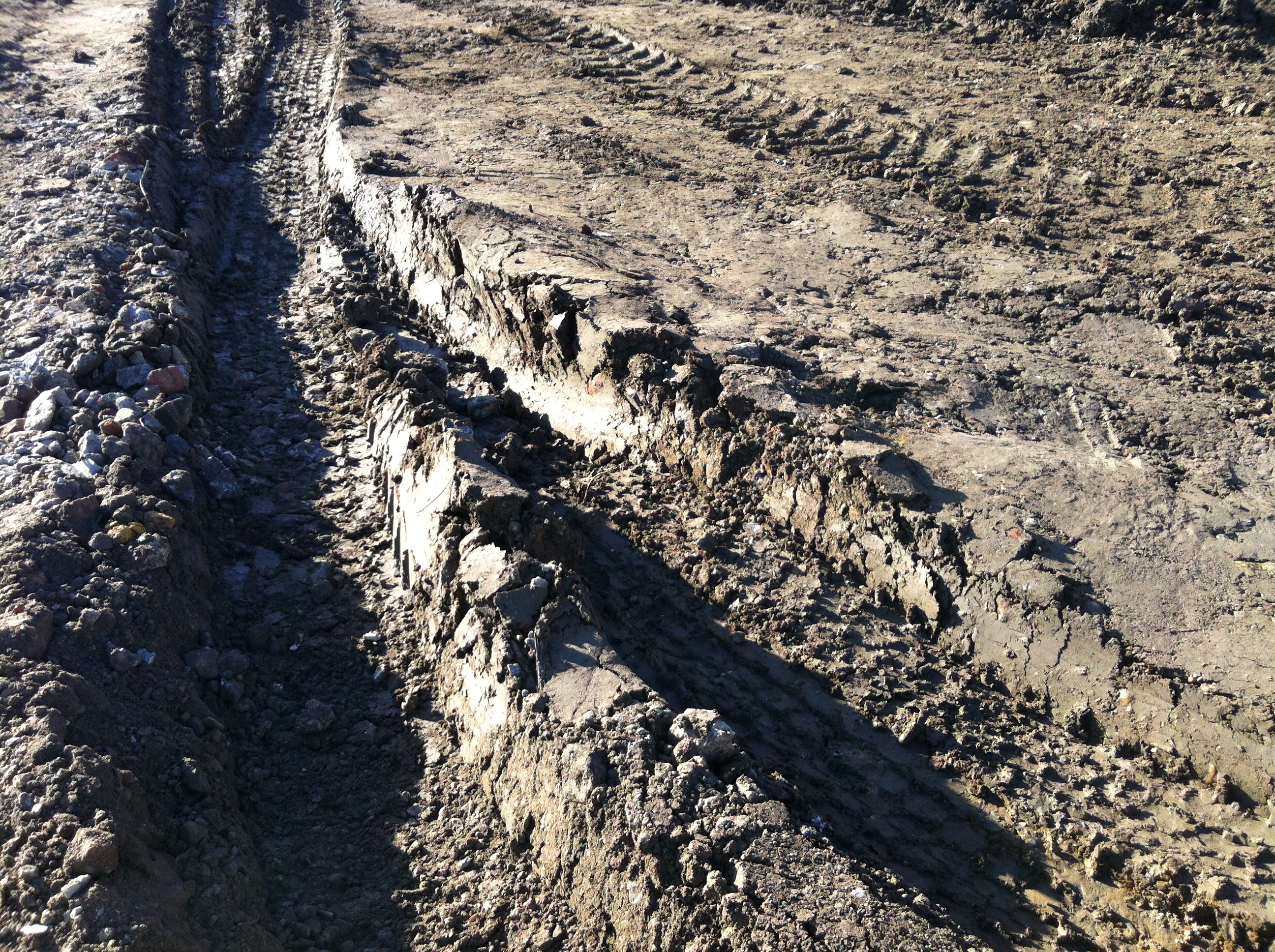
I could talk about this…

But instead I’m going to talk about fill.
After the nightmare of the sinking crane on Tuesday (see above), I have been keeping a keen eye on the construction of the mobile crane base for the construction of our second tower crane (we have 5 in total!). The base is to be 450mm thick. Laid in 4 layers. Each compacted with 3 passes of the roller onsite.
First of all they laid it far too thick. Then they didn’t realise that a roller is categorised by its mass per metre width. These things are forgivable. What followed is not…
About two months ago I was halfway through Rhubarb Creek writing about how the 6F2 would be compacted by a certain number of passes of a vibratory roller. At that point I didn’t really understand what 6F2 was (sorry Richard!), but now I do. It is a granular fill with a very specific grading curve. It is not:
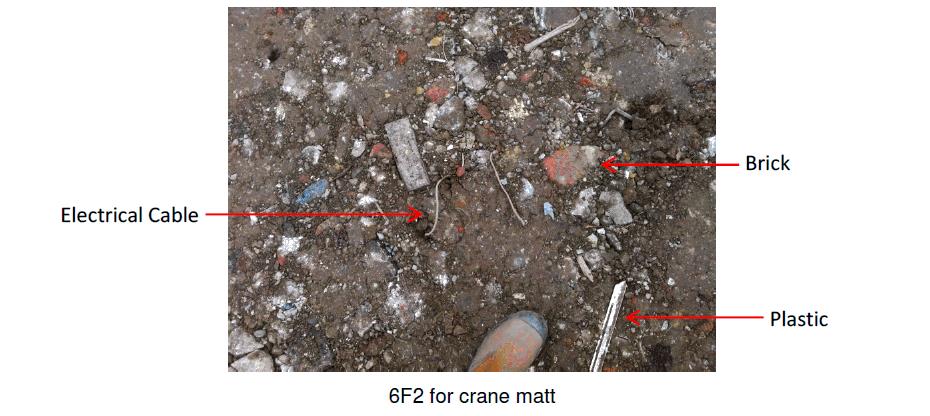
So I explained this to them. They said they would pick out the bits, compact and make sure it didn’t happen again. This morning I found this:
![IMG_0720[1]](https://pewpetblog.com/wp-content/uploads/2015/02/img_07201.jpg)
![IMG_0717[1]](https://pewpetblog.com/wp-content/uploads/2015/02/img_07171.jpg)
Plastic Wood
Now while this is fairly funny and a bit annoying for the bloke who is picking all the crap out of it, it’s not great for the company. They’re paying for 6F2 and they’re not getting it. The quality assurance process they should have in place they don’t.
So we’re working with a company who are running late already (we’re only 2 weeks in), they’ve already had an accident (see tipper above), and their workmanship is shoddy (see last weeks blog). They’ve got a bad enough name here as it is, so why are they accepting this? Probably the same reason why we hired them in the first place. The fill is like the company, a bit crap but bloody cheap!
At the end of my second week I have learnt an important lesson:
IT’S ALL ABOUT MONEY!
MPDS and Interview Prep
Brendan and I attended an IMechE industry contacts seminar in Aberdeen yesterday and it was predominantly about the Monitored Professional Development Scheme (MPDS) but it finished with a presentation from one of the interviewers for CPR in Aberdeen.
The bottom line is it has made me feel much more confident about going for CPR later this year.
This is most useful to those going for CPR with the IMechE and also PEW as an organisation. However, I hope that there are a few useful snippets for everyone.
I will describe the key agenda points and the important points as I see them.
Agenda
Introduction – no synopsis required and the only key point is that the IMechE website now has an ‘on demand’ facility that allows access to lots of online videos of conferences and seminars from around the world.
Tips for preparing for an MPDS accreditation visit – The title is self-explanatory so I will just go into some of the key points:
- PEW is not suited to the MPDS at all. It takes a minimum of four years to complete the scheme and it is aimed at new engineers joining a company. It is absolutely the right thing to continue with the standard application form approach and students on PEW should not be completing MPDS online.
- Over inflated scores of competencies is not helpful – to have a 3/3 across the board when you clearly haven’t reached that level is a red flag. Should the candidate then fail CPR it is difficult to re-rate and develop. Mentors should scrutinise competency ratings and pick them up prior to exposing to the IMechE.
- Media attention. There should be more of a big deal made of those successful at CPR, both for the applicant and the mentor. Many companies employ a financial incentive but this would not work for PEW. However, increased media coverage may be helpful and is something that could be developed. The key part is that there needs to be more of a celebration of achievement.
- A good thing to put in your E competency on the application is that you are a volunteer to be a mentor. The IMechE are short of mentors and the panel look favourably upon this.
Running and MPDS scheme – This was from the perspective of the Royal Dutch Shell MPDS scheme administrator. Most of his points were not relevant to PEW but it was clear how much effort these other companies invest in CPD for their employees. He suggested that mentors should not have the same background as the candidate so it forces the candidate to explain things properly and it is also beneficial for the mentor to read about different subject matter. I appreciate that this would be difficult for PEW.
Professional review interview – This is where the real gems were. It was a presentation from David Baker who is a panel interviewer for those taking CPR in Aberdeen.
- The application. It is competence based so do not just list a career history but describe how you have achieved the competence.
- During the interview he expected the applicant to do 75% of the talking.
- Interview lasts 45 minutes:
Introduction 2 minutes
A, B, C and D competencies 20 – 25 minutes
E competency 8 minutes
DAP 5 minutes
Closing comments 2 minutes
- He went into more detail for competence E. You should cover the following:
Code of conduct. Read it and equate it to your organisations code of conduct.
Examples of continuous improvement. For example, this could be new technology that you have implemented or a new maintenance regime you’ve instigated.
Environmental responsibilities. This could be considering HSE aspects.
Continuous CPD. Annual appraisals, courses you’ve been on etc
Promote engineering. Primary engineer for example.
Ethical manner. You won’t need to provide evidence of this competency until 1 Jan 16 but it could be useful to do so. Mark Hill (hobbit108) posted a useful piece on this in an earlier blog.
- Talk about things as “I did this” not “We did this”
- The sponsor is key to scrutinising paperwork, we get this after AER6.
- There should be mock interviews. I know the civils have this but I’m not sure how formal it is for the E&M students. I know that Imran very kindly offered to come back and run them for our course before he left and I will be chasing him to make good on that promise.
- Take in photos or calculations that you can talk about, especially if you’re the type to get nervous in interviews.
- You need to have three out of the five competencies graded at 3/3, with the other two at 2/3.
Key challenges to passing CPR:
Not providing evidence of A + B competence
Not being able to talk about the detail of what was in the application.
Another thing that I took from this is that PET students are different to the normal CPR candidate. They tend to be more discipline based with much less management experience.
From a personal perspective, I feel that my previous military experience plus phase 1 and my experience at BP has certainly given me 3/3 in C, D and E. I think I am on my way to a 3/3 with the A competency and I will be okay reaching a 2/3 with the B.
I also think that the role of mentor is very important. For those of us going to Staff College it could be a useful way of maintaining the CEng flame. I for one would be willing to look over someone’s application, their competency record as they build it up and if I’m available I would help run a mock interview next year.
Free Software – Phase 2 its out there.
After completing my last TMR which was based on the performance of solar thermal systems and the comparison of land cost. Before I started this TMR solar power to me was simply Photovoltaic (PV) cells, but after a lot of research it was evident that this was probably the worst type of harvesting of solar energy. The main problem I had with my TMR was the systems themselves are extremely complex, for example a Parabolic trough which heats liquified nitrile salts, to a working temperature of around 1500 deg C and running a Rankine cycle steam turbine combined system is rather complex. To compare these systems would be far too much work to be able to fit within one TMR.
This is where free software is the key, I personally have found getting enough raw analysis within a TMR has been hard at times, some times due to the complexity of the subject which I have chosen to discuss and sometimes lack of knowledge and capability. However using free software this can be alleviated, you can complete great research and using such a tool as the American Government package called System Advisor Model (SAM) which the National Renewable Energy Laboratory (NREL) have developed (https://sam.nrel.gov/content/sam-publications) you can use such packages to do the raw theoretical analysis which is required and this leaves you to draw the key information and complete true analysis of the data.
There is tons of free software out there and in terms of renewable stuff the NREL is great and if you need any other help with this subject Mark Hill is the man. I hope this helps Phase 2 a little as I know I was stuck a couple of time of how I can do a real comparison of different systems.
 Holdfast Training Services Trial Blog