Archive
The Good, the Bad and the Ugly.
It’s been a while so it’s time for another blog.
There has been a bit of a shift within the team as 2 of the Assistant Structural Engineers handed their notices in and left rather quickly resulting in a team of 4, under the Senior Structural Engineer, being reduced to me and one other. This has clearly increased my work load but frustratingly not entirely in productive areas.
The Good.
So the subject of my previous blog was an independent foundation design for a standalone gantry crane that I initially completed by hand as practice before inputting into the computer analysis software Masterseries. I completed this design and sent it to the client with my recommendations as their proposed orientation could not be accommodated due to the foundation size required and the existing building geometry. This has since been returned with a slight amendment and is sat in my in tray to look at their new proposal and make the design amendments accordingly.
This process led onto my largest design responsibility to date. I was required to design the foundations for a second 4 bay 7.0m x 35.0m extension to an existing portal frame building. The original building and first extension were completed by CRP so much of the design input was already available.
The first stage was to take the existing building footprint and set out the new nodal positions and detail appropriate section sizes based on the original frame as the steel section design information was unavailable. I had however received the loads from the steel designers, as nodal loads, (which made life easier) and allocated those to the frame accordingly. I made an adjustment to the surcharge load from the original due to a different slab requirement and dug out the original site investigation report to ascertain the ground conditions and safe bearing pressure of 225kN/m3. This indicated a layer of chalk at 1.5m from the underside of the slab and I decided that this would set the depth of my foundations. Once these parameters were established I individually designed the 16 foundations required before economising the design for ease of construction by reducing this to 5 different sizes. Partly due to the specified depth, I was able to negate the use of steel in the design and recommend the bases were constructed from mass concrete, thus reducing the cost. Once complete I submitted the design to the Senior Structural Engineer for a few tweaks before detailing the drawing in AutoCAD and sending to the client for discussion and approval.

Frame Complete.

Sections Allocated.

Loads Applied.
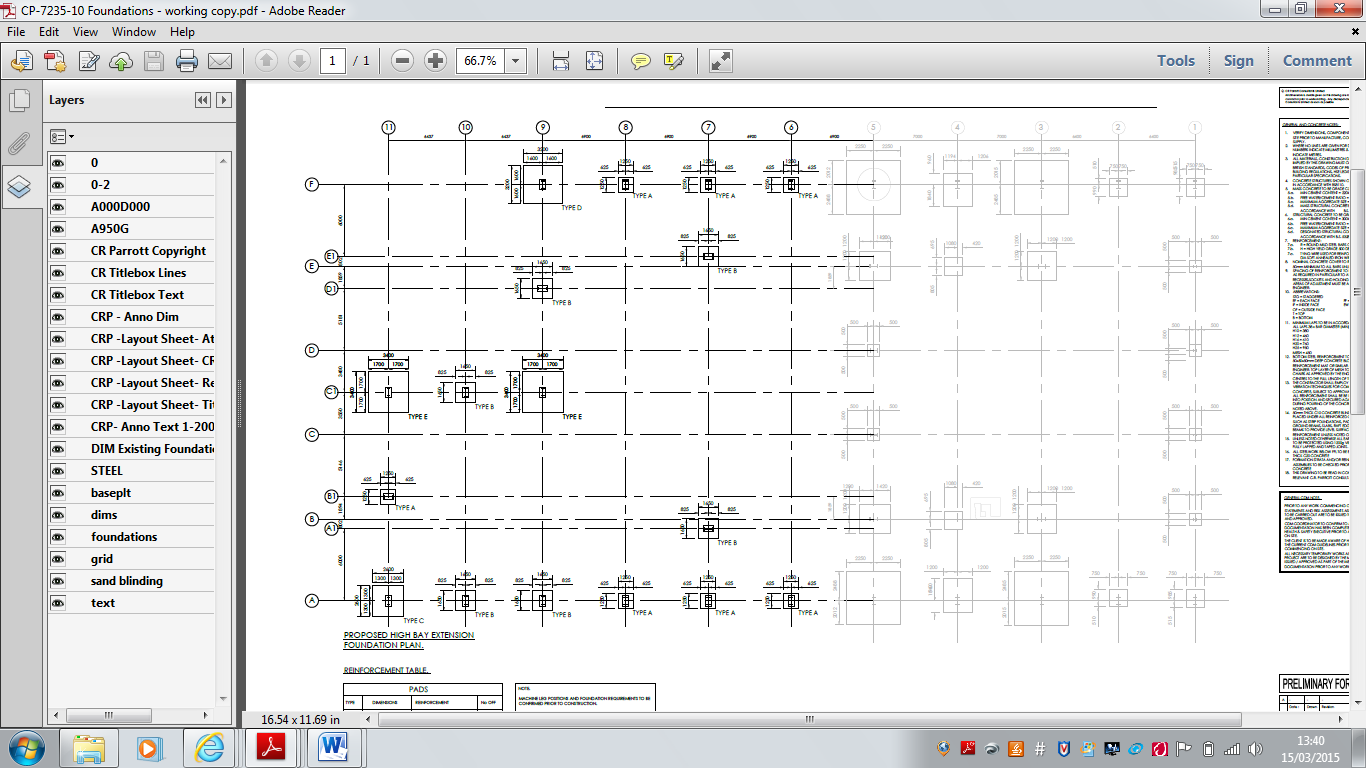
Drawing Complete.
I have also managed to get involved in a number of other areas of work that the consultancy cover.
I have worked on the preparation of a number of tenders in particular the drafting of remedial work specifications for small domestic and commercial projects. I have also been appointed Assistant Project Manager for a couple of local refurbishment projects. The first a £120,00 upgrade of a Day Centre, the second a £1m upgrade of a existing steel portal frame warehouse. Both of these jobs came about from my discussions with the MD to complete DO C5 (Managing Contractual Issues). I wanted to work on small scale, local projects that I could possibly see through during phase 3 and would allow me interaction on site. Whilst I was initially reluctant to be involved in the projects, as I did not perceive them to be engineering heavy, I have subsequently realised that they fulfill the requirements for the DO more than adequately. My work across both projects has included; feasibility studies and work specifications for tender, contractor hosting on site, return tender assessment, prestart meetings, liaison and coordination between the clients and the contractors during works, quality management and assurance on site (C4) and a host of other smaller tasks. All of which have contributed to finalising a number of outstanding DO’s.
The Bad.
Due to the 50% reduction in engineering staff in the office I have had to take on some additional drafting responsibilities. Whilst not hugely significant much of the design I am currently conducting I subsequently have to detail in AutoCAD. The 2 Engineers that left used to do much of the detailing to assist the CAD technicians (who are also undermanned) and hence the task has fallen to myself and the other Assistant Structural Engineer. I have voiced my opinion on this but equally understand that it partly comes with the territory and responsibility of working in a small, very busy consultancy. The issue will shortly be resolved however as 2 new CAD technicians start next week, one of whom is an ex RE draughtsman. I hope he brings his own sandbag for my war dits as they’re just not appreciated by civilian engineers.
And the Ugly.
It is something I realised on phase 2, but even more so with the projects I am working on during phase 3, there are plenty of opportunities to complete the DO’s, even in areas that are not immediately obvious if you push for them with your placement mentors. I am gaining a wide range of experiences on phase 3 and although I am not churning out impressive designs for half of London like Richard, or Riyadh Metro like Steven, I feel I am getting a rounded consultancy experience, akin to the type of activities we may be conducting when back in the green. I have continually sought to shape the direction of my placements, guided by the DO’s, by being outright and robust with the various MD’s and PM’s who I have found are generally receptive to my requirements. I would recommended this to the current phase 2’s as it is easy to become stove piped by companies as you show competence for the conduct of particular engineering activities and you suddenly become the ‘piling go-to guy’ and that’s all you experience in phase 2/3.
 Holdfast Training Services Trial Blog