Not a calc sheet in sight
Here are a selection of some of the issues that have arisen over the last week,
1 – My spanner doesn’t fit – The standard ‘you must be able to construct what you design’ comes to the forefront with my first point. The fabricators constructed the middle waling for the cofferdam, which consists of double UB’s welded together with plates. The problem is that the ends are bolted together and someone decided it was a great idea to position bolts inside of the facing web openings (see photo below).
Solution – Ignore the bolts and weld instead.
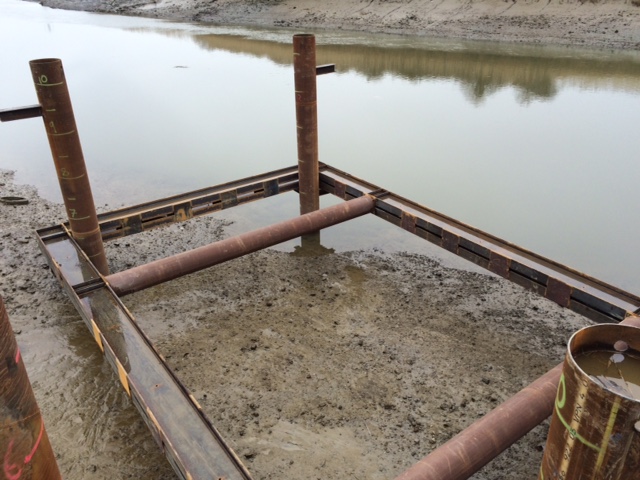
Cofferdam middle waling
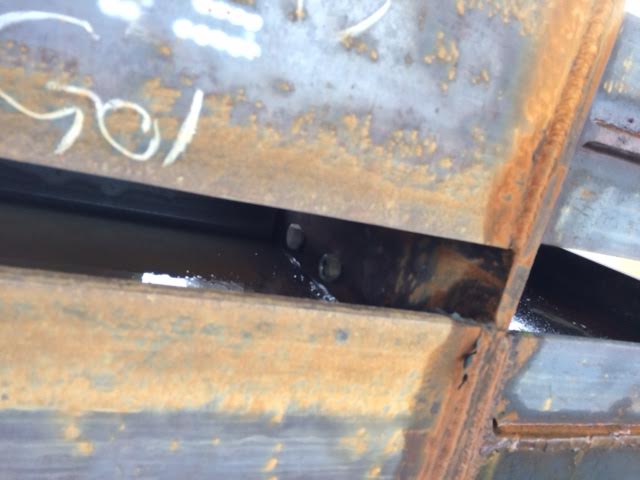
Close-up of restricted bolts
2 – Answers on a postcard please – Our sheet and CHS piling gang have done a good job, however, they are really starting to drag their heels. The commercial team who draw up the contracts have dropped a clanger and employed them on an hourly rate, which has been fine up until the last couple of weeks. They are now well aware of the last safe moment for the cofferdam to be finished and are doing everything possible to ensure they don’t finish a minute sooner. The question now is how do you speed up someone who has the upper hand and technically isn’t doing anything wrong, frankly neither the carrot nor the stick will work this time!
Solution – …?
3 – The chalk turned to toothpaste – The majority of the fill being brought to site is chalk. This is causing no end of issue given the current weather. If it’s in a dry-ish state and well compacted it forms a sound and stable base for the abutments and road surface to be built on, however, it is not so dry at the moment and yet we are continuing to receive 600 tonnes a day. The lads were told to stockpile it so that it could be distributed at a later date in the 200mm layers with 4 passes from a 3.75 tonne vibrating roller as per MCHW. BUT…what they actually did was cover the whole site with over 1000T and after a night of rain they rolled it. Watching the roller move would be like watching Jabba The Hut on a water bed!
Solution – A nuclear density and plate bearing pressure test will take place tomorrow to assess the situation. Any areas that require remedial work will be stripped back and sorted. The danger is that if the logistics are not managed correctly then areas could get missed and become soft spots. To add to the issue chalk continues to be imported to site and stockpiled correctly.
4 – My window won’t stay open – In order to monitor the settlement of the site, steel plates have been placed in the ground with vertical dywidag bars fixed to them. As the ground settles, the plates move down and this can then be recorded through surveying. The problem is what do you do when the window of your roller keeps sliding shut? Well, if you work here then you use a gas axe to cut 90-100mm of dywidag off that annoying rod that sticks out of the ground that you have to drive round, so you can make a window wedge!
Solution – Use average settlement data from the other 17 rods on the site to predict the settlement at that point and then offset all future results. Add a note on the site induction that all bars are not to be tampered with and brief all current staff at the following morning brief.
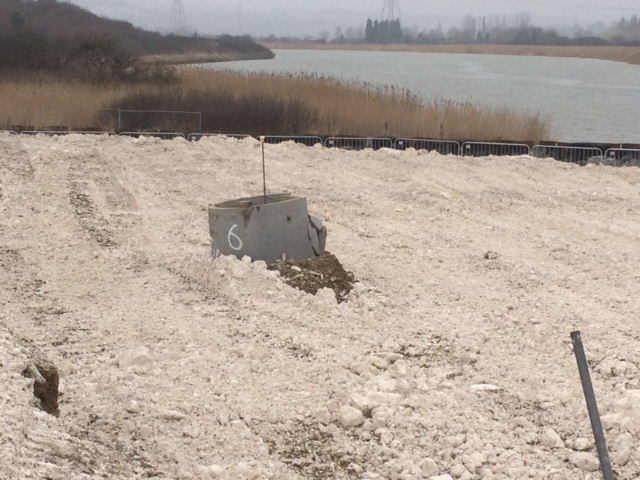
Another settlement rod who had a near miss with the same roller, good job it was protected.
5 – Who ordered the piles? – The first batch of cofferdam piles arrived this morning (AZ 20) but unfortunately the clutches had not been crimped. Before the batch was accepted the order was checked and it turns out it was our fault. The cost involved in sending them back to be altered was not the issue, in this instance it was time.
Solution – Level three precast concrete slabs left over from a design alteration on the crane jetty to create a welding bed. Tomorrow the center clutches will be welded together.

If only the piles had used crimpers instead of straighteners on their centre parting!
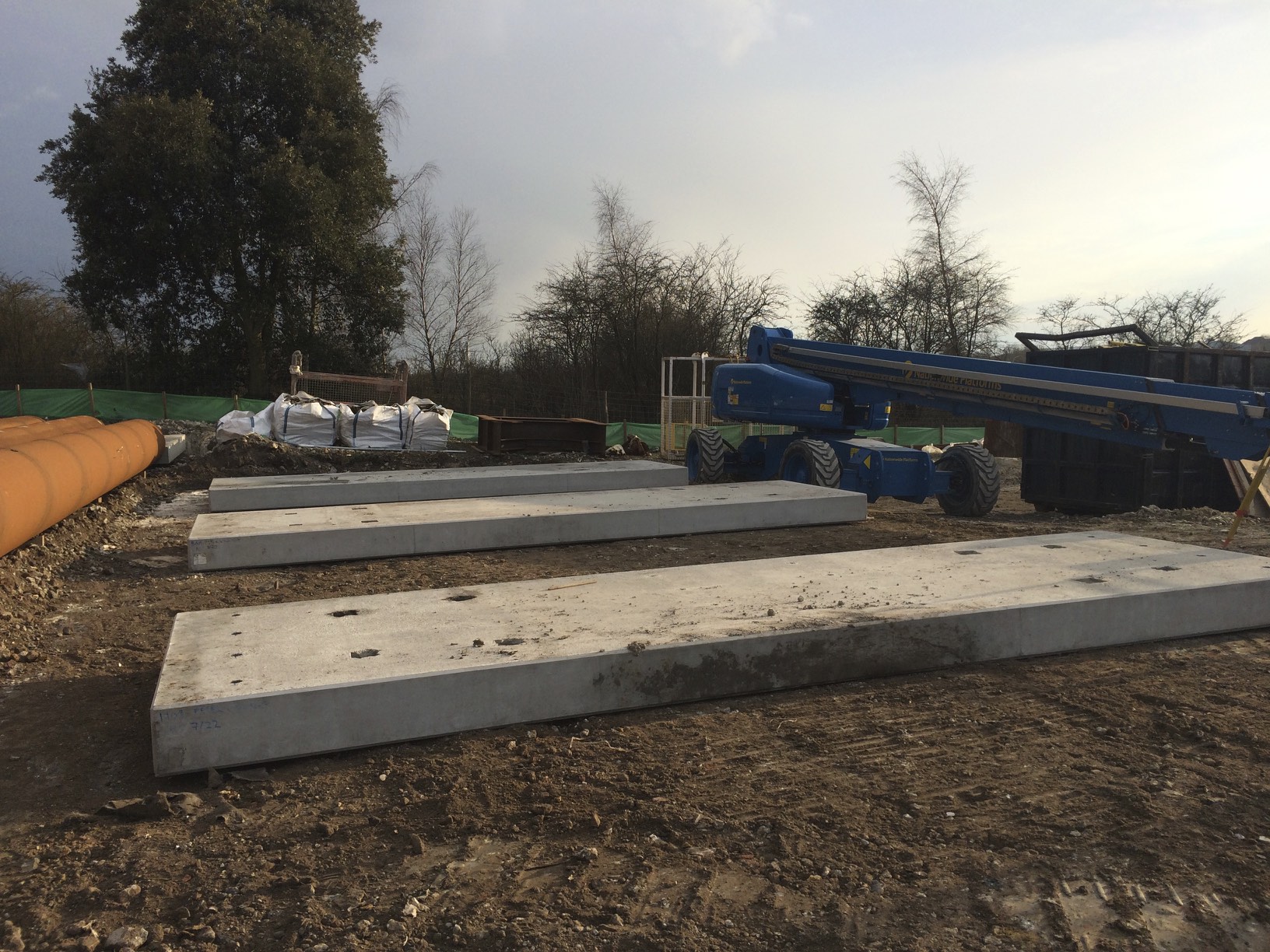
Our make shift welding yard
And finally – I saw our crane driver carrying what looked like a bottle of water, he must think I was born yesterday….my money is on gin or vodka!
 Holdfast Training Services Trial Blog
Hi Olly, regarding the chalk what is your allowable settlement for the plate bearing test? What is the chalk supposed to be providing resistance for, (Pile rig/crane?) Our pile rig load was about 360kN/m2 and the plate bearing test went to 1.5 of that. 6f2 material resulted in 1 to 4mm settlement. Interested to know number of layers at 200mm, from photo looks like 1 layer varying from 0-200mm? If not getting required ground bearing capacity, what about geomembrane?
Regarding speed of sub-contractor, what were they planned for in the pricing schedule and is what they are going to/time to do the work within that budget? Therefore despite slowness and day work, if it is within planned expenditure, is it a problem?
Olly, I think the only hope of getting the pilers to speed up would be if they had another job in hand that they could start on early. That way you could offer an early completion bonus. But if they haven’t any work to move on to I can’t think of any cost effective incentive to make them work any faster. Did the commercial team budget for them being on site till the last safe moment, or is there a looming shortfall? Is there the prospect of future work for the piling subcontractor with the main contractor, if so you could try to nudge things along with their management. Maybe dangle another project further down the line to them if they screw the nut and work faster?
Damo, Pete – sorry this is a bit disjointed and rushed:
Chalk – The chalk is being used to surcharge the existing ground which is mainly clay over laying sand and/or chalk however most of it will remain in situ after the desired settlement is achieved in order to raise the site to formation level, this ranges from 2 – 8m. Some areas have been loaded for five months and have already settled by approx 250mm and we are expecting a further 750mm by the end of the year once the site is fully loaded. The crawler cranes and piling rig will either work from the crane jetty or from the sides of the site that are not being built up. They will not work from the surcharged area until we reach 95% settlement and have constructed a load transfer platform. I will explain how this will be done later as it is a technique we have not been introduced to however it basically consists of knocking concrete piles in to the ground to tighten everything up. We are using Geo-membranes but only to prevent fine migration at this stage. When we start to construct the seat for the abutment then I believe the plan is to use some form of Geo-Grid.
ESG, our material testing company have just delivered the bad news. The chalk should have a MAX moisture content of 16%, the NDT rig has just measured 28-31% across the site. Furthermore the material was initially classified as a Class 1A and was laid in 200mm layers with 4 passes from a 3.75T/m2 roller however we have just been told it is to be reclassified as a Class 3 (We were constructing at risk as no construction drawings have been issued) which requires thinner layers with more passes from a much smaller roller. Our options are limited, spread out what we have and wait for it to dry out or strip it back and import more on dry days. As I type this the PM in outside dressed as a Red Indian conducting a sun dance!
Piling gang – In short, BAM had budgeted for the pilling phase based off their programme but had not contractually tied this in with the sub-contractor. The pilers next job is on the opposite side of the river on another section of this project (classed as separate jobs). The first phase of his contract was not defined by time and the second phase was detailed to start when phase one was complete. The icing on his cake is that it was not detailed how or how many staff he would use and the cherry on top is that BAM Nuttall would provide all material and equipment so he is currently running with absolutely no project specific overheads…the prefect job from his point of view. The expectation was that he would run multiple gangs working across the site, this is not the case as he has picked up work elsewhere and sent some guys away. Pete hit the nail on the head with the offer of further work, he has been offered a future work option with the client this morning but it requires him pulling his socks up. We have dropped in a coffer waling frame and driven two piles since the meeting.
Damo – In answer to your final Q, yes I feel regardless of whether we are running on time or not it is always worth exploring options to increase efficiency. It can do little harm as long if it is managed accordingly and will help to increase a buffer of both time and money for when things go wrong. I think only addressing problems when they have gone wrong are too late. This situation has highlighted how early rash decisions (which may have been made in good faith at the time) could have had a major time and financial impact later in the project as this section of work sits on the critical path, but through good management it has been dealt with in a way that helps all parties involved. Credit to the PM and a win win all round.
Olly, regarding your concern over your slowing piling subby, let Luke and Adrian of BAM’s commercial team know. They may not be able to make any immediate difference to your particular problem but it will give them commercial leverage when valuing and agreeing all the variations that make up the piling subbies final account. Regards Greg
Greg – Thanks for your comments. I must say that communication was key to solving/improving this situation. The work rate is now fine and it appeared to be a short term issue. We have now applied some elements of pressure to the pilers as we need the cofferdam they are working on finished asap. The have responded well and are due to meet the timings. If I now look back at the whole situation subjectively I think much of the problem could have been eliminated with better communication from the start. Everyone was doing their own thing and efforts were not as aligned as they could have been. This allowed all parties to protect their own interests and become critical of others…I suppose that is human nature.
I understand you did a some CPD with the team here last year. Let me know if you’re ever on site visiting.
Olly