Archive
Initial blog from Battersea
After three weeks leave, I have now arrived on site at phase 1, Battersea Power Station and started working for Carillion. This blog will outline the scope & set-up of the Battersea development and identify what seems to be the most significant M&E elements to phase 1 in order to set the context for future blogs.
The entire power station development will be split into 7 phases, phases 1 – 3 of which are now up and running. I’ll expand on phase one in the next paragraph. Phase two is the development of the power station which is being carried out by Skanska, phase three is just beginning and will be an extension to the Northern line. The entire development is scheduled for completion in 2025. The client is the Battersea Power Station Development Company, which is a Malaysian consortium investing approximately £8bn into the redevelopment. The client’s architect is Ian Simpson Architects, structural advisor – Burro Happold, M&E advisor – Hoare Lea, Quantity surveyor – Gardner & Theobold and Project Manager – Turner and Townsend. The client’s team has designed the project up to RIBA stage D.
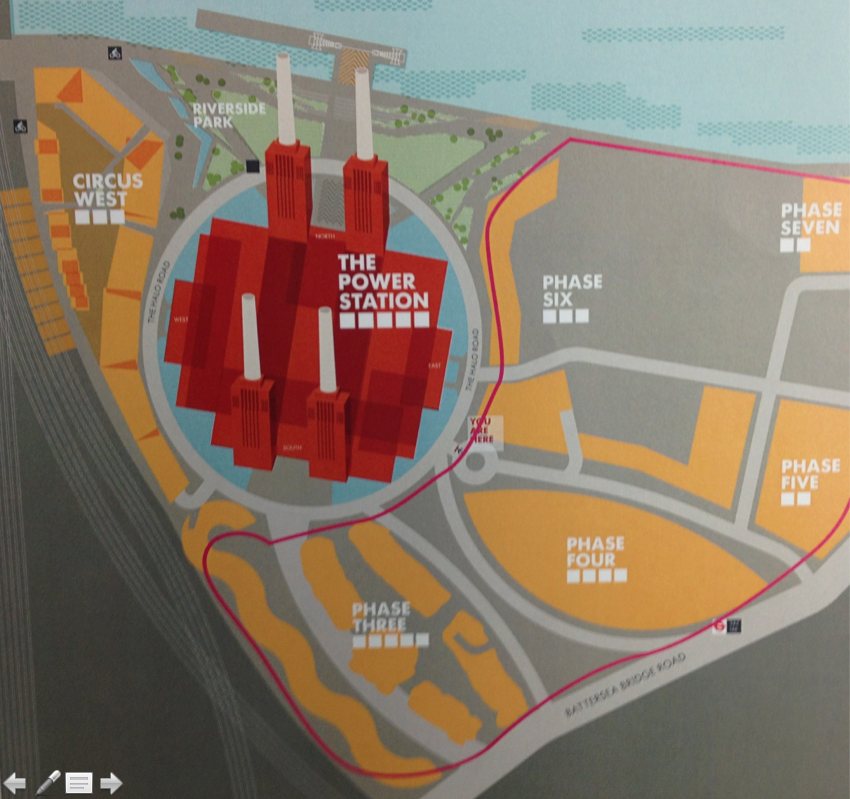
Overview of the Battersea Power Station Development. Phase 1 is labelled as Circus West.
Phase 1 consists of 866 luxury apartments located in the North West corner of the Battersea site; between the railway line into Victoria, the river Thames and the power station itself. Carillion are the principle contractor working under a JCT design and build contract to take the project from stage D to completion. Apartments range in price from £800k for a studio apartment to £4m for a four bed. The build is split into seven cores (A to G) which form RS1A, with a further five cores (H to L) which make up RS1B. RS1A is 14 stories tall with two basements and RS1B eight with two basements. Phase 1 is currently 74 weeks into a 148 week schedule, although this is likely to be extended.
The heating & cooling to the apartments will be provided by mechanical ventilation with heat recovery linked to a communal energy system. The most significant M&E engineering element associated with phase 1 seems to be the construction of an energy centre in the basement of core G. This will involve the installation of 2 x 4.2 MW boilers & 1 x 7.2 MW boiler, and 2 x 1.5MW & 1 x 3MW chillers. The original concept design saw this energy centre (which supplies services site wide, not just to phase 1) being constructed as part of phase 2. It appears the client is unable to complete this work prior to phase 1 & 2 being handed over and occupied. Therefore a variation has been made to phase 1 to install the energy centre in the basement of core G. This variation looks as if it will bring significant challenges with it. The current building design does not incorporate flues for the boilers that will be in the energy centre. This means a solution to take the flue gases across to phase 2 and up one of the power station stacks is having to be explored. The space available and limiting factors of working in the basement of block g means that certain elements of the energy centre will still need to be located remotely. This currently looks like it will involve the build of a remote cooling compound incorporating two cooling towers (let’s hope we don’t get legionnaires) for the chillers and life safety system generators. The remote cooling compound will be located somewhere on phase 4’s real estate and cross phases 2 and 3 to connect it, which will bring its own challenges. This remote cooling compound will bring about significant costs, effort to construct and is only temporary. The long term plan is build the original energy centre at the front of phase 2, connect it to the energy centre in the basement of core g, allowing the remote cooling centre to be removed in time for construction on phase 4 to start.
The Carillion M&E team currently consists of 6 personnel; head of M&E, 1 x design , 2 x commercial, 1 x delivery and myself. My role is looking like it will focus on the basements and the energy centre in core g, which should provide plenty of opportunities, but will involve working in a damp dark basement for a large portion of my time.
That should do for setting the context of the project. I’ll aim to provide another blog next week which outlines a little more of what my role will be and more details on the challenges / risks associated with the project.
Just Give It Time
Last week work started on the east bank crane jetty. The ITP requires that the first four piles are to be tested to ensure they will resist working loads. The working load per pile is 2000kN and FOS of 1.5, therefore each pile is required to resist 3000kN (or so we thought, I’ll come back to that later).
The west crane jetty piles were 18m CHS. The east crane jetty piles are the same tubes however they are 20m in length. The east side of the river has a thicker top layer of alluvial deposits and a thiner layer of terrace gravel which provide a lower shaft resistance through the first 9m than the west side. Below this level is Gault Clay which carries most of the load hence the requirement for a longer pile on the east.
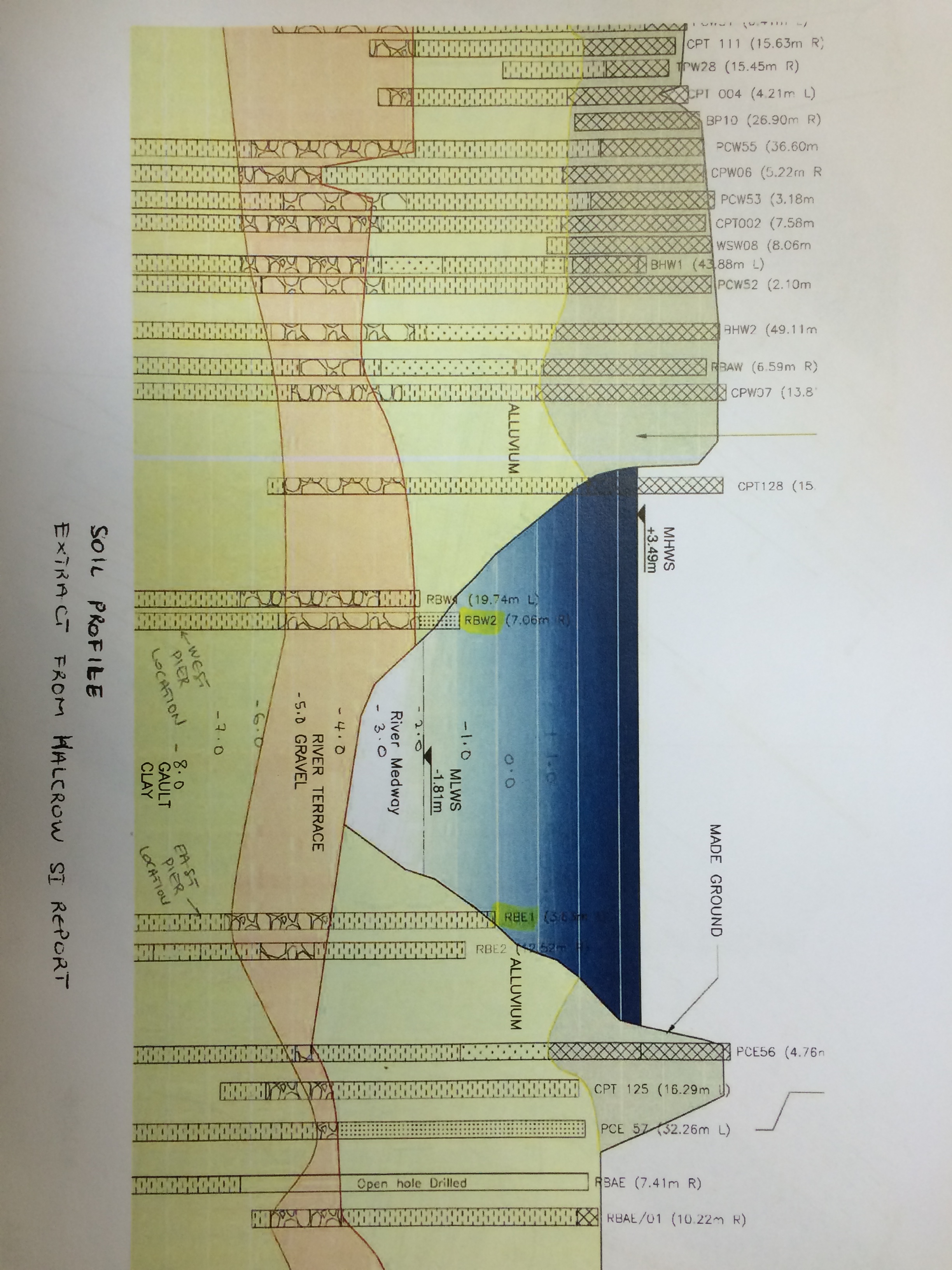
The piling gang were ready to start but the 20m piles hadn’t arrived, direction was given to use some 18m ones we had on site. This decision was based on the fact that the edge of the river is higher and therefore more of the pile would be supported. In reality all the piling gang did was hide steel under some alluvial soup that offered no support.
Once the first four piles were within approximately 600mm of their level a Dynamic Pile Test (DPT) was instructed. This consisted of two sensors being rigged to the pile (see below), the smaller sensor is an accelerometer and the larger a strain gauge. Once set up the pile is then driven further by the hammer. The pile dimensions and the hammer speciation are input into a Pile Driving Analysis (PDA) terminal which then records the results from the sensors whilst being driven. This then produces a window of pile resistance. Our first pile registered between 2700-2800kN, not the required 3000kN furthermore we only had 300mm of pile left before we hit our level.

The technician recommended that we should stop at this point and continue the test the following day. The next day the test was then carried out again on the first pile and it reached 2980kN…accepted! The three remaining piles also passed.
Cue Terzaghi and Mohr-Coulomb
When the pile was driven is caused the pore water pressure to rise. This created a hydraulic gradient. With the gravel the short and long term states are the same however in the Gault Clay they are not. The clay has a very low permeability so on face value I wouldn’t have expected much change overnight however the borehole data from the GI identifies veins of coarse sand and gravel with in the clay and also irregular fissures (although it is hard to know if these were caused by the boring process). The reduction in pore water pressure increases the effective stress and ultimately increases the strength of the clay.
These ‘Case Data’ results were then sent back to the office and run through CAPWAP software. This is a post processing tool that analyses the data from the PDA and refines the results with data from modelling and empirical evidence. The technician suggested we should expect upto a 10% increase in the capacity.
The Game Changer
This whole issue is now almost irrelevant; when the designer was called he informed us that the working loads were only 1000kN per pile so we only required 1500kN. This should have been blindingly obvious. The piles work in pairs and support simply supported beams. So four pile support the 110T crane, its load and the self-weight of the jetty deck. Based on the initial 2000kN per pile that would be in the region of a total load around 800 tons and alarm bells should have started ringing at this stage but everyone just got on and tried to achieve the results required without question.
I’m sure I’ve been told a few times to take a step back, look at the fundamentals and question the obvious before getting too involved……phuf, what did they know!
In other News
Guz – I can now join the ‘what’s the best thing you’ve found in your 6F2/5’ game. Today I found some super squishy foam, a glove and what looked like action mans left arm!
 Holdfast Training Services Trial Blog