Initial blog from Battersea
After three weeks leave, I have now arrived on site at phase 1, Battersea Power Station and started working for Carillion. This blog will outline the scope & set-up of the Battersea development and identify what seems to be the most significant M&E elements to phase 1 in order to set the context for future blogs.
The entire power station development will be split into 7 phases, phases 1 – 3 of which are now up and running. I’ll expand on phase one in the next paragraph. Phase two is the development of the power station which is being carried out by Skanska, phase three is just beginning and will be an extension to the Northern line. The entire development is scheduled for completion in 2025. The client is the Battersea Power Station Development Company, which is a Malaysian consortium investing approximately £8bn into the redevelopment. The client’s architect is Ian Simpson Architects, structural advisor – Burro Happold, M&E advisor – Hoare Lea, Quantity surveyor – Gardner & Theobold and Project Manager – Turner and Townsend. The client’s team has designed the project up to RIBA stage D.
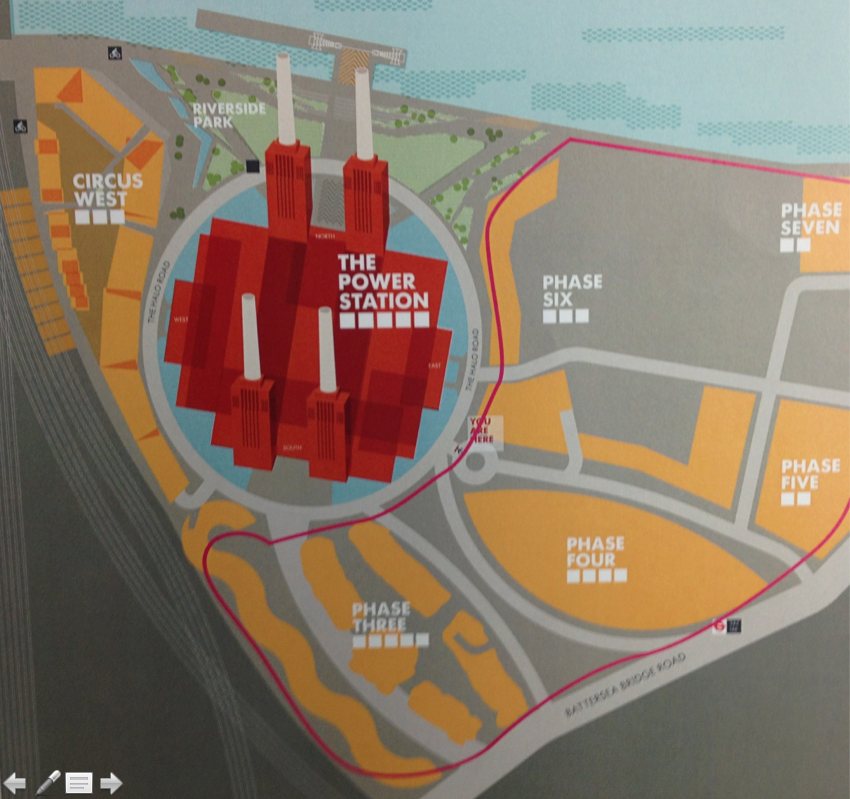
Overview of the Battersea Power Station Development. Phase 1 is labelled as Circus West.
Phase 1 consists of 866 luxury apartments located in the North West corner of the Battersea site; between the railway line into Victoria, the river Thames and the power station itself. Carillion are the principle contractor working under a JCT design and build contract to take the project from stage D to completion. Apartments range in price from £800k for a studio apartment to £4m for a four bed. The build is split into seven cores (A to G) which form RS1A, with a further five cores (H to L) which make up RS1B. RS1A is 14 stories tall with two basements and RS1B eight with two basements. Phase 1 is currently 74 weeks into a 148 week schedule, although this is likely to be extended.
The heating & cooling to the apartments will be provided by mechanical ventilation with heat recovery linked to a communal energy system. The most significant M&E engineering element associated with phase 1 seems to be the construction of an energy centre in the basement of core G. This will involve the installation of 2 x 4.2 MW boilers & 1 x 7.2 MW boiler, and 2 x 1.5MW & 1 x 3MW chillers. The original concept design saw this energy centre (which supplies services site wide, not just to phase 1) being constructed as part of phase 2. It appears the client is unable to complete this work prior to phase 1 & 2 being handed over and occupied. Therefore a variation has been made to phase 1 to install the energy centre in the basement of core G. This variation looks as if it will bring significant challenges with it. The current building design does not incorporate flues for the boilers that will be in the energy centre. This means a solution to take the flue gases across to phase 2 and up one of the power station stacks is having to be explored. The space available and limiting factors of working in the basement of block g means that certain elements of the energy centre will still need to be located remotely. This currently looks like it will involve the build of a remote cooling compound incorporating two cooling towers (let’s hope we don’t get legionnaires) for the chillers and life safety system generators. The remote cooling compound will be located somewhere on phase 4’s real estate and cross phases 2 and 3 to connect it, which will bring its own challenges. This remote cooling compound will bring about significant costs, effort to construct and is only temporary. The long term plan is build the original energy centre at the front of phase 2, connect it to the energy centre in the basement of core g, allowing the remote cooling centre to be removed in time for construction on phase 4 to start.
The Carillion M&E team currently consists of 6 personnel; head of M&E, 1 x design , 2 x commercial, 1 x delivery and myself. My role is looking like it will focus on the basements and the energy centre in core g, which should provide plenty of opportunities, but will involve working in a damp dark basement for a large portion of my time.
That should do for setting the context of the project. I’ll aim to provide another blog next week which outlines a little more of what my role will be and more details on the challenges / risks associated with the project.
 Holdfast Training Services Trial Blog
Rich,
Is the design intention for the 7.2MW boiler to be the main duty boiler with the 2 x smaller 4.2MW boilers being secondary duty/top-up and standby?
What % capacity will the main duty boiler be running at?
Similarly for the chillers?
Regards
Fran.
Rich – interesting that 3 out of the 4 PET students on UK projects are using JCT Design and Build contracts. After the focus on the NEC contract I wonder if that is more suited to Government contracts. Have you started to see issues whether Stage D was achieved but the designs fail to live up to reality in terms of buildability and subsequently cost more to execute?
It seems (from what Angela said on our visit to Battersea) that the Client is up to their normal changing mind antics. I am amazed, that even with such a big development bringing in huge revenue, it is an economically sound proposition. I think the rule of thumb is one third cost on land purchase, one third on construction cost and one third on profit = cost of project. I would very much expect the profit third to be diminishing if effectively you are moving an energy centre or cooling compound – this must equate to building it twice which I would not have thought originally costed?
Finally, if the cost of a 4-bed now is 4 million, when is it likely to be complete and if bought now at that price, by the time it is ready, will it actually be worth a lot more. Or are those forecast sales figures for 2025?
Fran,
The original plan was for the three boilers to be the same size, with a CHP plant providing the base load and the boilers the lag. The CHP plant has now been removed from phase 1 and will appear in phase 2 at a later date. I’m still reading into the specifications as to how the system will work, but I’m presuming that the larger boiler will provide the base load with the two smaller boilers providing assist / standby. I’m not sure how this will work in the short term if the larger boiler requires maintainance. In the longer term the CHP plant will be able to assist.
Damian,
I’ve not yet fully identified the undelying reason for the changes other than the energy centre in phase 2 could not be brought online in time. You are right that all these changes are going to cost money, however, Carillion are already 22 weeks behind schedule. Carillion wants more money and an extension for the variations and the client knows he can charge Carillion a lot of money for being late already. Given they both have each other by the balls it looks like some kind of compromise will be made. The costs I mentioned were when the units went on sale, they’ve all sold.
Rich
Good stuff, definietely interesting times ahead, moving flue gases around is not really a good idea, significant condensation risks, spatial problems and a whole raft of fire safety issues I would imagine – do you have any idea what the intention is at this point? John Marsh will know more from the CIBSE point of view but this is the sort of challenge that they will be interested in talking about – if you can get involved I would reccomend you do, even if only in the margins.
Following the money around on the project will be an interesting challenge too so keep an eye out.
WIth the CHP being pushed further to the right what are you feelings as to it’s long term chances of actually being installed?
Mark
Mark,
Thanks for your comments. I’ve been told the CHP will definitely happen as it’s required from a sustainablity point of view. It looks like the client is taking several CHPs that were around the site and lumping them into one giant CHP plant on phase 2, so it’s not something I will get involved in.
Rich