Archive
Captain Britain
So I’ve been slightly ‘under the RADAR’ since we arrived Stateside I guess. That has absolutely nothing to do with my work – more lack of it. Since we landed we have been through many a bureaucratic system which, when meeting the stupid foreigner, is akin to the unstoppable force meeting an immoveable object. Not a lot happens fairly slowly. However – I am now a fully fledged member of the office, with photos in the foyer to prove it and a modicum of responsibility to keep me out of trouble. I also have a Nickname, ‘Captain Britain.’
I will echo Henry in saying that this is fairly light on the engineering because, being a foreigner, I am still not allowed to go on site (an issue which is currently being resolved) however what I have been given will still be a fairly important piece to the overall programme.
The Programme – East Campus.
There is a lot of work in the area of camp which used to be a golf course, but is now known as East Campus. Currently there are 3 separate projects going on which are in various stages of construction, from 7 % – 90% complete. The largest of these is worth around $650m and the smallest is around the $50m mark. There was a contract awarded last Friday for another project, again at the $50m mark which makes the current programme close to $1Bn…so far. The interesting thing about all these projects is that each one is completely separately funded, procured and built. The reason being that government can’t politically allocate enough money in one funding cycle to build a whole campus. The overall strategy to mitigate this has been to procure each project separately and bid on separate funding cycles to senate for more money once it has been proved that the last chunk of funding has been properly managed and spent. This means that although there is an overall vision for what the campus will look like, there is really no way to say that it will all receive funding and be completed as imagined. This way of working has also led to huge issues with scheduling. With three large projects in various stages of construction in such close vicinity (one project also structurally ‘ties in’ to another) there have been inevitable conflicts in space and resources.
There is currently a ‘Master Integrated Schedule’ (MIS) which is supposed to help identify cross project conflicts before they happen, however much of the information is out of date and individual project managers are reluctant to release their un-approved schedules. The other issue is that the contract for provision of the scheduling service is due to expire shortly.
What I have been asked to do.
I have been tasked with getting the MIS running as it should, ie as a useful forecasting tool, and to deal with the issue of the expiring contract. What I proposed is that there be some more engagement with the Area Office (who are separate to the office I am working for, although still the same organisation. Think 2 Sqns in one Coy) and that the product be given grace to undergo a few iterations in order that tweaks can be made and input gained from the end users so that an accurate and, more importantly, useful tool can be produced. I also got someone with more clout than I to request the individual project schedules be released to the contractor so that a rough integrated schedule can be produced. I have called a meeting next week to discuss inter project logic ties so that any changes to one project will highlight impacts to neighbouring projects. I am hopeful that this will nudge the MIS in the right direction and that in a few iterations a useful forecasting schedule will drop out, rather than a few disconnected, out of date and inaccurate reports which the Project Managers view as an embuggerance to contribute to.
The other piece is to extend the contract that is used to produce the forecasting schedule. The contract itself is a Task Order (one of many), which is a part of a base contract for ‘scheduling, estimating and programmatic support.’ The base contract was for 5 years. The desire is to extend it although there is no specific clause to allow this (however the missing clause is referenced elsewhere in the contract). This issue has been referred to the Policy Department for a decision. If it can’t be extended that leaves until 25 May to push a new Task Order through. This will be a clever move because although the Base Contract will have expired, if a Task Order under the Base Contract is enacted prior to the final date of the Base Contract the Task Order and all money allocated to it is still usable until the Task Order itself expires. The money still remaining on the Base Contract is around $2m so I have drafted a Statement of Works for scheduling, estimating and programmatic support, under the provision of the base contract, and attached the $2m to it. This will accompany a Request for Proposal (like an ITT, but to the Contractor named on the Base Contract. Essentially asking the Contractor if they would like $2m to continue what they are already doing) to the Contractor who will then submit an estimate based on what I have asked them to do in the Statement of Works. I am also required to complete an Independent Government Estimate which needs to be within 10% of the contractor estimate in order to progress the application. More on this at a later date.
So what was all that about?
With the Base Contract expiring it appears to me that USACE wants the provision of service to continue, but a) missed out a clause allowing the extension of the base contract or b) forgot to put another Base Contract out for tender. Essentially, what I am doing (all legal by the way) is exploiting a technicality which will allow for the provision of services to USACE by the Contractor even though the Base Contract under which the services are provided has expired.
Other Stuff.
A letter, stating that I am a good egg, is in the pipeline which will hopefully allow me access to site. From there I will be able to start getting some more engineeringy posts up. Photos might be an issue. If I don’t get on site then you will all know that I am not, in fact, a good egg.
For Ollie’s Infantry shooty delectation; today I have been shooting with a buddy. He bought along a nice selection, including an FN SCAR and AR-15. Ages on the range varied from 8 – 68yrs. All good clean family fun.
Truck MPG – TBC; suspected low. Am hopeful it won’t be a DO 7.C fail in CPR.
Photos.



Pile Breaking
Site Two Fifty One
It has been the subject of many a previous blog but perhaps the reality of breaking C37 concrete away from pile reinforcement is only just becoming obvious now I see it first hand.
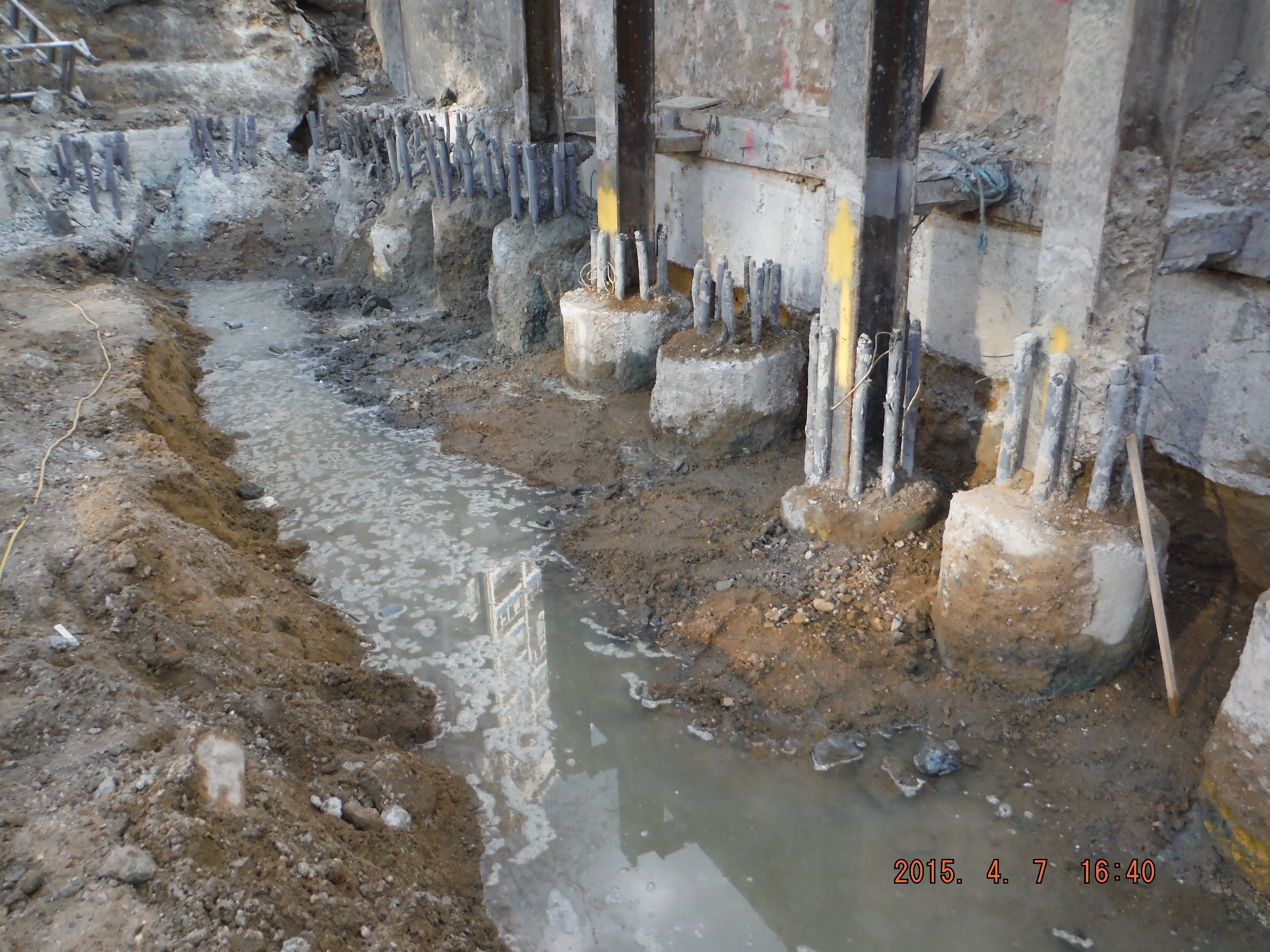
Male piles protruding well above cut-off level (see yellow spray bottom right).
Rotary bored piles which are cased allow piles to be cast to a cut-off level pretty closely. The secant pile wall must embed 75mm into the capping. This is a cut-off level of -1.105m AOD. The pile method was changed from rotary bored to CFA because CFA would enable deeper piles to be constructed. The deeper piles are tower and office bearing piles, not secant wall piles, however due to the constrained site size not all of the perimeter wall could be exposed to do the secant wall with the rotary method.
So what? The secant wall is being done with CFA. The problem? The pile platform level is at +0.150m AOD. This means piles are being cast 1.255m higher than is required because CFA piles can only finish at ground level. The consequence of this is that over a metre of concrete is having to be broken out.
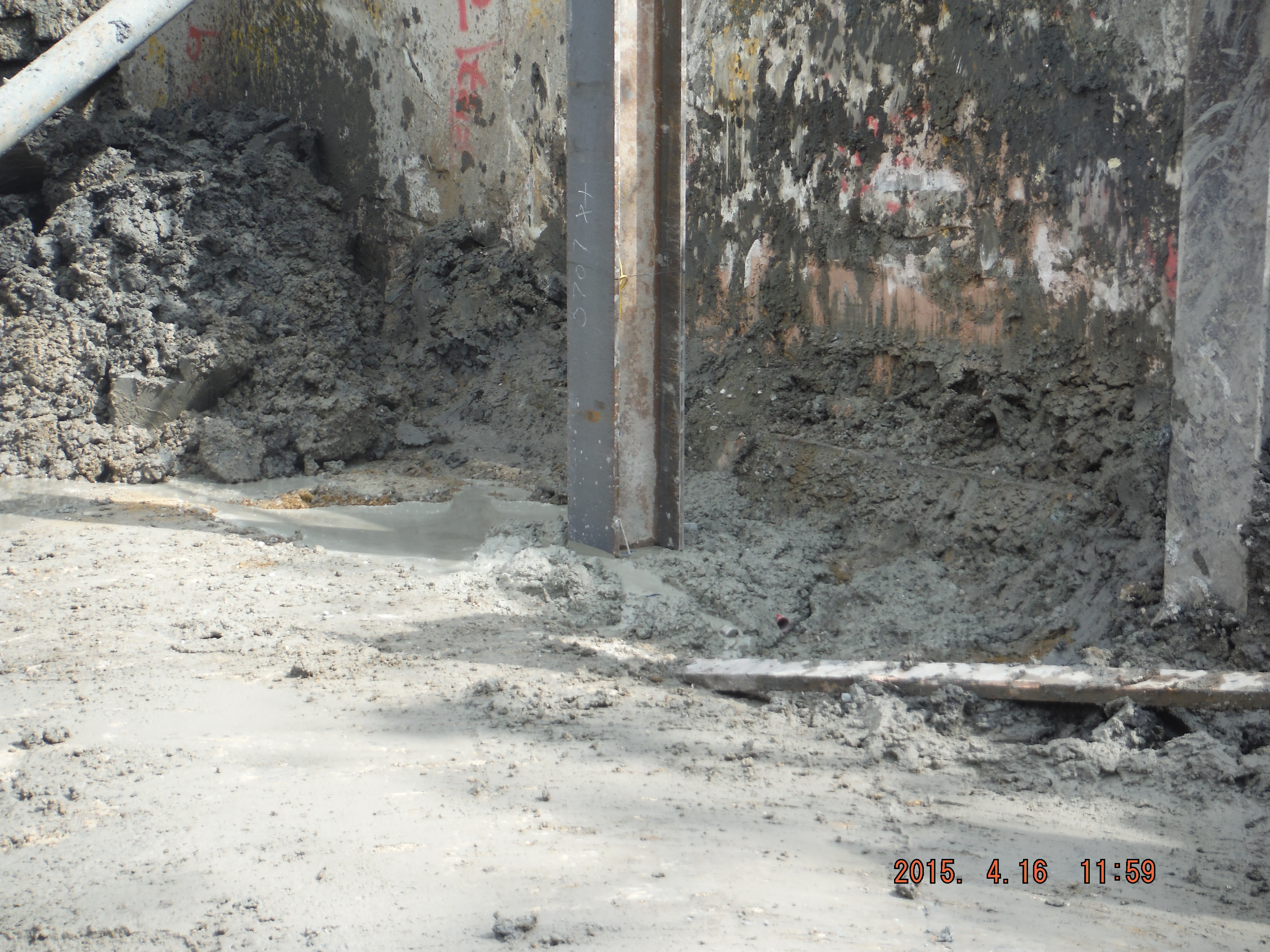
CFA pile with king post (embedded 3.5m into pile), cast at the pile platform level (1.255m above cut-off level).
I started the capping beam on 7 April with a foreman, mini excavator, 2 labourers and a carpenter.
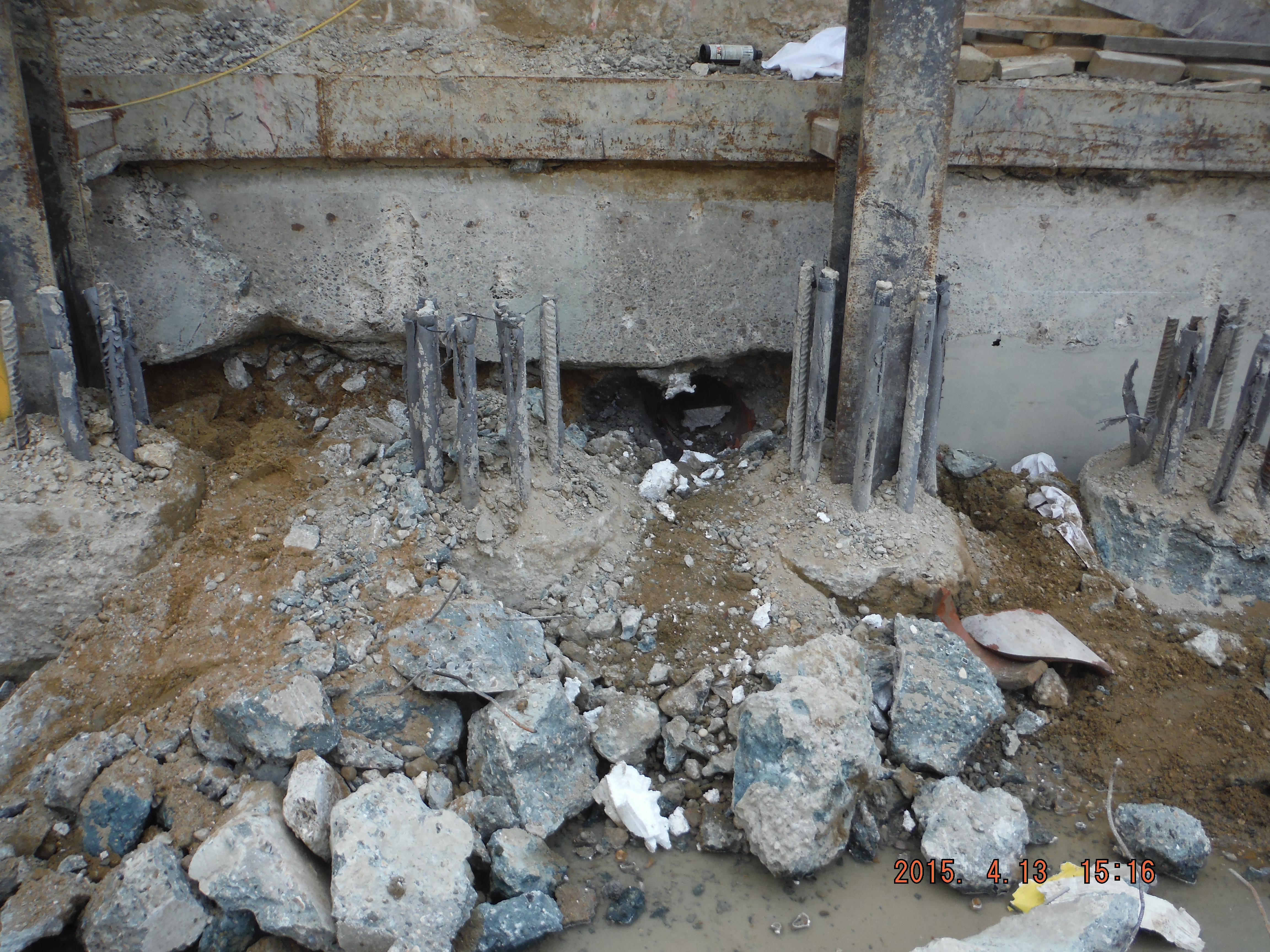
Task 1: removal secant pile guide wall, Task 2: underpin existing retaining wall, Task 3: break piles to cut-off level. Excavator used to remove bulk of concrete.
2 weeks on we have prepared a section about 30m in length, and have not started steel fixing, formwork or concreting. The capping beam length is 180m long, therefore this could take some time (12 weeks, programmed for 7 weeks, albeit not on the critical path). The options are plentiful but what is becoming more apparent is the consequence of what seemed to be a sensible decision (change from rotary to CFA piling method) is now only fully realised and understood.
Further complications: Temporary Works versus permanent works.
The Designers (Waterman) have designed the capping beam for the permanent case (mostly bending vertically). Clearly they know we are going to excavate down another storey, but the reinforcement for the temporary props is not down to them to design.
The Temporary Works Department have added significant extra side bars to account for the props. In some cases this amounts to 8 x H32 compared to 6 x H16.
The temporary works situation (king posts propping old retaining wall) sees the vertical column sections (king posts) embedded into the piles within the pile reinforcement. This is to prop against the wall behind to act as a cantilever retaining wall.
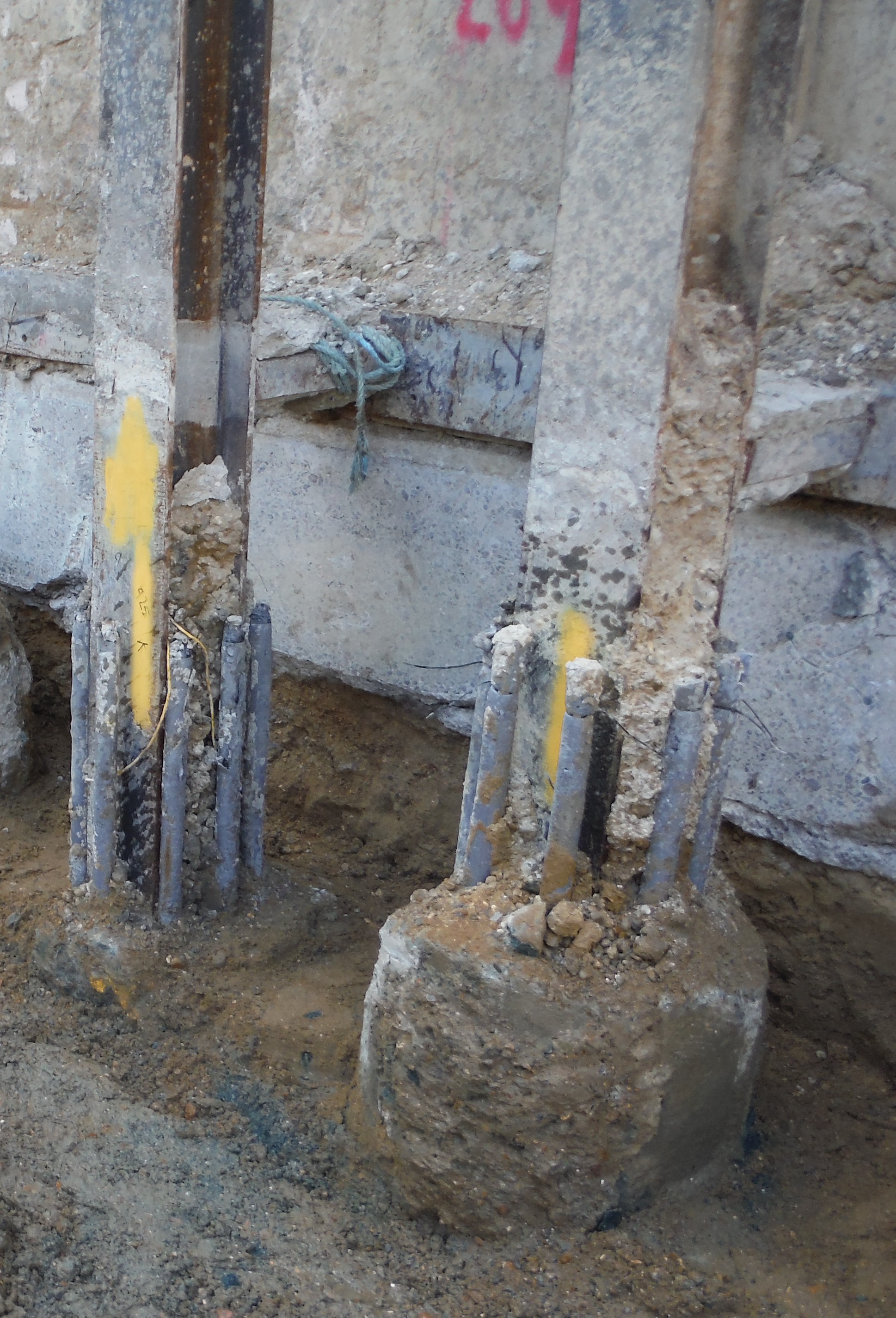
King post embedded into male pile adds to the difficulty of removing concrete.
Now break concrete from the piles with column sections and pile cage reinforcement in the way! This is all doable and I have been careful in selecting a tool which does not give you white finger after 5 minutes use (such as air compressor type breakers). This has included finding Hand Arm vibration limits for the Hilti TE1000 breaker and use of the HSE website. Turns out that the action limit is 4-hours 44 minutes trigger time. So what – a minimum of 2 people have to do the breaking. Add in some rest periods and only account for actual “trigger time” and that specific piece of equipment is fine to be used each day.
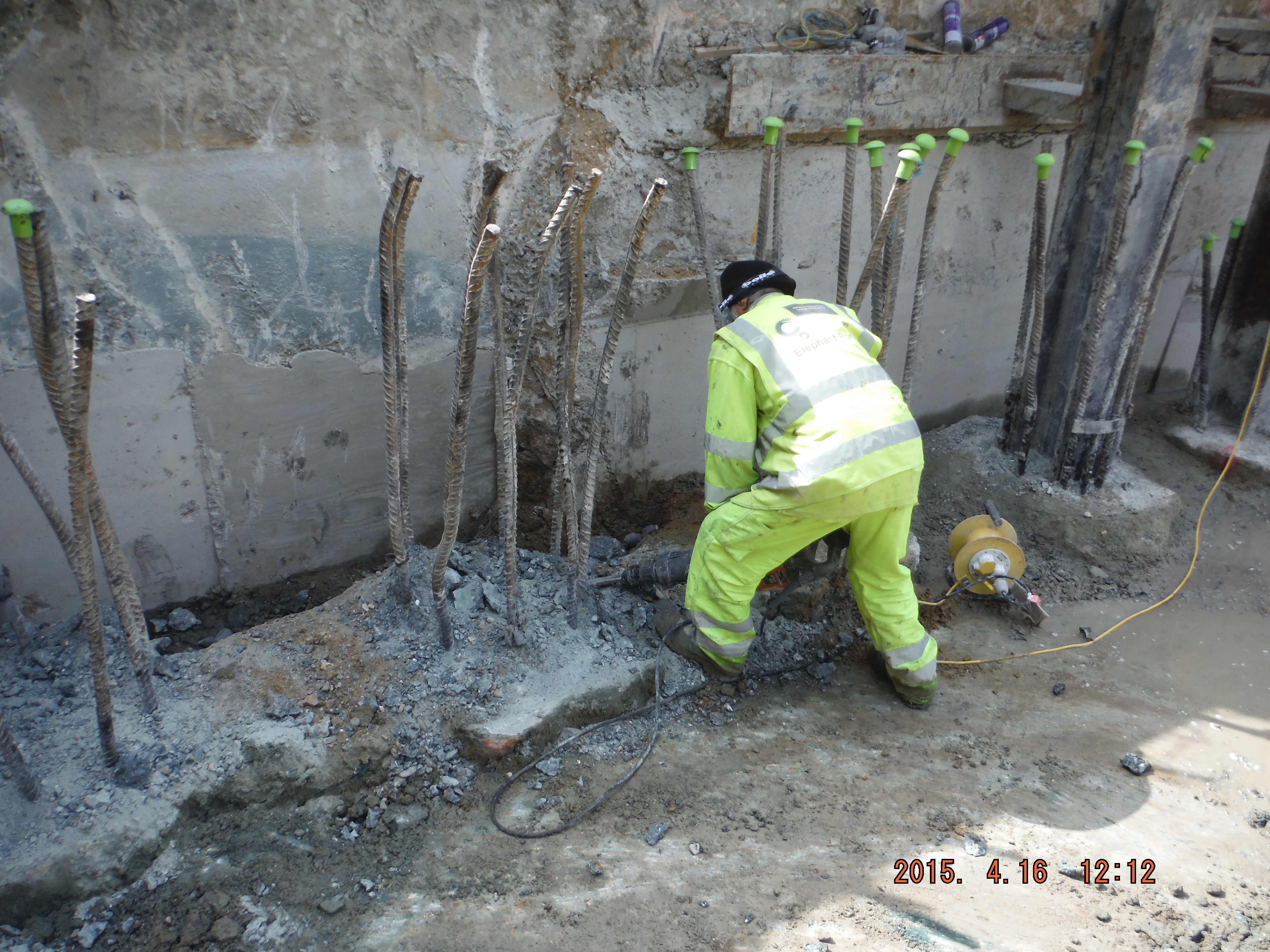
Breaking down the piles with a Hilti TE 1000.
Luckily the problem has become apparent before all of the secant pile wall has been completed. Therefore we will try and do something to reduce the utter nause of pile breaking.
Options:
1. Dig/ladle away wet concrete before it cures – sensible but that means putting 2 labourers close to the pile rig auger as it moves onto the next pile and as I have commented before the whole area is flooded in a slurry of wet concrete and clay.
2. Attach void former to web of king post to stop concrete even forming in the web.
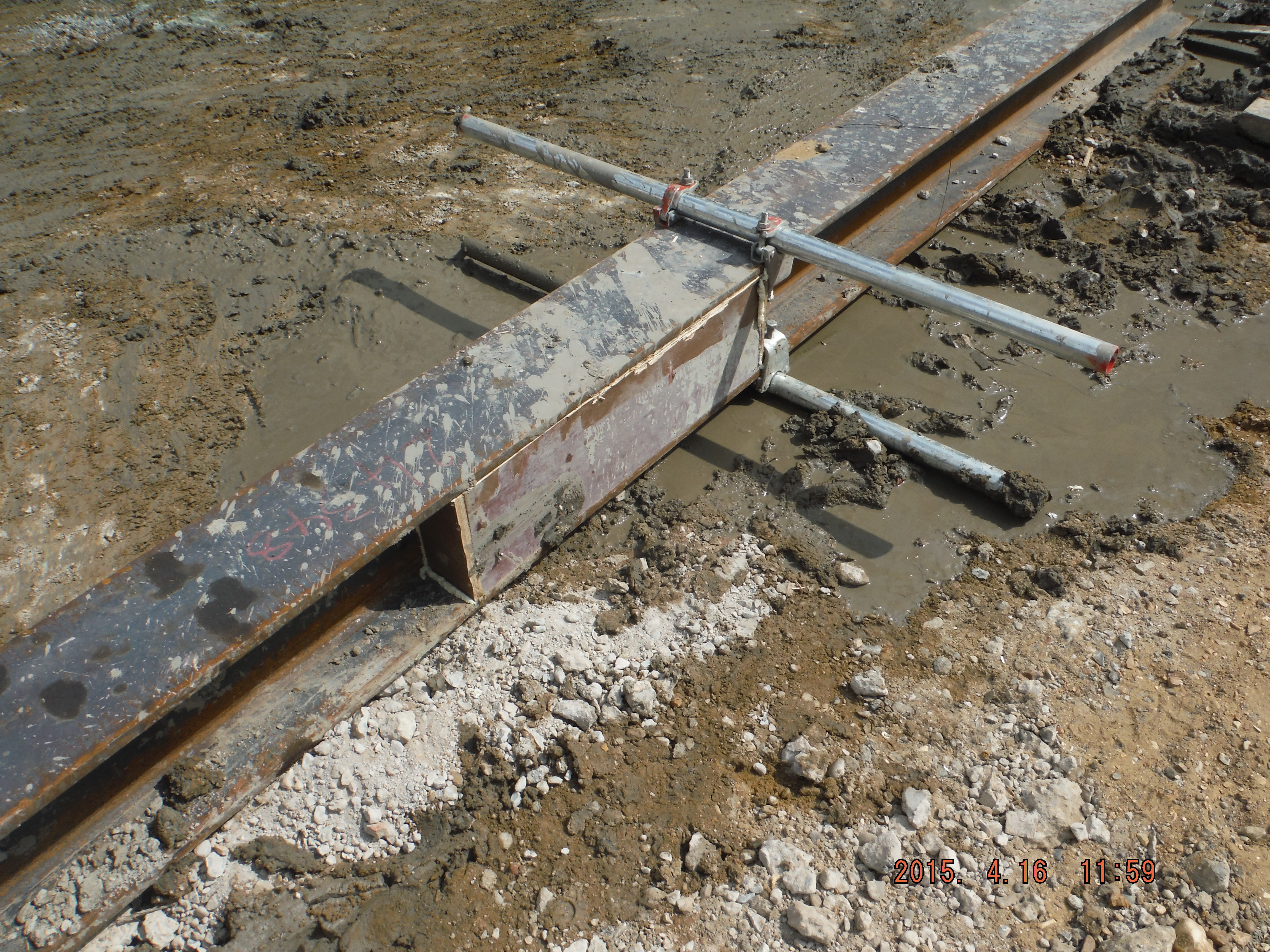
Void former to reduce amount of concrete to be broken.
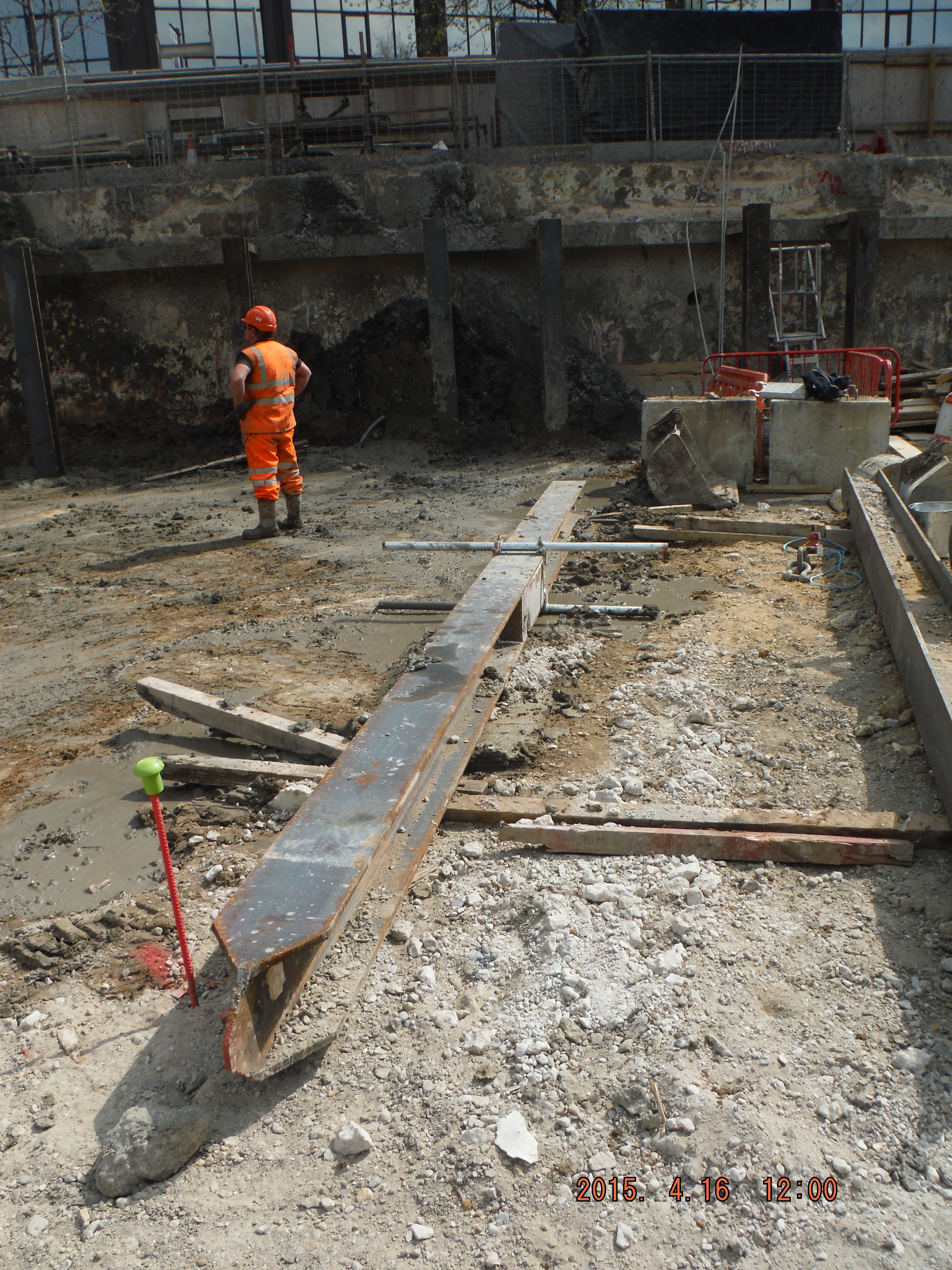
King Post with void former.
3. Suck out the concrete from the piles with a special concrete Hoover (apparently they exist).
4. Do nothing and head for the HAVS assessment.
Clearly the post pour options that exist are a bit trial and error and will involve an element of faffing about, however 20 minutes ladling some concrete out of the top of a pile compared to 2 weeks of chiselling it out is much preferred.
What I will take away from this is firstly to explain the importance of designing pile cut off levels and the consequence of not being able to execute the design. This might be to communicate the hazard through drawings and possibly the specification so that the contractor may mitigate the hazard before it is too late and the piles are cast.
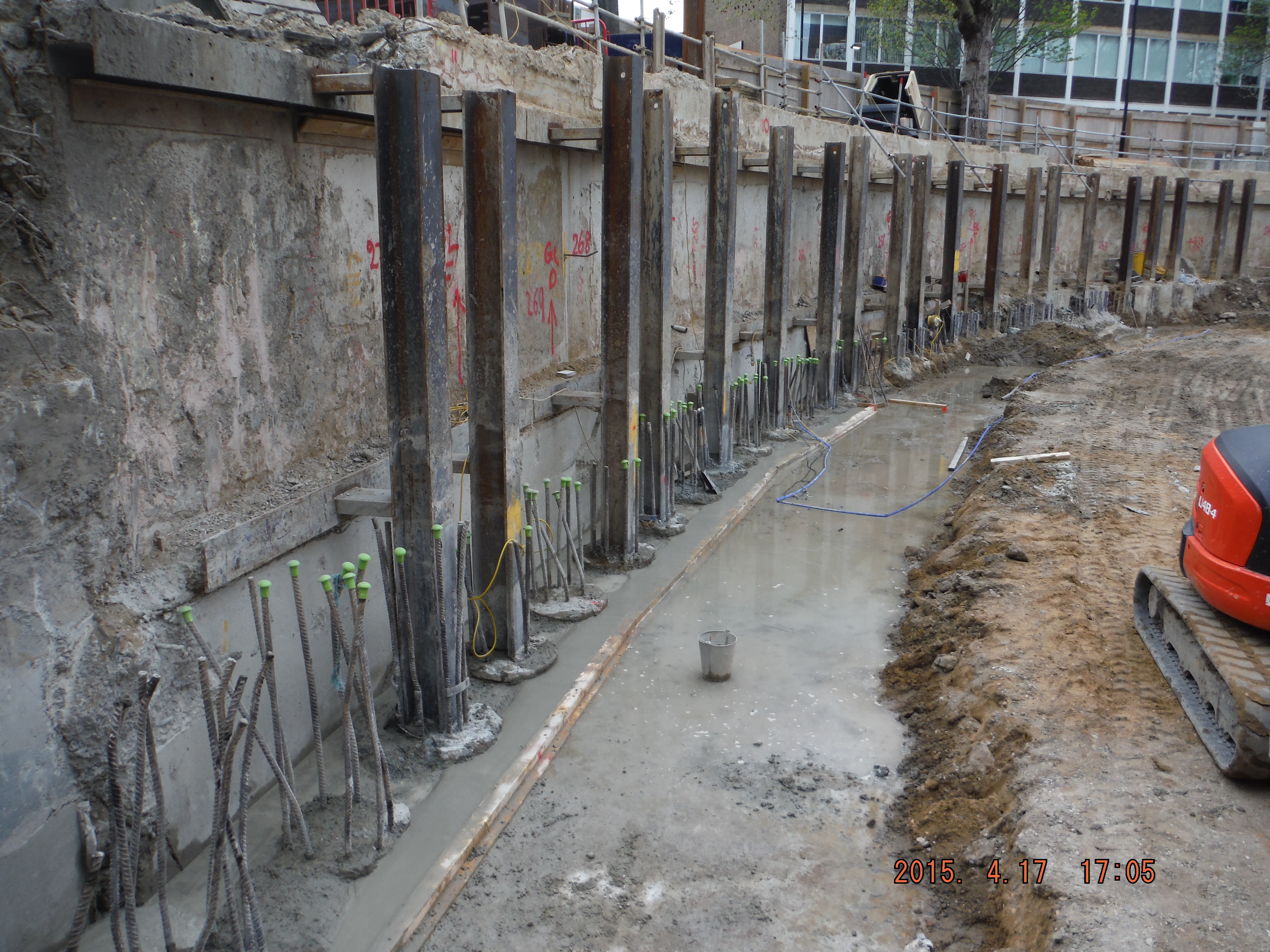
Slow progress – Piles broken to cut-off and blinding concrete complete 10 days after starting.
This blog subject will re-emerge in about July 15 when the excavation of the basement is complete and the ground bearing piles need to be broken down (hence submerging pile cage reinforcement).
Now for steel fixing and remembering what Richard taught use about steel reinforcement schedules!
 Holdfast Training Services Trial Blog