Archive
Lang time nae see, Far hiv ye been, min?
It’s now the start of my third week at BP and although I’ve not really got into the detail of what I will be doing and be responsible for, I thought I would summarise what I have done to date and offer an anecdote or two. A separate post will follow on BP, the contract and my role, in due course.
Safety, Safety, Safety
It’s a bit of an eye opener, exactly how safety conscious BP, and indeed the wider oil & gas industry are. I have had to do two inductions as you might expect, one for each of the buildings I will be working in. The Wood Group PSN induction was a fairly straight forward video, which lasted 15 mins or so, the BP induction lasted a little under an hour, at the end of which I received the guides shown below. The main document (top right) has 23 pages, each of which either presents critical information, directs you to read one of the other documents or asks you to carry our further reading / action, which all require a signature; this is then followed up by the second part of the induction process.
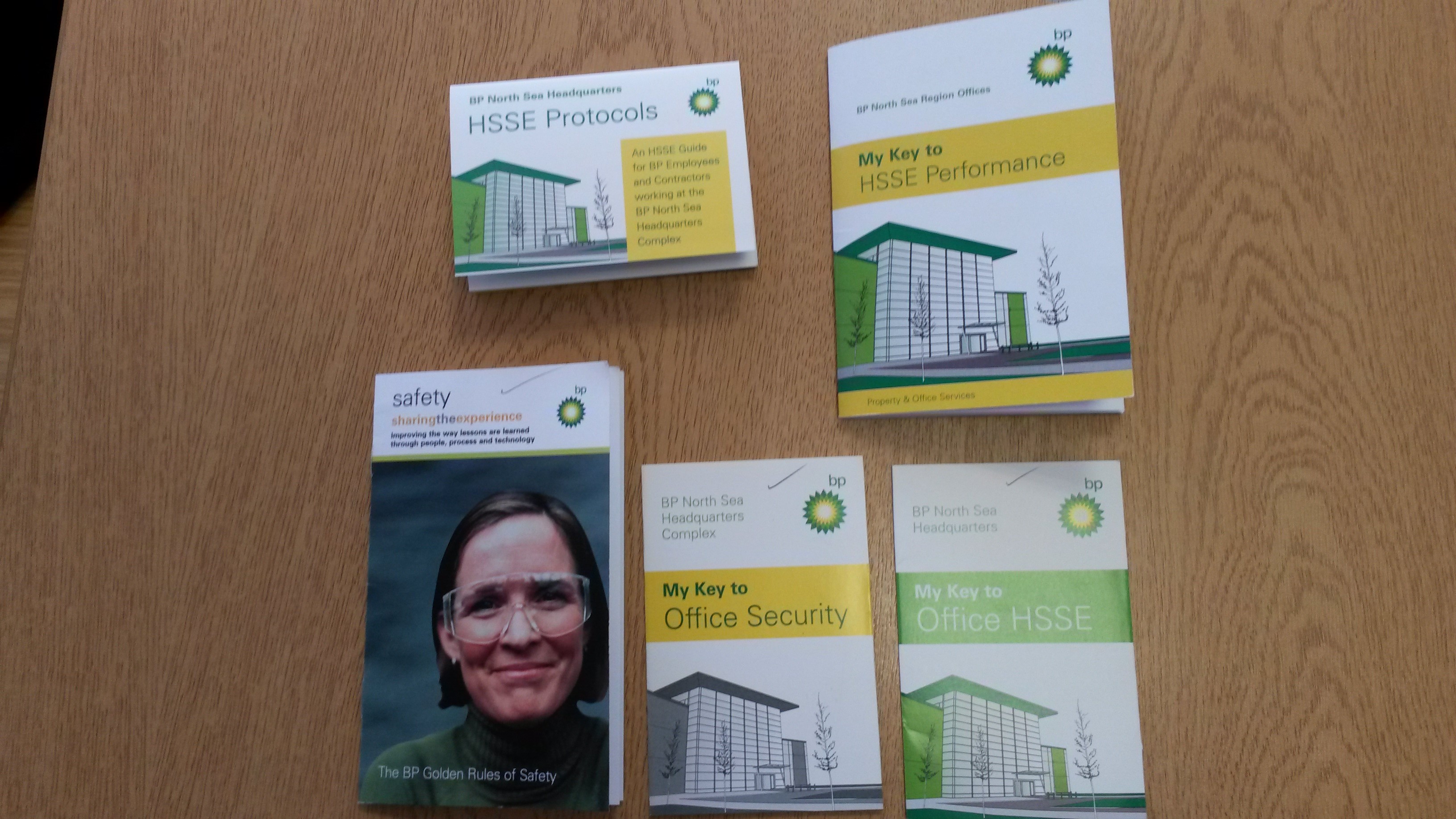
A bit over the top for an office environment? My opinion is not. (you may be surprised by that). What it does, is make you understand just how seriously they take your health & safety and drum this into you from the start, reinforcing the company values of ‘No accidents, No harm to people, No damage to the environment’. (try sitting at Costa in the Union Square shopping centre in Aberdeen; you’ll easily be able to identify those in the industry – they are the ones who walk up the stairs on the left and hold the hand rail)
The place where H&S is absolutely vital is of course off shore on one of the installations. To that end, last week, I completed the Basic Offshore Safety Induction & Emergency Training (BOSIET), Compressed Air Emergency Breathing Apparatus Course (CA-EBA) and the Minimum Industry Safety Training (MIST). The BOSIET Cse was probably the most interesting as it goes through the different types of offshore installation, how to survive in water and in a life raft, firefighting, basic first aid and of course the heli dunking; good value. MIST had some value and added to training already completed at the RSME and previously. (Offshore regulations, Fire, Risk matrix, permit to work etc)
Process, Process, Process
BP appears to have a very defined and slick process for everything they do; the most obvious is their Management of Change (MoC) process. This is supported by an online application which groups together information and documentation for any individual project from the screening phase all the way through to hand over, with great usable features including automatic email updates, assignment of responsibilities and go/no go gates.
They also appear to be very swept up in dealing with Information Management (IM) using their Intranet sites to good effect; I certainly spent a lot of time in my first week reading the various areas and has been useful whilst writing AER1.
Notice that I used the word ‘appear’ in both those paragraphs; I’m sure time will tell if it is as good as it looks or if it will be comparable to JPA, SPOC, MOSS et al.
Money, Money, Money
It’s eye watering looking at the costs of what seem to be simple projects. I will make this a separate post in the future, once it is fully understood as it’s deserving of its own blog.
In other news
Aberdeen is a great city – Would certainly consider living here
Charlotte is still pregnant (27 weeks) and don’t I know it!
Still waiting to move into new house (in London) and preparing for our DIY(ish) ‘Grand Design’
For future BP attach-mentees: I am preparing a 3-4 pager ‘Get you in’ Admin Instr to summarise the last few months of admin points, similar to the AUS document, but clearly a lot simpler. This will be stored on the RMSE servers. Additional documents (initial actions and HO/TO notes) will then be available on arrival which have been passed on from previous courses.
BIM – Bureaucracy or Beneficial
There is no public investment into the Peters Village project and the last time I checked it was not 2016, therefore we are not at liberty to conform to any governmental BIM direction. That being said we are aspiring to collate all of the project data centrally and utilise technology to increase efficiency at an engineering and management level.
So is it working?
The Good – We have a BIM co-ordinator, a cloud based server, lots of drawings and 3D models. We have iPads with more auto-syncd forms than you would ever need and the ability to capture any media file type and link it to technical information. There is a data base that allows you to see (with permission) the commercial files, drawings, specifications, programmes, plant and materials lists on your phone if you so desire.
The Bad – The engineering check list and QA forms are on Autodesk BIM 306 on the ipads but the filing system is overly complex. The cloud based system is different to BIM 360. We have multiple designers who are using different CAD co-ords so dwgs need aligning. The designers are mostly sending through drawings in pdf format and not as part of a master CAD dwg. The cloud based servers is provided through a satellite link on the East Site compound and boosted over the river (very unstable). Whilst the cloud based system allows access anywhere, the system to upload and download files reminds me of the pain I went through trying to submit AER1. On and on…
The Ugly…Truth – The aspiration is commendable, one central log of information, accessible by all, from anywhere, anytime. The reality is multiple databases holding vast quantities of unrefined information. This is not as a result of lack of ambition but rather lack of training, man power and strategy. Those driving BIM are double hatted and unable to dedicate themselves to it, also they seem to lack the full support of the wider workforce.
BIM carries a high price tag and requires considerable effort to establish the required processes. Early set up and buy in are key, without them the whole process becomes a clunky digital filing system with increased vulnerabilities and lacks the ability to assist with increasing efficiencies. I find myself wondering if the system we have in place has actually brought about improvements of if it has over complicated things.
Growing Tomatoes in the Desert
This blog aims to give a brief overview of the project I am working on here in Port Augusta, along with progress to date and key risks/issues identified by John Holland Group (JHG).
The Project
The overall aim of the project is to produce a year –round sustainable horticultural products for the Australia’s national grocery market and to do so with minimal fossil fuel usage and no extraction of fresh water from the environment. To achieve this the project will incorporate a solar energy collection system that is designed to heat water for thermal energy storage and use. The hot water is then used to distil freshwater from sea water and heat the greenhouse in cold conditions. The excess steam produced is used to drive a steam turbine and generator. The greenhouses alone will cover 20ha and the tower will be 115m. This system is simplified below:

The Site
The site is in the bush, approximately 12km South of Port Augusta. For those of you unaware of Port Augusta, it is classified as a major city in South Australia, but with a population of around 13000, think more like small town. It is situated about 300km north of Adelaide at the head of the Spencer Gulf and it is a bit of a crossroads town, with the main communication lines (rail and road) linking North/South and East/West crossing here. The site was selected as the area has a warm desert climate, with low humidity and sun almost every day of the year. (Although this week work on site was suspended as 33mm of rain fell in 12 hours).

Contract
The contract is an Engineering, Procurement and Construct (EPC) which is the same as a Design and Build Contract. It was awarded to JHG on 1 Dec 14, with ground works beginning just two weeks later currently the project is due for completion in Oct 16.
As this an EPC contract the final cost ($168 million) of the project has already been agreed with the client and finances secured from an investor. In order to secure this finance the client was forced to appoint a main contractor to manage the whole project, additionally the amount of finance is the upper limit, therefore there is no scope for change on the client’s behalf, without having to find savings elsewhere within the project, and this again is identified as a key risk by John Holland Group (JHG).
The majority of subcontractors have already been selected for the construction and have been used in the detailed design stage, and are listed below:
Civil works – York Civil
Greenhouses – Van Der Hoven
Power Generation – AALBERG
Balance of Plant – KBR
Electrical – TBC
Risks
One of the key risks identified by JHG is the interface between each of the subcontractor elements, in particular the E&M elements. In addition because several of the subcontractors are new to working with a main contractor there are concerns over the difference in perceptions and procedures, especially in regards to risk management and planning. As an example, last week two loads of concrete had to be turned around from site; Van Der Hoven had ordered it for the foundations for the first greenhouse, however they had not submitted Inspection and Testing Plans, thus no one from JHG had inspected the foundations. In addition the delivery had not been briefed during the pre-start, therefore none of the plant operating on site knew about it, raising issues about safety. By the time inspections had been made, the concrete had been sitting there too long and was rejected. Clearly there are also various environmental risks when working on a site in the middle of the bush:


Progress to Date
So far the ground works have been the focus, laying out of the first greenhouse is now taking place and the foundations dug. So far JHG representation on site has been limited to around 5 personnel, this is changing at the moment with someone new turning up almost every day, and a new project manager (Former Royal Engineer Mark Burnett OBE) is due in the next couple of weeks. With this influx of personnel the organisational structure and roles and responsibilities on site is changing daily, with the new project manager hopefully this will stabilise. My role within the project is still up for debate, with various people offering up opinions, but confirmation TBC. So far similar to Rich I have been reading various contracts, attending meetings with stakeholders and getting to know the JHG procedures.
 Holdfast Training Services Trial Blog