Archive
Level of Learning: Conscience Incompetent
Following a good week in the office last week, I am starting to understand BP, Projects & Modifications and my role within it; here’s a flavour.
Ground
BP North sea operations currently own 6 assets in the North Sea. Bruce, Claire, Magnus, Andrew, Foinaven and Eastern Trough Area Project (ETAP), which are a mixture of single and double, steel jacket design platforms, with or without multiple subsea wells connected to the processing platform, with Foinaven being a Floating, production, Storing and Offloading (FPSO) vessel. It is the hub which covers ETAP that I have been assigned to.
Eastern Trough Area Project (ETAP) is an integrated project consisting of 9 independent reservoirs (each containing one or more well heads), 6 owned by BP and 3 by Shell, all linked to a central Processing platform. Considerably different from what a layman might consider a ‘standard’ single well, steel legged rig; the truth is there doesn’t seem to be a standard, with each of the 6 BP North Sea assets different from the next.
The diagram below shows the layout of ETAP. The main structure consists of a Processing, drilling and Raising (PdR) platform connected to a Quarters & Utilities (QU) platform, separated for safety. The Marnock well is directly below the PdR platform, with Monas, Mirren, Machar and Madoes (and Shell Egret, Skva & Heron) all being subsea wells, tied back to the Central Processing platform (CPP). The 6th BP well, Mungo, requires a Normally Unmanned Installation (NUI) in order to carry out additional processes on top of what is required for the other subsea reservoirs.
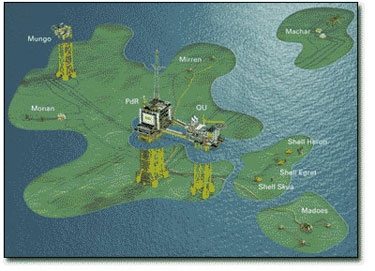
ETAP Schematic
The picture below shows the QU platform on the left, consisting of a heli deck above the accommodation and welfare facilities, power generation units (gas turbines) and other services, connected to the PdR in the centre. The structure on the right is a Flotel, which provides additional Person on Board (POB) capacity when required (i.e. during construction or Turn-A-Round (TAR)).
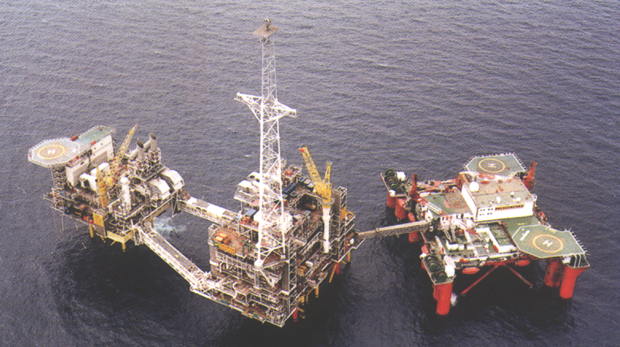
ETAP QU & PDR platform with Flotel
Organisation
As mentioned earlier, I am assigned to a hub which currently only deals with ETAP (and Mungo), although asset responsibilities often move between hubs depending on workload, personnel and suitability. The 3 or 4 hubs (again remaining flexible) all work within the Projects and Modifications branch of Engineering Services, which itself lies within BP Global Operations Organisation, comparable, I guess, to a TLB in the MOD.
The main role of the Project and Modifications team is in the title. It doesn’t deal with well drilling or new platform construction (these are dealt with by Global Wells Organisation and Global Projects Organisation (other TLBs)) but instead deal with any routine or emergency upgrades, additions or repairs, primarily to enhance safety or production, up to a value of $15m.
Contract
A contract was renewed this year with Wood Group PSN (WGPSN) called BP Focus, which is a 5 year contract (with a 2 year extension option), which covers Upstream (offshore assets) and midstream (onshore processing) on a cost reimbursement + basis. WGPSN primarily only deal with the latter stages of the project lifecycle, (Define & Execute), with the earlier stages, (Appraise & Select), being delivered by Costain. Again, remain flexible.
The Cost reimbursement + contract means that WGPSN invoice BP for all direct costs incurred, due to general overheads and any work carried out on the specific projects. Added to this is a fixed mark-up percentage, the value of which depends on the cost element but as an example is 6% for ‘Real estate services, desk space, phones etc and up to 8% for personnel. In addition, there is an incentive scheme which offers a bonus of up to 4% against some of the cost elements, primarily personnel if a project meets certain Key Performance Indicators (KPIs) which are agreed annually.
My Role
As a Project Engineer, I am the Single Point of Accountability (SPA) for a number of projects on ETAP. My role is to liaise with the appropriate team within WGPSN and monitor the development throughout each of the project lifecycle phases, engaging with BP staff, WGPSN staff and external agencies as required in order to move the project forward. Budgets and scheduling are key, and it will be my responsibility to ensure that timings are adhered to, budgets are realistic and monitored, whilst constantly feeding this back to the BP side to ensure there is one version of the truth. The BP Method of Change (MoC) process which is there to help identify, assess, manage and communicate risk throughout the project lifecycle also needs to be managed, to ensure the correct processes are being followed and that all relevant documents are up to date and easily accessible. This along with other key documents will form the basis of a go/no go decision at key points along the project life cycle either between phases or at the 12, 6 or 2 week review before the project is executed offshore.
Clearly this is an attempt to summarise in a paragraph what I am meant to be doing, having had very little experience to date; talking to Brendan and Nick, it is clear it is not as simple as it sounds and only be doing it will I get a thorough understanding. My next blog will explain a project I have just taken over, which should hopefully provide some clarity on all the above.
Key points to take away: The military are just amateurs when it comes to TLAs and flexibility is key!
Other news
Pregnancy – Still
New house – aim for contract exchange this Friday, completion next week.
Just been along to a meeting at my local BSAC dive club, looking forward to some off shore diving soon.
Developing
Being positioned away from London clearly Brad and I will be unable to get to any of the evening Institution lectures to broaden our scope as Engineers prior to professional review. Enter USACE’s Officer Professional Development (OPD) programme to fill that gap. The current programme to gather Baltimore District’s 15 military members is quarterly meetings of a day and an annual 3 day trip. This year’s 3 day bender centred around the civil works programme within the Baltimore District, more specifically on the restoration and maintenance of the Chesapeake Bay. Below is a quick canter through the challenge presented to USACE:
However, before the learning, the programme started with a PFA and Howard had instructed us that it was ‘tradition’ to make sure the superpower was kept in check. So after a nervous start a Brit 1, 3 was achieved; we also managed to avoid embarrassment in the later ‘Ultimate Football’ game; end to end exhausting fun.

After round 1 didn’t go their way we had to play with this funny rugby ball
Chesapeake Bay
When America was colonised the Chesapeake Bay and surrounding area were some of the first places that the settlers put down roots due to the abundance of seafood in the bay and the favourable conditions for shipping of a sheltered deep harbour. As Richard indicated during our river and flooding day in Chatham however, the impacts of firstly the Royal Engineers and later USACE building dams and developing farmland have, alongside over fishing changed the landscape. Now Maryland state must ensure that the bay now supports the industries (shipping and fishing) that have grown up within it as well as be environmentally sustainable.
Shipping is one of Baltimore’s biggest industries as it has one of only 2 ports on the Eastern Seaboard that can receive ‘Super Panama Tankers’ which require a 50’ channel. This is as a result of dredging channels and, despite biting the hand that feeds it; Maryland state law presents some difficulties to the disposal of the dredged material. Dredged material can’t be dumped in the open water of the Chesapeake Bay and new islands can’t be created within the State’s waters. Additionally all the material in the habour is considered contaminated (with heavy metals etc) potentially causing water pollution when disturbed.
Being America clearly the numbers are big: 4.5 million cubic yards (the volume of 1.5 football stadiums) per year of sediment needs to be removed from the bay channels for maintenance alone. It is 180 miles from Baltimore Harbour to the mouth of the Chesapeake and the Atlantic Ocean where the first open water dumping ground would be; this would be expensive so they don’t do it. Instead the solution is land reclamation, either extending peninsulas or enlarging islands, and as the dredged material looked as if it had all the structural properties of a soggy blancmange the land is mainly used to build nature reserves and still isn’t cheap.

The scale of the Chesapeake Bay
The current main destination is Poplar Island, which over the last 20 years has taken approximately 100 million cubic yards at a cost of $1 billion, so $10 per cubic yard, or $50 million a year. The engineering is pretty simple; build berm from sand etc, put in loch gate to drain out water, pump dredged material (80% water, 20% solids), let it settle and drain the excess water. Of greater complexity are getting the water quality to the acceptable standard to drain into the Chesapeake Bay, introducing plant species to be beneficial for wildlife and hold the island together and the liability USACE will have for the island once completed.
They are planning on handing the National Parks Service (NPS) as a nature reserve. However, the maintenance of islands made from contaminated dredged material isn’t the NPS’s Mastermind special round choice and so USACE will still be responsible, and liable, for ensuring the island maintains its integrity. Clearly in the grand scheme of things with both parties being Government departments it is merely the department best positioned to deal with the issue being responsible which is best for the Nation and Government but that philosophy is muddied by departmental budgets and politics.
Other elements of note were the Conowingo Dam on the Susquehanna river is now ‘full’ of silt which is going to result in more being transported down stream and into the Bay. This is again an area of liability controversy as it was built by USACE, in 1926, but is now operated by Susquehanna Electric Company (SEC). Clearly neither want to accept liability and pay the exorbitant dredging costs, though ultimately SEC has the upper hand as if they don’t deal with it behind the dam then the problem will get passed on to USACE when the silt hits the bay. From an E&M perspective, more interesting than the silt was 1950’s style sign, below.
Also the rare forethought of the 1920’s designer who foresaw the increasing need for electricity and built space for an extra 4 turbines over the 7 installed at commissioning. The original 7 turbines produced 250 MW of power, in the 1960’s the remaining 4 were installed with equal power output giving the dam an output of 500MW.

The very 1950’s sign and the 1960’s turbines.
 Holdfast Training Services Trial Blog