Oz – PCH Issues, Issues, Issues…
Week 2/3 and I have now started to get involved… Below are the details thus far of one issue I am getting to grips with – I have another in the back pocket for another blog as I’m conscious they can get lengthy…
BOC and Nilsen Essential Critical Power Supply
Who’s who?
BOC – Medical Gasses Equipment Supplier.
Nilsen – Electrical Sub-contractor.
NDY – Design Consultancy Sub-contracted to JHG.
The Issue
My first real task was to aid in an issue that arose when the BOC sub-contractor tried to ensure power connection to his plant (2 x medical gas compressors and 6 x vacuum pumps) in Plant Room 6 (PR6) to the power supply and found there were no cables fitted. This issue is also mirrored in PR5.
For all plant installation it is the responsibility of the plant manufacturer/sub-contractor to electrically connect back to an isolation point (usually via an isolation box). Nilsen then take responsibility from the isolation point back through busbars, distribution boards etc to the main distribution board and incomer in the basement. The issue was that there weren’t any cables installed and Nilsen’s defence was there were no cables on the design drawing (fair enough). There were no cables on the dwg because NDY didn’t put them in during the design phase (why? Who knows).
The Solution
After an on-site mtg with BOC, Nilsen and JHG (consisting of the block construction manager, my LM and me) we came to the solution that Nilsen would install the necessary cable to a distribution board; the board needing to be roughly equidistant between each piece of plant to ensure a balanced load. This placement required my LM and me to look at the design dwgs and position it on the nearest column structure that also met other factors like accessibility, where the cable runs would go etc. Nilsen also required the load of each installed plant/equipment which consists of; 1 x compressor at 46kW (configured under a N+1 arrangement with the second compressor being stand-by so only one compressor will be powered on at any one time) and 6 x vacuum pumps at 6kW each (5 x duty and 1 x stand-by) giving a total load of 76kW. From this Nilsen can size the cables. NDY and Nilsen’s bigger task was to establish which connection point to the mains was best; either all the way down to the incomer in the basement (4 levels down via the service riser) or; as pointed out by the block construction manager connect into the Critical Essential Supply (CES) bus duct (essentially what a busbar is designed for) which is only one floor away and a number of rooms across but which is a lot closer overall and thus a much cheaper option as there would be a much reduced cable length (cost not yet estimated) not to mention reduced installation time/labour. However, my LM and I were discussing afterwards that actually the cheaper option of connecting direct to the busbar might not necessarily be the correct option. The busbars should always have spare capacity (in terms of load) designed in so as to enable future plant/loads to be added – part of the head contract specification to ensure the design is ‘future proof’. So, by connecting direct to the busbar you will save on time and cost but you reduce the capacity for future flexibility provision both in electrical capacity (designed for 20%) and space(designed for 30%) this is in addition to the contingency provision of 10% capacity and 15% space. The devil will be in the detail as the load required by the BOC plant may be small enough that it won’t add significantly to the busbar – it depends on what percentage of spare capacity we can eat into, bearing in mind it may have been eaten into already. And will the client have an issue with it?
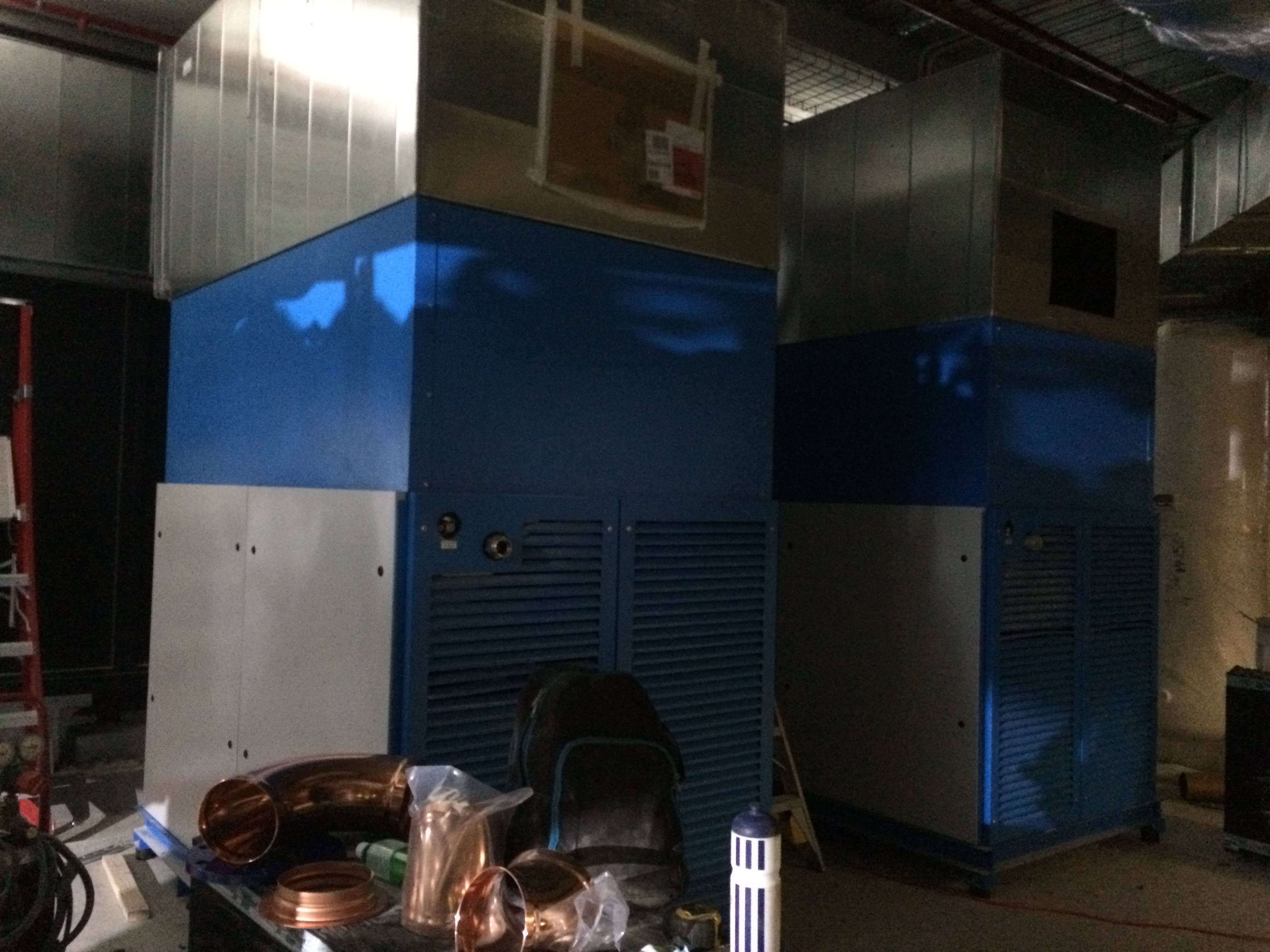
2 x Lento 37 Medical Gas Compressors set-up in an N+1 configuration.
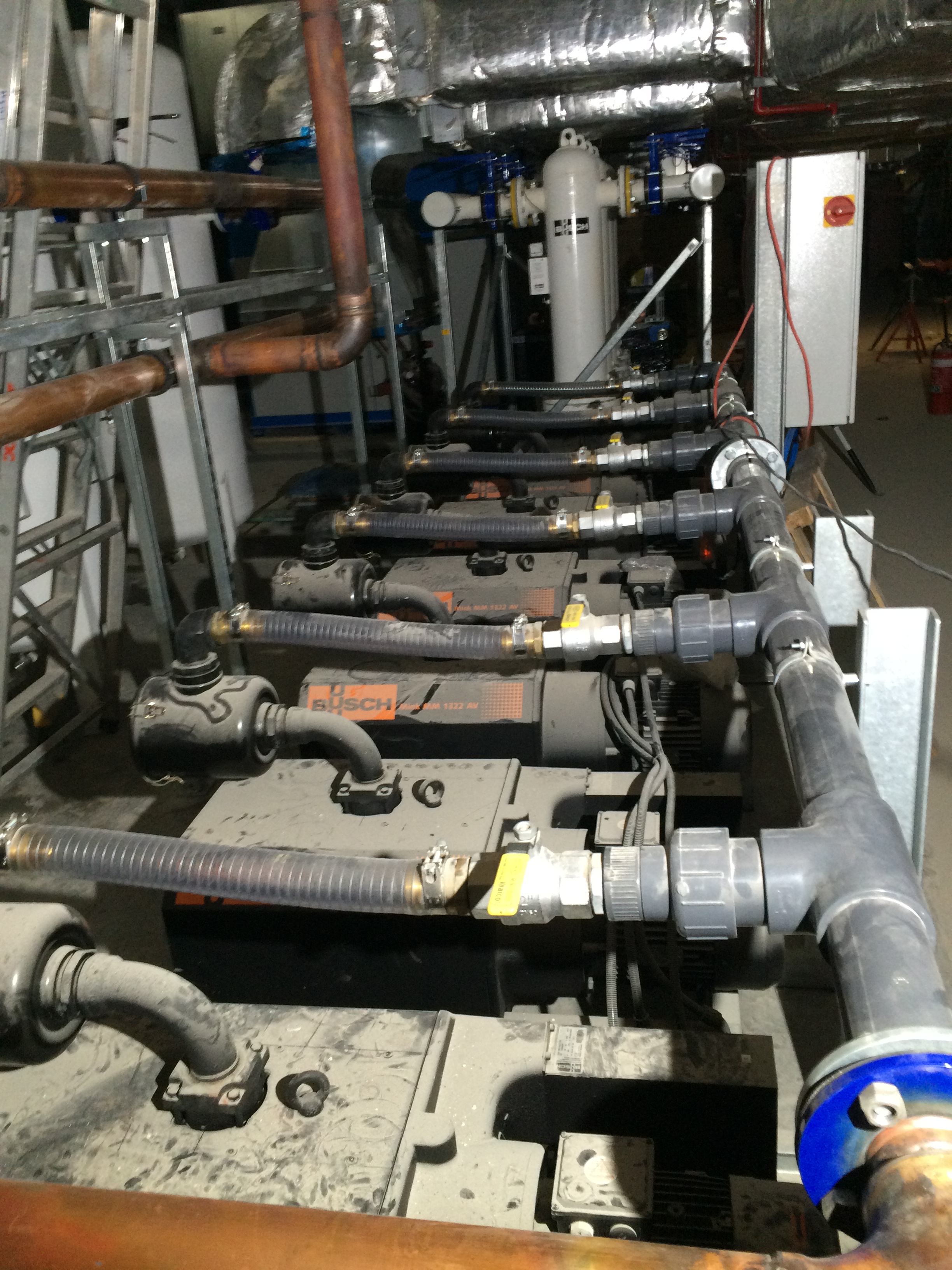
6 x Busch 6kW Vacuum Pumps set-up in an N+1 configuration.
Commercial Aspects
Of course the biggest issue here is who is going to pay for the cable omission? This is where on a project of this size it’s good to be able to off load it onto the commercial team who deal with sub-contracts, late notice payments etc etc all the time….but for me personally this is an opportunity to understand the commercial aspects and help toward ticking off some competencies. Contractually, here are the options (I must add this feels like answering one of Greg’s PCM exam questions): BOC say “we need power to our plant, where is it?” Nilsen say “no cable on the dwg therefore we haven’t installed one” (fair enough). JHG investigate and it turns out that NDY didn’t design it in therefore why it’s not on the dwg. So, quite clearly contractually Nilsen will put an invoice in for doing the works to JHG and JHG slap a design variation order on NDY. Cut and dry right? Well no, because NDY are a consultancy and they don’t have pots of cash lying around to dip into for mistakes like this, what they do have though is their liability insurance. The issue here is it costs (in this case JHG) money to reclaim costs against a consultant’s liability insurance – somewhere JHG doesn’t particularly want to go. So where does that leave us? JHG will have little choice but to instruct Nilsen to carry out the works and when the variation payment request from Nilsen comes in pass it over to the Contracts Administrators to investigate how to handle it. The bill will be in the order of $250k, hence the block construction manager highlighting a possible cheaper solution.
Nilsen are on a Guaranteed Maximum Price (GMP) contract, essentially they priced the entire works at the tender stage and should have a substantial ‘risk pot’ to cover these design issues but generally JHG will reject any Variation Order (VO) from subcontractors under a GMP contract. So JHG can turn to them and say “this is in your scope of works so we’re not paying twice for it”. However, JHG have rejected a vast number of VOs from Nilsen already to the point where another rejection (especially of this cost) could cause relationship issues and push Nilsen to rethink further business with JHG. The political point to add is that Nilsen are one of the best electrical subcontractors in WA and that is something JHG have to factor in. So the CA may have to come up with some form of compromise and when the total VO costs come in there may be some horse trading to be had. This is going to be a commercial contracts issue that is initiated by me raising a Subcontractor Direction – Authorisation Request (due to the commercial risk) which is then sent to the CAs and added to the overarching risk register.
An update whilst compiling this blog came through with the Project Director issuing NDY with a VO notice to pay for the entire variation and we are now awaiting NDY’s decision – potentially this is heading to the courtroom! This has been a good learning experience to investigate the ‘what ifs’ regarding contractual relationships and I will follow this through with the commercial team to see how it pans out and fall a little deeper into the bottomless pit that is contractual issues.
So what?
Aside from this issue on the whole JHG will try and steer any possible VOs away from a subcontractor under a Lump Sum (LS) fixed price contract and onto a subcontractor under a GMP contract as they know they can reject any possible variation claim. This only really occurs when the issue is at a physical point in space between two or more subcontractor’s remit of works and JHG can wangle it so the subcontractor under a GMP contract has to rectify the issue – thus knowing they are highly unlikely to win a claim for the variation. A basic example being ductwork (to be installed by subcontractor A – GMP) which will clash with water pipework (to be installed by subcontractor B – LS). If it is proved the positioning of both services are correct, as per the design dwg, JHG will try and make subcontractor A change their design.
 Holdfast Training Services Trial Blog
Fran, a potential $250,000 VO. I am sure that is concentrating minds wonderfully! The Project Director has made the call against NDY and I think he is right. NDY the consultant are being employed by JHG for their professional expertise and experience in designing a fully complient and functioning installation and in missing out a major component from that design, they have submitted a proposal that is not fit for purpose. Nilsen the electrical subby are only passing on the shortcomings of NDY’s design to the project team for a decision and they may also be looking for an extension of time and delay damages. NDY may be checking their PPI insurance is up to date..! Regards Greg
Greg,
Thanks for your comment. NDY have made numerous errors in their design plan and I think had that not been the case the Project Director made have not been quite so bold in his actions but I’m sensing that JHG have had about all they can take of their incompetence – clearly I may not be quite so critical when I move their for Phase 3 but I am simply relaying what people are saying. I’m told all VOs are put into a pot and come the end of the project when it’s time to cash in the Project Director will be having lots of business lunches with respective subcontractors to strike some deals – no one likes going all the way to the courts or even as far as arbitration. I’ll update you on how Nilsen deal with the situation.
Intersting. Having seen similar issues in the past I would suggest that if NDY should have put a cable in that position i.e. the location had been clearly designated for the plant and stipulated as requiring the connection then the extent of their error lies in the cost associated with making the necessary changes to the drawings. The client (JHG under the D&B) would have had to pay for the materials and labour associated with installation if it had it been shown and so the fact that they were not previously having to do so and are now is immaterial, unless there is a difference in the amount arising from the late notification. That you and your PM have designated the route and connection means that NDY could also argue that there is nothing required of them and therefore they have no action to take and no cost to meet. If the area was not clearly indicated as needing power then it cound have been assumed to be a storage area or similar and so NDY have absolutley no case to answer.
The cost of materials and labour then comes to rest with JHG but they have a fixed price lump sum contract with Nilsen who, if they priced for this nbased on drawing showing oii as an area indicated as having the power supply are now simply completing work for which they should have included (NDY should have shown the cable route but the installation need would have been implicit and Nilsen should have priced accordingly). If the drawings didn’t show a need for power then Nilsen would not have priced but NDY would not be at fault and the specifier i.e. clients rep JHG is. Furthermore, if the drawings didn’t show a need for power, not only would Nilsen not have priced for it but, double whammy, the cost is one that would have existed but has become a saving made by JHG becasue of its exclusion for the lump sum i.e. JHG would have agreed a larger figure to include this work becasue it would have been on the drawing and all that is now occuring is that they are picking up the bill they would have had anyway.
Bottom line is that the designer may be at fault for a design that doesn’t work but any additional cost in providing one that does would have been part of the build cost anyway and so is not actually additional cost incurred due to the omission but a saving that is not realised.
It will be intersting to see where cost eventually fall.
Richard,
NDY, being the design consultants and on a lump sum contract, will have tendered for the complete design of all building services. In designing in the medical plant they should (according to their design consultancy experience) understand they will also need to power the plant therefore most likely would have factored in the cost of installing the cables. The fact that they didn’t is unknown…suffice to say that all the service risers and cable trays are already in as they are shared by other services and cables etc. If NDY feel they haven’t broken their contract, which I would strongly argue against, then they have definitely failed to deliver in accordance with the Head contract by not performing to the required specification in making all systems installed work as intended.
This is why JHG are happy to put in the variation claim against them and happy to lose a little (in comparison) on going after their PPI insurance to gain a lot – A lot being $250,000.