Archive
Site Two Fifty One – Dewatering while piling? and hot concrete.
Site Two Fifty One – Dewatering while piling?
“Draining the Bath”; this is our terminology for dewatering the site within the river terrace deposits now that the site is cut off from water recharge (secant pile wall bedding into London Clay). How soon is the question.
Considerations include plan area of site, depth of excavation, permeability, porosity and permissible discharge.
Various methods of how best to dewater have been discussed:
- Dig a hole to about 1m within the water table, insert a perforated pipe, insert sump pump within pipe and de-water. Repeat until required depth is reached.
- Drill out a core using the CFA auger and insert perforated pipe before the hole (wet gravels and sands) collapses.

View of site with pile rig roughly in the centre. When the excavation starts it will be from the far end of site and continue towards the near end (where photo is taken from). The second sump will be near the excavator bucket shown in the foreground.
I prefer option 1 because the sequenced lowering of the water table will reduce the risk of hole collapse because of not having to dig full depth in one go.
Some numbers. From the Ground Investigation the following figures have been assumed:
Initially dig depth: 5m, groundwater at surface of excavation, river terrace permeability: 1×10⁻³, porosity: 15%, plan area: 1900m2.
Putting this together gives 1500m3 of water which is to be removed using 2 sumps at either end of site.
The question is whether removing 1500m3 now, while piling is taking place is a good idea.

Image shows 2 sump locations. Sump 1 will be constructed by excavating down into the water, placing the pump and pumping until the ground water levels out. Repeat until 5m depth is reached.
Risk: Differential settlement. Removing 1500m3 of water is going to create (worst case) 15% more air voids which may settle up to 750mm. Clearly this assumes complete de-watering is achieved, when in reality there will be some moisture left within the pores. Additionally, the soil skeleton has strength and so despite the removal of water that does not directly imply the air voids will settle. If settlement does occur but happens evenly, then we could start dewatering now, but the risk is we don’t know.
Risk: Slip failure near to excavated area. Firstly the excavation edge will not be near to the piling operations. Secondly, by removing 5m depth of water will increase the effective stress by approximately 50kN/m2 – so dewatering will actually improve that risk.
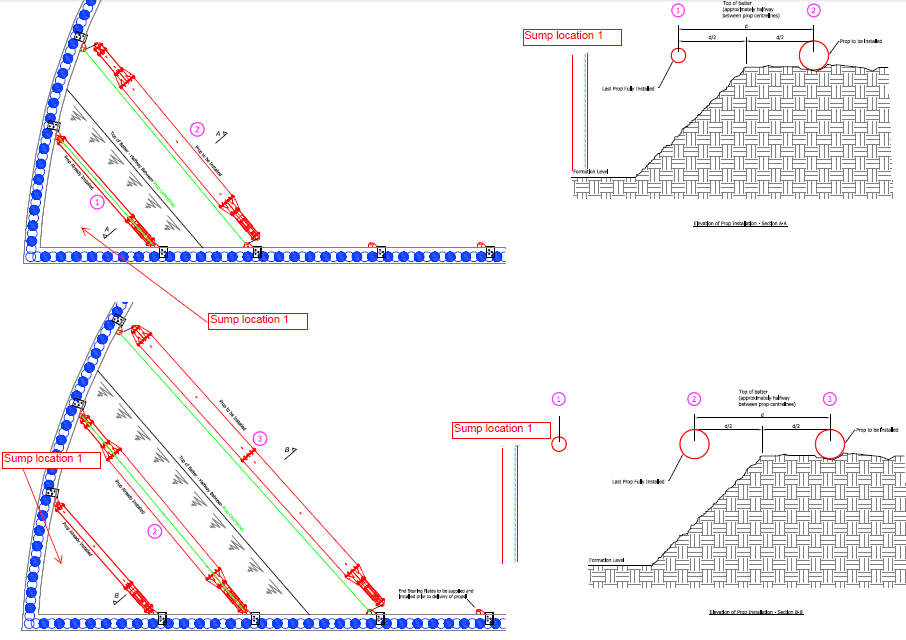
Method of excavation shown here in stages but sump 1 overlaid. Not risk of slip failure reduces as dewatering continues because of improved effective stress.
So what? Delaying dewatering until piling is complete will delay prop installation which delays excavation and the programme longer term.
Proposed solution to follow!
Hot weather and concrete.
Getting concrete in London is difficult at the best of times. However, this week a burst water main near Kennington has not helped, with delivery times exceeding 3-hours. With temperatures reaching into the forties, the concrete supplier has stated that tickets will have to be stamped meaning they cannot guarantee its quality! The concrete is for piles so the risk of quick curing is low once in the hole, the risk is getting it into the hole before it cures in the pipeline. This is not an issue I thought would be a problem in the UK, but turns out it is.
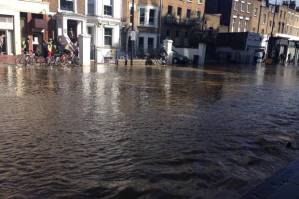
Burst pipe causes chaos.
The mix already has a plasticiser in it to make it workable for pumping and to enable cages to be plunged. To cope with the hot weather, the solution adopted was to add a retarder to delay the initial set. The retarder “slows down the initial reaction between cement and water by slowing down the growth of the hydration products”. The supplier, Lafarge Tarmac, does not have a plasticiser that works well in hot weather, hence the use of a retarder – it appeared to work well. The concrete did not cure in the pipes and the cages were plunged successfully.
 Holdfast Training Services Trial Blog