Site Two Fifty One – Time, cost and quality
Site Two Fifty One – Time, cost and quality
This week at Two Fifty One I seemed to be more directly involved in the time, cost quality triangle and so I thought I would highlight a couple of simple examples to demonstrate.
Commercial background.
The commercial arrangement on site Two Fifty One is that the project is to be run on a negotiated design and build contract. Having agreed a lump sum price to the client of £119M, except for provisional sums, the contractor: Laing O’Rourke, is obviously keen to build it for less to make a profit.
How does this affect me on site?
This week another capping beam pour took place, while a health and safety advisor was visiting and while the drainage order was being finalised.
Cost.
In reverse order, the drainage order included consideration of the attenuation tank which is to be situated below the basement level 2 slab. Company 1 was specified by the designer (or an approved alternative could be applied for) and therefore almost without question Company 1 were to be used. The QS team then got involved and got a quote from Company 2. A series of reasonably sensible RFIs from the designer followed (focussing on maintenance and strength of tank to resist earth pressures) and time started to disappear. Company 1 were informed about a second competitive quote and reduced their price. This meant that by simply asking the question of Company 1 they reduced their price saving a few thousand pounds.
Lesson Learnt? So other than saying it’s obvious to get a number of quotes, it is perhaps less obvious but equally commercially important to recognise when to challenge an expensive design, especially in a design and build contract. These smaller sub-contract packages are actually pretty key in the Design and Build contract arrangement. So far there have been about 10 sub-contractor packages ranging from sheet piling to attenuation tanks to concrete waterproofing supplier. So clearly a bit of effort getting quotes/bids from the market lots of cost savings can be gained from that which the initial project tender was based on. I here Steve’s bus…
Health and Safety/Quality.
Next comes the health and safety advisor’s visit. On a difficult day with machines breaking, particularly low consistence concrete (to gain high early strength) making pours difficult, a 5m deep excavation confining the site further and a muck away lorry to be loaded every 15 minutes, managing every activity was challenging.
This photo shows the ever decreasing space on site with muck away lorries needing to be loaded effectively non-stop all day.
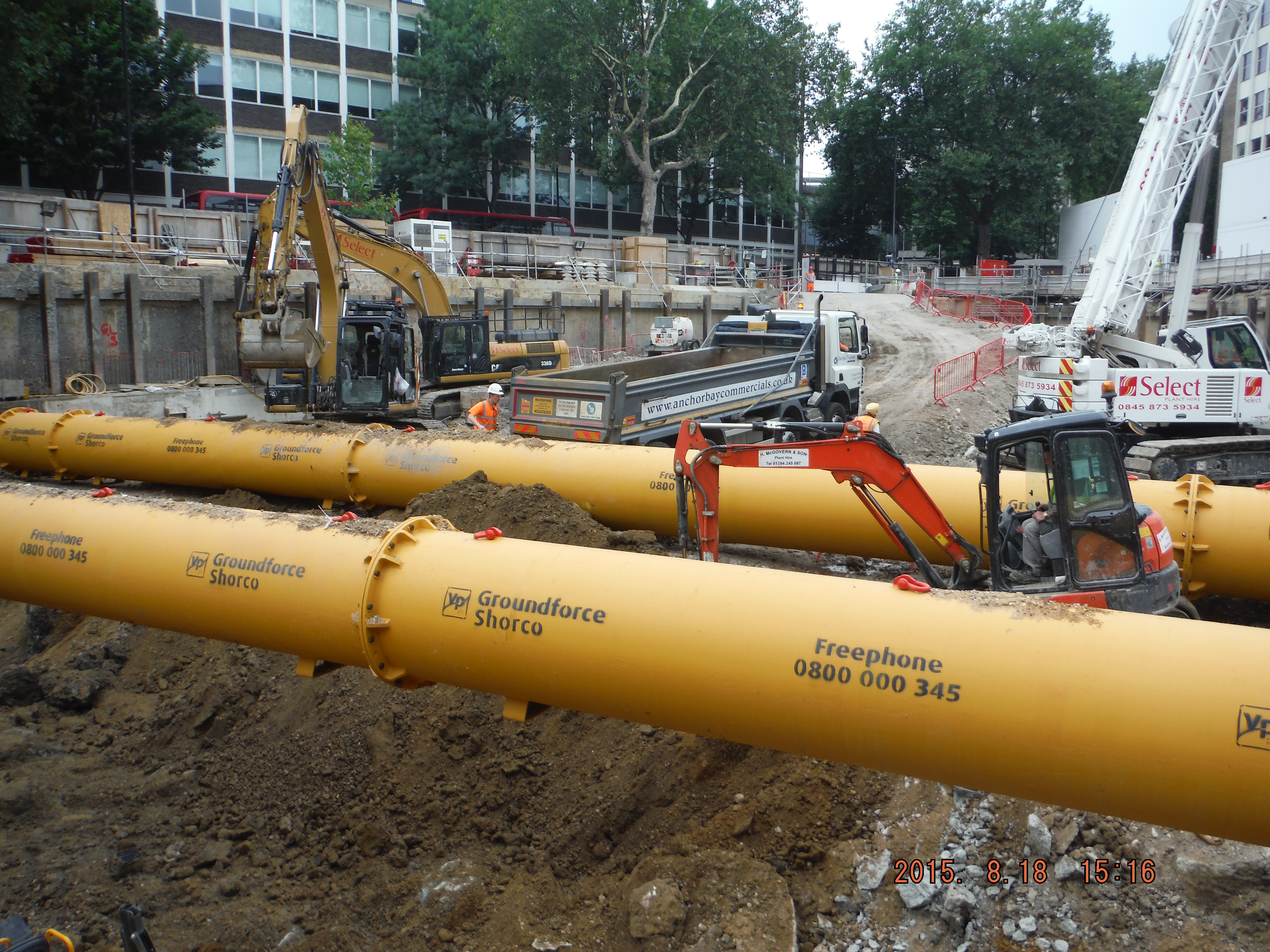
Props reducing site space

Crane at maximum reach.
Of the issues that could have been raised, the main one was access.
To get the formwork shuttering ready for the pour the focus had not been on access. When pointed out it is obvious and I suppose the lesson is: there are a few basics that must be correct and access is up there. The photo below the walkway barriers leading towards the concrete pour. It does not show that the walkway just ends in a 1m drop meaning the operatives had to scramble down the bank.
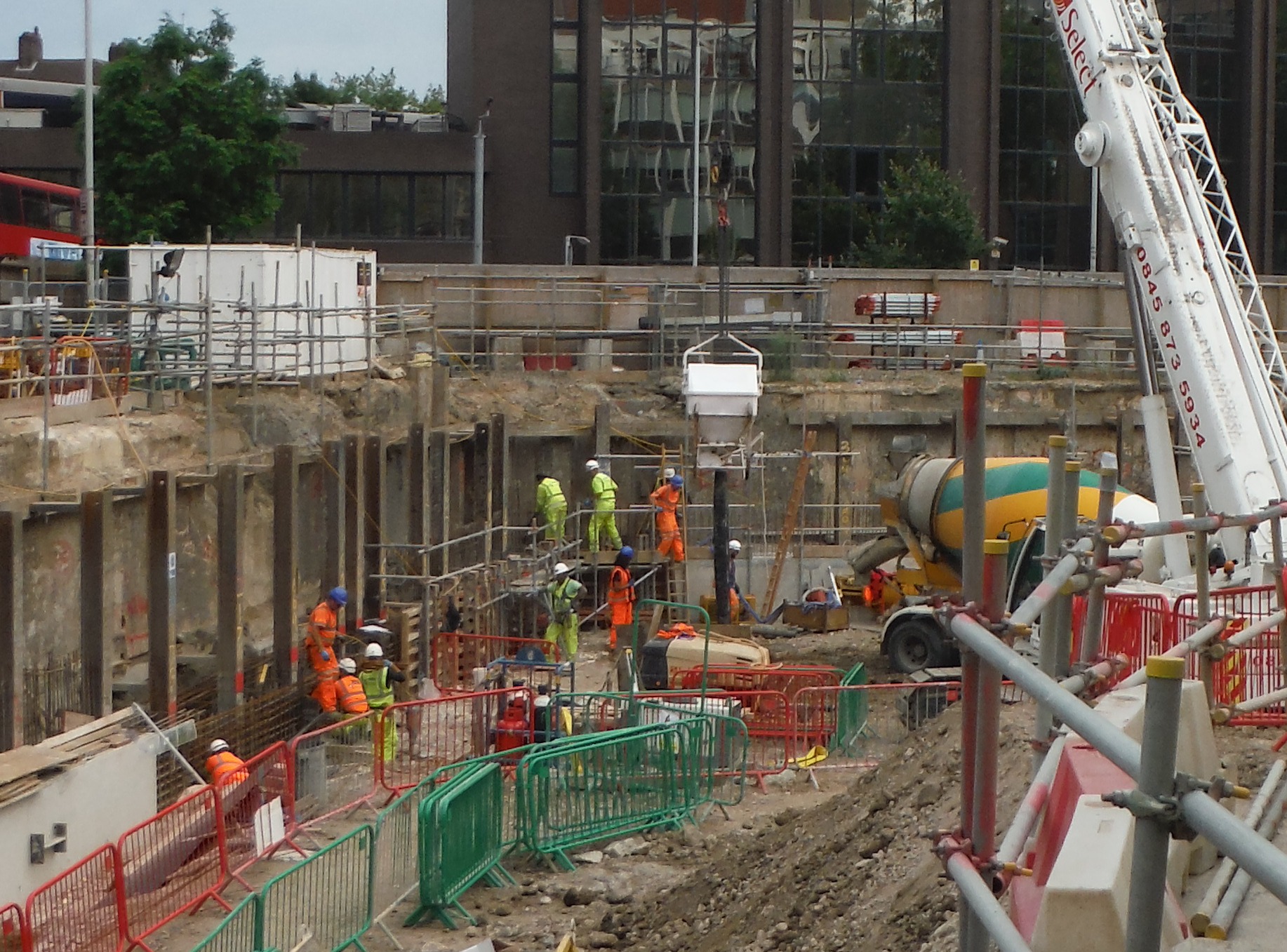
Barriers with no access at the end!
Time.
The capping beam has to be completed to be able to dig down. In order to do this the concrete strength within the capping beam must be greater than 30N/mm2. This would have been fine but due to a slow exit of the piling team we are on catch up.
So what? Capping beam pours have been completed and props installed shortly afterwards. With over 10,000m3 of sand, gravel and clay to be removed from the site the emphasis is on digging, i.e. loading the props and therefore loading the capping beam. In short, the time for the capping beam to reach 30N/mm2 has reduced from a few weeks to a few days. To solve this there were numerous plans to crush more cubes, do temperature matched curing and place thermocouples within the capping beam to assess in-situ strength. However there was no time to see what might happen/work, so the mix design was altered to attempt to get a quicker strength gain. (So much for previously trying to avoid cracking!)
Mix design alternations focussed on the cement content.
Original cement content: CEM 1: 135kg/m3 with GGBS: 315kg/m3.
High early strength concrete: CEM1: 405kg/m3 with GGBS: 45kg/m3.
Wowser! You could have fried an egg on the concrete. Basically the high cement content produced a very high early strength (about 41N/mm2 within 7 days). So despite there being a cost for the higher cement mix the key driver was time in order to get the excavation going, and therefore multiple work fronts to attempt to regain lost time.
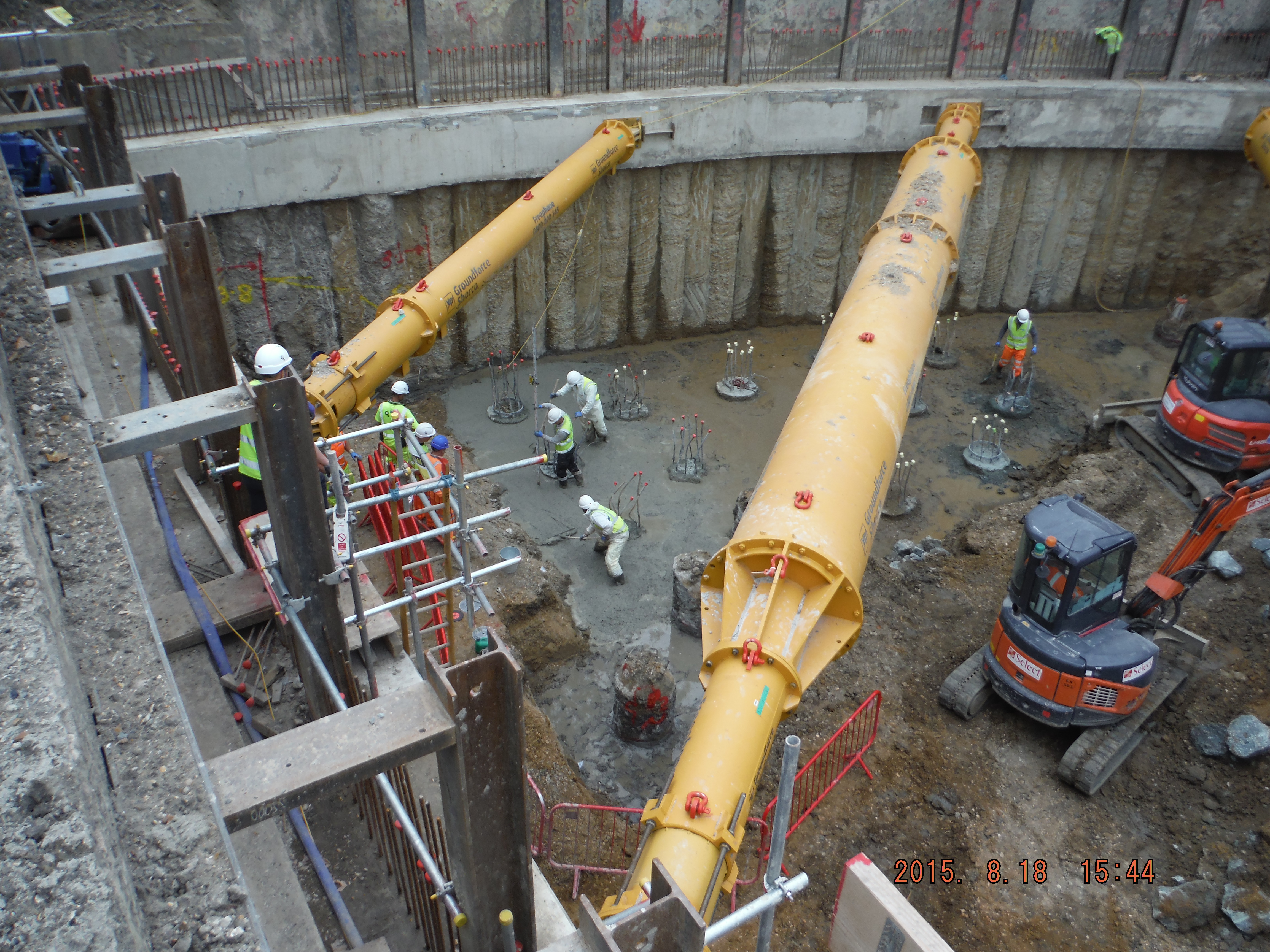
Capping beam fully loaded by props. Excavation needed to get going to prepare ground for raft slab pour.
Summary.
Every step of the way in the project revolves around time, cost and quality. I had a reasonable argument with the QS team saying that rather than faffing about getting quotes from everyone endangering getting items ordered in time, the focus should be on constructing the building. But then if the building costs more than £119 there will have been no point doing it for the contractor. So it seems the way forward is within the triangle, perhaps being at different corners at times, but it is a balance of time, cost and quality that is the key, which I think is wrapped in the word sustainable.
 Holdfast Training Services Trial Blog
Damo,
You say that the piling team effectively held up you getting started on pouring the capping beam. Assuming that this is on the critical path is there any way you can recover some of the extra costs incurred for the concrete mix?
Also, and be gentle with me, given that you have a high early strength from your concrete mix I assume there are some engineering properties that you will have to trade off for this? Or is it just cost?
Damo,
How did the health & safety advisors visit go? Where there any key points picked up? Whenever they visit our site it’s as if they’re walking around with blinkers on / I think the ISM manager is particularly good at steering them to where they need to be.
Damo – I’m guessing that by ‘slow exit’ you are referring to a delay on the programmed time, if so how long? Are you now chasing them for liquidated damages? If not why? if so then is it a problem? The money you get (assuming the contracted was sufficient) should cover the costs you need to get back on track by increasing the programme tempo in other areas or by covering your liquidated damages for a late completion?
Also keen to hear what feed back you got from your H&S visit. Unlike Rich, our visits are pretty thorough and they get into everything. Our visits can be split in to two distinct areas:
1. weaknesses identified and and dealt with (a couple have been biggies).
2. nothing is found but submitting a good report seems not to be the done thing so we get silly reports that talk about absolute rubbish, waste time and rub people up the wrong way.
Olly,
Are you insinuating that the H&S Inspectors are trying to pick holes in your project to justify their existence…
NO, No, no, not the good ones anyway!
Henry, Rich, Olly, Thanks for the replies – lots of food for thought.
Piling delay. Unlike most main contractors, Laing O’Rourke tends to own subcontractors. For example the job I am on has plant which is hired through Select Plant – a Laing O’Rourke subcontractor, it has piling, Laing O’Rourke own Expanded Piling, precast concrete – Laing O’Rourke own a massive precast concrete manufacturing centre. The list goes on. The point is that going after an internal subcontractor is not the done thing within the company – there is a one team approach to reduce double manning (hence no official Laing O’Rourke presence on site) and the ethos is very much to work together to get things solved. On my site we are talking about a 2 week delay but attempting to catch up is difficult because we have a major pinch point that is the one access ramp to remove spoil from.
Health and safety advisor visit.
I would say the visits are useful but painful. The aim is not to be annoying or stop things progressing but to think about how tasks can be improved and done more safely. Often the points raised are sensible, like getting a safe form of access to a work area, but they can veer towards a utopian world that just doesn’t exist. So I guess we have had the extremes too.
Unfortunately there are some things that just wear you down, like repeatedly telling people to wear ear defence or machine drivers to wear gloves when they leave their cabin. So when you get told that by a H&S person it is frustrating because they are right and there are no excuses.
I suppose my feeling is that if tasks are safe, planned and thought about, then I will sleep at night. I don’t mean producing a risk assessment which nobody reads but when a task is thought about and briefed the team know what they have to do, or often more importantly what not to do.
The key point I am learning or re-remembering is that site operatives generally take the easiest option. Therefore despite frequent briefings, the method of communication needs to extend to brief, ask questions, check that the task is being done as planned, amend the plan because it is not, re-brief and monitor.
It makes sense with the piling subcontractors, although when you finish two weeks behind I imagine the delay they caused will be long forgotten and it will be blamed on something more recent given that people tend to have short memories.