Site Two Fifty One – Environmental Problems
Site Two Fifty One – Environmental Problems
During the removal of spoil from Two Fifty One to enable the installation the Groundforce props some of the lorries of muck were rejected from the tip because they smelt of diesel. I had no record of a diesel spillage on site so it all seemed strange. The loads had to be returned to site because the tip was refusing to take them and the carrier (Erith) were not able to dispose of them. Typically as the excavation progresses it becomes harder to separate/segregate anything. Therefore having excavated material returned to site is somewhat of a problem.
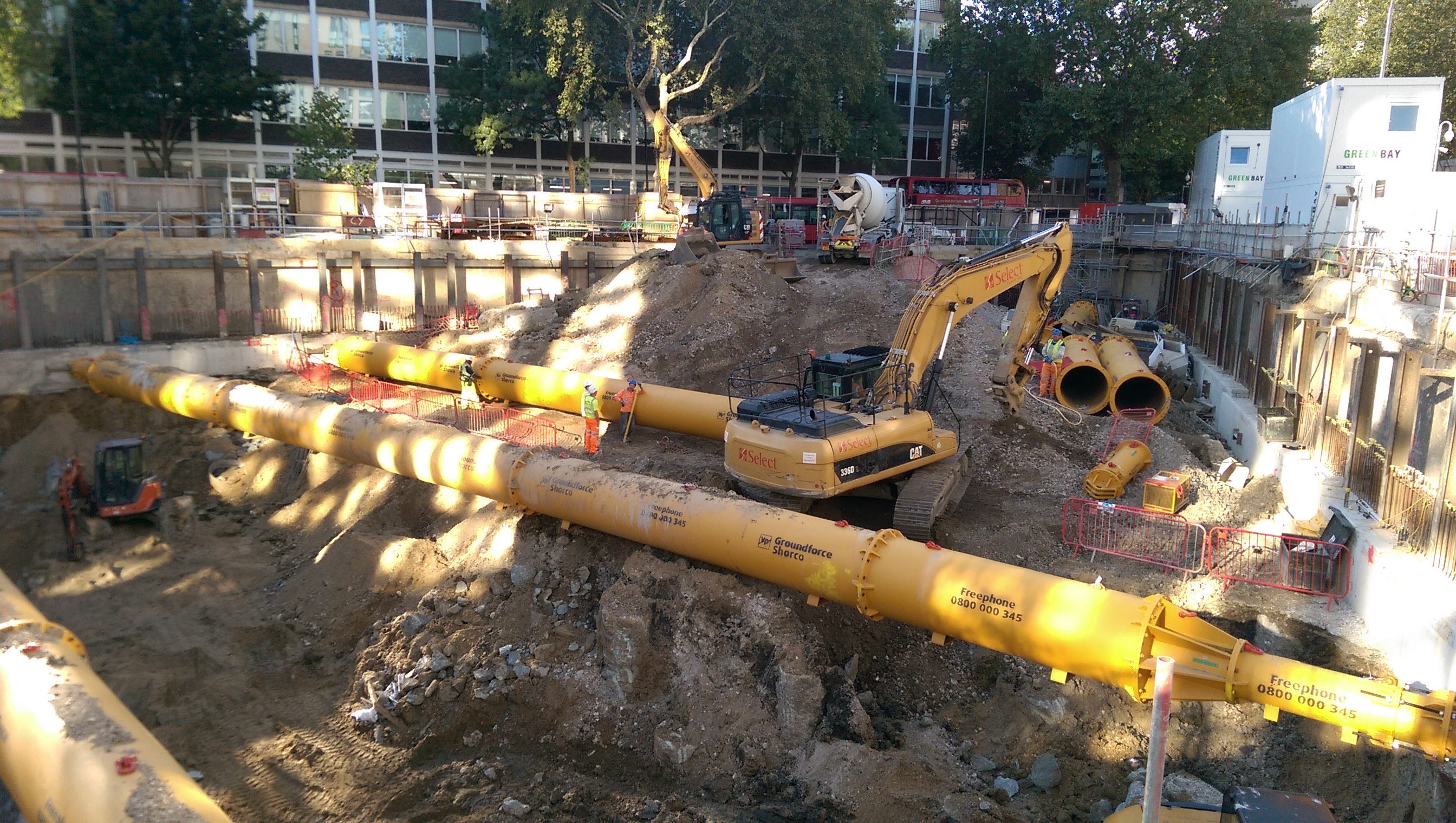
Contaminated material being stored left of the ramp access into site.
On further inspection of the area the muck was being excavated from it was identified that some of the sand and gravels had turned grey. I.e. it contains diesel.

The photos show the grey streak in the sand and gravel showing the diesel contaminated ground.
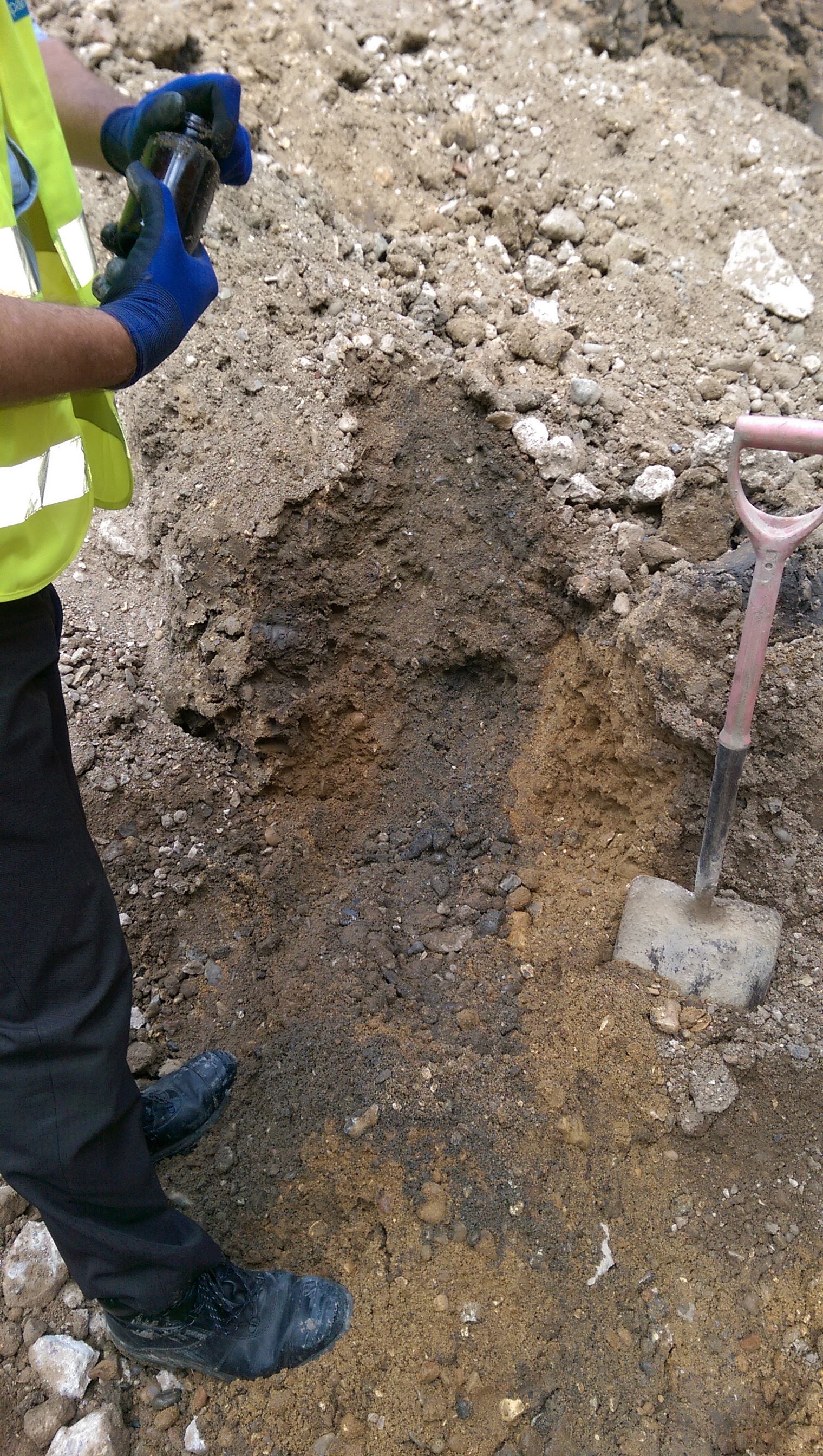
Aside from the fact that the majority of the area had been excavated and loaded onto tippers (albeit to then be returned to site) it was clear where some of the more affected areas were which should help reduce the spread of contamination.
So what?
The extent of the problem is just getting started (no environmental agency involvement yet) and as it has happened and now stopped, typical actions – such as using a spill kit/isolating the source are redundant. Therefore I have highlighted some of the post incident considerations we are currently going through.
- Stop sending muck away from the site (significant impact on programme as the key task is to remove muck at this stage).
- Identify what the contamination is. Initially, this will be done by using a Photo Ionization Device – this gives a rough and ready level of volatile organic compounds in the sample. Below 50 parts per million is apparently acceptable. You don’t need much diesel to make things smell of diesel so I am hoping that is the case…
- Record/report the incident, brief the site team on the importance of reporting spillages.
- Once we know the extent and type of the contamination the loads can be removed. Worst case the muck will be removed as hazardous waste at £1700 per load which comes with permits to move hazardous material. We are paying about £200 at present so that would have significant commercial implications!
- Attempt to keep to schedule with a mini-mount Everest forming in the corner of the site!
More widely here is a brief update on drainage and reinforcement installation.
Drainage.
We have just started to install below ground drainage in the Basement Level 2 raft slab. We are using the Saint Gobain timesaver inspection chambers and Ensign pipes. For future reference, Ensign is a significantly lighter product, more easily moved/handled and costs much less (we have made a circa £30K saving by requesting to use the lighter system).
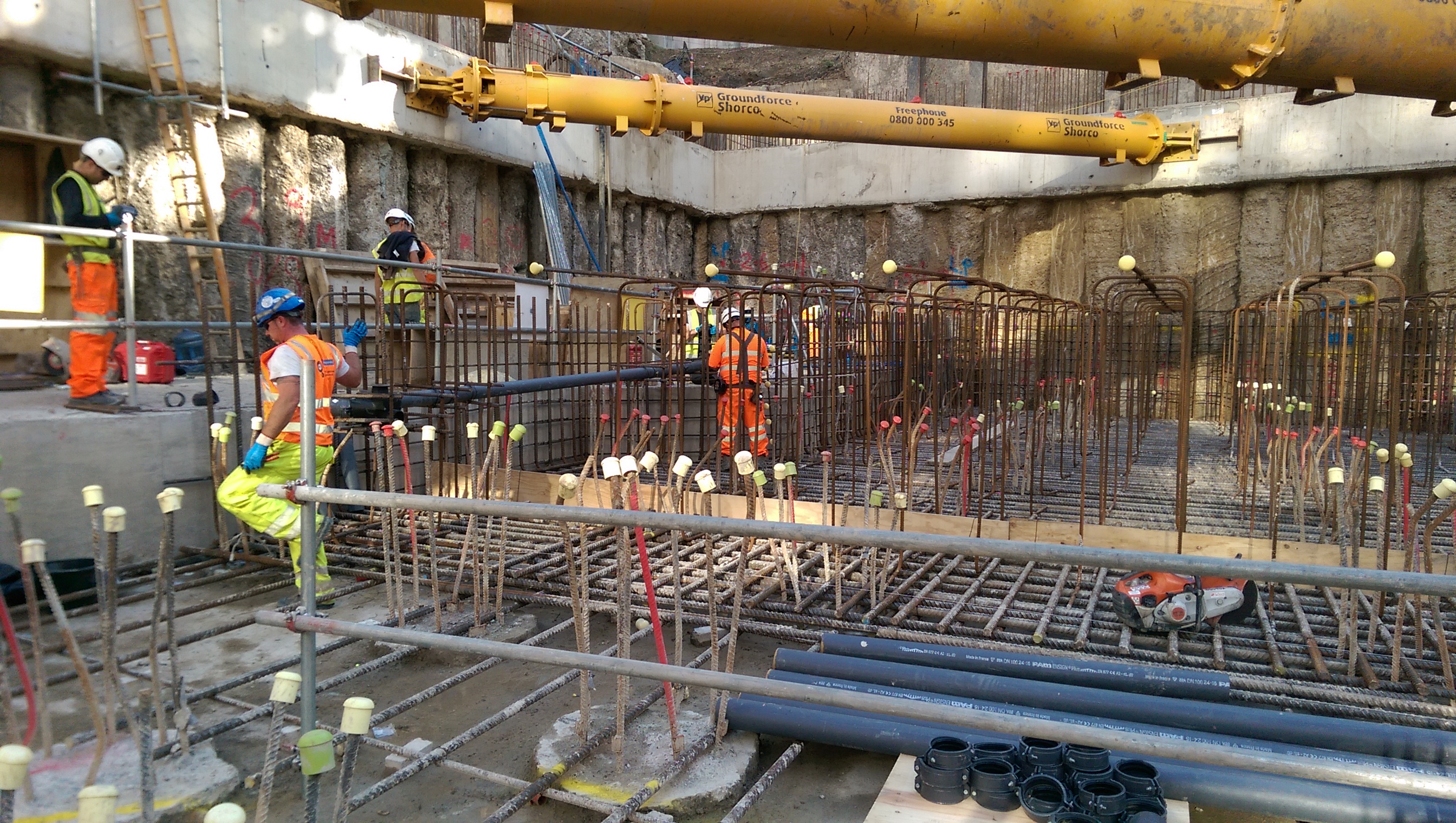
The drainage is being installed within the area between the bottom and top mats of reinforcement.
What I wish I’d known:
- Testing methods – something about bungs, and air bags. More to follow when I understand what that is.
- That a foul gully run cannot rapidly change gradient in a run because the solids will separate out.
Basement Raft.
The 2.1m deep raft foundation is currently being constructed. It is quite an impressive site seeing 40mm, 12m long bars being positioned by hand.
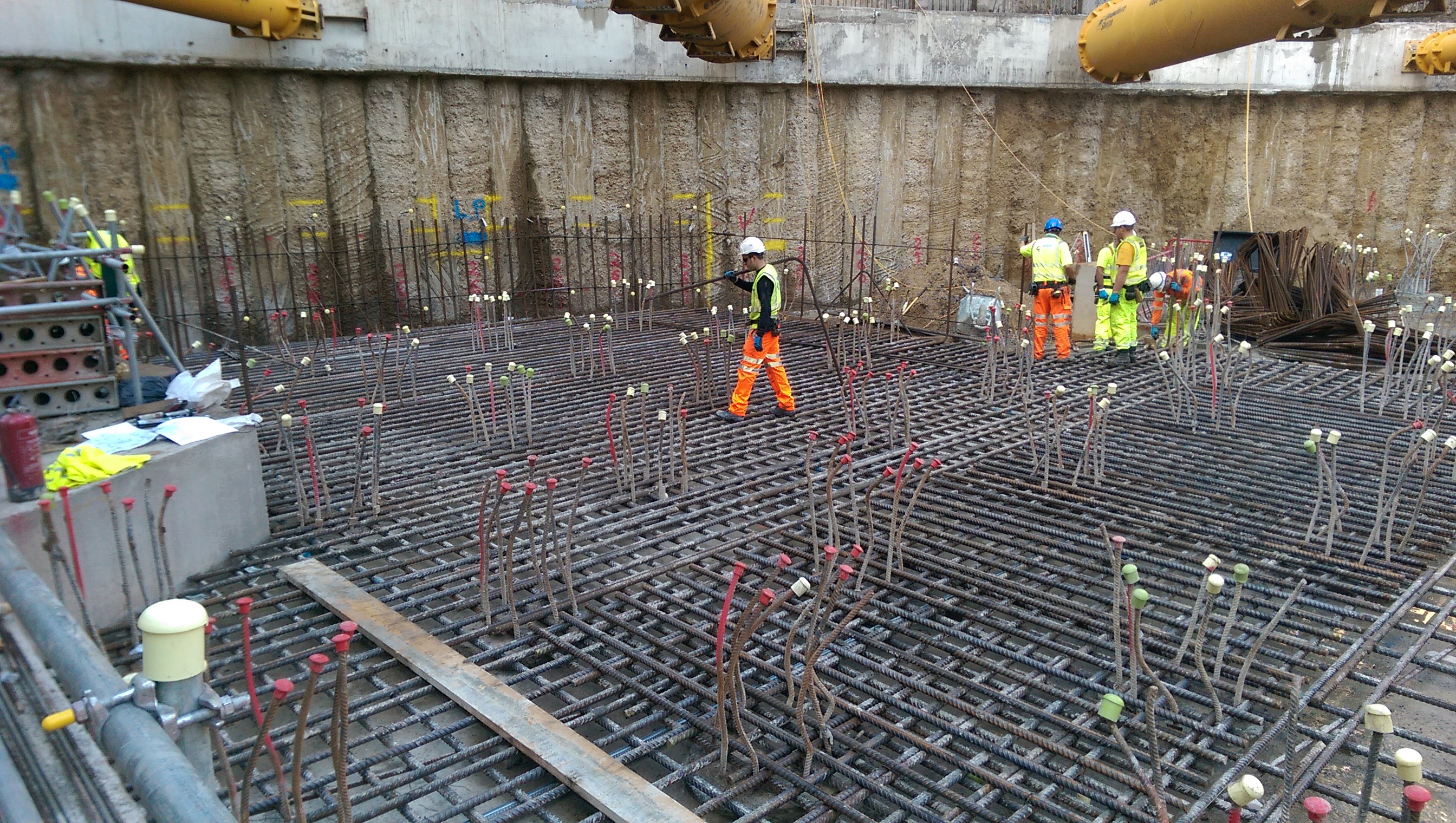
Raft bottom mat reinforcement being installed.
The original aim was to use Pecafil formwork (permanent sheeting) for the concrete pour. Due to the number of piles this is proving a little more complex. As the ground is excavated, pile reinforcement acts a bit like dragons teeth preventing easy access to return to backfill around the raft. The plan is continuing with the idea to use a small dumper to move material back into position, rather than switching to the use of shuttering. Again, more to follow on the success of this plan!
A final thought:
There is a slab (450mm) which will be poured across the site, including on top of the raft making a total of a 2.1m deep foundation.
There is a bottom mat to fix in the raft and a top mat to fix in the slab.
Would you, a) fix the bottom mat, pour the concrete raft then fix the top mat and pour the slab? Or, b) fix bottom and top mat, then pour raft, then pour slab (i.e. do pours with all steel fixed)?
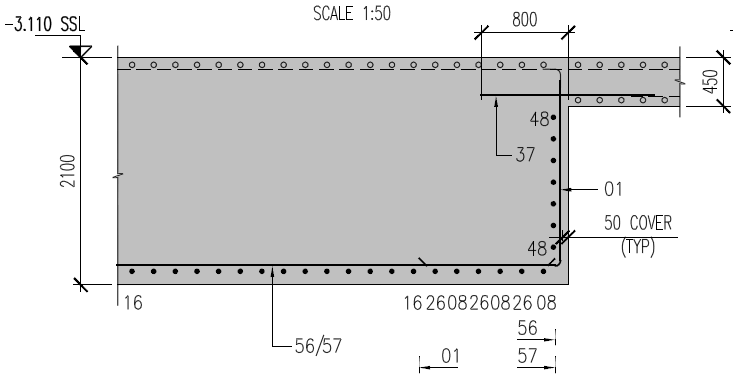
Raft foundation comprised of 450mm slab and 1650mm raft.
 Holdfast Training Services Trial Blog
Damo – is the drainage being tested with water or air pressure? We are currently using a modified drainage air testing kit to test our PT ducts…it’s a real pain!
How big is the raft (area or cube)? Our pile cap was >2m deep and it became a pain trying to ensure we had good coverage around the bottom mat (5 layers of 40mm). How many pours will take and how are you managing the cold joints? What size aggregate is in the concrete? How are you managing the issue of working the concrete at depth, are you going to have people under the top mat and remove them as the concrete rises or will you do all the work from the top mat and poke the pump and vibros down?
Olly,
Thanks for the questions. The pour sequence for the whole raft is broken into sections, the largest pour being something like 250m3. We have an F5 flow concrete with 20mm aggregate so should reduce likelihood of failing to properly form the raft. Cold joints will be hyrib but we did ponder the idea of a premade stopend. For a bigger pour or numbers of pours that would have been efficient. The way we are doing it, probably not.
Regarding mat installation to aid actually doing the pour that was my final thought! Yes, all of the steel will be fixed and vibrated from above.
Not sure even my health and safety standards would allow a person to be within the raft while it is poured! Is that what you had?
Damian, you need to be really careful if you are air testing and watch the contractors performing the work like a hawk. I was on day three of my site attachment when my meeting with the PM was interrupted by the unmistakable sound of a low velocity explosion. When we got outside, there were a lot of stunned bricklayers (one with an Acro prop buried like a javelin in the ground next to him) and two catatonic pipe work contractors in what would become an inspection pit, but was at the time little more than a fox hole.
The pipe work contractors were responsible for laying the fire main ring around the building. Before they could bury it though, the insurance company required an air pressure test up to about 10 Bar. As ever, they were massively behind schedule and the open trenches containing the pipes were in danger of delaying other trades. Their boss had therefore told them to get on with the test despite the fact that the inspection pits containing the terminations of the pipes weren’t yet formed. To get around this, they wedged the bungs in with a scaffold plank held in place with two Acro props braced against the earth wall of the pit via a second scaffold plank.
When the air pressure got to the test level, the earth wall failed, releasing the stored energy in the gas, launching the Acro props and the planks across the site. The stored energy incumbent in air pressure tests makes them really dangerous. Make sure that the RAMS etc are absolutely spot on and in compliance with the guidance in HSE GS4.
We’re conducting our air tests on site at 8 bar and due to the safety concerns mentioned by Jim above the work is being conducted out of hours to minimise the impact if something were to go wrong. I’m not entirely convinced this is the right approach as the rules get bent / snapped more than enough when works go on during the day.
We did hydrostatic tests on the seawater pipeline running to site up to 6 bar and are just in the process of getting the test procedure for the remaining underground services approved some of them are to be tested up to 15 bar. Rich you are right, even doing the tests during working hours the subcontractor tried to cut corners with regards to safety and lowering the test pressure or duration. When we asked the Dutch guys how they were testing all the buried services they had installed they just started at us blankly.
Just to throw my tuppence worth in – We are looking to leak test two flowlines later this year to approx. 380barg. The medium used should be liquid, which water is most likely, the pressure is increased using either Nitrogen or Helium.
It is possible to use hydrocarbons as the medium and to solely use N or He, but given the pressure reqd and the fluid it will be carrying (produced water) then water and N will almost certainly be the chosen option.
I just had a quick chat with Richard Farmer and he assures me that air testing of things like sewers is very common and not dangerous as they use a very low differential pressure above atmospheric and simply monitor the pressure drop over a stated period of time. This is clearly a very different procedure to the tests described above and that are of the more familiar type for M&E engineers. However the basic message remains the same; you need to treat compressed gases with a great deal of respect.
Damo – In the end we carried out the pour from the top mat but it was tricky getting the pump hose down through four layers of 40mm and then controlling what was going on 2m below. This was because of the steel complexity of cranked bars.
I’m not sure H&S is a big issue. As long as you have access in the top mat that can be closed up once the guys climb out I don’t see a problem. They would only be inside for the first part of the pour to ensure good coverage around the bottom mat. This would only be a few inchs deep which is normal, they’re not going swimming in the stuff. They then climb out and you close the top mat behind them and continue pouring. The best method is to place the pump end in the rising concrete (richard commented on my blog a while ago) to prevent separation of the mix. From a H7S point of view it would be no different to doing a slab pour in a ‘top down’ basement construction with a roof already above you. I hope that makes sense…
Damo – are you testing gravity of pumped mains?
Hi Damo, did you manage to ID the source of contamination in this case? Also, is there any contingency fund for unforeseen issues such as this; The difference in cost to muck away is significant! Is it the case that Erith can’t conduct the muck away because the end location in this case can’t receive them, or is Erith not allowed due to certification? (in which case I guess you will need to source a new sub contractor to do the contaminated muck away)
Olly – not yet, just the foul and surface water drains. Will post a quick blog on the air tests for reference.
Brad – Source is most likely from an old diesel leaks from the building before this project started (brown field site, old use of the building included an underground car park).
Not much in the way of contingency but if it can be shown to have already existed the client will be asked to pay for the costs involved. Erith are pretty much just the middle person. They will muck away but need the certification to prove to where they take the muck of its contents. The site is overly clogged with muck, both contaminated and clean because the tip we were sending it has refused to accept further loads until they receive test results (smell does not equal hazardous waste but that was their take). As soon as that comes in we will put on crazy numbers of tippers to attempt to claw back some of the lost time.