The Seven P’s.
In should come as no shock to anybody that water in is pretty expensive in South Australia, costing in the region of $3.32 per kl. The project received its first bill this month (don’t ask me why it has taken this long to get here) that covered the start of the project Dec – Apr which was quickly followed by a second covering May – Jul, with the total over $350,000. The cost arose from the fact that water was required almost 24hrs during the summer months for dust suppression during the bulk earth works. Surprisingly this cost was not captured in the budget for the project and was excluded from contract with the subcontractor responsible for the earth works, so it will eat in to the profit for the job.
From this episode the project team were tasked with carrying out a review of the budget to identify any other holes and quite a few were identified. The main one sticks with the water theme as it became apparent that the cost of filling the various systems on the site (in the region of 30Ml) with demineralised water had not been accounted for. The options for supplying this were limited, using the reverse osmosis plant at the local power station or getting in portable reverse osmosis plant to site to produce our own. The power station was discounted because in order to fill the tanks on site we would need to fill the 5km worth of pipe to get it here and find a method of pumping it. The current plan is to use a subcontractor to bring in temporary plant to produce it on site. This is producing a number of issues in itself, the main one is trying to find a subcontractor with the capability to do this, we are currently looking at GE supplying the equipment and another subcontractor to install and operate. Further issues we will need to work out on site include finding space for the plant, power and water to operate the plant and a method of discharging the brine, all of which the project will have in the future but not necessarily in time.
No one is sure what this is going to cost but best estimates coming from our procurement team at the moment are around $500,000, plus the cost of the feedwater approximately $100,000. This is likely to fall to John Holland, as the head contractor we are ultimately responsible for commissioning the plant (although no doubt we will try and push some of the cost back to the client).
Looking for causes as to how this could have been missed I think it’s quite simple, in the rush to get shovels into the ground after signing the contract a draft program was produced, with no product or work breakdown conducted to back it up. As the project progressed no one has had the time revisit the program so it has just been updated where necessary, which is fine for sequencing works, but doesn’t identify items that are missing altogether. In their defence I know at the time the project team was pretty limited and they were under immense pressure to get the project started.
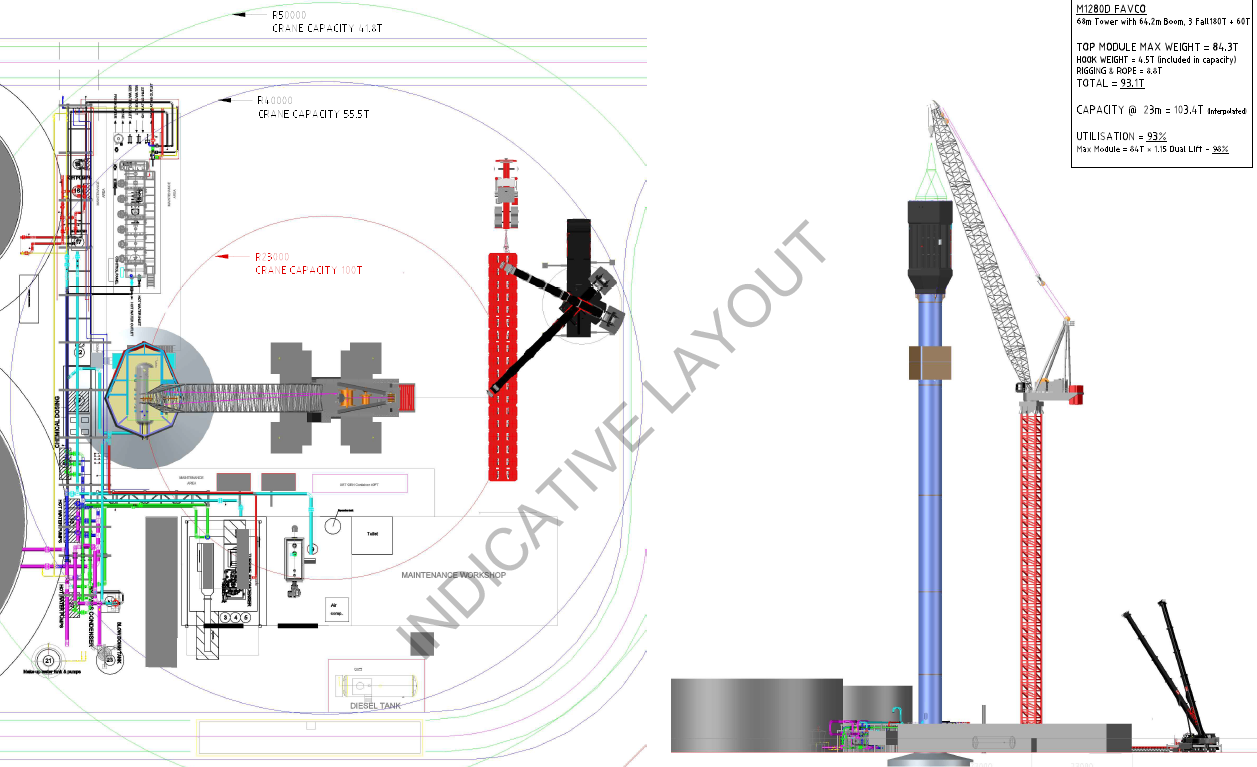
The picture below is just to attract some attention to this blog, it shows the planned lifting strategy for the 115m high tower, hopefully before I leave site in November.
 Holdfast Training Services Trial Blog
Hi Matt,
The theme of starting early, either due to planning requirements/demonstrate intent/or simply just to get going, is a common one. I wonder whether waiting a month, getting the plans in place and being more organised generally would actually save a month during the project. I.e. the balance of time spent planning versus construction time. I suspect time would be saved on the ground but it is not very easy to quantify savings of planning a task.
How big is your commercial team? My project adopts frequent budget to build and contract reviews to establish progress, scope and any items that were not originally priced. We are in a slightly bizarre situation that the contract has not yet been signed, so any changes in design actually cost the client. I would have thought it more sensible (cost saving) to get the contract signed earlier as it is a design and build project.
Damo, the commercial team consists of one person on site and one off site, although we are on the third iteration of the one on site and also the third planner! We have also had a few large claims from the bulk earth work subcontractor as they were not given IFC drawings and of course the design changed, luckily some of these were passed to the client. I’ve been shocked by the whole planning side of things, the contract names four separable portions (SP) but gives no detail as to what they include i.e. SP1 is simply Greenhouse 1 and 2, no mention of if that includes power, water or cooling. Even the client representative on site is unclear, which is actually to our advantage at the moment, but I’m not sure how the program could have been put together without this information.
Matt,
Who was pressing the issue of getting work started? Was it the client or JHG? If it was JHG presumably they had already costed the project in the tender stage so the issue is unlikely to be solveable in the build stage?
Matt,
How involved are you personally with tracking the commercial issues? More specifically the valuations that have now increased due to oversights?
I ask as I have asked to work alongside a Commercial Advisor in the contracts team to get a better flavour on things. I have been set a mini project (hopefully able to turn into TMR 4) to review a works package that has massively increased since the tender stage. I need to find out why and how it could have been avoided including any lessons learnt for future projects. Something similar on your project could be a good TMR?
Henry – The drive to get the project started was led by the client and was linked to getting the first crop in the ground inline with the seasons, they are still trying to get in to two of the greenhouses by the end of November.
Fran – I look after four subcontractors on site and am responsible for everything to do with them engineering and commercially wise, calling in the commercial team if required. You should see me review their progress claims $$$$$$, they hate it. Do you mean the scope of works increased or just the cost? I’ve got another blog about on of our subcontractors and some of the variations they have tried to claim, not sure there is enough material for a TMR.
Matt,
I bet you’re a right scrouge on their claims. I think it’s mainly the cost has increased so I’m going to investigate why and what actions/decisions led to it.
I have Found that a lot of Client delays are due to the time taken to gain internal financial approval for a new contract. Ironically, the time taken to achieve due diligence eats into the preparation time before starting on site thereby actually increasing the financial risk of the project.
The original drivers that determined the start date remain extant and are usually underpinning the financial case that was put forward for approval. This therefore becomes an immovable date and the consequences of the rushed planning that this causes are all too familiar within the construction industry. Clients seem to rationalise this situation by imagining that all of the risk sits with the Contractor. Legally this may be the case, but the reality is that they also suffer blow back in some form or other (poorly constructed buildings, contractor goes bust leaving them with the mess to clean up, missed time to market allowing a rival to steal a lead on them etc).