Archive
Two Fifty One – Concrete continuity
Two Fifty One – Concrete continuity
RC Detailing.
By way of background, Two Fifty One has two levels of in-situ basement followed by 40 storeys of precast concrete to form the tower superstructure. The lateral stability is provided by shear walls which form a perimeter around the lift and stair shafts.
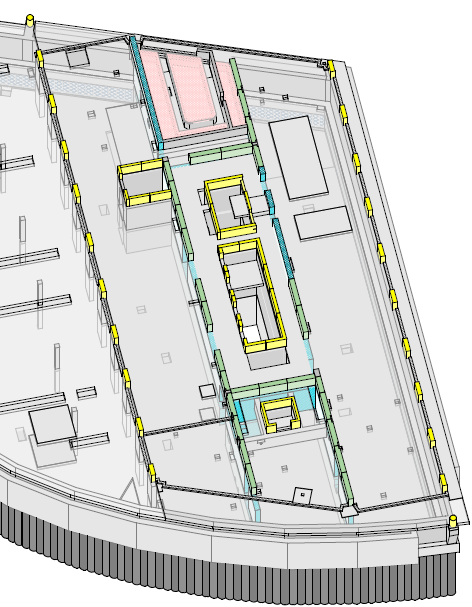
Substructure – The green walls represent the shear walls in the tower. Inner yellow walls demote lift pit and stairwell.
The slab to shear wall connections in the tower basement floors have been designed using kwikastrip. These are pre-bent bars that sit within a case and then are bent on site at a later date.

Kwikastrip pull-out bars
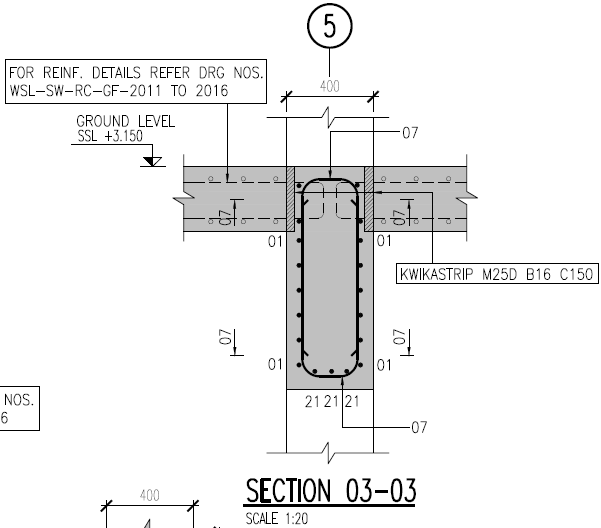
Kwikastrip used to form wall to slab connection joint.
The more typical method would be to run slab steel through the walls as shown in the figure from the IStructE Standard Method of Detailing Structural Concrete.

The reason is to enable the walls to be poured in higher strength concrete than the slabs. This is because the walls carry the loads down the building to the raft foundation to the piles below. From a buildability perspective it means the walls need to be cast to the structural slab level (ssl) rather than to the slab soffit. Other than the fact the falsework had initially been designed to soffit level this not a problem.
One of the key considerations of using pull out/continuity reinforcement bars is the rebending of the reinforcement.
Bending reinforcement on site presents the risk of overstressing the steel by bending it to too tight a radius thereby weakening it.
The bar diameter of kwikastrip is limited to 16mm and a bar bending tool should be used to rebend the reinforcement. The IStructE Standard Method of Detailing Structural Concrete states that “where it can be shown that the bars are sufficiently ductile (kwikastrip uses Class B steel so is acceptable) bars not exceeding 12mm size may be rebent provided care is taken not to reduce the mandrel size (radius of bend) below four times the bar size”. The same is also be true for 16mm steel at seven times the bar diameter.
This requirement needs close quality control to ensure bars are rebent correctly. The walls use both 12mm and 16mm steel kwikastrip making it even more important not to confuse the bar diameter with bar bending tool (or the strips themselves). Halfen (kwikastrip supplier) state: “the straightening tool is a steel tube with a specially shaped end and an internal diameter only slightly greater than the diameter of the bar to be straightened” hence strict quality control is needed to firstly use the tool (rather than any old scaffold tube) and secondly use the correct tool.
Other considerations include:
Increased time to fix the items in (fiddly).
Procurement ordering time – the items need to be ordered specifically, not called off from reinforcement schedules which requires lead time and storage.
Increased cost (circa 8k for one level of slab) compared to extending the reinforcement bars a short distance. Cost of standard stock steel per tonne is less than equivalent of weight of kwikastrip.
The structural requirement to maintain concrete continuity has overridden the practical installation disadvantages and that is how it will be built.
Other points
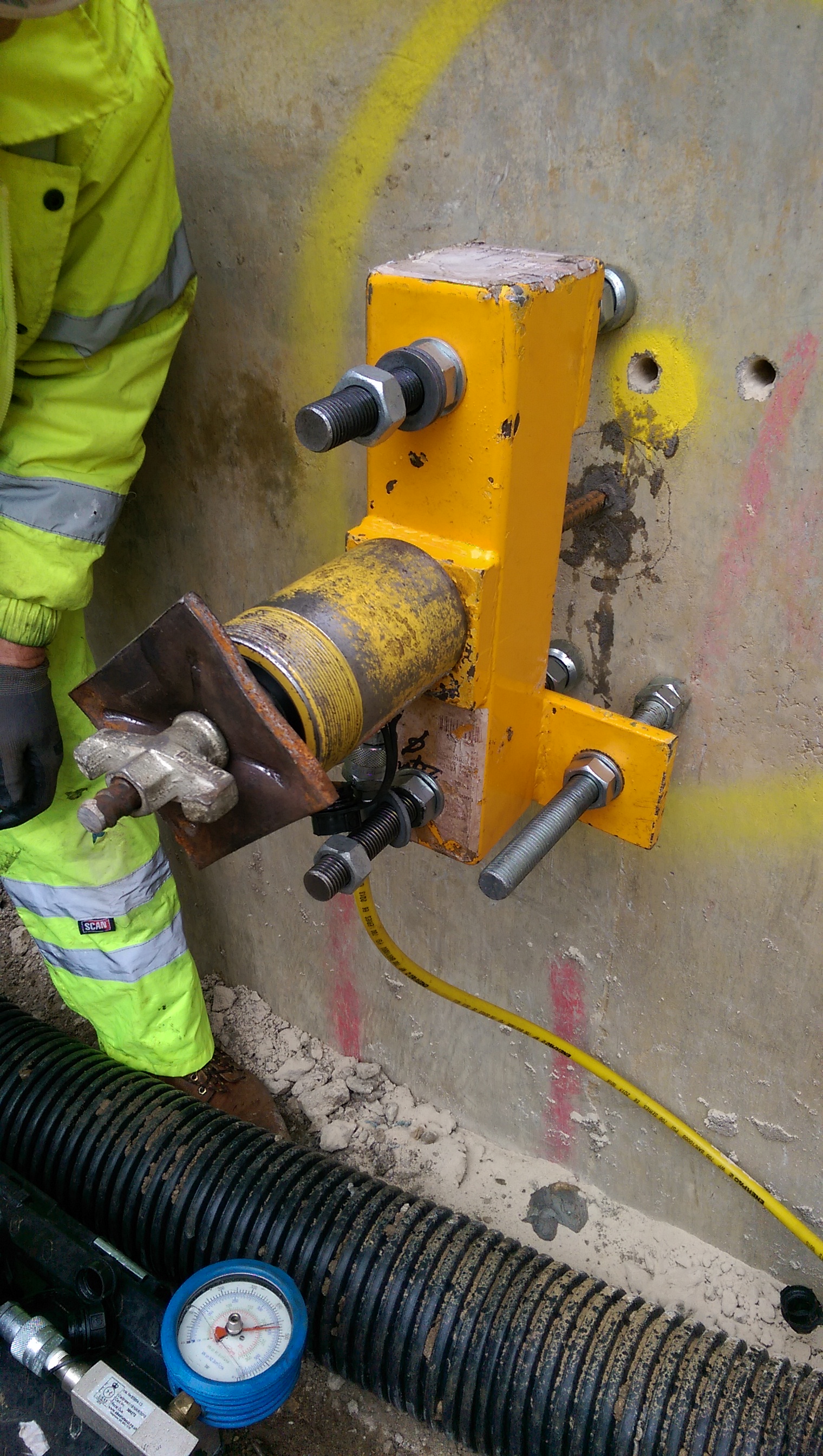
Pull out tests. We want to use an existing retaining wall to resin in dywidag bars to connect a one sided shutter to form a new retaining wall. We will be using Peri shutters with pre-set tie bar positions. The pull out tests showed no movement at 150kN, other than a bit of feet penetration into some old plaster on the wall. At 150kN there was a crack sound as the resin slightly debonded from the concrete and at 200kN there was evidence of some a cone failure (see circular crack around bar). The aim was to confirm a 90kN force would not be exceeded which the tests proved was the case. Interestingly the critical factor in pouring the walls will now be the pressure on the formwork soldiers and walers, rather than tie force. Therefore the rate of rise will be controlled especially because we have retarders which increase the pressure exerted on the formwork.
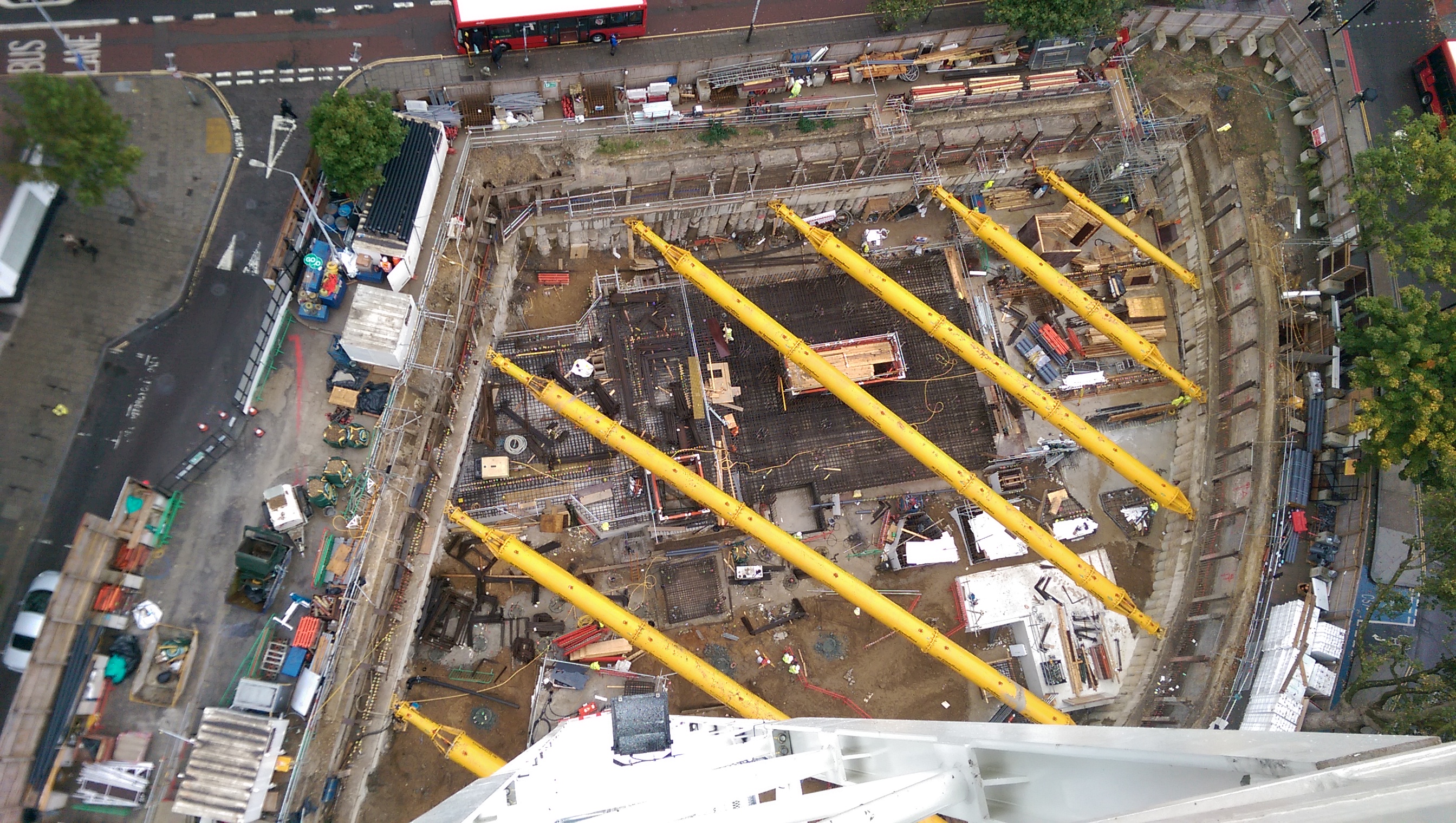
Propping scheme. The view below shows the site with the props spanning over the basement. In order to remove the props the basement level 2 slab must be cast halfway between them. This was creating a bit of a pour sequence issue as clearly the props are not angled in a way which suits the foundation layout!
Two Fifty One from our first of 4 tower cranes.
H&S – executing your plans
One of Guz’s recent blogs identified the difference between civilian and military idiots being that our idiots do as they’re told. This blog aims to echo that point and manage the expectations of those in phase one who are no doubt already chomping at the bit to be released into the wild. In the hope of giving something worth taking home, I urge you not to consider the health and safety box ‘ticked’ just because you have written a risk assessment and method statement.
We hold a pre-start meeting every day to brief the workforce on forthcoming activities and highlight any areas of concern (almost always H&S). This week we identified that as the shafts get deeper, the risk of carbon monoxide poisoning from plant operating at the excavated level increases. To reduce this risk, we have installed extractor fans to suck exhaust fumes out of the shaft. Should that fail, we have gas meters at the bottom of the shaft. Flashing lights on the meters indicate danger levels have been reached and work must cease until safe levels have been restored.
These meters have no audible means of alert, and are only useful if you can actually see them. The workforce was hanging them down the shaft off a piece of rope tied to the handrails at the top of the shaft. The problem is that the meter cannot be seen when the excavator is facing the other way. To mitigate the risk of the operators not recognising danger levels, we instructed the workforce (in the pre-start meeting) to place the meters in the cabins of the plant. A couple of hours later and they had already forgotten (figure 1). Note the meter hanging from the handrail. Civilian idiots don’t listen.
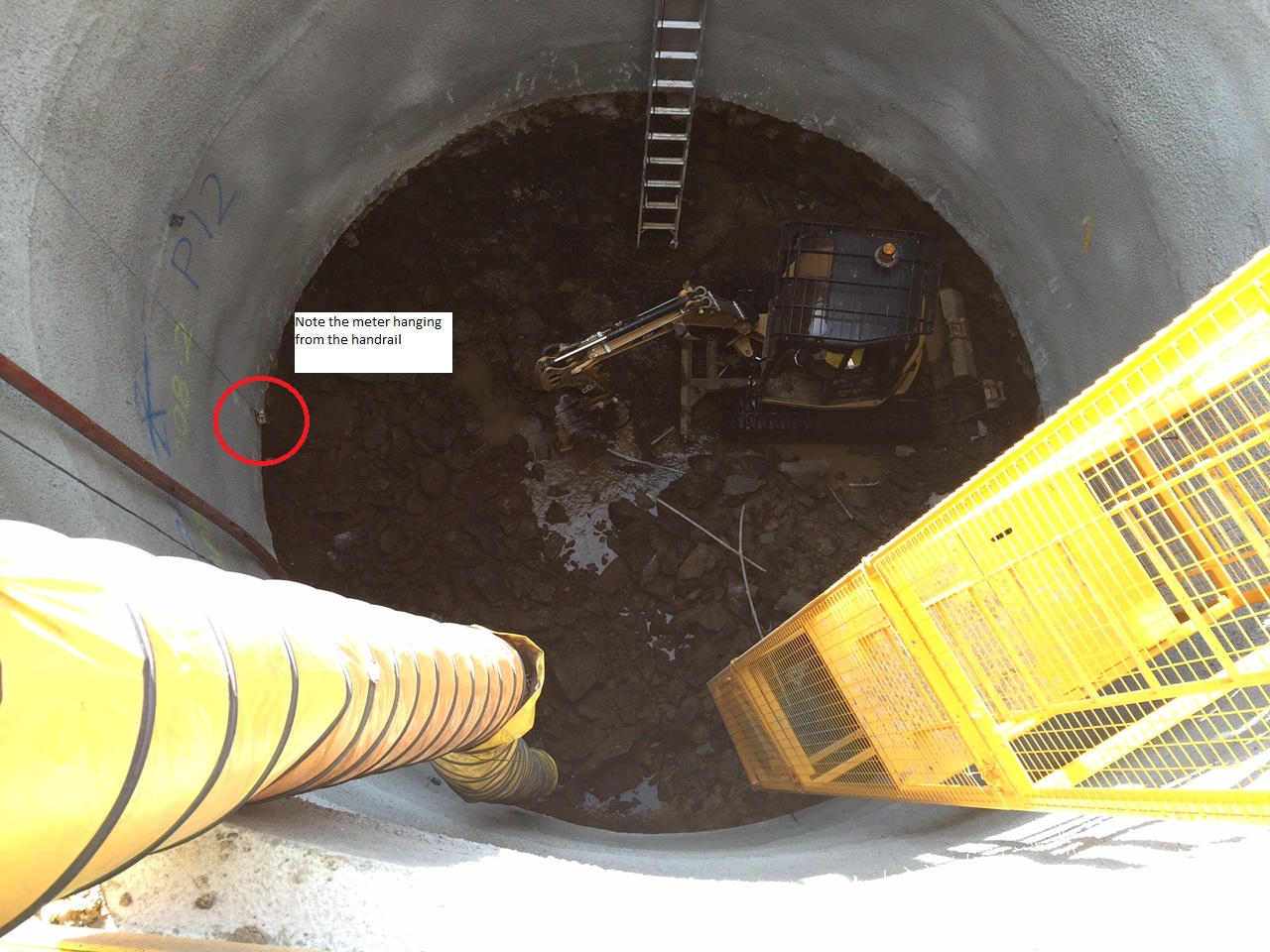
Figure 1. The red circle indicates the gas meter hanging from the shaft handrail
In addition to this, we had a working at heights issue. I produced the AMS (Activity Method Statement) for shaft excavation. This included shaft access and the introduction of a bespoke shaft access system which we had fabricated specifically for this project. The theory behind this system is that it offers both safe access to (and from) the excavated level, and a safe haven for the workforce when muck is being craned out. The PM was keen to eliminate the need for the workers to evacuate the shaft every time the kibble (skip) was craned in/out of the shaft in an effort to increase productivity (the crane costs $1600 per day).
You will identify the mesh cage surrounding the structural elements of the tower which also eliminates the need for a fall arrest or restraint system. Descent/ascent ladders are placed on alternating sides for each segment installed i.e. climb on the left, walk across to the right, climb on the right, and so on (figure 2).
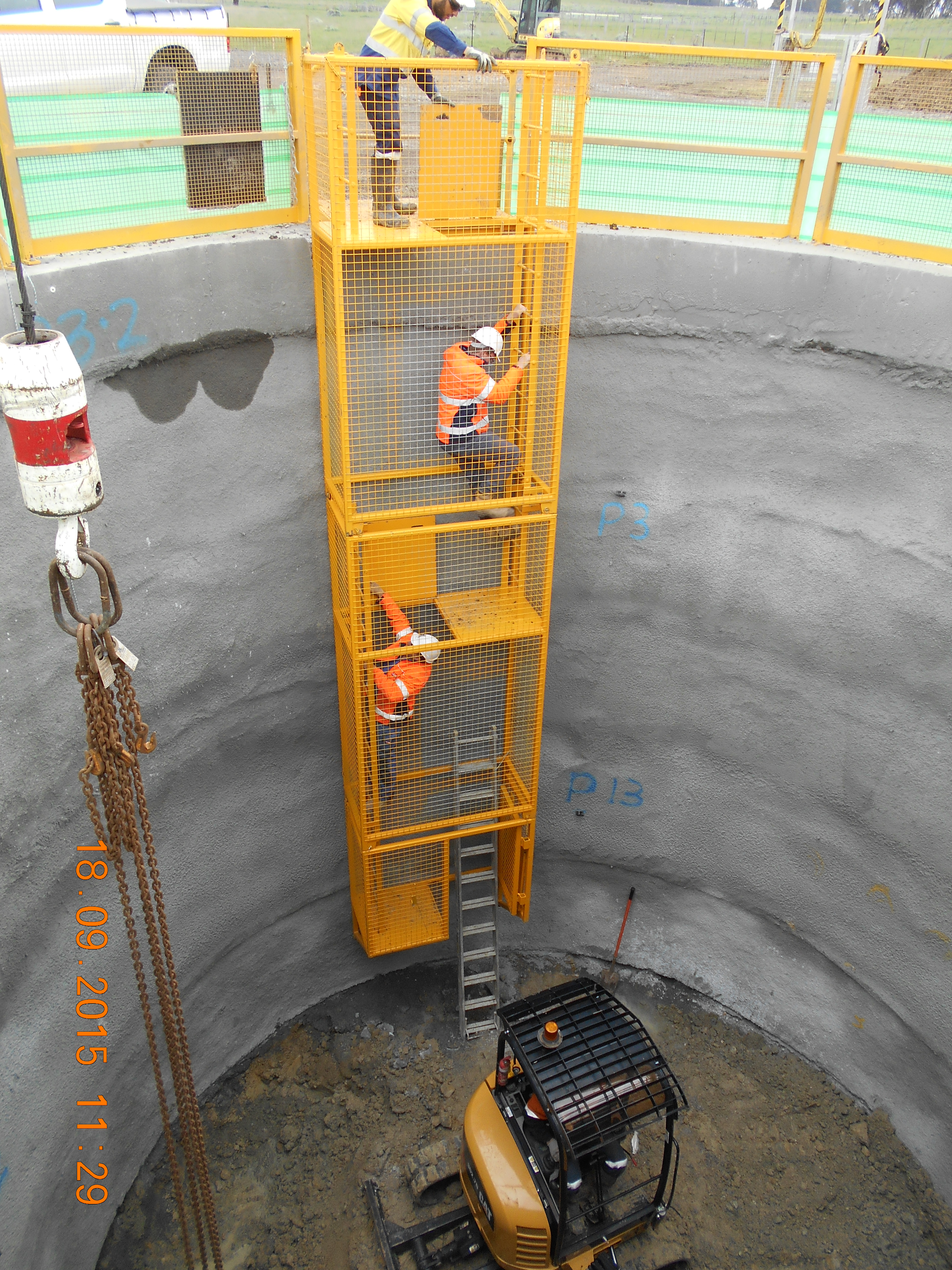
Figure 2. Correct layout of the access tower. Note the alternating ladders.
I inspected a shaft today to calculate the volume of concrete required for the base slab which signifies the end of billing works to my shaft excavation cost code. The tower had been installed such that there was no alternation between segment platforms i.e. falling off the ladder would see a re-enaction of the opening scene to cliffhanger. – the tower was effectively nothing more than a 6m ladder (figure 3).
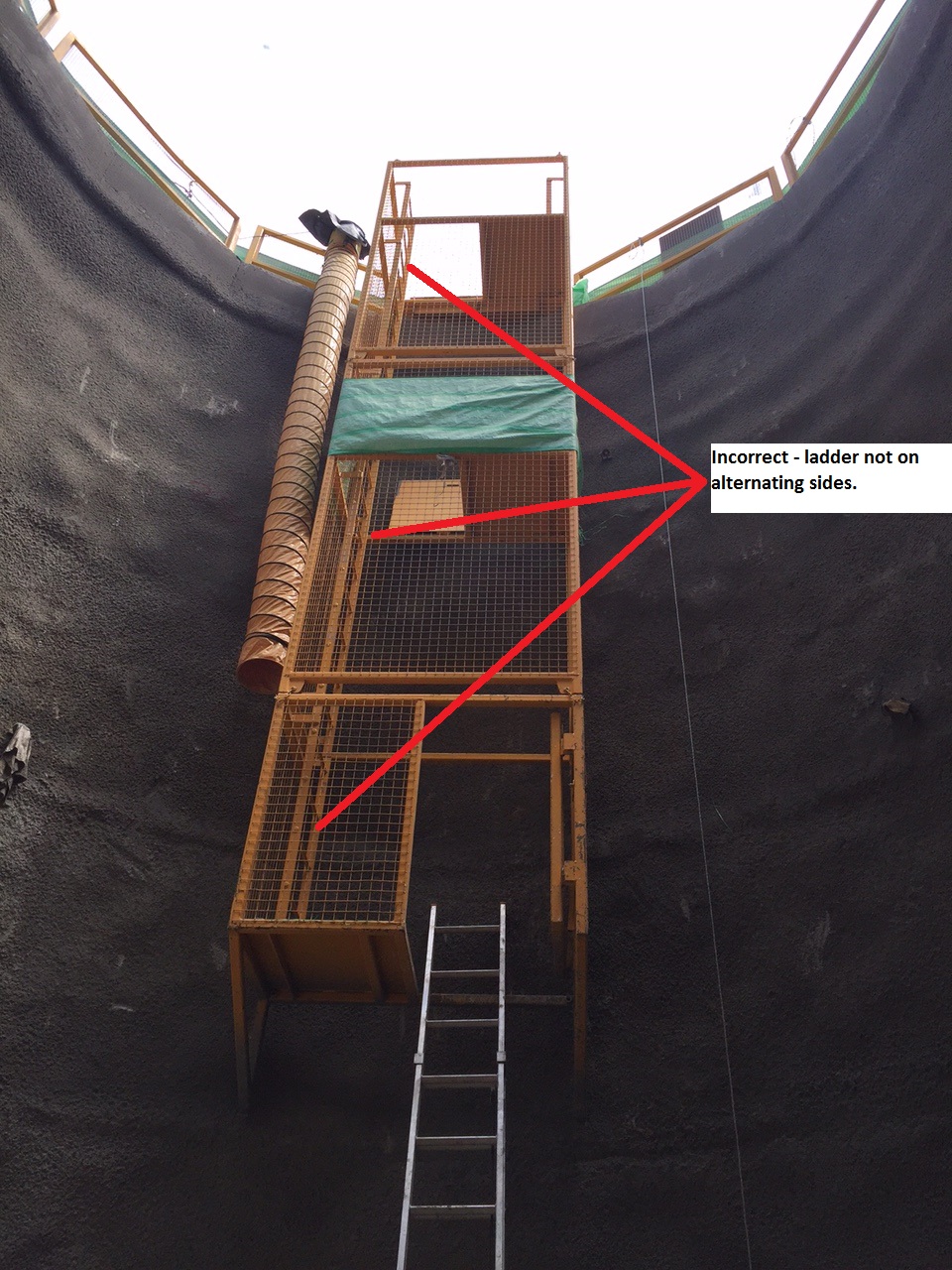
Figure 3. Incorrect layout of the segments (not alternating). It’s a 6m drop from top to bottom with no fall arrest system.
In conclusion, civilian idiots don’t listen. The workforce failed to implement two critical (and simple) measures designed to reduce and mitigate the risk of harm to them. To those who have not dealt with ‘simple’ workers (probably your average Australian) yet, brace yourselves. Delivering toolbox talks and pre-start meetings ticks the boxes at management level, but failing to follow up through regular inspections nullifies your efforts.
On a lighter note, I caught a redback spider yesterday. My JHG one-up knows to expect her in his stationery drawer if he gives me any more shit jobs (figure 4)

.Figure 4. Meet Mrs Amaroo – keeping shit jobs away
 Holdfast Training Services Trial Blog