Changing Seasons
An interesting Chemical Anchor letter in the NCE, link below:
What is interesting about this is the warning which the author gives and the prevalence of these anchor systems on my site. In one case design starter bars were ‘RFI’d out’ of the design in preference for a drilled and epoxied system to be installed at a later time. The rationale being that leaving the starter bars out of the floor room my subsequent work, and was less of a safety issue.
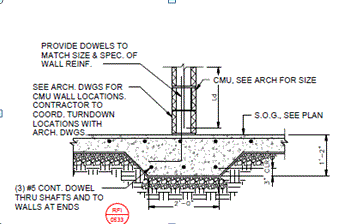
Epoxied rebar to replace CMU starter bars
I had HILTI delivered training which supports the letter; there can be a huge loss of design strength in these systems if they are not installed properly and, by HILTI reckoning only 20% of anchors are properly installed. HOWEVER, these systems can be very effective. So what? If these are specified on your site, or indeed if you end up specifying them as a part of your design phase then just make sure that the tradesmen installing the systems have the correct qualifications and equipment otherwise, as the letter highlights, especially in safety critical applications you may ‘have dramas.’
Changing Seasons affecting Work
The cold weather is encroaching slowly but surely (a bit like my progress towards the finish line of a recent ten miler). This has highlighted a slight lapse in the PC’s QC process in-so-far as there is a cold weather plan for the placement of CMU at my central utility plant, but it is not being stuck to. On a recent cold snap the block had become too cold and the grout samples were not being taken by the specialised testing sub contractor at a representative time. Nor was there a QC rep on site to remediate the issue. As QA acting on behalf of the client I was required to step in; the simple fix being to stick the blocks in the sun for a while to heat gradually and use warm water in the cement mix to maintain the correct temperature (per the plan). I engaged with the QC manager to ensure that as the cold weather becomes more frequent there will be a QC rep on site at time of the key risk, in this case first thing in the morning when the very first blocks are being laid.
False Reporting
I conducted the latest pencil walk last week in conjunction with some of the other area representatives (M&E, architectural). There have been some discrepancies in the PC reporting, including the reporting of percentage completion of a scheduled activity which doesn’t tally with the expected remaining duration. It seems that it is easier to project the cost of an activity rather than its expected duration. At present activity percent complete is reported and agreed, and the remaining duration and accrued cost of the activity is calculated. For payment this is fine, because the payment estimates are fairly accurate but for remaining durations it is not working. This is leading to a false representation of the project completion, which is what the client, hence USACE is interested in. In some cases (my CMU for example) the original duration was estimated at 15 days, based on a 5 day calendar. It has been going on for almost 2 months now. It is around 65% complete, which means that the computer thinks it has around 5 days left to complete before the successor activity can proceed… In actual fact the successor activity can’t proceed for, in my opinion, another 15 days. This will eat into the activity float. Not a problem for my CMU, which has oodles of it, however if an activity with less, or no float has this issues then the critical path might be affected. The PC now has to walk through and agree actual remaining durations with USACE on future pencil walks to ensure the accuracy of reporting. This will help more accurately reflect the contract completion date. Below is an example of the issue – the overhead HVAC has an original duration of 40 days, is 25% complete yet has an anticipated actual remaining duration of 60 days.

Example from pencil walk
 Holdfast Training Services Trial Blog
Surely if an activity is programmed in for 15 days, is 65% complete and will last another 15 days, then surely the original time estimation was wrong?
We have a problem on our site with the planner, he doesn’t really understand what is required with design approvals and thinks it all happens in one day, which it doesn’t. Arup are no where near that fast! So as a result the package managers are always getting grief for being late.
Additionally, you have a concerning view on what is “interesting”!
Guz, Thats correct yes. Thats why we have requested the reporting of actual remaining durations (human input from the PEs instead of simply accepting the schedule with the computed output based on the original durations.)
* Ah – just re-read, Isee I seem to have inadvertantly edited out the line where I explained that bit about the original time estimate being wrong…!*
Additionally, I found the sweetcorn skip at the water treatment facility interesting.
Hi Brad, Have you found the type of resin changes with season? We have to use summer and winter resin and our climate has less temperature differential to yours.
Do you have liability clauses for sub-contractors that finish late? Presumably if one activity directly delays another blame can be apportioned and costs claimed? Good to have spotted this now otherwise the compound issue in months time might be difficult to distinguish whose fault it is/was.
Are the subcontractors on lump sum payments? If so can they afford to carry on taking longer than planned if they are paid a ser amount? Why are things taking longer than estimated? Did you take subcontractor time estimates or base the programme from how long usace thought activities might take? If the latter, whose fault is the delay?
Hi Damo, Thanks for the questions. And thanks for the heads up, I wasn’t tracking for a change in epoxy but have checked. BLUF there is no requirement to change the epoxy, just to implement a cold weather plan (which has been submitted and accepted by USACE). Basically this kicks in at various temperature ranges depending on what the installation is; -10C – 40C for rebar, and threaded rods; 5C – 40C for anchor rods and requires maintenence of suitable temperature for placement, much like concrete or grout.
I am not intimately familiar with the sub-contracts due to where I sit, however have spoken to the guy who i run through the pencil walks with and negotiate monthly payments etc. There are clauses and insurancies applied to the sub contracts, yes. If delays are on our site then its a fairly straight forwards issue (as well as can be) of enecting the cluases in the sub-contracts, however it gets slightly more convoluted in overlap areas where separate projects are working in the same space. Case in point, literally yesterday one of the PCs (Clark) was trying to install a drainage run and inlet (of around 30m in length) in order to be environmentally compliant and hence able to move onto phase 2 of their construction plan. They hit Hensel Phelp’s electrical ductbank, however and were held up. Hensel Phelp’s have installed the ductbank slightly out of the contract alignment in order to tie into the existing electrical ductbanks, which were installed incorrectly by a third PC, which is a Hensel Phelps / Kiewit (HPK) joint venture. To top things off, Clark and Hensel Phelps are using the same sub contractor (Harndon) on the separate projects. [The point I am making is yes, there are contract clauses etc, however it quickly becomes a complicated issue with regards to who is to blame for holding who up.] Usually the PCs are held to account separately by the govenrment and left to deal with the internal disputes themselves. In this case it will probably be the case that Clark will submit an RFI to their Designer of Record (DOR) to try to address the conflict, and submit an Request for Equitable Adjustment (claim) at a later date to the government. The government may or may not then go to HPK, although I suspect not.
Subbies are not on lump sum no, they are in reciept of staged payments, much like the principal contractor. Are any of your subbies on lump sum payment? I can’t think of why they would be?
Things are taking longer than estimated for a number of reasons. Either site conditions, as is the case in the above example, QC issues causing re-work, or the initial estimates were wrong in the first place. The schedule estimate is entirely put together by the principal contractor at the tender stage. (I think blogged about this earlier, or meant to. Anyway….) At the tender stage PCs who are interested in the work submit their proposal packages, essentially saying how long they think the work will take and how much they want to prosecute the work. The government then selects and awards the contract based on these, after consideration of costs, time, PC capacity to prosecute the work technically, PC capacity to gain approporiate clearances and other ‘stuff’. At no point does the govenrment dig into the proposed timelines. The initial schedule is required as a pre-con submittal, no later than 42 days after Notice to Proceed (NTP) has been given. At this point the government checks the schedule for compliance to the specifications. This includes checking the system used to produce the schedule, the format and computer system used, the logic and durations, activity coding, etc It may seem odd to not get an indication as to the correctness or otherwise of the PCs schedule, however the govenrment has shed the risk of an inaccurate schedule by awarding the contract at the agreed price. This means that even if the schedule is wrong, the PC needs to hit the agreed contract completion date and costs.
Brad, very interesting last paragraph. Was the procurement route design bid build? If so I am amazed that there seems to be so many reasons for the delay. If time risk is transferred to the PC has there been instances of reason for delay being claimed because of poor design (in addition to the issues of drainage/ cables you mentioned)?
I just wonder if you can transfer time risk or it is really only cost and quality that can be transferred. Perhaps this is achieved by massive liability clauses?
Delete liability, insert liquidated damages.
The procurement was design bid build yes – the reasoning being that the promoter has had experience of constructing this type of structure before and has very specific requirements it requires to fulfil (mainly with regards to the secure operation of its mission). Other projects on this site are design build.
The PC does almost anything to prove design busts, yes. It doesn’t help that the DOR seems to be fairly sloppy (poor detailing, conflicting notes on drawings, approving submissions erroneously etc…) and the PC in this case is usually involved with Design Build contracts and has a relatively competent design background. A way around this (ingenious really) is that the government requires contractor suggestions for the resolution of RFIs where applicable. This obviously reduces time to resolve design busts.
Having said that the time risk has been transferred through LDs in the contract, however I don’t think they are massive (off the top of my head c.$6000 per day) Part of the reason they are not so huge is the government position of being ‘fair and reasonable’ in its dealings. These damages will have been calculated with a skeleton USACE supervisory crew and minimal costs of delayed operations on the part of the promoter.