London School of Hygiene and Tropical Medicine Update
As previously mentioned one of the projects I am involved with at Bryden Wood Limited (BWL) is the replacement of steam plant at the London School of Hygiene and Tropical Medicine (LSHTM). This blog is a long overdue update on the project, which aims to give background information and highlight what I’ve been doing.
The project
The LSHTM currently has two steam generators that are sized to produce 1300kg /hr of steam at 10 Bar g (g denotes gauge pressure). Steam within the building is mainly used for autoclaves (units you put kit in for sterilisation) and a couple of air handling units (AHUs) although the current generators are also linked to a district heating system and provide redundancy for an element of the school’s heating system. The generators are located in a sub-basement and distribute steam up two risers to serve the loads in the building. The LSHTM was originally shaped like a capital A. Extensions to the building have seen the two hollow sections within the building filled in. This is leading to insufficient ventilation reaching the plant room where the steam generators are, resulting in the building overheating. Analysis of the use of steam within the building has identified that it is no longer required to supply the district heating system and will only be used as a back-up heating supply in extremis. Therefore maximum steam demand is 520 kg /hr.
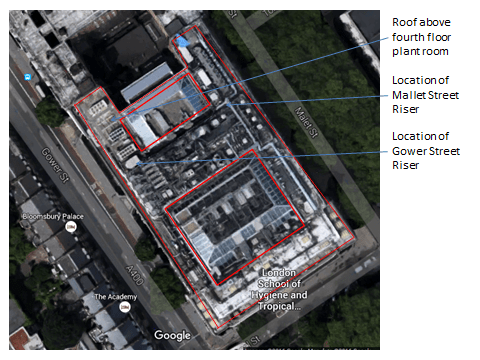
Aerial view of LSHTM. The red line demotes the outline of the building which used to form a capital A shape. The two hollow sections of the building have now been filled in.
The client, LSHTM, therefore wishes to install two new, appropriately sized boilers at fourth floor level and take steam back down the building to serve various loads. The existing system will stay in use and only be stripped out once the new system is fully online. This will require a period of gradual handover from systems as individual loads are brought online. The project is valued at £1M and the consultancy fee is a fairly small £50K.
The BWL team looking at this project is 3 strong; a director who effectively brought the job to BWL when he moved company, myself as the mechanical lead and an electrical engineer. The project is mainly mechanical in nature and the director is keen to take a hands-off approach, so I’ve essentially got a huge degree of responsibility and autonomy on the project which is great.
Steam
Before I go any further it’s probably worth explaining a bit about steam, although I won’t fully explain all the concepts this will end up like War & Peace. The following link is very useful and informative if you get involved with steam design at all or want more information:
http://www.spiraxsarco.com/Resources/Pages/steam-engineering-tutorials.aspx
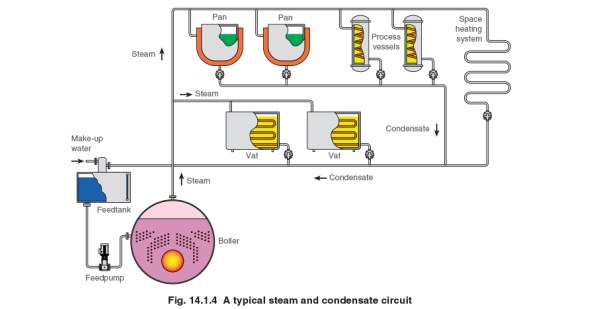
In normal mechanical systems it is usual to see a flow and return pipe. This is the case when dealing with steam except that the flow pipe contains your steam, which is dry saturated steam (steam that has had energy added to it so that it is completely dry) and the return contains something called condensate. Condensate is generated when the dry steam is subject to a change that allows it to change state to a wet steam of liquid. This change in state can either be caused by a drop in pressure or temperature. The change in state can be deliberate – the steam is being used in a processs e.g. through a heat exchanger or unwanted, e.g steam running along a pipe cools and condensate is generated due to the loss in energy. What we don’t want to happen is for condensate to build up in steam lines (impacts the performance of heat exchanges, is corrosive and can lead to water hammer damage), therefore condensate is removed using something called a steam trap. We also don’t want to waster condensate if possible as it still has energy within it which we can reuse at the boiler / generator and is valuable in that water going into a boiler needs to be treated. Reducing the amount of new water required by recirculating condensate reduces costs massively.

What have I done to date?
I’ve surveyed the site and produced a basic REVIT model of the plant room that we need to put the new boilers. In conducting my surveys I’ve also identified that one of the AHUs being served by steam isn’t utilising the steam (valves isolated and pipes cold), I’ve since spoken to the facilities manager who has confirmed this has been the case for two years. This has allowed me to removed the AHUs from the steam load profile a saving that allows me to drop down a model size on the boiler and save the project up to £50k – not bad for just having a walk around. I’ve just pulled together and submitted a Pre-Qualification Questionnaire and mini-tender document for the purchase of the steam boilers which goes a long way to filling the short falls in my C competencies from phase 2. Next stage is to move onto a bit more detailed design and start sizing pipes.
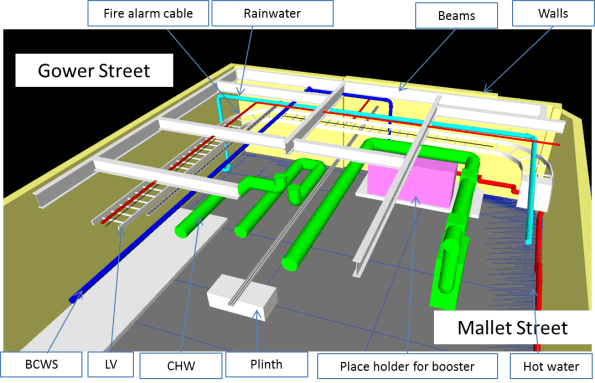
Basic REVIT model exported to NAVISWORKS to show the constraints within the fourth floor plant room.
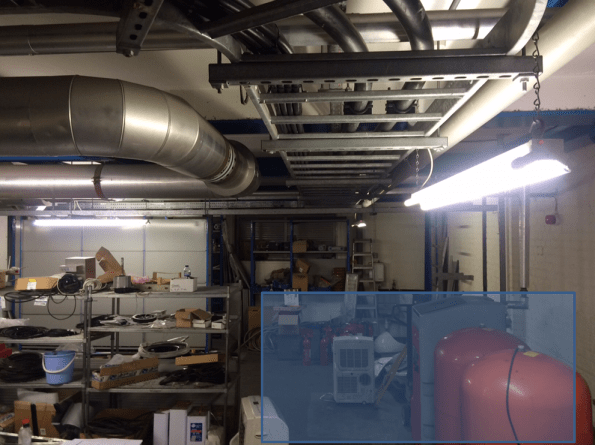
View within the fourth floor plant room where the new steam plant will go (denoted by the blue square).

View within one of the existing risers. This is the better set out of the two, the other looks like someone has just thrown pipes and wires in. There appears to have been plenty of expansion over the years but not stripping out. There are also no as built drawings or schematics, which when services are incorrectly labelled makes coming up with a plan interesting.
 Holdfast Training Services Trial Blog
Hi Rich – sounds good from both technical and managerial aspects. Can you explain more about the £50k saving – is that through being able to re-use the old pipework or saving through not having to model it? Is it a traditional project or are you getting the installation contractor involved in the design? Is there much interaction with the building’s facilities manager regarding how the new system will be installed before the old is removed – not sure how old the building is but are there any H&S concerns (asbestos)?
Damian,
All good questions, some of which I’ll cover in more detail in future blogs. The 50k saving comes from being able to select a smaller boiler – I’d worded this badly in the blog. There’ll also be additional savings in that a smaller load should allow for smaller pipework and lifecycle savings due to the boiler being able to operate closer to it’s 100% load, which is generally more efficient. However, the 50K saving is just from selecting a smaller boiler. The contract is traditional, so we have CDM responsibilities, although I’ll be on phase 4 by the time work starts – although it’s a small job some of the plant has long lead times. From a H&S point of view I’m not too concerned about asbestos, but we’ll always bear it in mind. The school is a 1930s buildings, but has undergone a huge amount of adhoc refurbishment, therefore a lot of asbestos has already been removed. My greater concern is access for installing pipework, it’s very easy to draw a line on a piece of paper, but the reality is that some of that pipework will be 5 stories up in the air above a glass atrium.
Good intro to steam Rich. How have you found Revit? I start in it next week…
Henry, I found Revit painful at first, but once I’d been given a bit of a steer it became relatively user friendly. My experience is that the key is to get your views set up correctly initially. Best to use a template or get someone to do it for you. Will you be creating your own families? If so I can send you a link that uses a creating a generic VAV box as a good example.
I’m hoping there are a fair few families set up in a dusty file somewhere. That said, if I haven’t had to make too many of my own I might just do so for the learning value. Could you put the link up here?
Rich
Good to see a bit of work on steam, still a useful source of energy and a good all round study of mechanical principles. There are C and A/B competences to be had and hopefully you find it interesting. Steam trapping and condensate return are key, as you point out the energy that went into generating steam in the first place has to be preserved as far as possible.
Mark,
Thanks. Although we’re trying to preserve energy I’m not entirely convinced how much we’ll get by the time the condensate has dropped to the basement, been collected and pumped to high level. The nature of supplying autoclaves is that most of the condensate produced is contaminated and so has to go to drain. We’ll only be collecting what comes of PRVs and steam traps on main runs. I envisage this will result in the condensate return unit sat in the basement waiting until it has collected sufficient liquid before the pump kicks in and sends the condensate back up to the fourth floor. Although from a design point of view this is no bad thing as I don’t have to worry about cavitation on my condensate pump. The main driver for return the condensate it the expense of the water treatment – any saving is greatly welcomed. Do you have much experience of RO system on water treatment for steam?
Rich
Completely forgot the system was for autoclaves, sorry.
Not for steam systems but RO is fairly standard in principle so ports accross relatively easily, are your going to be using any other water treatment methods?
It sounds like you’ll have a high make up demand so I’d imagine any heat recovery will be useful, have you looked into the viability of exploiting the heat from the waste stream?
Henry,
I’ve also got a user guide from BWL, I’m sure USACE will have something similar, but if they don’t let me know and I ‘ll fire it across to you on email.