Design of Structural Elements Against Explosive Blast
I mentioned in my first blog that the construction of the ground floor slab is considered a critical milestone. With that for context you would assume that everything possible is being done to ensure the concrete pours on this slab are completed on programme. This brings me nicely on to the topic of this blog.
Early last week, only 60 mins before a significant concrete pour (50m³) was ready to begin on a key part of this slab, an issue was identified during final reinforcement inspections. This caused a fair amount of aggravation and stress on site between the consultant engineers and concrete package sub-contractors .
The issue relates to the column in Fig 1.1 and in particular the depth of fillet welds between the web and flanges. The column protrudes through the GF slab and was scheduled to be encased in concrete up to GF level as part of this pour. The engineer consultant, during his final check of the slab reinforcement bar, identified an issue with the welds on the column that stopped work until the senior structural engineers at the design office could be consulted.
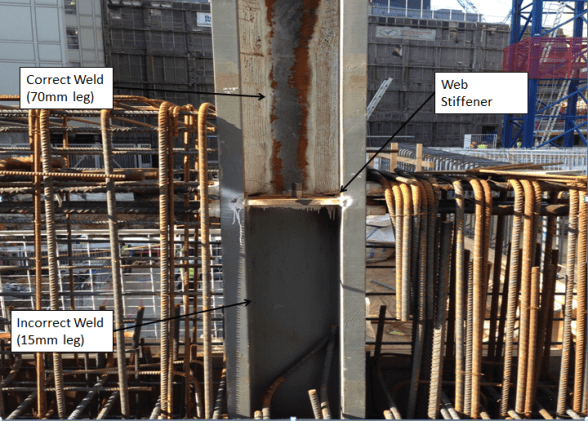
Fig 1.1 – Incorrect Weld Configuration on Column L8
As I know the audience reading this blog adore explosives, and in particular blowing up military bridges on exercise, I thought they might be interested to hear that many of the structural elements have been designed to resist an explosive blast detonated at very close proximity.
Robustness in a building is usually achieved through one of a number of approaches. The most common is to design alternative load paths in case a structural element fails. On this project however, due to a late notice client dictated design change, this was not a viable approach. Robustness is therefore only provided through the alternative ‘protected element’ method. By this I mean key structural elements are designed with adequate individual robustness and additional protective measures (i.e. encased in sacrificial concrete or steel) to ensure they do not fail even when exposed to the designed worst case load condition.
In this particular column the weld design has been specified for this worst case condition. Unfortunately the column was not constructed in accordance with the design drawings. To provide suitable shear resistance in this element, the Blast Engineering Consultants specified a 70mm multi run fillet weld along the full length of the column to the base of the ground floor slab. As Fig 1.1 shows, the steel contractors only installed the fillet weld from the top of the column to the first web stiffener, leaving a considerable length of this column with minimal 15mm deep fillet welds. To try and understand the magnitude and context of the site engineers concern I tried to conduct some very basic analysis of this section.
In the first instance I modelled this problem as simply as possible and effectively considered the column as an I beam bending in one axis with an 8.6MN worst case vertical shear reaction force. To be clear from the outset, it will become apparent later in the blog that this model is far to simple for the complexities encountered in this problem.
Students on the civil stream will fondly remember the “Say It” equation which allows calculation of shear stress along a particular plane at any point in a bending beam. One of the key components in this formula is the thickness (b) of material providing longitudinal shear resistance along the assessed shear plane. The greater the (b) the smaller the shear stress. In steel plate sections a fillet weld exists to simply transfer the shear stresses from the flanges to the web so that the top and bottom flange can work together as a single beam (ie they know about each other). It’s worth noting that because these columns are steel plate girders, there is no monolithic connection between the web and flanges to provide an additional contribution towards this shear resistance. I have simplified the diagram to sum this up and illustrate why the reduction of this weld from 70mm to 15mm might be a problem.

Fig 1.2 – Simplified Column Section Model
Diagram A shows the steel column, as installed, below the web stiffener. Along this length the fillet weld installed is only 15mm in width each side of the web, this provides a total (b) of only 30mm. Diagram B shows the steel column where the fillet weld has been correctly installed. This weld, 70mm on each side of the web, provides a total (b) of 140mm of resistance along this shear plane.
In accordance with BSEN 93-1-8 Para 4.5.2 you actually need to use the effective Throat thickness (a) of each weld in this calculation (This provides a conservative estimate) which can be acquired with some simple trigonometry. I calculated weld throat values of 10.6mm and 49.5mm for case A and B respectively. These figures are then doubled through most of the calculations because we have a weld on both sides of the web.
I then plugged these dimensions and the known constants into the “Say It” equation, with the two different welds considered, to analyse the varying shear stresses induced as a result of the designed maximum blast load occurring on the column:
Calculation Details:
Max Vertical Shear Force on Section Vz = 8.6 MN
Second Moment of Area = 32.77 x 10⁴ mm⁴
Distance from NA to Centroid of Area above shear plane = 200mm
Area above Shear Plane = 38400mm²
Width of Material under shear (Weld Throat): Case A = 21.2mm
Width of Material under shear (Weld Throat) : Case B = 99mm
After I’d run the calcs through using the information above I got the following shear stress values through the welds in each case:
Shear Stress in Weld:
Case A: 950.7 N/mm²
Case B: 203.6 N/mm²
I also calculated the greatest shear stress likely to be seen in the I section for both examples in order to allow further comparison. We know this appears along the NA where the web in this case is 60mm. I ended up with shear stress values as below.
Shear Stress along NA – Web:
Case A: 371.1 N/mm²
Case B: 398.78 N/mm²
When you look at this logically, it raises a few interesting points. In Case A the shear stress expected in the weld is over 2.5 x greater than that seen in the web on the NA. Therefore, when affected by the blast load, the weld is likely to fail long before the web of this section.
In Case B however the weld sees an expected stress that is approximately half the shear stress seen along the NA in the web. In this case it is likely the web would fail before the weld. This suggests the 70mm weld is therefore larger than actually required. Generally a design throat thickness of an I section, doubled to account for both sides of the weld, should be a similar depth as the web thickness on that section. Any additional weld depth is most often unnecessary because the failure risk is transferred to the web.
Using BSEN I then checked the actual permissible shear stress in each weld. In both cases I calculated this to be 230.9 N/mm². When you compare this to the expected stresses, it is clear that the fillet weld in case B is capable of carrying the design stress of 203.6 N/mm² but not the 950 N/mm² of case A; clear indication that the 15mm weld is grossly under strength for the worst case load condition assumed in this model.
I mentioned that my first model kept this analysis as simple as possible. In reality the problem is considerably more complex for a number of reasons. Firstly, I assumed the blast occurred directly perpendicular to top flange. Blasts occurring at different angles to the section would undoubtedly affect the results. In addition to the 8.6MN vertical shear reaction load I considered on the section there is also a 9.5MN axial load from the weight of the building applying a compressive pre stress through the column. Furthermore, the complex nature of the dynamic/impulsive blast load on the section is also far more challenging to categorise; it is affected by numerous variables including charge size and type, stand off, ambient pressure and charge proximity to the ground, amongst others. The response of a steel column to a blast load is also influenced by stiffness, its dimensions, vibration period and strain-rate. The point being, this is far too complex to analyse with such a simple model.
What is very clear is that no one in the project team seems to understand the science or engineering behind the blast design analysis. All we know is that there is a specified design explosion and the consultants tell us the size of elements required to provide robustness. If I can learn about the science and engineering models applied in the space and time between the immediate explosion and its impact on the column I will probably know more than most of my immediate colleagues and have a potentially interesting thesis topic. Fortunately I have managed to arrange a visit to the blast design consultants test facility in the coming weeks to see first hand how they model their problems to produce the design output. With any luck they will also let me blow up some steel columns in the name of thesis or TMR research.
In practical management terms the project team on site got irritated by this problem because the column had been in position for three weeks before the issue was spotted. Had we employed more thorough quality assurance inspections, it is likely this issue would have been picked up earlier.
This incident is also a potential indication of a more commonplace issue. From a brief investigation I am certain that the column was inspected and signed off imediately after installation. The likely problem therefore, I’m speculating only, is that the individual who inspected and signed off the steel either didn’t do it thoroughly, made a mistake or potentially didn’t know the detail of what they were looking for when completing this process. Which raises the question of how to best ensure QA inspections of completed work are only conducted by individuals capable of understanding the technical importance of the details contained on drawings and specifications.
Once I have got more information on the modelling methods used by the blast consultants I will attempt to publish another blog on the subject and its affect on my own analysis of the issue identified.
 Holdfast Training Services Trial Blog
Good stuff Tom – if you’re interested (or anyone else for that matter) in a TMR/Thesis in blast modelling then Cranfield have “ProSAir” modelling software which is free for academic licenses (no commercial use though) – Richard will doubtless know about other software packages used
Of course by the time you reach the web stiffener the column will be encased in concrete so it won’t be possible to excerpt a perpendicular shear to it and will benefit from a significant amount of concrete to resist whatever is applied. So it might well be that the situation as shown would be absolutely fine…
As a good start on the subject area you might read Me Vol IX Part 1. It’s pretty much the basis of Peter Smiths most recent book.
Sure is confusing. The most common method of designing for robustness is called peripheral tie – it’s vertical , longitudinal and transverse ties capable of accepting fairly nominal forces. If the building shape mitigates against this- then you’re onto alternative path and … if you can’t find alternative paths ( atriums are a common bugbear)…this it’s protected element.
The Ronan Point back analysis gave protected element characteristic pressure of 34kN/m^2
A fag packet assessment of Tom’s loads gives an localized pressure of around 50-60 times this value…I guess the difference between an accident and intentional.
It is really difficult to figure just what this design is out to achieve. What is not clear for the photo are the following
There is a deep beam running way from the column – hidden behind the column as we are looking at it
All the longitudinal reinforcement bar in the three connected beams are positively connected using couplers welded to the column.
Finally this massive fillet weld tapers back to something that looks normal over a length of just over a metre from the stiffner position -again not clear in the photo
So what is this extremely extnnsive piece of fabrication doing…?
…..answers on a postcard
This afternoon the steel contractors confirmed that they fabricated these welds in situ after the column was installed on site. The weld is therefore tapered towards the splice position, just above the image I put up, to allow them to install further full width (70mm leg) weld over the splice once the next length of column is bolted on.
To allow fabrication of welds this large they use a propane heating system to preheat the column sections in place. I’ll keep an eye out for the next time they complete this process to try get some photos.
I also spoke to the senior engineer consultant and steel contractors on this issue today and both openly admit they think the weld is unecessarily large and neither can fully explain its requirement. Hopefully my meeting with the weapons effect engineers will provide answers tomorrow.
Tom,
Not being a civil, I won’t throw my hat into the ring on the calculation front. But making the assumption that it was designed correctly I was wondering what the commercial implication was of the current status. Presumably the concrete is now in and everyone has moved on but is the client aware? Is the project a design build or traditional contract?
Henry,
This is a design and build contract and correct, the concrete is now in and the project is moving on. The client has not been made aware of this issue because from the structural engineers perspective it was assessed that the column still provides the protection levels specified in security report. As a result the building still meets the employers requirement. Had the issue reduced the capacity of the building to resist the worst case load condition, then the client would have been informed of the issue. I suspect we would then have been required to correct the fabrication before we were allowed to start pouring the concrete.
Tom,
Can you sketch us a free body diagram of the column please?
Who did the blast analysis: D J Goode?
Guz
Gents, all good questions. Rich’s point about concrete beams running in three directions away from the column was the agreed answer on site. In its permanent state the column is encased in concrete providing significant restraint to the section even when exposed to the blast. In the end the engineer consultants agreed this was a sensible approach so signed off the column in its current state allowing the pour to go ahead. That aside, the design specification clearly shows the weld running to the base of the concrete GF slab. The exact reason for this specific weld design is not clear to anybody on site at this point. John tells me these type of welds cost a good amount of money to emplace so I assume that they are justified somewhere. I have a meeting with DJ Goode’s weapons effect engineer first thing Friday when I hope interrogate him about their design process and modelling methods. I will specifically investigate their calculations proving requirement for this weld and I’ll be sure to put up further info on the blog. I admit there are some large holes in my understanding of this problem. Despite that I thought this was an interesting topic because Blast design is the only aspect of this project I have identified where everybody I speak to openly admits they know absolutely nothing about it.
Tom
Well done – short, sharp and sweet. I have never seen a FW so large
Kind regards
Neil