108 Update
Time for an update on site progress at Australia 108. Lots of progress on site this week. 90% of the piles caps are complete and we have begun the excavation to Basement Level 1. We are 38 days behind the site program due to various issues and delays with the piling as well as lost days due to weather.
The most recent big issue is one of out-of-tolerance as-built piles. The Australian Standards allows for 75mm tolerance however due to the risk in the piles, the designers have allowed for 150mm. So what do you get when you discover that a 2100mm, 80MPa pile with a design axial load of 111.6MN, moment of 16.5MN and shear of 2MN ends up being 401mm out of position? An increase in moment to 49.9MNm; the design effect has greatly exceeded the design resistance of the pile = big problem! The engineers are currently looking at rectification methods involving large transfer beams in lieu of individual pile caps and transferring the addition moments generated to the other piles and the core if necessary. It is estimated to be at a cost north of AUS$400k = 200GBP +. There have been 12 piles over the specified tolerance and with the exception of one, the others have luckily had adequate capacity to resist the additional moment due to the redundancy in the pile with minor rectification measures being introduced to the ground beams.
My TMR is looking into the risk management strategies of deep foundations so once I’ve finalised it, I will post a very abridged version highlighting our issues and probably causes. I know a few of you are soon to commence piling in your projects and can benefit from hindsight of some really simple errors that have been made on this site – most of which could have been easily avoided.
Here are a few pictures to keep you up to date with progress on site.
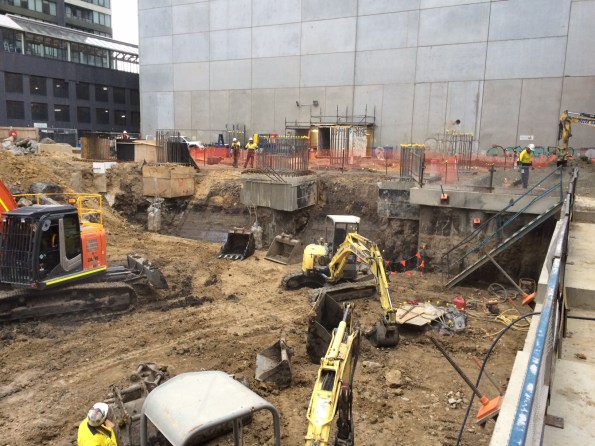
View to the East

View to the South – excavation of the core piles has begun consisting of 16 x 1800mm king piles with 600mm dia CFAs between

View to the West – secant retention wall to protect a 60 yr old heritage facade at the northern end of the site
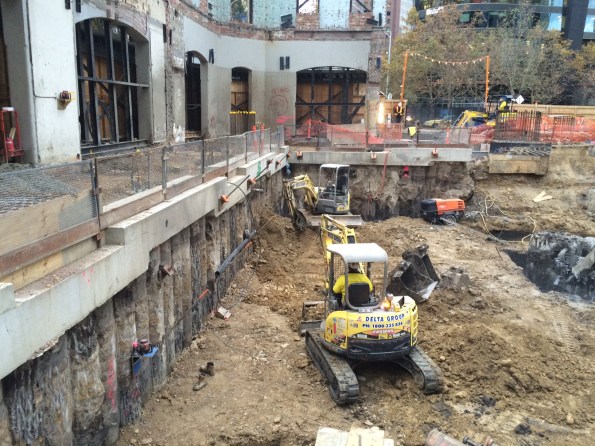
View to the North West – northern retention wall and one level excavation
And for those of you with beady eyes it will not escape your attention the 3+m high vertical face of the southern end to the excavation. Fine grained soils, 30t excavator rolling back and forth on the top of it and no retention or batter. We’ve also had a lot of rain recently (for Melbourne anyway – the news reported a taxi getting flooded out to mid-point of its wheels!!!!!) I have raised this concern to the powers that be and it has already been mentioned to the subcontractor who have chosen to continue as it – because they do it all the time. BMC are allowing them to continue (cynical view – because any changes will slow down progress.) They have instigated no one to walk at the foot of the wall yet people are still walking at the top of it. I’m astounded that they will stop work for the slightest speck of rain because of the potential hazards created, yet they will let people walk along the top of an unprotected excavation. And they are constantly telling me how at the forefront of H&S they are. Barking!
Progress on 12/5/16


Progress of 13/5/16


 Holdfast Training Services Trial Blog
Hi Jo, are you using Delta as your subcontractors as well! I am told they are pretty dominant in Melbourne area.
I share your pain with piles and secant pile walls. I have had a problem with batters and benches here. What has your Union delegate to say? They have real power to bring the subbies into line for safety if they are onside. Do you have a consulting Geotech on such a big job and is that black soil acid sulphate as well? Given the amount of rain what dewatering are you doing at the moment?
Delta are the subcontractors doing the ground works now the piling in complete. Ref H&S, we have a union rep permanently on site who is usually the first to stop works if he deems there is a H&S risk. There has been no action taken on this one so work continues as is.
The black soil is Coode Island Silt (CIS) which is classified as a very soft silty clay. CIS does contain sulphides so I’ve done some reading about this particular soil as we are not going through the same treatment of soils that you are in Brisbane. In short, CIS has been found to contain up to 5% unreacted sulfides which has the potential to generate sulfuric acid when allowed to oxidise. It stinks when excavated!!! A study was done in the late ninties following the excavation of 250000 cubic meters (potential for generation of 15000 tonnes of sulfuric acid) from the Crown Casino site, just over the road from 108. It was stock piled in an aerobic environment from 1996-1999 to use as noise mounds during construction but the generation of sulfuric acid never happened. I don’t know the ins and outs but its something to do with a natural buffering capacity of sediments in the soil.
We also do not have any dewatering going on. The GWL was assumed to be mid-basement level but we haven’t hit it yet, even with the rain. The first couple of feet are an imported fill then is CIS all the way more or less to way below the base of the first one level excavation. The permeability of the clay is extremely low so flow into the excavation is pretty much negligible. The deepest excavation is in the core which has been retained with a continuous wall – contiguous piles with jet grout infills. The intention is to hire in some sump pumps if required, but that’s as far as the plan goes.
Thanks Jo,
I was going to ask a question or two about the apparently chaotic site layout and low level/absent laydown planning but think you’ve effectively said that this simply wouldn’t pass any European standard scrutiny. Just when I thought colonial superiority was becoming a thing of the past. I am particularly intrigued by the unattended pair of boots in the penultimate photo and bemused by the concept that something post war and 5 years younger than John Marsh should be considered as heritage and worth propping up! Australia may be a continent short on historical buildings but surely… A colleague recently commented that the difference between the British and Americans is that they consider 100 years to be a long time yet we dismiss it off hand and we consider 100 miles to be a long way yet they dismiss it off hand. I guess the Australians aren’t so different.
Hi Jo,
I know you’ve said that you’ll cover the risk management strategies of deep foundations in a TMR and subsequently blog about it, but at this stage can you identify what possibly went wrong? Being 250mm out of tolerance seems pretty huge. Who was responsible for QA?
Jo,
I would definitely appreciate some advice on the piling front. We are about to start with about 150no 1200mm piles in June and I will be responsible for confirming the layout of these. One of the section engineers is going to set them out initially.
What were the big issues you had with setting out that led to this error?
Cheers
Jo, another interesting blog full of lots of so whats.
I am sure you have this covered off, but I made the mistake of totally missing a key risk within a basement excavation which you have quite literally got loud and clear. That is noise. Not sure how many decibels each of the excavators breaking away is creating but I suspect its over most normal short, and probably daily limits. The noise is an issue for site operatives (in theory plant operators have sound proof cabins, I question that and normally they like a window open), site engineers and other people attending site. I am sure ear defence is issued and (mostly) worn by all. However, I can’t see much attenuation for the neighbours outside? If there is attenuation (hoarding?) does that make it worse for those inside… So the risk becomes one of disobeying noise limits which turns into orders to stop works with consequential time and cost implications. The sustainability triangle of social – ultra annoying for neighbours, economic – schedule delays are expensive and prolong the problem, and environmental – noise is disturbing and makes it unpleasant to work nearby (offices, etc). Then there is vibration and dust to compound the problem.
I have similar questions on organisation to Richard but also feel for how difficult access is to manage when routes change by the minute.
Chris – I am rambling on now but for setting out, we managed to go wrong as you saw at Two Fifty One – a 10m (yes metre) misplaced pile. Kind of ridiculous and totally avoidable but really no suitable controls were in place. What controls would you employ to set out a building or check something is being done to the plan? I think I would approach it again by looking at highly sensitive areas (any tower crane piles, highly loaded piles and other structurally important ones) – if you have hundreds of piles, you might have to prioritise. Get these key piles to either have ‘hold points’ or some means of double checking. This might be by another site engineer, but whatever it is, I would advise it to be independent. Hopefully you have a local grid to work from so grid references are meaningful. Final piece of advice is use a drawing and don’t be afraid to get a tape out to do some spot checks – this avoids relying on a total station all of the time (after all it is as only as good as what has gone into it).
Starting from the top..
Richard F: The boots – the workmen tend to swop their steelies for a pair of gum boots if they are going to wade around in the CIS. I didn’t even notice them in the picture till you mentioned it. The facade – As you suggest, heritage is in the eye of the beholder. Melbourne was only colonised in 1835 so the oldest buildings are less than 200 yrs old. There has been a growing trend in recent years to knock down older low rise buildings and replace them with high rise leading to a loss of a large proportion of older buildings in certain areas, especially the CBD. There has been a growing trend since the 1990’s of facadism – where by only the facade of the building is retained and built into the new structure and the remainder is demolished – and there are examples of this all over the city. It is highly likely that planning permission will not be granted unless this is done. However, this is likely to change as Melbourne City Council is hoping to tighten measures in a bid to protect a larger proportion of a buildings heritage rather than just its facade.
Rich G: Out of tolerance piles is only one issues we’ve had on site. The piling subcontractor cannot 100% determine why the pile is out of position so far – its is either a set out error (but its not out by a round number which you would likely expect) or the casing has moved during drilling. These piles are big at 2100mm and a steel casing was placed in the ground to guide the drill rig and provide protection to the borehole. The ground is extremely soft so it is possible, and more likely, the casing shifted. There was a serious lack of control measures in place and I would argue that corners were cut on the QA and blind eyes turned to try and keep up with the schedule. Two things should have occurred prior to the pour of the concrete: 1. The casing should have been resurveyed 2. The reinforcement should have been surveyed. I would put money on the first not being done and the second was not possible owing to their construction method. The pile heads at this location are at Basement Level 1 depth (RL -1m) but the piles drilled from ground level (RL +2.4m). Rather than bring the reinforcement to the top in order to survey and cut back down later, the subcontractor opted to drop it deep beneath the level of the polymer so it was not accessible. Other issues we’ve had with the piles are borehole collapses, reinforcement cages dropped low (1200-1500mm), lost reinforcement cages, reinforcement cages misaligned in the boreholes, excessive silt at the base of boreholes, unrecoverable broken kelly bars owing to drilling through basalt extusions, and I could go on with more minor issues. Your question on the who was responsible for the QA is rather interesting. The BMC employee overseeing QA is a cadet (an undergraduate who is employed in the company), however BMC employed a third party piling consultant who does peer reviews to come and oversee the piling. Having read the reports, there were many issues flagged up and plenty of recommendations made, most of which would have involved slowing the construction process down. Read into that what you will.
Chris: What sort of piling are you going to be doing? I wasn’t around for the set out here but absolutely concur with Damo’s comments. I think identifying the piles which pose you greatest risk will focus your attention on the QA front to the piles that definitely need it as well as double checking your set out. My TMR looks principally at bored piles – we’ve had far more issues with these than the CFA piles – and I’m more than happy to ping it across to you and/or have a FaceTime chat if you want. You might as learn from mistakes on this site!
Damo: NOISE!! There is plenty of it on this site. Interestingly, the basic PPE requirements over here are boots, hard hat and high vis. Gloves and ear defence are not mandatory and to worn as deemed fit. That said, the majority of the blokes on site are wearing ear defence – including all the machine operators – but surprisingly not all!! BMC only impose the minimum PPE requirements and leave the subcontractors to organise their own workforce. It is too much hassle and too political to interfere due to the union input into everything. I am pretty certain I will leave Australia still not fully understanding that beast. I have seen blokes pouring concrete in shorts, no gloves or eye protection with more than just a splash making contact with bare skin. I have also got to admit, noise restrictions had never occurred to me until you mentioned it. I asked the site manager who had to refer to his documents to find the answer. The site is only permitted to reach a decibel limit of 10dB above the normal working background noise of the area. They don’t know what that is, and they don’t know how much noise is actually being generated on site. There are no specific attenuation measure put in place. The fine for going over the limit is AUS$2000 and a wrist slap – pretty negligible in the grand scheme of things. 7 months into the job no-one has come to check. The SM did not seem concerned about site closures or orders to cease work. Again, the unions really drive the construction industry – if work ceased due to noise, it would have a negative impact for the construction workers. The only complaints we are aware of are those of neighbouring residents, but those complaints go to the building managers. It is a community of renters here. The building managers mention it to BMC who take them out for free coffees and lunches to discuss their concerns. I can’t imagine apartments in this area remaining vacant too long should anyone leave so I don’t know how concerned the building managers actually are. The only thing they are really strict on is working hours. Mon-Fri 0700-1900; Sat: 0800-1500; Sun: 1000-1400 (permits required on Sat/Sun).
So that’s an end to my cynical ramblings and I hope I answered your questions. I have also updated the photos in the initial blog to give you some photos from a few consecutive days.