We will rock you
So in my last post I said I would cover a little about working with rock. I am currently excavating in low to medium strength phyllite. Phyllite is a metamorphic mudstone somewhere between slate and schist. It is highly foliated and has fine clay like material in between the layers. The foliation is at 70 degrees to the horizontal across the site. Despite being fairly weathered it is still relatively intact with only a few faults across the site. RQD was between 50-75 % across site. The problem is it weathers so incredibly quickly when wet. I am about 15 m below the water table and water coming through the anchors at about 5 litres per minute. So what I hear you cry – well its rock but it is a galactic pain in the back side to work with.
I am now down at footing level and I am faced with an even worse problem than the bulk excavation. The design has called for individual pad footings which are all at different levels and a core that is 3 m below any of the other pad footings. There are zone of influence clashes everywhere, the architect/structural engineers have very helpfully not included any footing RL so I have had to work them out, as well as how we are going to get the batters and benches in while still being able to move. The geotechnical report states that with low strength phyillite I can achieve a batter of 0.7 H and meduim strength 0.5 H. With H being the height of the batter (not exceeding 3m). So rock strength can be pretty important.Footings Handover Schedule
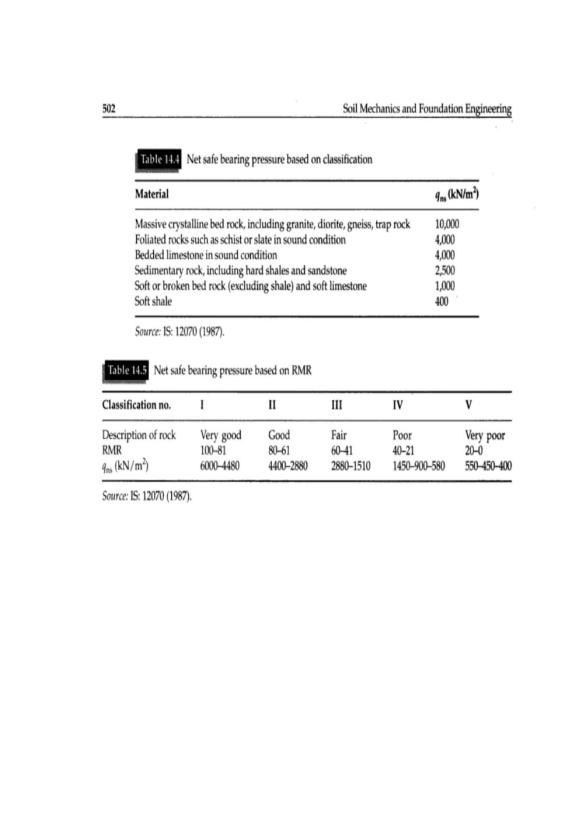
What strength is that rock? You cannot just take the results of the lab test for Ultimate compressive strength and point load tests. There is a very good website that helps with estimating rock strength via the Rock Mass Rating (RMR) process (RMR rating)that can be then used to calculate the allowable/safe bearing pressure for foundation design. Ultimately though this counts for very little as to get anything signed off you end up with a geotech going mental with a geo hammer on site before telling you its half of the strength you have calculated.
A conversation with the local geotech went along the lines of “how do you come up with the safe bearing pressure do you use RMR.”
“RMR what’s that? Nah, I just use experience, umm what does the drawings say this should be?”
Incidentally I got an RMR of around 45 -50 across the site. That gives between 2880- 1510 KPa am I right?
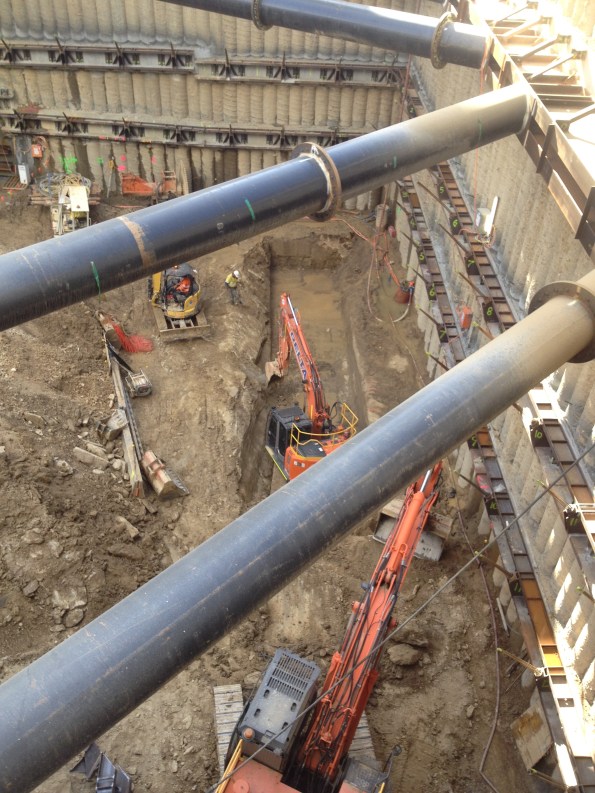
I made the mistake of being over confident with the bench and ended up having get the geotech back in. In my defence I excavated a pad footing expecting it to be open for the maximum of a week and the PM didn’t make the call on the steel contractors in time so it was open for nearly 3 weeks. The result was water got in and the sides blew out, I had to get the geotech and subbies back in to batter back a ridiculous amount. This all meant time, concrete and money.
There is worse to come – the other Site engineer (little e deliberate)- to be now known as ‘the lone ranger’ took responsibility for the crane base and has massively ‘dropped his baseball’. He wrongly measured the zone of influence of the crane base to the core and failed to gain approval for the design of the pad footing from the geotechs. We are now faced with delaying the tower crane erection or digging the pad footing deeper. It hopefully won’t end up like the crane around the corner though, which has a lovely lean to it. 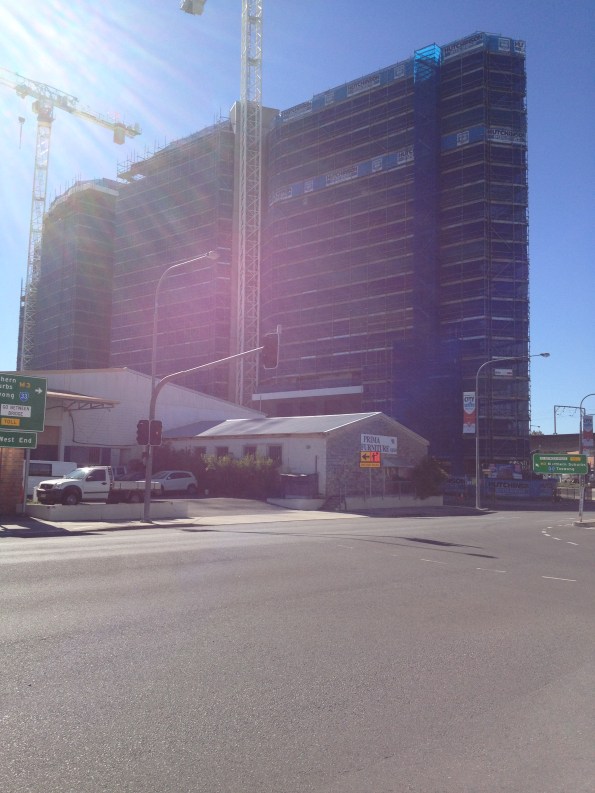
Prima furniture may be getting some renovation work done in the future.
 Holdfast Training Services Trial Blog
Wow, l can’t believe that I have beaten John Moran to be the first to comment on a geo blog. I need to get out more! Doug nice review of the situation, but clearly I haven got a clue what you are talking about, although I have now learnt that hitting things with hammers is more reliable than using scientifically based methods of assessment. Who knew when I stuck my heel into the ground at Corilci before declaring the ground strong enough to allow a Chinook to land that I was at the cutting edge of CMT practice 😳
Doug
I presume as a sedimentary rock this is incredibly susceptible to how it is handled? Are you able to re-use any for backfill elsewhere?
We too have differential levels under the basement slab, pike caps, core and service runs! Our subbie has not considered it and I think we will need about 25 submersible pumps should it rain.
It’s metamorphic, although I don’t think it makes a difference. It is actually pretty good fill and is currently going into Brisbane airport extension.
I’m re-living your presentation on chalk again Rich!!!
Doug, I assume the mental geotech on site is from the same consultancy that produced the GDR, or are they with the D-C subcontractor? How thorough was the initial site investigation and the analysis of data to estimate the rock strength? I ask because we had two layers of very strong weathered basalt on our site which massively f*8&ed the piling. The site investigation only took 4 cores (2 from the top layer and two from the bottom layer) and did a UCS to estimate its strength. In John’s words, mass vs material and not triangulating the strength meant what was encountered was much stronger than the estimates which cause a whole heap of issues trying to drill through it.
On a different note…when you say the PM didn’t make a call on steel contractors – do you mean steel fixers to construct the pad footing? How come holes are being opened up if the next in line subcontractor wasn’t ready to go? And I see another fine example of H&S from the Aussies – that hole looks at least a couple of meters deep in relation to the guy standing close to the top of the batter, with no edge protection. Looks remarkably similar to my site at times.
It has some similarities with chalk so not a bad comparison.
The Geotechs are the same company that produced the geotech report and groundwater analysis. The docs are pretty thorough but the structural engineers interpretation was poor. I have real concerns of achieving the desired bearing pressure in the core. There were 10 boreholes dug on site. 5 high and 5 low. The low ones are the only ones to penetrate the Phyllite. So I am pretty spoiled. However, the geotech report was compiled by the A team and I very much have the B team on site. FYI The site survey was commissioned by the client prior to the bid (otherwise the PM might have blown it off).
Edge protection – we ripped away the fencing to increase the batter after the sides blew out and then replaced it. Phyllite is pretty strong but it can have clay seams that are a nightmare. For each footing we have to clean out the footing with compressed air to expose the seams. So it’s using the geotech report with observations in the footing to complete the RMR which gives you the properties at the base. Or just smack it with a hammer like you are unhinged psycho trying to bash a teenagers head in. Incidentally I have been in with the A team Geotechs today about how to deal with the crane base. So I have some more news soon
My sympathies with the piles. It is interesting to see on site how they change as the go through the different horizons (I don’t get out much). When we hit the Phyllite they bulged out – I will try and get a photo
I was under a bit of pressure to get the detailing done ASAP. Imagine my surprise when I find out (not from the PM) that they hadn’t secured subbies to actually build them. I don’t know what the PM manages but it isn’t his staff or the project.
Doug
At least it keeps you off the streets. So many things that sound simple are not really simple at all. You mention the other crane…..is that also yours? Is it derated or how is the lean accounted for? Who is accepting the costs? I assume that the crane operator is happy with it
Neil
The crane is on another site and we have no jurisdiction. They are still using it unfortunately. I think the crane base has failed though.