Bored piles – analysis of issues and recommendations
As promised in a previous blog, see below for a synopsis of the key risks, issues and recommendations from the piling on Australia 108
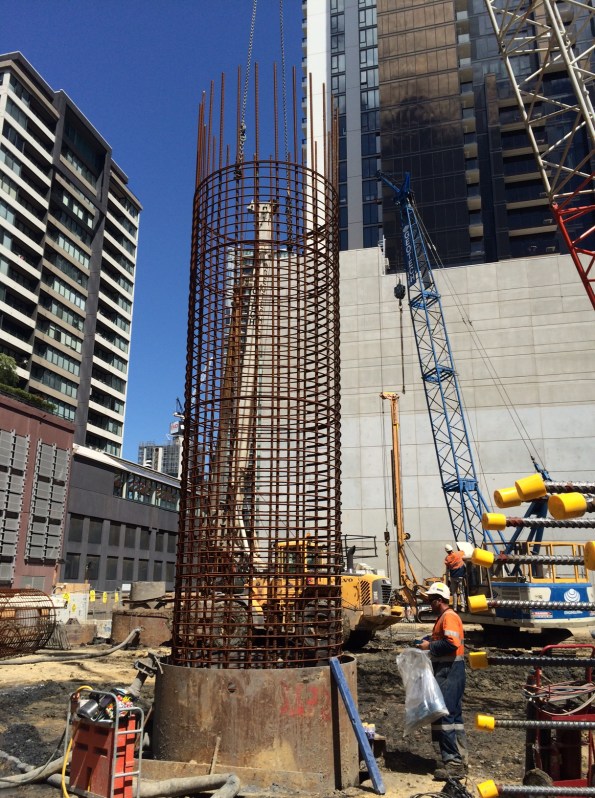
Analysis of issues encountered with bored piles
The delivery of deep foundations on any large project is always on the critical path. The risks inherent to piling are substantial and failure to identify and mitigate these risks adequately can lead to significant impact on cost, schedule and performance of the piles. Both the client and contractor have a vested interest to develop and implement an effective risk mitigation strategy to avoid such risks from being realised. The recurring nature of some of the key issues during piling on Australia 108 signifies they did not occur by misfortune indicating that risk could have been managed better, and some issues avoided.
There are two primary requirements associated with piles: piled foundations must have both the structural capacity and geotechnical bearing capacity to safely transfer the actions from the superstructure to the ground without requiring excessive strain to develop the load capacity.
Risk and mitigation
Risks associated with piling are generally accepted as fitting four categories:
- Risk of encountering unexpected ground conditions.
- Risk to foundation performance.
- Risk to construction productivity.
- Risk of construction defects.
Mitigation strategies generally adopted:
- Geotechnical Design Report. Identification of risk and recommended design solution. Any residual risk should be identified to ensure it can be mitigated through construction processes.
- Risk Transfer. Design-Construct contracts transfers some risk to the subcontractor. Costs can always be passed to the subcontractor if they fail to mitigate risk appropriately, however time cannot be recouped once lost due to delay. The attempt to reduce the overall project delay applies early pressure to a program which will often risk compromising quality.
- Testing pile performance. This verifies that piles have reached their design performance criteria. Increasing the rate and reliability of testing procedures affords greater design resistance to the piles, increasing the redundancy they offer for the same design effect.
- Construction methodology. This must be simple and specific to mitigate residual risk from design by avoiding any ambiguity or interpretation in construction procedures.
- Technical competence. The most effective way to mitigate risk is being able to recognise early that a risk is materialising as an issue. A timely, informed decision on appropriate action to mitigate that risk, balancing time and cost, is essential to limit the impact of that risk.
The underlying causes of materialised risk are often:
- Failure to identify the risk.
- Failure to recognise the risk was becoming an issues.
- The risk was identified but inappropriately evaluated.
- The was identified but due to either time or cost incentives, risk mitigation was not applied.
Australia 108
Foreseeable risks on Australia 108
- Difficulty drilling through the basalt in the Northern sector.
- Settlement of Coode Island Silt (clay) relative to the piles creating negative skin friction.
- Necking of the boreholes due to the soft clay collapsing and loss/contamination of polymer support fluid with ground water through gravel layers.
- Ability to core for establishment of pile in siltstone.
- Structural capacity of the pile due to high axial loads and eccentricities.
Issues encountered on Australia 108
- Out of position piles. 35% of 48 bored piles were out of position by more than the tolerance leading to significant rectification measures and redesign.
- Reduced drilling rates through basalt. The basalt encountered was harder and thicker than anticipated significantly slowing progress.
- Voided pile. The voided pile was due to broken equipment abandoned in the borehole while drilling through basalt. This resulted in additional piles being drilled either side and significantly increasing ground works to gain access.
- Borehole collapse. Either identified during drilling which required additional drilling to correct; or during the concrete pour which risked the performance of the piles and additional testing was required to verify the pile.
- Excessive sediments. Encountered in the base of piles and required significant airlifting prior to pouring, sometimes resulting in concrete pour being delayed a day due to the remaining time on site being insufficient to pour.
- Pile cages placed too low. Cages installed at incorrect RLs required additional breaking back of piles in 80MPa concrete to locate cage followed by rectification of pile and additional welded bar to ensure correct development length of starter bars.
Recommendations
- Identify the high risk piles using probability vs impact of risk materialising. This will focus QA efforts on the right piles.
- Be specific in the construction methodology about techniques to be used to reduce any ambiguity. Ensure it is followed on site. Measures in the construction methodology are there to mitigate risk.
- Check location of casing of bored piles after drilling before pouring. Out of tolerance piles can be evaluated prior to pouring. Redrilling of the pile now may have less impact on the program than rectification measures to the structure later. (This might be implemented for the piles identified as high risk).
- Use of GPS in the drilling rig will give real-time information on location, depth and verticality of the borehole allowing early identification of casing shift.
- Appropriate identification and classification of soils strata, specifically rock with regard to location and strength. On Australia 108, the basalt was not included in the design stratigraphy for the piles.
- If using polymer, slow and steady extraction rates of the drill reduces the likelihood of suction on the boreholes, reducing the effectiveness of the polymer chains used to support the borehole. If collapse is occurring in soft soils, slow the drilling and extraction rate down.
- Keep polymer levels 1-2m above the ground water level to reduce the risk of borehole collapse.
- Good polymer management is key to reducing the sediment within the polymer; especially prevalent when recycling the polymer from one borehole to another. Reducing the sediment pumped into the boreholes, reduces the need to pump out prior to pouring.
- Good polymer management is key to ensuring the polymer chains are effective. Check the length of the polymer chains dripping from the drill on extraction. Long chains indicate an effective polymer. Shorter chains indicate that new polymer needs to be mixed in.
- Requirement to check the RL of the pile cage prior to pouring. If necessary, the pile cages can be built up above the level of the polymer to check; or the length and laps of the cages be checked and recorded prior to installation.
 Holdfast Training Services Trial Blog
Jo, a very interesting introduction to piling for a novice like me. One aspect I would like to understand for my ongoing education is what role the polymer plays in the piling process? Is it used in all piling operations for instance, what does it contribute and at a more detailed level, why do you recommend stopping 2 m above GWL? I appreciate that the Civils will already know this stuff; I just want to broaden my knowledge. I hope the weather is better with you than it is here ☔️
Jo,
A really interesting read. There are so many angles to this and I think it is interesting that some of these problems/themes are common world wide. For me, the points you bring out sit within the ‘if I were to do this again/what I wish I’d known bracket. It does surprise me that competent contractors struggle with pile position, but then if the youngest, cheapest engineer is responsible for setting out and there are not sufficient checks in place, tolerances will be missed. I suspect a bit of time of a senior engineer checking locations of riskier piles would be time and money well spent.
I attended a brief about piling in high groundwater and where there are dense sands and gravels. The problem you describe about rate of piling and speed of extraction (reaming) is particularly important for granular material. My view is that effective stress reduces to zero so granular material is ‘sucked’ in, but I suspect this causes piles to collapse if the gravel layer is within the pile length. The mitigation strategy in these conditions was as you say (firstly) with rate of penetration/extraction but also (secondly) the power in the rig to generate sufficient torque to achieve that and thirdly, which I think answers Jim’s question on why the level of polymer needs to be high, is to keep the total stress higher than pore pressure to maintain a positive effective stress. The Arup presentation termed this a plug of material, but I think this would be applicable to your gravel layer. I think this is the technical nub of a managerial issue.
The piece about sediments, I think, should be within competent contractors’ normal routine ways of working but I suppose ensuring that actually happens is the challenge.
Pile cages too low. 2 things here. 1 Does it matter (probably in your case, in my case it was a couple among many piles so load could be transferred else where) and secondly did you have a method to stop the cages plunging south? On my site there was, but it was not always followed.
Damo, the real shocker in all of this is a qualified, competent surveyor who works for the D-B subcontractor did the setting out, not an engineer. The fact there is no consistency in the position of the piles (anywhere from the 100mm max tolerance to >400mm) indicates the casings have shifted in the soft soil during drilling rather than a setting out error. The problem is we can only assume because no-one checked the setting out.
WIth regard to the sediments, the assumption here is the contractor was competent in the use of polymer. There is so much literature out there describing how contractors using polymers do not understand the fundamental differences between polymer and bentonite and treat it exactly the same. The main issue with polymer management I identified when reading through the reports was the polymer was being recycled and pumped from one borehole to a holding tank and being reused thereafter. The subcontractor was pumping polymer from the bottom of the holding tank – where all the sediment would settle – effectively pumping out the most contaminated polymer within the tank to pump into another borehole.
This blog is essentially a synopsis of my TMR. The conclusion I came to was that the piling subcontractor did not manage the risk well. They did not identify all the risk, did not evaluate the risk appropriately, did not identify when risks were materialising as issues and therefore did not act appropriately. BMC paid to pass the risk, or so they thought, so made no effort to evaluate the effectiveness of the subcontractors risk mitigation strategy. They also did not have the technical competence within the team to identify or understand the risk or assess the subcontractors approach to risk so did nothing but wait and see how it all turned out. Their QA consisted no more than glorified tracking of progress and testing. The failing on BMC was they did not know or understand the risks to recognise the subcontractor was not dealing with the risk appropriately. The subcontractor has picked up the tab for increased costs but the time lost due to delay is gone leaving us nearly a month behind program. Not ideal. Whether all risk can be passed on in a design-build contract is another debate – another blog maybe for another day.
Jim, the boreholes need to be supported during their excavation to prevent collapse. Support fluids are used to do this job by exerting a hydrostatic pressure on the surface of the boreholes to resist external pressures from the soil and groundwater. Traditionally bentonite has been used for decades and it does so by forming a barrier or ‘filter cake’ on the surface of the boreholes to prevent loss of fluid into the ground and creating a surface layer on which the pressure can act. More recently, polymer support fluids are being used as they offer certain benefits to bentonite if used properly (I blogged early about the advantages and disadvantages of polymer vs bentonite). Polymers do not form a layer of filter cake on the exposed soil surface so fluids will continue to flow into the surrounding soil formations due to the hydrostatic gradient established between the borehole and surrounding soils. The viscosity of the polymer is a controlling parameter for the rate of fluid flow as well as the permeability of the surround soils. In short, the polymer must be maintained at a level higher than the GWL to ensure that the pressure inside the borehole is greater than the pore pressure outside the borehole.
I hope that answers your question. Weather is ranging between 3-15 degrees at the moment but at least its sunny today. We lost several days last week due to the rain – unfortunately during the CI’s visit as well.
Jo, very clear thank you. In other words once you get to GWL the water pressure is the same inside and outside of the bore hole, so nothing to be gained, it is the equivalent of saturation in psychrometry. If you have to drill below GWL, this is presumably where coffer dams start coming into play? You might want to point out to Damo that your cages will plunge North if things go wrong 😉
Jeeez Jo, I’d have accepted the piece a s a full TMR!
Just on the polymer – I’m going to give the upsides ( in terms of risk management)
1 The footprint of the polymer farm will be about half of an equivalent bentonite one
2 The rate of polymer debris uptake is far lower than benotnoteamd on any benotine farm the clean up operation produces a very large amount of bentonite ‘infected’ soil. IN the UK the thing is, that this is treated as contaminated spoil, with al the muck-away burden that that brings
3 The disposal of polymer- just sling in _ can’t quite recall- some basic household product like bleach and you can pour the water like fluid into the drainage system – it’s like a party trick
It occurs to me that , on your site, the boundaries, properties and groundwater were well established …..so there’s at least half my lecture series to hell in hand cart…..no, wait, I can rest easy…….it was just that the mitigation methods on each were very poorly communicated or implemented. The main contractor passes these risks to a specialized subcontractor …at a risk cost…..
The problems in balancing the hydrostatic pressure; the draw of sand into the drilling fluid ( but excess suction on withdrawal normally) , the problems in the siltstone and similar problems in the basalt – well these are all communicable from designer to contractor- without prejudice… particularly if the sub contractor is a piling company
John, don’t worry, the full TMR is sitting on the ELE so you can have a read of the full version and not just the synopsis if you want. Although I think I’ve probably managed to articulated myself better on the blog!!
Full copy is on my desk – Hence I think it unwise that I comment here other than to say that this is, indeed a succinct summary.
Enjoy 😀
And just properly read your last line – its a Design-Build subcontract so the designer and the sub-contractor are the same company which makes it so much worse. World according to Jo, I think the geotechnical engineer responsible for overseeing the job was spread far too thinly across too many jobs and couldn’t oversee/ manage them effectively. He was fragged whenever I saw him, which wasn’t often, as he was rarely on site. Needless to say, he quit Geotech and walked out on them in the last few weeks of the piling contract.
Sorry I should have said that they are running comparative work as between log chain polymer and bentonite on Jonny’s site…. there’s a thesis in there somewhere….or at least a credible title!