What do you do when you pour the wrong concrete?
Well, apparently nothing. A recent issue we have had at the NLE involves a situation where we “accidentally” poured the wrong concrete. Of course there were processes in place that should have prevented this but it still happened.
The pour in question was for a 2m x 2m section of capping beam 8m long. The design requires a C50/60 concrete strength (C50/60 20mm CIIIA+SR DC-3). Unfortunately the last 13m3 poured was a C32/40 20mm CIIIIA WRA Pump Mix (a Temporary Works concrete mix). Not great for the 150 year life span required by the client.
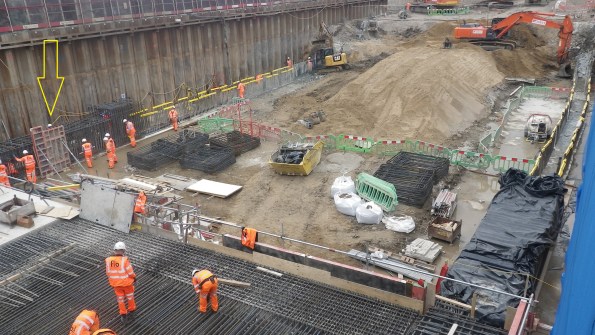
Pour 5 – South side of Capping Beam (yellow arrow)
This particular section started pouring at 1715 (a slab was also poured earlier in the day). And whilst the concrete was only just going warm and the pump was still being cleaned out the site engineer at 8pm then realised the issue. The fact that almost the entire workforce had already left the immediate call was to leave it in. The next morning, once we understood the full picture, again the decision was made to leave it in. Of course if you are going to strip it out you want to do that as soon as possible before the concrete gains any significant strength. So what was the perfect storm that led to this problem happening in the first place?
Supply
The concrete is being supplied by London Concrete, and although only one mix was ordered that day the supplier changed the mix after 8 loads (62m3) for the last 2 loads (13m3). London Concretes reason for this is that a computer crash required the staff to re-input the mix design which they got wrong. Crucially the delivery ticket did show C32/40 mix.
Checking
The site if using a sub-contractor (ESG) to conduct testing of concrete. Flow tests are taken on every load and cubes every 50m3. Incidentally they are meant to also check the mix design. The C50/60 concrete is designed to have a 600mm flow where as the C32/40 concrete is a much stiffer mix and designed to have a 170mm slump. When tested the C32/40 mix achieved 560mm flow! – so the load passed and was accepted. Quite luckily 4 cubes were taken for this load.
Pre-pour checks
Finally the site engineers are meant to check the delivery tickets, test and accept the load. Whilst they do this they fill out a pre-pour inspection sheet. Unfortunately the practice that has crept in is that the Site Engineers collect the tickets and fill out the inspection sheet later after the pour in the office. Incidentally no one noticed the difference in mix when it was loaded into the pump or when it was placed.


Resolution
Well, once the decision was made not to strip it out early you might as well leave it and see how it goes. 7 day cubes achieved 35kN/m2 so we are pretty confident that the final strength will achieve at least 40kN/m2.
Removal – If we were to remove the offending concrete (about 0.65m from the top) we would need to hydro-dem it off. High pressure water jet that strips concrete (queue much YouTube video research on what this entailed). This is apparently very cool and efficient but expensive and requires a lot of measures to protect people from flying concrete. The estimated cost came in at £200,000 to go down this avenue (not including the cost of additional concrete which would have been negligible in comparison). As the project Manager said “I would rather have to paint the beam in gold than have to strip it out”.
Re-analysis – The principle designers were good and very quick at giving their assessment within hours of being told the next morning. Their assessment is that a reduction in concrete strength reduces the bending capacity, bond strength and shear capacity. The bond strength is the most significant. However in another stroke of luck we changed the top and bottom laps to couplers to assist the construction programme which laps only in the side reinforcement. A review of the beam calculated as if it was all C32/40 and it showed that the section had adequate capacity.
The only concern Motts has is over the durability, the C32/40 design mix complies with DC-2 chemical class where as DC-1 is required. This means that we need to ensure that our backfill material is tested for sulphate content – this is an easy fix.(having had a look though Eurocode 2, I can’t see any reference to DC chemical classes. I will ask next time I see Motts but does anyone know where this reference comes from?)
Outcome
London underground have now officially received this information during a joint client/contractor/designer meeting yesterday and they are reviewing. Hopefully they should accept it but they are within their rights to ask for it to be replaced. This is a target price contract (50:50) but being a defect the cost would fall all on FLO.
In chatting with the structural engineering team they say that the reduction on concrete grade has little effect on the section capacity. I am not sure on the loads but I certainly remember quite a high sensitivity of concrete strength on the capacity of a section. Which implies that there is plenty of “fat” in the design. Additionally the impact I have noticed with the operatives is the impression that mistakes like this are ok to make which really is the wrong message. We have amended the processes on site. It was a close call which we just got away with. Had circumstances been slightly differently, we might be coating the beam in gold!
 Holdfast Training Services Trial Blog
Hello mate. You wont find DC in the EC because it’s referring to a designated concrete, not a designed concrete. DC concrete is specified for a purpose, so by definition the exposure class is included in the spec. Based on the purpose the concrete will have been designed to an “X” exposure class (in EC parlance), in your case I imagine something like XC-2.
A less chemically resistant concrete will suffer from ion transfer over time which will result in a change in the pH of the concrete and allow ions form the ground water to penetrate the concrete. Over time these ions will reach the steel which will corrode. As it corrodes it will swell, creating cracks which let in more ions and the cycle starts again.
So for your application the exposure class is important. And while ensuring a specific fill will help, the presence of ground water will mean there is only so much you can do to combat the effect.
Jonny
A good blog – £200k is expensive concrete.
Guz – A good response – no warm fuzzy feeling!
Neil
Thanks Guz, I may have gotten my DC-1 and DC-3 the wrong way round. Essentially as long as we can prove that the backfill material has below a certain level of sulphites we are fine as it is. If not we will need to treat the capping beam with some product to increase its protection and durability. We (and the designers) are pretty confident that it will be fine, but we still need to prove it.
Jonny, Having spent a number of hours arguing with London Concrete over slumps and flows, I’d be interested to see where you get to with liability for this mistake. London for supplying wrong concrete or FLO for using it.
Regarding the bending capacity and concrete strength I would go back to moment = concrete stress x section modulus which shows how important the concrete strength is. I had a similar problem where the correct concrete was used but did not reach sufficient design strength by 56 days. Therefore the design was checked and luckily for the elements below specification, the strength the concrete had got to was acceptable. If the point of lower strength concrete is located where BM and SF is lower than at maximum locations this will help.
At the risk of embarrassing myself, where the connectors are for the beam and slab implies tension in the slab (upper) part of the beam. Why not have the 2 rows of top steel as 1 top row and 2 bottom rows – that way get far more out of the steel?
Guz, nice answer to corrosion of concrete. I learned this lesson where I had the same strength concrete for internal columns being requested to be used for a perimeter wall (annoying having multiple concrete mixes for a range of pours on the same day and then you get random mixes turning up for a different site). “Same strength, so what’s the problem?” I was asked. Clearly the exposure class is the key so important to know the difference. Chances are though, with a higher strength mix, it will also meet exposure requirements, but best to check the specification.
Hi Jonny,
With a 7 day cube of 35 N/mm^2 I suspect you’ll see 45N/mm^2 at 28 days if not more, however, I’ll put in an excuse now for getting this wrong on the basis of it being dependent to upon admixtures used. Either way it is significantly below the 60N/mm^2 specified. I suspect however that the specification is as much to meet the durability requirements as it is to achieve design strength. Whilst Guz is correct about the ingress of ions and steel corrosion you are in London Clay and might well have a need for sulphate resistance hence the -SR DC-3 part of the specification and the need to control the fill. The Aggressive Chemical Environment for Concrete (ACEC) classes that are used by BS8500 have a design Chemical (DC) class which must be notified to the supplier as part of a designed concrete mix specification. See Concise Eurocode 2 section 4.4 and onward reference to A.2.4 in BS 8500-1 etc. If you want more direction please do ask…
Damian’s observation that the slab and beams appear to be transferring a hogging moment into the capping beam is interesting because this makes sense at the end of continuous members but doesn’t tell us anything about the moments in the capping beam along this length. If in Hog then the concrete is all about providing the lever arm to the steel and resisting environmental degradation so strength matters little. A look at the reinforcement drawings might give some indication. If strength is an issue beyond the hope that this section does not experience the peak moments and/or shears there is always a gamma c that can be used against actual material strength to claw a little headroom if the designers feel the need but it must never be forgotten that it is there for a reason.
Your final comment that this appears to have given site operatives the impression that concrete quality is not important is interesting and could be tackled in a number of ways. GOld seems a little OTT but there may yet be merit in painting the capping beam with Black Jack or similar (even if not needed) just to make the point that there were issues that arose. Whilst clearly this would cost, the reduction in risk of future quality issues due to complacency might be worth the outlay (PM’s decision based on cost/risk balance).