To PC or not to PC…. That is the question.
Sorry about the title. This blog is about the issues surrounding working on someone else’s site; something it seems that M&E engineers have to put up with a lot.
The work being carried out by my employer (ATC joint venture or ATCjv) involves installing a long term temporary ventilation system to replace a slightly cobbled together short term system – please see earlier blog. This involves fitting out most of the bottom floor of the station (level -4) with four ventilation fans, ducting and associated attenuators and dampers. See image below:
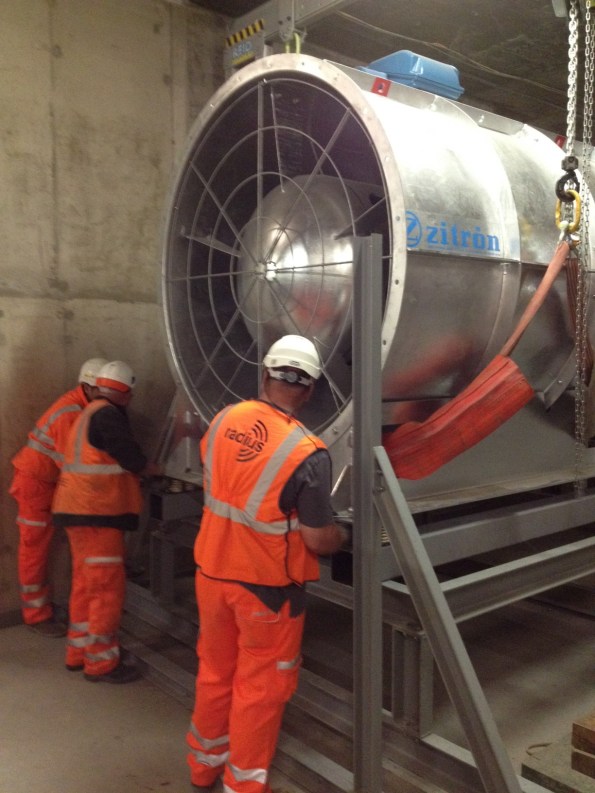
Temporary Ventilation Fan Installation
Co-ordinating the installation process has occupied most of my time for the past month. It involves threading the equipment through the existing ticket hall structure, most of which is still an active building site. As you can imagine this creates a nest of interfacing problems with the main site civils contractor, Costain-Skanska Joint Venture (CSjv).
The CSjv site is running to its own schedule and is unwilling to give up an inch of it to allow the tunnel ventilation works to go in. They have taken the step of insisting that ATCjv take Prime Contractor or ‘PC’ responsibility of our work area; leaving the unusual situation of a ‘Russian doll’ arrangement where we own and run a site four stories underground inside another separate site. The extents of the ATC site are shown below:
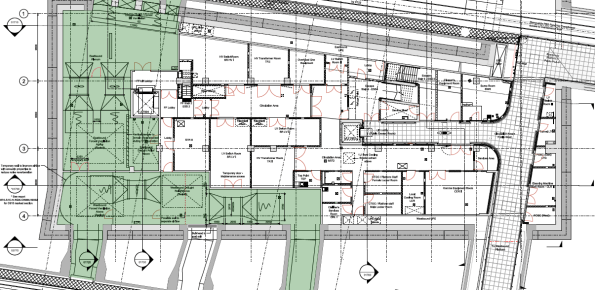
The ATC site shown in green (four floors underground in the CSjv basement)
The process of setting up the PC area was not smooth. Any readers who have yet to undertake the SMSTS course may be in the dark as to the requirements of holding PC of a site. The full requirements are on the HSE website here:
http://www.hse.gov.uk/construction/cdm/2015/principal-contractors.htm
Keeping it as brief as possible the PC is the ‘duty holder’ of legal responsibility of the site; they are required to produce and assure the health and safety of the workforce, compliance with environment and noise regulations, secure the site and provide welfare. The end result is a substantial pile of paperwork that no-one will ever look at unless an accident happens.

PC Paperwork. It’s what I joined up for.
I found it interesting to consider the depth and detail of site paperwork compared to that I remember being in place on RE construction sites.
The idea that ATCjv can setup and run a complete site in the middle of another fully functioning site is a bit silly. When that site is underground it is very silly. However, ATCjv have been instructed by Crossrail to do so: his brings around an odd situation that to use their welfare facility the workforce has to walk 1.1km along a tunnel and then climb to the surface to use the toilet (in reality they just find a dark corner of the tunnel!)

The Site Welfare Facilities
Digging slightly deeper (excuse the pun) it seems this arrangement has come about because the first work group to enter the site from ATCjv were roundly regarded as “cowboys” and managed to get a Crossrail H&S warning raised against them. The CSjv site basically looked for any way to transfer the perceived H&S risk over to ATCjv; this has then caused nearly two years of paperwork hassle for ATCjv to run and administer a completely separate underground site.
It seems that in construction first impressions are everything.
 Holdfast Training Services Trial Blog
If there’s such a long walk in why aren’t you using bicycles? I’d get a portaloo down there before you end up with another breach and resulting paperwork nightmare associated with unreasonable provision. Crossrail will not see the funny side of missing the tideway tunnel by a mile…
Rich,
The track that is now laid would not be good to cycle over…. unless you are thinking about one of these:
The PC state that the workforce will use the ATCjv welfare facilities (1 km down the tunnels). In actuality the site workforce unofficially uses the site welfare facilities.
The bulk of the actual welfare problem exists for the workforce in the tunnels themselves (see response to Damien at bottom) rather than the ATCjv site workforce in the bottom of the station.
Solution still TBC. However, it doesn’t seem like the contractors have enough guts about them to kick up a fuss.
Mark.
What about wag bags and bottles with some sort of medical waste disposal provision to get rid of the arisings?
Mark, Not sure if I missed the fan frame resolution but I see it in pictures with a square hollow section. How is the section attached to the steel frame – welded, self-locking screws?
Out of interest, other than perhaps volume, what health, safety and welfare paperwork have you identified on this civilian site that were not completed on the military project?
You implied it was CSJV who said ATC had to run as a separate Principal Contractor but is this within their power to do that? I thought it was the client’s responsibility, Crossrail in this case, that appointed a single Principal Contractor. How does the contractual trail fit with this. I.e. have Crossrail employed ATC under a (sub-)contract or have CSJV? If the latter then I am slightly puzzled.
What happens if there is an accident getting access to the -4 level, say just about to move down from -3, who has the responsibility to report it if required?
What happens at other deep sites for toilets on Crossrail?
Damien,
Cheers for your response; in order of questions:
The frame issue has been resolved by the addition of a box section in place of the previous channel solution. The new beams are bolted into place using the previously designed fixing points. The new channels also offer much more support for the AV mounts.
The PC paperwork included individual policies on security, environment, H&S plan, emergency procedures among others. My previous RE sites have been at RAF Northolt and Laikipia in Kenya; as I remember it the above points were generally covered as subjects within the DEP; however to less detail. I was interested to see the level at which the policies above were signed off within ATCjv. Again as I remember it this was a difference between the civvie and military solutions to the same problem.
CSjv are a ‘tier 1’ contractor working for the PM (Crossrail) for the Client (Rail for London, or RfL). ATCjv are also tier 1, however they ‘own’ the tunnels as distinct sites and work within other stations as a contractor. The CSjv organisation successfully lobbied Crossrail to instruct ATCjv to take PC of the area (this discussion/argument took place over 2 months). The CSjv director of Bond street station has now subsequently moved over to command ATCjv…. I wonder if he regrets his previous campaigning?
The ATCjv emergency plan dovetails with the Bond Street station plan. An emergency on our site is dragged to the interface before the CSjv plan takes over. The same arrangement exists with the waste management plan but not welfare – CSjv actively resisted this element.
Toileting is an ongoing unresolved issue for the tunnel sites; portloos have recently made an appearance at a few of the shaft sites with crane access to the bottom, however there is currently no method of moving them by rail. Dedicated construction trains have an onboard chemical toilet that is apparently full about halfway through the shift period.
Hope that covers the lot…. as you can see there are a few issues that are not being resolved quickly!
Regards,
Mark
Mark
I am not sure I am as surprised as you to have been made PC. We have signed over PC/had PC signed over to ourselves on numerous occasions for the most ridiculously small works areas.
As I read the situation: “it’s all about RISK!” said in a John Moran style whilst banging the desk loudly. Certainly in our case the normal PC (duty holder) was not prepared to accept the HSE risk associated with the works when not familiar with the sub-contractors/RAMS/pre-construction enquiry details/Inspection Testing Approval Procedure/etc without causing a lengthy delay to the works by checking all this “stuff” – Therefore – quickly sign an area over.
Rich,
I am quite possibly just sharing the opinions of those within our team. However, the ‘signing over’ of PC does seem to now happen a lot as we are continually required to sign it back to the station as they go about making good the civil snags in our area.
My argument has been that although you can ‘sign over’ a small area does it really absolve the main PC of its responsibilities? I suppose the only acid test would be in a dispute resolution process if something big went wrong. When the smaller site is wholly contained within a larger one it does make a bit of a mockery of some of the legal bits (e.g. security/environment).
A possible example that springs to mind is that of security. If a drunkard breaks into the CSjv site before falling over an ATCjv handrail to plummet to their doom then who is at fault?
The majority of Crossrail sites have a main PC only. All other contractors (whether they are bigger/smaller/same size) act as subbies within the PC and submit methods statements, do the site inductions, etc. They are instructed (and so presumably also paid) to do this by the PM (Crossrail).
Cheers,
Mark
How does the PC issue affect your previous comments about the tunnel air quality monitoring being based mainly on the use of PPE rather than a more robust monitoring scheme? Seems to me that transferal of duty holders puts you in the hot seat for H&S here
Mark,
The air quality issue is being treated as the concern of the tunnel teams; they are the ones that need to guarantee the environment at their site before work starts. The tunnel teams are part of the same jv as ourselves but are treated as a separate PC; I therefore assume the responsibility lies within the same company but not our site team.
There are air monitoring systems within the running tunnels but not within the station structure, despite that fact that they are linked together – this is the element that could possibly put our station-based PC at fault (if bad gases leaked in?).
The air quality within the tunnels is becoming a greater and greater issue as the ‘concrete train’ finishing the track installation progresses. These are pushed by standard diesel engines that are pretty polluting (mainly NOx, so I’m told). In my opinion the jv is very exposed to air quality problems (and the ensuing future liability for health down the line) – none of the newest tunnel teams are equipped with personal gas monitoring and instead rely on a on-site fixed sensor to start works.
I am only exposed to a limited part of the problem as a station team member; the fans we are installing will serve the tunnels. The operation and maintenance responsibility of these fans is still uncertain; it is likely that the station teams will have to assure the coarse flow rates on a daily basis before work starts in the tunnels. Detailed flow rates and monitoring for polluting gases will be carried out at the tunnel work site, which is a separate PC (under the same jv).
More PCs than you can shake a stick at.