Modification of post tensioned concrete
A quick reminder… I know all C’s have this covered but for the E&Ms, unlike conventionally reinforced and mass concrete, the modification of pre-stressed concrete is complicated due to the potential energy stored in the member. If suspended, all members contain gravitational potential energy but prestressed concrete stores elastic potential energy in its stressed tendons. This makes the modification, demolition and decommission of prestressed concrete members a more complex operation. Moreover, an alteration to any part of a pre-stressed member is highly likely to effect the entire structure.
With this in mind, you can imagine my horror as I was recently told I was responsible for the modification of a post tensioned slab which formed part of an exisiting structure adjacent to my project.
Sitch… In brief, I have got to co-ordinate the removal of a strip of PT slab (2m x 17m x 250mm thick), which cantilevers from ground level, over our basement, obstructing progress. Our structure will tie into the existing slab once we reach ground level. The image below shows the offender, north is up.
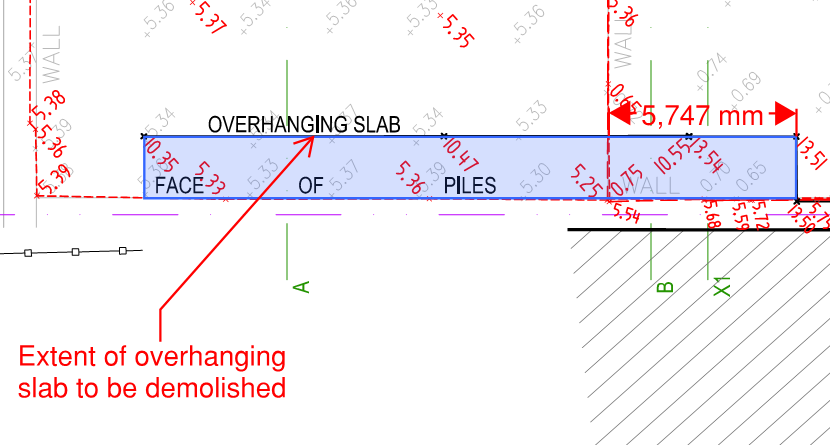
The western most 12m of the slab is 5m above our current rock level, the remainder is 10m above a lower rock level.
Thoughts so far… Having consulted almost everyone in the office, the structural engineer consultant and the PT sub-contractor I have come up with the following methodology…
Confirm effect of these works on remaining structure, temporarily back-prop remaining structure if required, back-prop the slab with falsework, provide edge protection, confirm tendon locations, expose tendons and confirm grouting, anchor the tendons with new ‘onions’ if required, cut strands, cut slab into manageable sections, sling and crane out, treat exposed edge of remaining slab with epoxy paint to prevent corrosion. Once the new structure ties in to the existing, any temporary back-propping will be removed.
I’ll take some photos and let you know how we get on.
 Holdfast Training Services Trial Blog
Andy,
For clarification, is the strip you’re removing a complete slab or is it a section of a larger slab (clearly, a lot more complicated)?
This could be an interesting job, I had designed a scheme similar to this on Ph3 which caused no end of problems.
Hey mate, unfortunately its part of a much larger slab. There are a few things in my favour though… The structural engineer responsible for the existing slab is also employed on my job, as is the PT concrete subcontractor. I’m hoping this lubricates the job.
Presumably the cantilevered section has PT tendons anchored on the over hang face. Can you see anything of the anchorages? Do you know if it was designed one way or two way spanning? Have you got, or could you produce, Section A-A to give a reasonable feel for this?
Is their any evidence of tendon corrosion in the existing slab? Do the tendons run parallel to the cut or are you cutting active tendons? It’s a bit hard to understand, a couple of sections and photos would help.
Rich, the tendons do continue into the cantilevered section but there is no visible evidence of them. I plan to meet with the sub-contractor to discuss the issue further as part of my TMR. I should be able to better describe the situation after that meeting.
Ollie, no evidence of corrosion, the structure is only 2 years old. The tendons are perpendicular to the cut. I hope to have some better sections and photos after I meet with the subbie. Consider my blog a WngO, more detail to follow.